

How Burker Scaled Global Support and Cut Email Traffic by ~50% with Tidio’s Lyro AI Agent
80%
Lyro resolution rate
10,000
Lyro conversations handled monthly
50%
drop in outsourced email traffic
- Location: Netherlands
- Industry: Ecommerce
- Use case: Lyro AI Agent automatically answers all WISMO related requests.
- Used products: AI Agent
- Website: www.burkerwatches.com/
Results at a Glance
- Lyro resolution rate (April): ~80%
- Drop in outsourced email traffic (vs. February): ~50%
- Week-over-week traffic reduction: 15–20%
- Lyro conversations handled in April: 10,000
- Lyro resolution rate (March, first month): 75%
About Burker
Channels: Website live chat, Instagram, TikTok, Email
Platform: Shopify
Previous stack: Email, social media, no tooling for livechat
Company size: ~20 employees
Monthly traffic: ~450K
Founded in London and headquartered in Amsterdam, Burker is a fast-growing direct-to-consumer women’s watch and jewelry brand. Built around the idea that beautiful accessories should be accessible to every woman, Burker designs minimalist timepieces alongside a growing range of bracelets, necklaces, earrings, and rings.
The brand sells globally through its Shopify store and has a particularly strong presence on Instagram, where its clean aesthetic and engaged community have made it one of its most important sales and support channels. In recent years, Burker has expanded aggressively into new markets.
That ambition comes with a support challenge. A worldwide customer base, multiple product lines, highly seasonal demand, and the expectation of instant answers in every language were pushing the team to its limits.
The Challenge: Seasonal Spikes, Repetitive Questions, and a Team That Couldn’t Scale Fast Enough
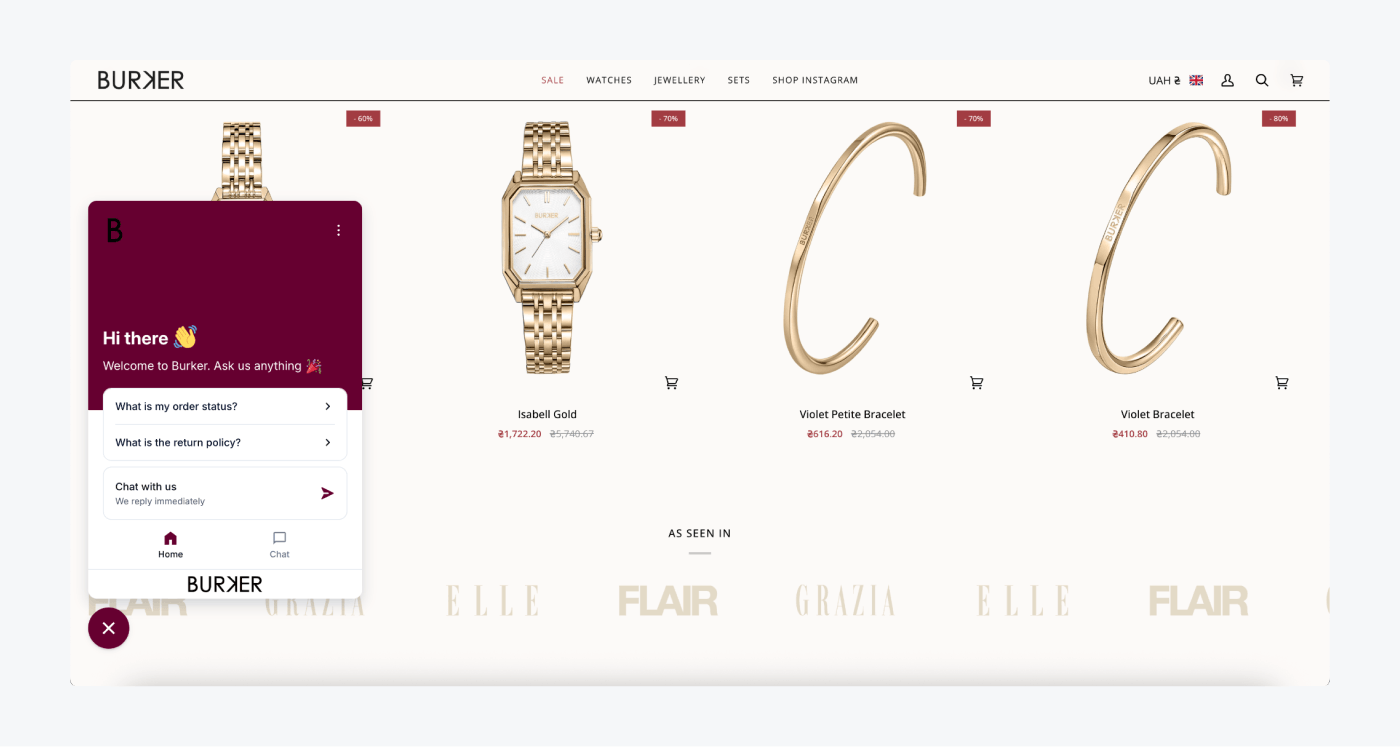
Burker’s support operation is lean by design. Two in-house team members handle social media support across Instagram and TikTok, while an outsourced team based in the Netherlands manages the email queue. The two sides work closely together: complex DMs get escalated to email, and the in-house team focuses on refining automations and improving the overall customer experience.
For a long time, that model worked. Then the sales seasons started hitting harder.
During peak periods like Black Friday, Valentine’s Day, and seasonal sales, inbound support volume would surge from a baseline of 3,000–5,000 messages per month to as many as 17,000 in a single month. The vast majority of those messages were asking the same things: Where’s my order? When will it ship? Which watch is right for me? Useful questions, but not ones that require human judgment to answer.
The outsourced team had been brought in specifically because handling that volume in-house was impossible. But even with the extra support, the email queue struggled during peaks, and the live chat widget on the website—once handled by the outsourced team—had to be switched off entirely because the volume was unsustainable. Customers were left with a contact form and a hope that someone would reply soon.
“We had a very detailed FAQ page. But clients still reached out for the same standard questions. We needed a smarter way to meet them in the moment: automatically, in their language.”
Daria Nifontova
Head of Customer Service at Burker
The team had an eye on the bigger picture.
Why Tidio and Not Gorgias?
Before committing to Tidio, the team evaluated several options, including Gorgias, which is widely used among Shopify merchants. Gorgias fell short on one critical dimension: language support.
Burker’s customers shop from across the globe, and the brand’s philosophy has always been to communicate in the customer’s native language. At the time of evaluation, Gorgias supported approximately five European languages. Tidio—and Lyro, its AI agent—offered broad multilingual support out of the box.
For a brand operating in dozens of countries, that wasn’t a minor feature. It was the key factor in a category where chatbot pros and cons vary a lot based on the channels and languages a business must support.
Tidio also offered the flexibility to connect Instagram as a support channel through a custom integration, allowing Burker to use it as a buffer between their social DMs and the email ticketing system managed by the outsourced team.
The Solution: Lyro as the First Line of Support
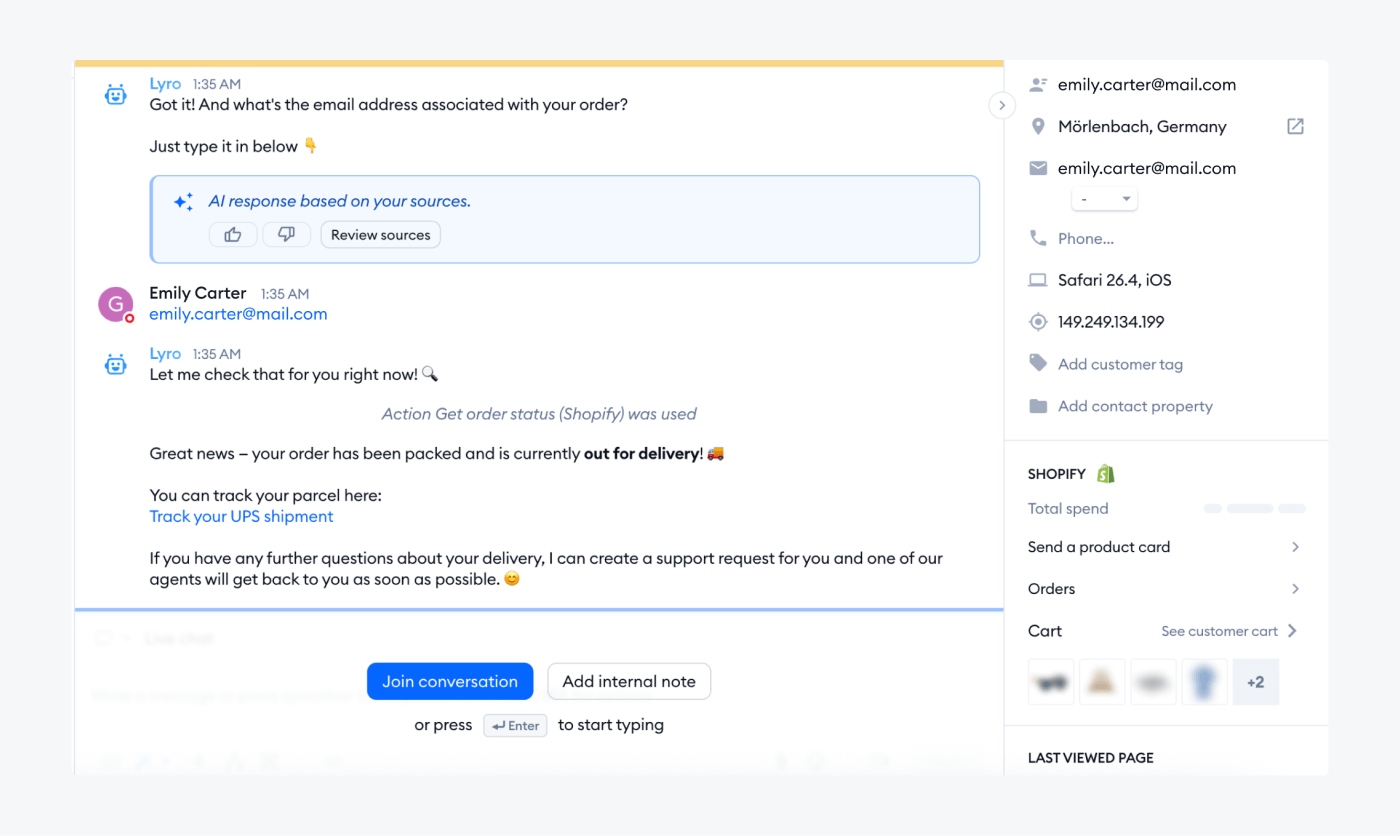
Burker began testing Lyro in March, initially running it as the live chat experience on their website. The setup was straightforward: Lyro handles incoming conversations automatically, resolves what it can, and escalates unresolved cases directly to the outsourced team’s ticketing system. No manual routing. No delay.
Together with Tidio expert Joren Wouters (Chatimize), they:
- Trained Tidio’s AI on Burker’s business info and FAQ information
- Set up AI workflows for collecting order statuses and human agent handoff
- Developed a custom integration with Instagram (launched in April)
From day one, the in-house team focused their energy on improving Lyro’s performance rather than triaging tickets. They refined its data sources, customized its guidance, and built out Flows—proactive conversation triggers designed to catch shoppers at key moments in the purchase journey.
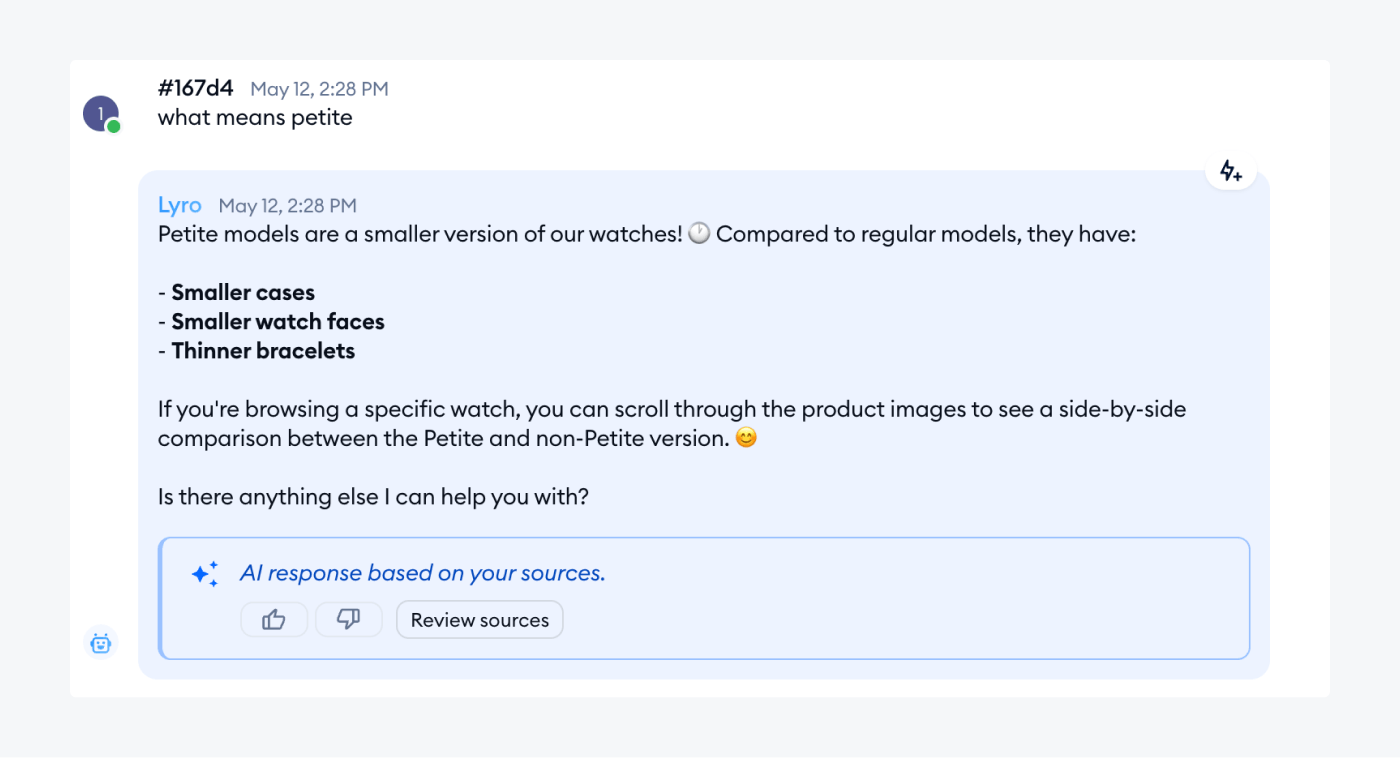
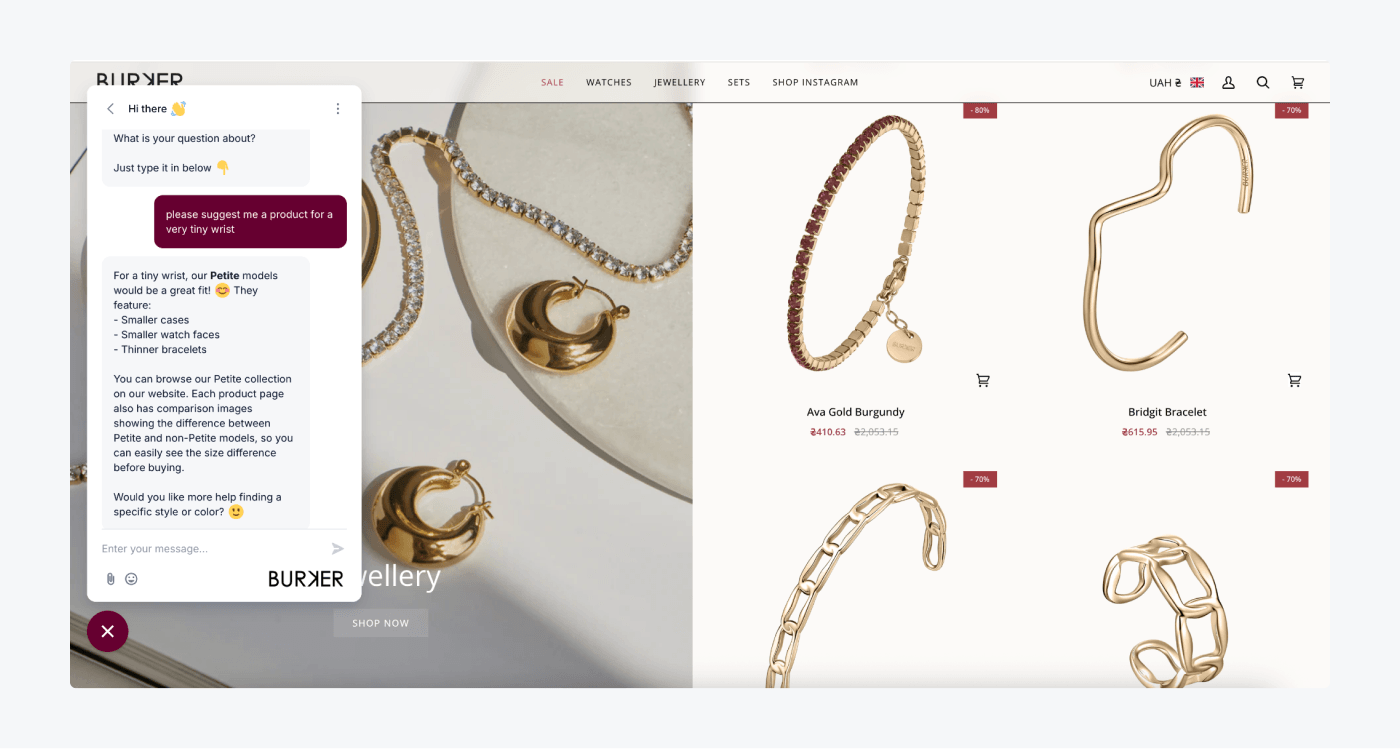
One of Lyro’s biggest use cases quickly emerged: pre-sale support. Burker’s customers ask a lot of questions before they buy: about sizing, shipping timelines, the difference between a standard model and its Petite counterpart, and which pieces work together as a set. These are among the most common chatbot use cases for e-commerce brands, and exactly the conversations that Lyro handles best.
The team also used Flows to proactively open conversations with visitors showing purchase intent, surfacing answers to common questions before customers even had to ask. For a brand that generates a significant portion of its revenue from impulse-friendly, gifting-oriented purchases, removing friction at the decision point has a direct impact on conversion.
The Results: Less Traffic, Higher Resolution, Happier Team
The impact showed up immediately and kept compounding.
In March, Lyro’s first full month of operation, it handled 5,000 conversations with a 75% resolution rate. During the same period, the outsourced team saw a 48% drop in email traffic compared to February. Some of that drop was seasonal (February is a high-traffic month due to Valentine’s Day), but the direction was clear.
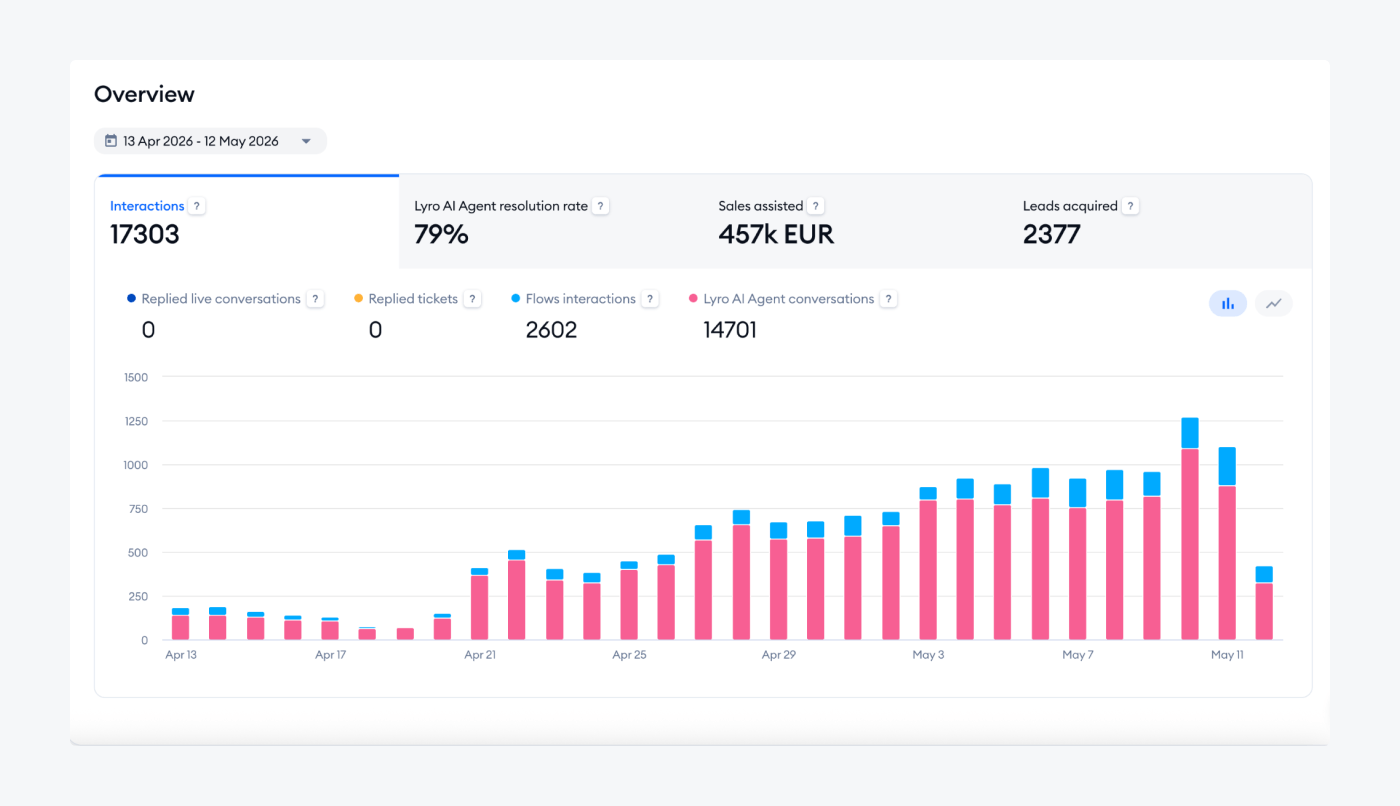
In April, with a sale running on the website, Lyro handled 10,000 conversations in a single month, hitting the plan’s conversation limit. The resolution rate climbed to nearly 80%.
Compared to February, total support traffic in April was down almost 50%. Week over week, the team observed a consistent 15–20% reduction in inbound volume reaching the outsourced team.
“The metrics speak for themselves. Lyro stops the repetitive questions from ever reaching our team. Clients get an immediate answer in their own language, at any hour. That’s exactly what we needed.”
Daria Nifontova
Head of Customer Service at Burker
The improvement is especially significant given that Burker was simultaneously expanding into 15 new markets, a move that would normally be expected to increase support volume for brands investing in chatbots for small businesses at this scale. Instead, the combination of Lyro’s proactive support and self-service capabilities absorbed most of that growth invisibly.
What’s Next: The Shopping Assistant and a New Revenue Story
Burker hasn’t yet activated Tidio’s Shopping Assistant functionality. A deliberate choice. The team identified a technical prerequisite first: ensuring that their Shopify product data is clean, accurate, and displays correctly before connecting it to an AI that will use it to make recommendations to customers.
The challenge is partly a product one. Several of Burker’s watch models, like the Macy and Macy Petite, look visually identical but differ in case size. Getting an AI to reliably distinguish between them, and to answer precise questions about those differences, requires the underlying data to be airtight.
The team’s current plan is to start testing the Shopping Assistant with the jewelry collection, where the product range is less complex, before rolling it out to watches. Once it’s live, the expectation is that the support stack will shift from a cost center to a revenue center—with the Shopping Assistant’s analytics showing exactly how much of Burker’s sales can be attributed to AI-assisted conversations.
“Fully implementing that functionality would be a huge win, both for the business and for the customer experience team.”
Daria Nifontova
Head of Customer Service at Burker