
Key takeaways
- WhatsApp automation needs a business number connected to the WhatsApp Business Platform, usually through a tool such as Tidio. The free WhatsApp Business app only automates greetings, away messages and quick replies.
- You can reply freely for 24 hours after a customer writes to you. After that, only a Meta-approved template can reopen the chat.
- Since October 1, 2026, each business number gets 1,000 free service messages a month. Template messages are charged per delivered message.
- Start with the five questions customers ask most, a clear handoff to a person and a monthly spending limit.
- Automating a personal WhatsApp account with unofficial tools risks a ban. Use the official route.
WhatsApp automation is the use of software to send and answer WhatsApp messages without a person typing each one. A chatbot or AI agent replies to common questions and collects contact details. Complex chats go to your team, and pre-approved messages such as order updates go out on schedule. It runs through your business number, not a personal account.
Meta says more than 3 billion people in over 180 countries use WhatsApp,[1] and many of them now expect a business to answer there within minutes. This guide is for small and mid-sized support and sales teams, especially online stores. It explains how automation works and what Meta’s rules and fees look like as of October 2026, then walks through use cases and a step-by-step setup.
Connect WhatsApp to Tidio for free
What is WhatsApp automation?
WhatsApp automation means a program handles part of your WhatsApp conversations for you. It watches for incoming messages and answers on your business number in seconds. Some of it follows fixed rules (“if the customer taps Order status, ask for the order number”). Some of it is an AI agent that reads the question and writes the answer from your own help content.
The term covers three layers, from simplest to most capable:
- Built-in app tools. The WhatsApp Business app lets you set a greeting, an away message and saved quick replies. Nothing else runs on its own.
- Rule-based chatbots. Buttons and keyword triggers lead customers through a fixed path, such as checking an order or booking a call.
- AI agents. A tool like Lyro answers free-text questions from your website and help center, and hands off to a person when it can’t.
Most small teams combine them: an AI agent for the common questions and rules for the structured jobs, with a human inbox behind both. If you are choosing software, our roundup of the best WhatsApp chatbot tools compares plans and fees, and our guide to the WhatsApp chatbot goes deeper on the bot itself.
Why WhatsApp automation matters
Customers message on WhatsApp because the app is already open on their phone, and they read replies fast. A slow answer feels like a missed call. A small team can’t staff the inbox around the clock, and most of the questions are the same few: where is my order, what is the return policy, do you have this in stock.
Automation takes the repeated questions, and your team keeps the conversations that need judgment, such as a damaged parcel or a bulk order. For an online store, it also means a shopper who asks about delivery at 11pm gets an answer before they close the tab. Tidio’s Lyro AI agent can resolve up to 75% of support requests, so most of the first-line load can move off your agents.
How WhatsApp automation works
Every automated WhatsApp message travels through the same chain. The customer writes to your business number. WhatsApp passes the message to the WhatsApp Business Platform, Meta’s interface for businesses. A provider such as Tidio, connected to that platform, receives it, decides who answers and sends the reply back.
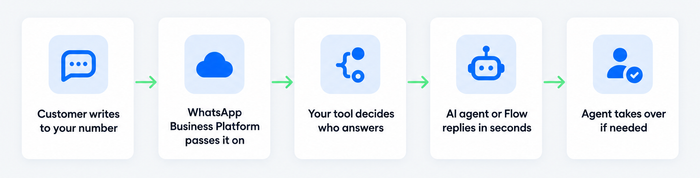
The chain depends on these parts:
- A verified business number. It belongs to your company and can’t be in use on a normal WhatsApp account at the same time.
- A provider. This is the software you log in to. It connects your number to the platform and gives you the inbox, the bot builder and the AI agent.
- Automation logic. Triggers and rules (Flows, in Tidio), an AI agent trained on your content, or both.
- A human handoff. Anything the bot can’t settle goes to an agent in the same thread, with the history attached.
Message templates are the fifth piece, and they exist because of one rule: you can only answer freely inside a 24-hour window. The next sections cover it.
WhatsApp Business app vs. Platform
The two products have similar names and very different limits. The Business app is a free phone app for a single small shop. The Business Platform is what chatbots, AI agents and shared inboxes use.
| WhatsApp Business app | WhatsApp Business Platform | |
|---|---|---|
| Best for | Solo owners and very small shops | Teams, stores with steady volume |
| Automation | Greeting, away message, quick replies | Chatbots, Flows, AI agents, templates |
| Who answers | You, on a phone or a few linked devices | Many agents in a shared inbox |
| Reach customers | Only by hand | Replies, plus approved templates |
| Setup | Install the app | Connect a number through a provider |
| Cost | Free | Provider plan plus Meta’s message fees |
If you only need an away message while you sleep, the app is enough: it has a customizable away message, a greeting message and quick replies. Once you want a bot to answer questions or more than one person to share the inbox, you need the Platform. Moving a number from the app to the Platform means removing it from the app first, so plan the switch for a quiet day.
Meta’s rules and fees for automated messages
Two rules shape every automation you build. Both come from Meta, not from your tool.
The 24-hour window. After a customer messages you, you can reply with any text for 24 hours. Each new customer message resets the clock. When the window closes, you can only send a template: a message you wrote in advance and Meta approved. Templates have three categories that matter here: marketing (offers, announcements), utility (order, account or appointment updates) and authentication (one-time codes).
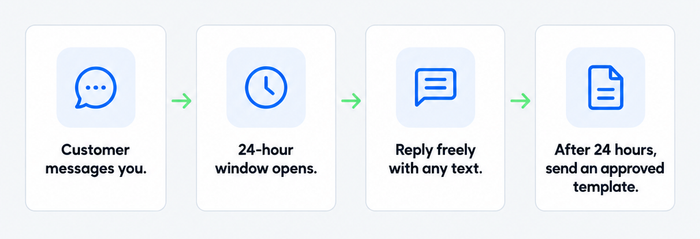
The fees. Meta’s pricing documentation says businesses pay per delivered message, by category and by the recipient’s country. Since October 1, 2026, each business phone number also gets a free tier of 1,000 service messages a month (replies sent inside the 24-hour window). From the 1,001st, those replies are charged too, and unused messages don’t roll over. A conversation that starts from a click-to-WhatsApp ad opens a free entry window. Meta’s own marketing page still describes service messages as free, so trust the developer documentation and check it each quarter, because Meta changes rates on the first day of a quarter.
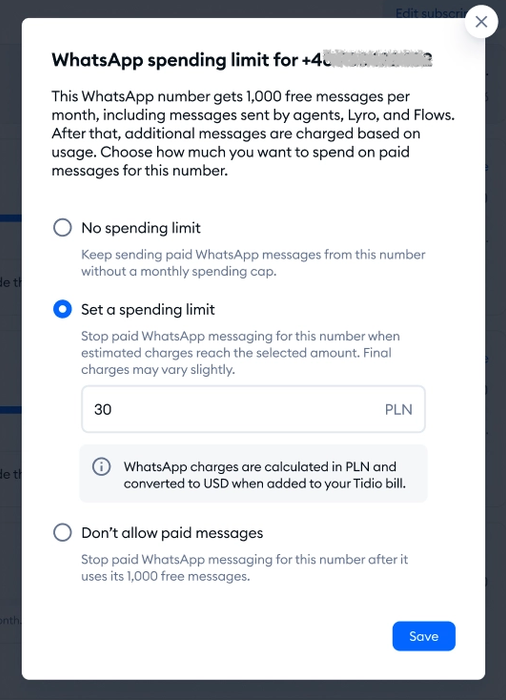
Your provider decides how the fees reach you. In Tidio, the WhatsApp integration is free on every plan. The 1,000 free messages per number count everything Tidio sends: agent replies, Lyro and Flows. Above that, Tidio bills Meta’s rate for your customer’s country at the end of the month, with no markup, and you can set a monthly spending limit. Free and trial accounts stop at 1,000 messages instead of being billed.
Benefits of WhatsApp automation
- Answers at any hour. The bot replies in seconds at night and on weekends, so a shopper’s question doesn’t wait until Monday.
- Fewer repeat tickets. Order status, shipping times and returns make up most of the inbox. An AI agent handles them and your team keeps the rest.
- Faster first response. A reply that arrives in seconds keeps the customer in the chat instead of sending them to a competitor’s site.
- Contact details you can use. A flow can ask for a name and email before the chat continues, and Tidio saves them to the customer profile.
- One inbox for every channel. WhatsApp, Messenger, Instagram, email and website chat land in one place, so nobody checks five apps.
- Context for your agents. Tidio matches the sender’s number to an existing contact, so an agent sees the earlier orders and chats before replying.
- Costs you can predict. With a free tier, a spending limit and no markup on Meta’s fees, a small shop can cap the monthly bill.
WhatsApp automation use cases and examples
These jobs suit a small team. Each opens with the short answer, then shows how it works in practice. The scenarios are illustrations, not customer stories.
1. Answer common questions automatically
An AI agent answers questions about shipping, returns, sizing and opening hours straight from your help content. You train it once on your website and help center, and it replies on WhatsApp the same way it does in website chat.
A café owner who adds a menu page, an allergy list and a delivery-area page to the agent’s knowledge base sees the “do you do oat milk?” questions disappear from the inbox. Keep a fallback (“Let me get a colleague”) for anything outside that content. For more on the bot side, see our guide to automating customer service.
2. Send a welcome message and route the chat
A welcome message tells the customer what to expect and offers buttons: Order status, Returns, Talk to a person. The buttons send each chat down the right path from the first second.
In Tidio, a Flow starts when the visitor says something and replies with a short quick-reply menu. WhatsApp shows only the first three buttons of a menu, so keep the options to three. Our welcome message examples have wording you can adapt.
3. Check order status
“Where is my order?” is the question online stores answer most. An automated flow asks for the order number or email. It looks the order up and answers with the status and a tracking link.
For a Shopify store, Tidio’s integration lets agents see the cart and order history in the conversation, and Shopify actions are available on the Growth plan and up. A shopper who writes “where’s my parcel” gets an answer without waiting for someone to open the admin panel.
4. Capture and qualify leads
A flow can ask a few questions, such as what the customer is shopping for and their email, then tag the contact. Hot leads go to a salesperson. Because the customer wrote first, the chat is already warm.
This works well after a click-to-WhatsApp ad, since those conversations get a free entry window from Meta. Our guide to chatbots for lead generation has the question flow.
5. Follow up after the 24-hour window
A customer asks about a product on Monday and goes quiet. On Wednesday the window is closed, so a normal message won’t send. An approved template can: “Hi Anna, the jacket you asked about is back in size M.”
In Tidio, an agent picks a template from the inbox, fills in the variables (name, order number) and sends it. Template sending needs the Growth plan or higher, and Meta charges for each template message. This is a manual follow-up inside an existing conversation. Tidio can’t start a WhatsApp chat with someone who has never written to you.
6. Send order and appointment updates
Utility templates carry updates the customer expects: “Your order has shipped”, “Your appointment is tomorrow at 3pm”. They are short and specific, which is why customers read them.
Write the template in Meta’s WhatsApp Manager, submit it for review (it usually takes minutes, sometimes up to 24 hours) and send it from Tidio once its status is Active. Clinics, salons and repair shops use the same pattern for reminders.
7. Hand off to a person without losing the thread
Automation that traps customers fails. A good setup lets the customer type “agent” at any point, or triggers a handoff when the agent doesn’t take the conversation. The person who takes over sees the whole chat.
In Tidio, the “Agent doesn’t take the conversation” trigger can send a holding message (“We’re on it, reply within the hour”) or move the chat to another team. Our canned responses examples help agents answer quickly once they step in.
Challenges and limitations
WhatsApp automation has real constraints. Plan for them before you promise anything to customers.
- You can’t message strangers freely. Meta requires a template and consent for outbound messages. In Tidio, you can only reply to people who wrote to you first, so it is not a broadcast tool. If mass campaigns are your main goal, compare tools in our WhatsApp chatbot tools roundup.
- Setup needs a Meta Business account. You need Facebook Business Manager access, a company-owned number and your legal business name and address. If the number is on the Business app today, remove it there first.
- Fees add up above the free tier. A busy store can pass 1,000 service messages a month on one number. Combine several short replies into one message and check your Flows for repeated sends.
- Features are limited by WhatsApp. In Tidio, Flows on WhatsApp work with only three triggers (Visitor says, Agent doesn’t take the conversation, Agent starts the flow). Calls, statuses, reactions and group messages aren’t supported on the API.
- Templates need approval. Meta can reject one. Tidio can send Marketing and Utility templates with a text header, but not Authentication templates or templates with image headers, catalogs or carousels.
- Unofficial tools risk your number. Browser add-ons and scripts that automate a normal WhatsApp account break WhatsApp’s rules, and the account can be banned. WhatsApp’s Terms of Service prohibit bulk and automated messages and allow it to suspend accounts.
- AI answers need checking. An agent is only as good as the content you give it. Review real conversations each week for the first month.
How to set up WhatsApp automation
The steps below use Tidio. The same order applies to other providers.
1. Pick three jobs to automate
Open your last 50 WhatsApp chats and mark the questions that repeat. Pick three, usually order status, returns and opening hours. A short list is easier to get right.
2. Gather what Meta asks for
Have these ready: access to your Facebook Business Manager account, a phone number your company owns that can receive a call or SMS, your company name as customers should see it, your legal business name and your official address. A personal number won’t pass.
3. Connect your number
In your Tidio panel, go to Settings > WhatsApp and click Integrate WhatsApp. Log in with Facebook, choose or create the Meta Business Account, create or select a WhatsApp Business Account, then enter your number and confirm the verification code. The integration is free on every plan.
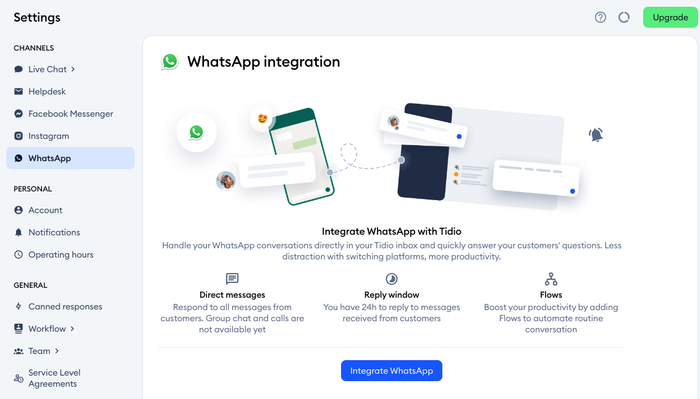
4. Turn on an AI agent for the common questions
Add your help articles, product pages and policies to Lyro’s knowledge, then switch Lyro on for WhatsApp. Ask it ten real questions from your inbox and fix any answer that is wrong or vague by editing the source content. You can try Lyro on its Free-plan allowance (50 Lyro conversations, once) before you pay.
5. Build a welcome Flow and a handoff
Create a Flow that triggers when the visitor says something. Greet them, offer up to three quick replies and send the Talk to a person option straight to the inbox. Add a second Flow on the “Agent doesn’t take the conversation” trigger as a holding message.
6. Create templates for the follow-ups you need
In Meta’s WhatsApp Manager, go to Account tools > Message templates and create a utility template for order updates and one for follow-up. Use variables for the name and order number. Wait for the Active status, then check the template appears in Tidio. Template sending needs the Growth, Plus or Premium plan.
7. Set a spending limit and test
Open Project > Billing and set a monthly limit for WhatsApp usage, or block paid usage and stay inside the free 1,000 messages. Then message your own business number from another phone and walk through every path: the welcome buttons, an AI answer, a handoff and a template. Fix what breaks before you tell customers.
Connect WhatsApp to Tidio and set up Lyro
WhatsApp automation tools compared
The right tool depends on what you automate. Marketing broadcasts and support inboxes need different things. This table is a short guide; the full list with prices is in our WhatsApp chatbot tools roundup.
| Tool | Best for | Notes |
|---|---|---|
| Tidio | Small e-commerce and support teams that want WhatsApp, an AI agent and live chat in one inbox | Replies to customers who write first; templates reopen chats on Growth and up |
| Respond.io | Mid-size B2C teams with high WhatsApp volume that need routing and AI agents | Meta bills fees directly, no markup |
| WATI | Teams that run broadcasts and support from a WhatsApp-first inbox | Extra numbers cost extra |
| ManyChat | Creators and Instagram-first brands adding WhatsApp flows | Strong on social marketing flows |
| Landbot | Teams that design conversation flows visually first | WhatsApp is an add-on with a markup on templates |
If you are an online store that mainly needs to answer customers, Tidio is built for that job. If your main goal is sending campaigns to a large opt-in list, a broadcast-first tool fits better. Many stores use Flows for support on WhatsApp and a separate tool for campaigns.
Start with the questions you answer most
- WhatsApp automation connects your business number to a bot or AI agent through the WhatsApp Business Platform.
- The 24-hour window and Meta’s templates decide when you can reply and how you reopen a chat.
- Start with three jobs, a handoff and a spending limit, then review the conversations every week.
Related guides: WhatsApp chatbot · WhatsApp Business · chat flows · e-commerce automation · abandoned cart apps for Shopify
Connect WhatsApp to Tidio for free
Notes for editor
- Byline: author and reviewer placeholders in the byline line.
- Link back to this page with “WhatsApp automation” anchors from: /blog/whatsapp-chatbot-tools/, /blog/whatsapp-chatbot/, /blog/whatsapp-business/.
- Screenshots needed (3): Tidio Settings > WhatsApp, the Select template button in the inbox, and the billing spending limit. Sourced from the Help Center articles where possible.
- Meta fees: the developer docs and the marketing page disagree on service messages; the draft follows the developer docs (updated September 30, 2026).
FAQ
Connect your business number to a provider through the WhatsApp Business Platform, then turn on a chatbot or AI agent. In Tidio, go to Settings > WhatsApp, click Integrate WhatsApp and log in with Facebook. If you only need a greeting or away message, the WhatsApp Business app has both built in.
Partly. The WhatsApp Business app and Tidio’s WhatsApp integration are free. Meta then gives each business number 1,000 free service messages a month, and charges for more and for template messages. Tidio passes Meta’s rate on with no markup and lets you set a spending limit.
Not safely. Official automation runs on a business number through the WhatsApp Business Platform. Unofficial tools that control a personal account break WhatsApp’s rules, and your number can be banned. Move your business conversations to a business number instead.
It depends on the job. For customer support and e-commerce with an AI agent and one inbox, Tidio fits. For broadcast campaigns, WATI and similar tools are built for it. See our WhatsApp chatbot tools roundup for the full comparison.
Only with a Meta-approved template and the customer’s consent, and Meta charges for each template message. In Tidio you can’t start a chat with someone who has not written to you. You can send a template after the 24-hour window to reopen a chat the customer began.
Yes, through the official WhatsApp Business Platform. Meta sets the rules for the 24-hour window, templates and fees. Automation that uses unofficial software or sends unsolicited bulk messages is not allowed.
No. It takes the repeated questions, and your team handles the cases that need judgment. The best setups give the customer an obvious way to reach a person at any point.
Use live chat to support your customers in real-time