
Chatbots are often pitched as an easy win: always-on support, fewer tickets for agents, faster replies for customers. But when it’s time to prove the impact, the same question keeps coming up.
Is the chatbot actually paying off?
That’s what chatbot ROI is for. It compares what a chatbot delivers against what it costs to build, run, and improve. The part that trips most teams up is simple: ROI looks clean on paper until the true cost of automation is added into the model.
This guide covers how to calculate chatbot ROI in a practical way, what “true cost” includes, and how to use ROI as an ongoing checkpoint.
Measure the real impact of Lyro AI Agent on your support team
What chatbot ROI means in practice
Chatbot ROI, or return on investment, measures whether the value created by a chatbot outweighs the costs of deployment and ongoing operation.
The basic formula is straightforward:
Chatbot ROI = (Gains from chatbot investment – Cost of chatbot investment) / Cost of chatbot investment
The trick is to define gains and costs in a way that reflects what actually happens in support.
A chatbot can reduce workload by deflecting tickets. But it can also increase costs if it escalates too often, gets customers confused, resulting in constant intervention from the team managing it.
That’s why ROI becomes easier to defend when one metric sits at the center of the calculation: cost per automated conversation.
Cost per automated conversation: the metric that clears up chatbot ROI
Contact centers routinely track cost per call, while live chat teams often know their cost per chat. In many support environments, human-handled interactions cost significantly more than automated ones, especially when you factor in agent time, overhead, and infrastructure.
When teams build ROI models, they often compare the average cost of a live interaction with the total cost of automated conversations over the same period. The exact numbers vary depending on region, salaries, and support complexity.
In short, cost per automated conversation shows what’s actually being spent each time the bot engages, and whether the interaction produced a real outcome or simply pushed the customer into a more expensive channel.
How to calculate cost per automated conversation
At first glance, calculating the cost of an automated conversation seems simple. Divide what you’re paying for the platform by the number of conversations the bot handles, and you’ve got your answer.
A basic approach looks like this:
platform and license fees / number of bot conversations
That formula gives you a starting point. But in reality, it rarely tells the full story. It only captures surface-level costs and ignores what actually happened during those conversations.
A more useful view includes three inputs:
- Platform fees (licensing and implementation): this includes subscription costs, setup, integrations, and any required add-ons. These are the visible, contractual expenses most teams account for from the beginning.
- Conversation volume: volume affects unit cost because fixed costs spread out over time. Early costs typically look higher because implementation work is front-loaded, while higher usage later on usually lowers the cost per conversation.
- Automation quality: automation isn’t just the process of the bot replying. It’s also whether the customer got what they needed without repetition or unnecessary frustration.
What a good cost target can look like
There isn’t a universal number to aim for. The simplest way to evaluate cost is to compare automated conversations with your own live support costs.
The goal is straightforward: automation should cost less than the human interaction it replaces.
If it doesn’t, the problem usually isn’t the platform itself. It’s how the automation is set up. Improving how the chatbot understands questions, refining conversation flows, and reducing unnecessary escalations will usually have a bigger impact on ROI than trying to lower subscription fees.
Why cost per automated conversation matters
This metric does two things that most chatbot ROI models struggle to do:
- grounds ROI in reality, because it shows the true spend behind automation
- acts as a performance signal, since rising cost per automated conversation often points to higher escalations
It’s also a budgeting tool. Once the cost of automation is clear, it becomes easier to decide how much to invest in improvements to hit a specific business target.
Benefits of Chatbot ROI
Cost savings are the most common ROI driver, but ROI becomes stronger when it includes benefits the business can see in daily operations.
Operational savings: fewer tickets and shorter handling time
Savings can be estimated by comparing the cost of automated conversations with the cost of the live interactions they replace.
Even when a conversation escalates, a chatbot can still reduce costs by collecting context up front and shortening average handling time for the agent who takes over.
Our internal data shows that businesses using AI chatbots have reported up to $20 million in cost savings, and some support teams reduce customer service costs by as much as 30% through automation of repetitive inquiries.
Revenue uplift
In ecommerce, automation can influence revenue by helping customers move through product questions and checkout issues faster.
For example, if a chatbot assists customers who are hesitating at checkout and some of those interactions lead to completed purchases, that incremental revenue can be included in ROI calculations. The key is using consistent attribution rules so the model remains credible.
According to our own data, in ecommerce environments, some online stores have seen median order value increase by around 20% within the first week of implementing chatbots. This shows how faster responses and guided conversations can directly impact revenue.[1]
Faster response times and round-the-clock availability can also reduce drop-off during support interactions, which in turn supports higher conversion rates.
CX value
Customer experience gains often get dismissed because they can feel “soft.” But they stop being soft when tied to churn or lifetime value.
One structured way to approach this is by modeling how improvements in satisfaction might correlate with retention. For example, if internal data shows that higher CSAT scores are associated with lower churn, even a modest improvement in satisfaction can translate into measurable revenue protection.
The exact relationship depends on the business, but the method remains the same: link CX metrics to financial outcomes.
The additional chatbot ROI costs
If ROI looks too good in the first draft, it usually means costs were simplified too aggressively. Here are a few things to consider:
- One-off vs. recurring costs: One-off costs can include setup, integrations, and onboarding, while recurring costs include licensing, infrastructure, ongoing maintenance, and optimization work. If LLM-based features are part of the setup, usage-based costs like token consumption can also become a meaningful variable line item.
- Ongoing training: this should be treated as a recurring operational expense. Flow updates, performance monitoring, prompt adjustments, and intent refinement all require continuous effort.
- Human-in-the-loop costs: even mature bots escalate. Escalation rates vary depending on use case complexity and automation maturity. Those escalations carry real costs, including agent time for escalations, and training agents to take over smoothly
- Poor CX: If the bot frustrates customers, it can drive repeat contacts, increase demand for expensive channels, and contribute to churn.
You should be aware that new costs can appear as automation grows. This could be due to more integration usage, additional data storage, and even support for more languages.
A practical ROI formula that holds up
After taking everything above into account, a more complete formula would look like this:
ROI = (Annual financial benefits + Monetized CX benefits – Total costs) / Total costs × 100%
It keeps cost savings at the center, while allowing CX value to be included when it’s tied to measurable business outcomes.
Benchmarks: what “good” ROI can look like
ROI expectations vary by industry and use case.
Rather than relying on external benchmarks, it’s more useful to evaluate internal improvements such as:
- reduced repetitive ticket volume
- improved containment over time
- stable or rising satisfaction for bot-handled conversations
- measurable cost difference between automated and live interactions
Our internal data on chatbot statistics also indicates that average chatbot ROI can reach approximately 1,275% when calculated based on support cost savings alone. Additionally, the global chatbot market is currently valued at $7.76 billion, reflecting strong and sustained commercial adoption.
Many companies report measurable ROI within the first year of implementation[i], especially when automation targets high-volume, repetitive support topics. While results depend heavily on execution quality, efficiency gains and cost savings are often repeatable when performance is monitored and optimized consistently.
Calculate AI support savings with Tidio’s ROI calculator
Tidio offers an AI support savings calculator designed around ecommerce inputs. It takes into account details such as the type of business, support team size, annual GMV, channel distribution across live chat, email, and voice, and the desired level of automation.
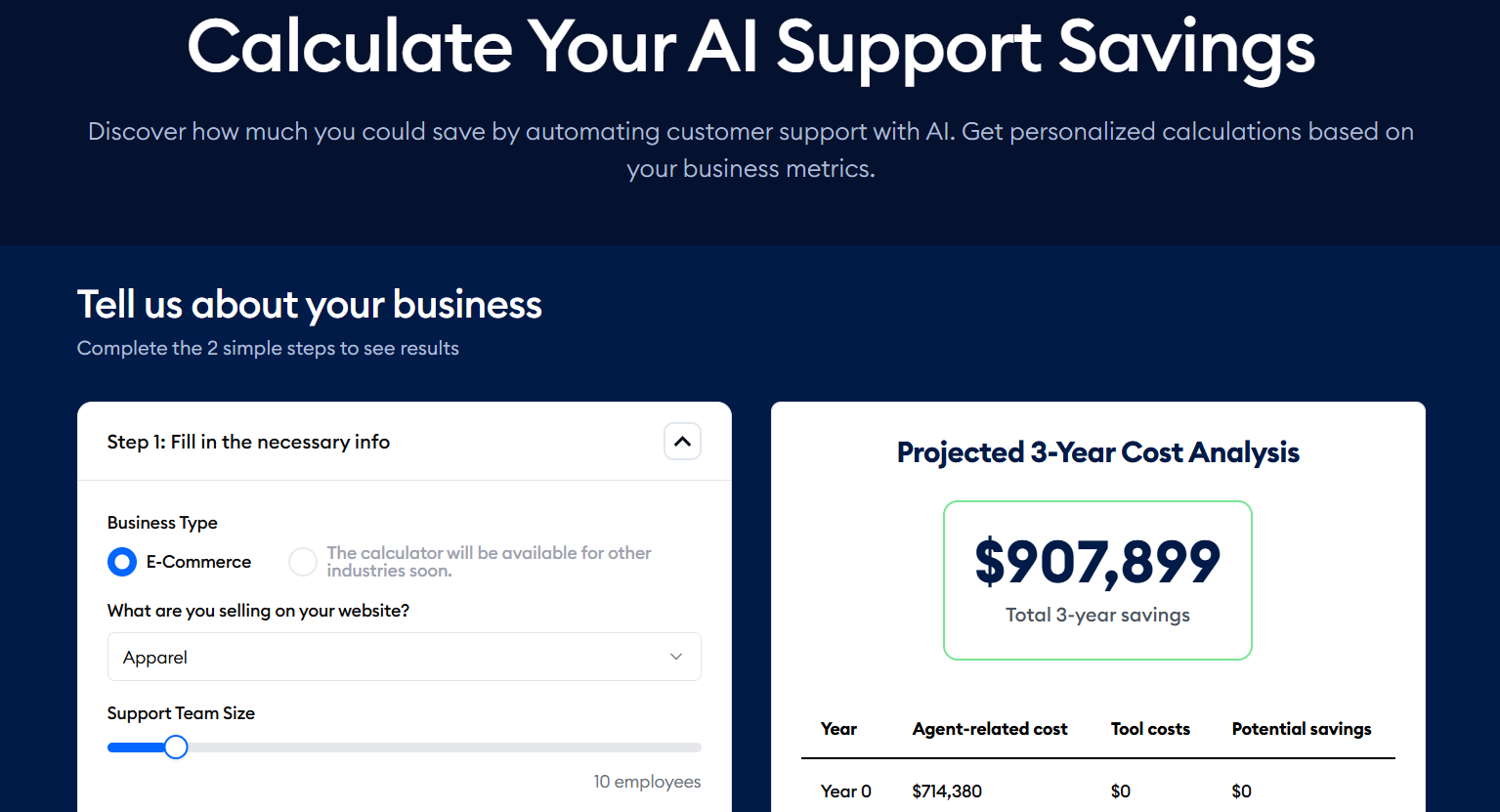
Based on those inputs, the chatbot cost calculator generates a projected multi-year cost analysis that compares agent-related expenses, tool costs, and potential savings over time.
All amounts are shown in USD, salary assumptions are based on standardized market estimates, and results are projections. Actual outcomes of chatbot ROI calculation will always vary depending on things like implementation quality and support complexity.
Key takeaway: chatbot ROI grows after launch
Most ROI gains don’t happen on day one. They show up after launch, once the chatbot starts generating real data and small friction points become visible.
Improving chatbot ROI usually comes down to refining the details. That might mean tightening intents that trigger unnecessary escalations, or rewriting answers that cause customers to return with follow-up questions. Or, it could mean simplifying flows that feel slow or confusing. In many cases, even a modest reduction in handovers to human agents can noticeably shift overall costs.
The biggest financial impact rarely comes from cutting platform expenses. It comes from improving how well the automation performs. When escalation drops and task completion improves, cost per automated conversation naturally decreases.
Over time, small improvements add up. When teams continue refining how the chatbot works instead of setting it up and leaving it alone, the results tend to improve steadily. Ongoing adjustments, even minor ones, can lead to consistent and long-term ROI growth.
Measure the real impact of Lyro AI Agent on your support team
FAQ
Tidio is a customer service platform that helps businesses manage conversations across live chat, email, and social messaging channels in one place. It combines real-time chat with AI automation tools, including chatbots and AI agents, to help teams respond faster and handle more inquiries without increasing workload.
Yes. Tidio uses artificial intelligence through its AI agent, Lyro, which automatically answers customer questions using your existing content and support data. AI is also used to assist human agents, automate repetitive tasks, and improve response efficiency.
Yes. Tidio includes chatbot functionality that allows businesses to automate conversations, qualify leads, answer common questions, and route inquiries to the right team. These chatbots can be rule-based or AI-powered (Lyro).
The return on investment (ROI) of using Tidio comes from the cost savings and performance improvements the platform enables. Tidio’s automation, including live chat, AI chatbots, and the Lyro AI Agent, can reduce support workload and cut time spent on repetitive queries. In addition, it improves response times, all of which lower operational costs. Last but not least, Lyro AI has a 67% resolution rate.