
Key takeaways
- Best for online stores that want AI and a human inbox in one place: Tidio. Lyro can resolve up to 75% of support requests, and on Shopify your team sees carts and order history beside the chat. Human-only plans start at $24 a month and plans with Lyro at $33 (both billed annually).
- Best for Shopify brands with thousands of tickets: Gorgias, a help desk built around orders, with the AI billed per automated interaction.
- Best store-only agents for sales: Zipchat and Rep AI, which recommend products and recover carts. Zipchat prices by replies, Rep AI by site sessions.
- Already on Zendesk, HubSpot or Freshdesk? Try that vendor's own AI agent first; it already reads your tickets and contacts.
- Price per resolution, not per seat. Most agents bill each resolved conversation on top of the plan, so model your order-status volume before you sign.
Most "AI agents" pitched to online stores answer questions well and stop there. Then a shopper asks to change an address or return a jacket, and your team picks it up anyway. We compared 10 AI agents on what they do inside a store: which orders they can change, how they recommend products, how they hand a chat to a person, and what each resolved conversation costs. Each entry has a strength, a limit and its price.
The best AI agents for e-commerce at a glance
Our top picks: Tidio for online stores that want AI and people in one inbox, Gorgias for high-volume Shopify help desks, and Zipchat for stores that want an AI sales assistant first. The table shows every tool with the price you pay to start and how its AI is billed.
| Tool | Best for | Starting price | How the AI agent is billed | Free plan / trial | G2 rating |
|---|---|---|---|---|---|
| Tidio | Online stores, especially Shopify | $24/mo (Human only), billed annually ($29 monthly) | Built into With Lyro AI plans, from $33/mo for 50 conversations | Free plan · 7-day trial | 4.6 (2,076) |
| Gorgias | Shopify brands with high ticket volume | $10/mo for 50 tickets | $0.85 to $1.00 per automated interaction | Free trial | 4.6 (582) |
| Zipchat | Stores that want an AI shopping assistant | $64/mo, billed annually | By replies: 750 on Starter, $49 per 250 extra | 7-day trial | 4.5 (11) |
| Rep AI | High-traffic Shopify stores | Priced by monthly site sessions | Plan price by sessions | 14-day trial | 4.9 (66) |
| Skara AI agents | WhatsApp and email selling | $79/mo | Credits: 30,000 on Lite | Not stated | No G2 listing |
| Intercom Fin | Digital-first teams that put the agent first | $29/seat/mo, billed annually | $0.99 per outcome | 14-day trial | 4.5 (3,930) |
| Zendesk AI agents | Large teams that need ticketing depth | $19/agent/mo, billed annually | 5 to 10 resolutions per agent a month included, then $1.50 to $2.00 | 14-day trial | 4.3 (7,097) |
| Ada | Enterprise teams with high contact volume | Custom | Custom | Demo | 4.6 (174) |
| HubSpot Customer Agent | Stores that keep customer data in HubSpot | $90/seat/mo, billed annually (Professional) | $0.50 per resolution, paid in HubSpot Credits | Free tools (no AI agent) | 4.4 (3,018) |
| Freshdesk (Freddy AI Agent) | Growing teams that budget per agent | $19/agent/mo, billed annually | First 500 sessions free once, then $49 per 100 | 14-day trial | 4.4 (3,795) |
What is an AI agent for e-commerce?
An AI agent for e-commerce is software that resolves a shopper's request itself instead of only suggesting an answer. It reads your catalog, policies and order data, replies in natural language, takes an action such as a refund or an address change, and passes the chat to a person when it should. A scripted chatbot with button menus does none of the last three. Analysts expect agents to take over most routine requests: Gartner predicts agentic AI will resolve 80% of common customer service issues without human intervention by 2029[1]. For the concept in depth, see our guide to AI agents for Shopify.
How we chose these AI agents
We started from the tools that today's search results, AI assistants' answers and G2 category pages name for this topic, and kept 10 that sell an AI agent a store can buy and test. We left out general chatbot builders, ad and email tools (see our list of AI tools for e-commerce) and tools with no public product page for the agent. We judged each on six criteria:
- Store fit: native Shopify, WooCommerce or BigCommerce connections, and order and catalog data.
- Actions: whether it can cancel, refund or edit an order, not just answer.
- Selling: product recommendations, cart recovery and pre-sales questions.
- Handoff: escalation rules and what the human sees afterwards.
- Pricing: public prices and the billing unit for the AI.
- Reviews: G2 rating and review count.
The list is ordered by fit for online stores, then by team size, not by rating, which is why Tidio is first. We did not test resolution rates ourselves. Where a vendor publishes one, it appears as the vendor's claim.
The 10 best AI agents for e-commerce in 2026
1. Tidio
Best for: online stores that want AI and human support in one inbox

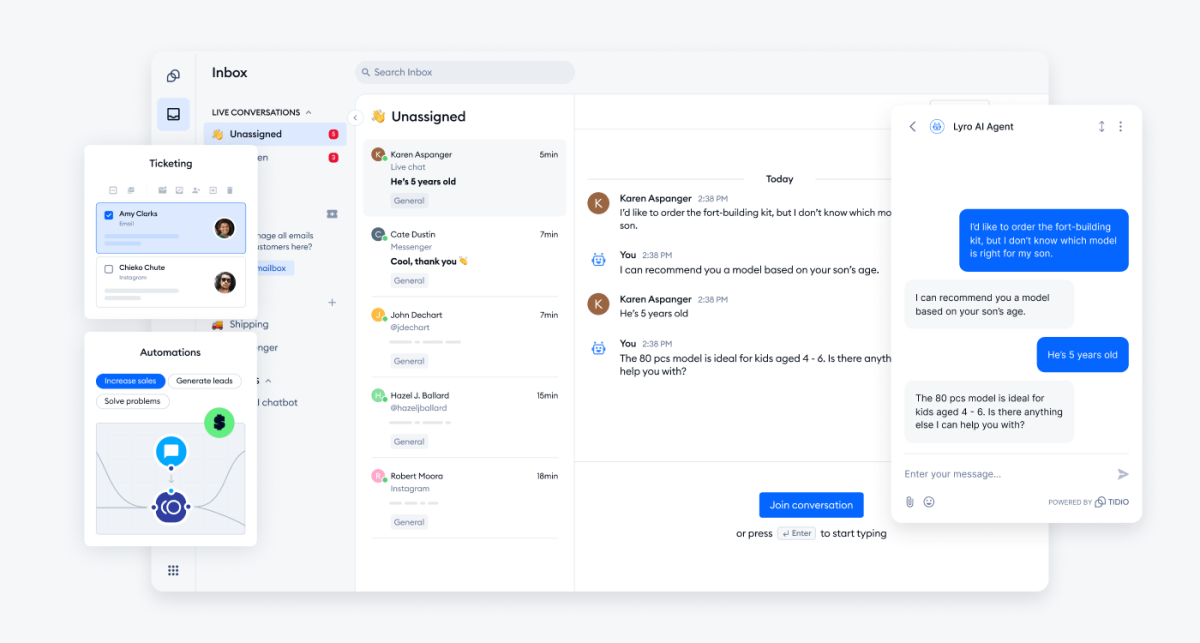
Tidio's AI agent, Lyro, answers from your help center, product pages and FAQs, and works next to live chat and an email inbox, so a handoff keeps the whole conversation. Lyro can resolve up to 75% of support requests. On Shopify, your team sees the shopper's cart and order history beside the chat, and Lyro can recommend products in the same thread. With Lyro Actions, the agent can also handle order updates and lead qualification.
Tidio fits stores like these:
- Shopify stores that want cart preview and order history next to every chat.
- Small and medium-sized shops that need more questions closed without hiring.
- Stores with many repeat questions about shipping, returns and order status.
- Shops that sell across channels: live chat, email, Messenger, Instagram and WhatsApp in one place.
Skip Tidio if you want a ticketing-first help desk for a large enterprise team; a platform such as Zendesk covers that depth.
Key features:
- Lyro AI agent: replies in the shopper's language and follows the escalation rules you set with Lyro Guidance.
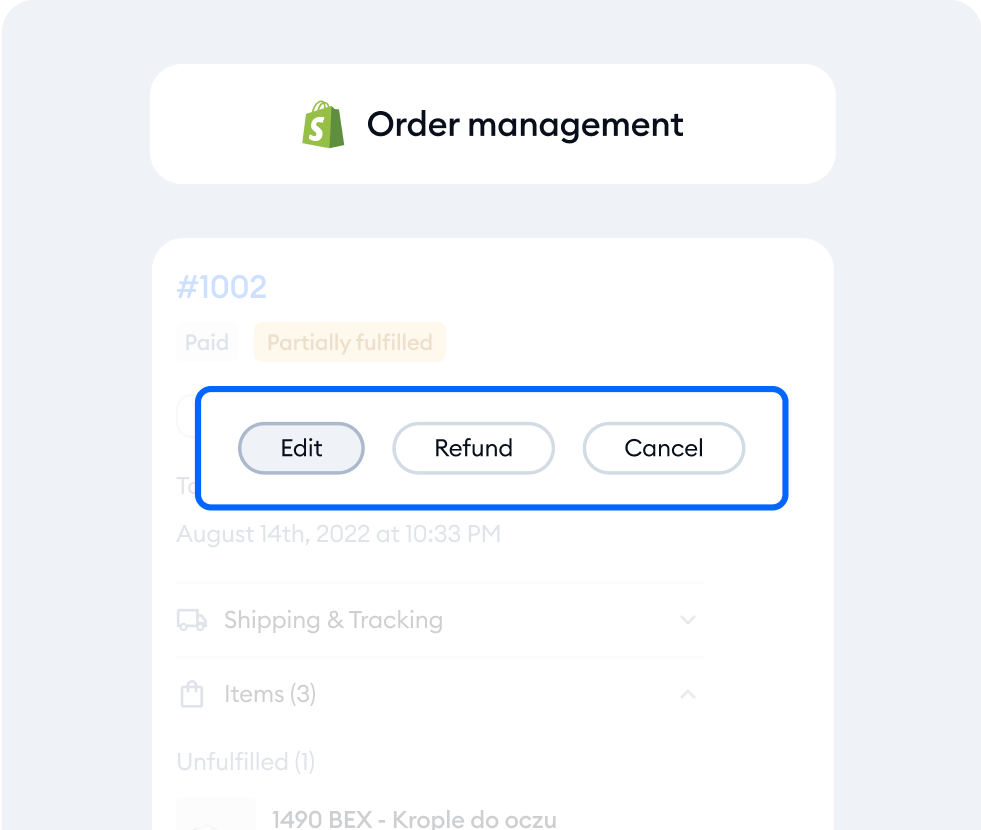
- Shopify order tools: see the cart and order history, then cancel an order, offer a refund or change a shipping address from the inbox.
- Product recommendations: Lyro suggests items from your catalog during the chat.
- Flows: automations that greet visitors and nudge shoppers who leave a cart behind.
Pros
- Lyro answers from your own content with guardrails and is built on Claude from Anthropic.
- Chat, email and the AI agent share one inbox, so nothing restarts at handoff.
- Free plan and 7-day trial let you test on real traffic.
Cons
- Lyro and your team share one conversation quota, so peak season eats into it faster and is worth planning for.
- Native Shopify order actions come with Growth and up, so Starter suits simpler setups.
- Larger deployments with departments or custom limits run on Plus or Premium, where Tidio's sales team shapes the quote with you.
Pricing:
- Free: 50 human conversations/month, 100 Flows visitors/month + 50 one-time Lyro AI conversations.
- Starter: Human only: from $24/month for 100 conversations. With Lyro AI: from $33/month for 50 conversations shared by AI and your team.
- Growth: from $41/month for 200 human conversations or $63/month for 100 AI + human conversations; scalable to 1,000/month.
- Plus: from $300/month + usage. Premium: custom pricing.
- Optional add-ons: Flows, Inbox AI, Help Center, Voice, and branding removal.
- 7-day free trial: Growth features with Lyro AI and 100 AI + human conversations, no card required; moves to Free unless you choose a paid plan.
Starting prices shown with annual billing.
See Tidio pricing.
Rating: G2 4.6/5 (2,076 reviews)
Put Lyro on your store and see what it resolves
2. Gorgias
Best for: Shopify brands with thousands of tickets a month
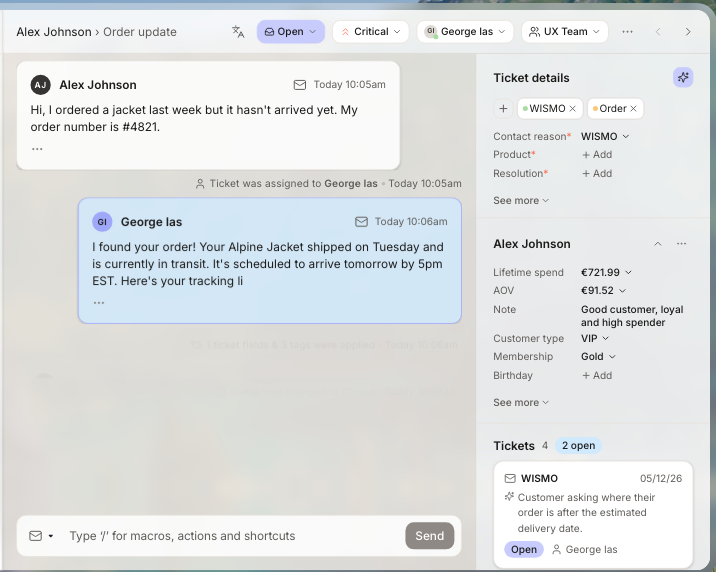
Gorgias is a help desk made for online stores. Its AI Agent answers questions, recommends products and handles returns, tracking and cancellations through native Shopify, BigCommerce, Magento and WooCommerce connections. Plans follow ticket volume, not seats. Outside e-commerce it has little to offer.
Key features:
- AI Agent pre-trained on 18+ store verticals, with brand voice and guardrails.
- Order actions inside each ticket: cancel, refund, discount and track.
- Shopping Assistant for pre-sales questions.
Pros
- No per-agent fees; plans from Basic include 500 user seats.
- Connectors for Klaviyo, Yotpo, Recharge and Smile.
Cons
- Each automated interaction is billed on top of the plan.
- AI actions such as cancellations are not on Starter.
Pricing (monthly; annual in brackets): Starter $10 for 50 tickets (monthly only), Basic $60 ($50) for 300, Pro $360 ($300) for 2,000, Advanced $900 ($750) for 5,000. The AI Agent costs $1.00 per automated interaction on Starter, $0.90 on Basic and Pro, and $0.85 on Advanced. Free trial, no credit card.
Rating: G2 4.6/5 (582 reviews)
Read more: Gorgias alternatives · Gorgias review
3. Zipchat
Best for: stores that want an AI shopping assistant on every touchpoint
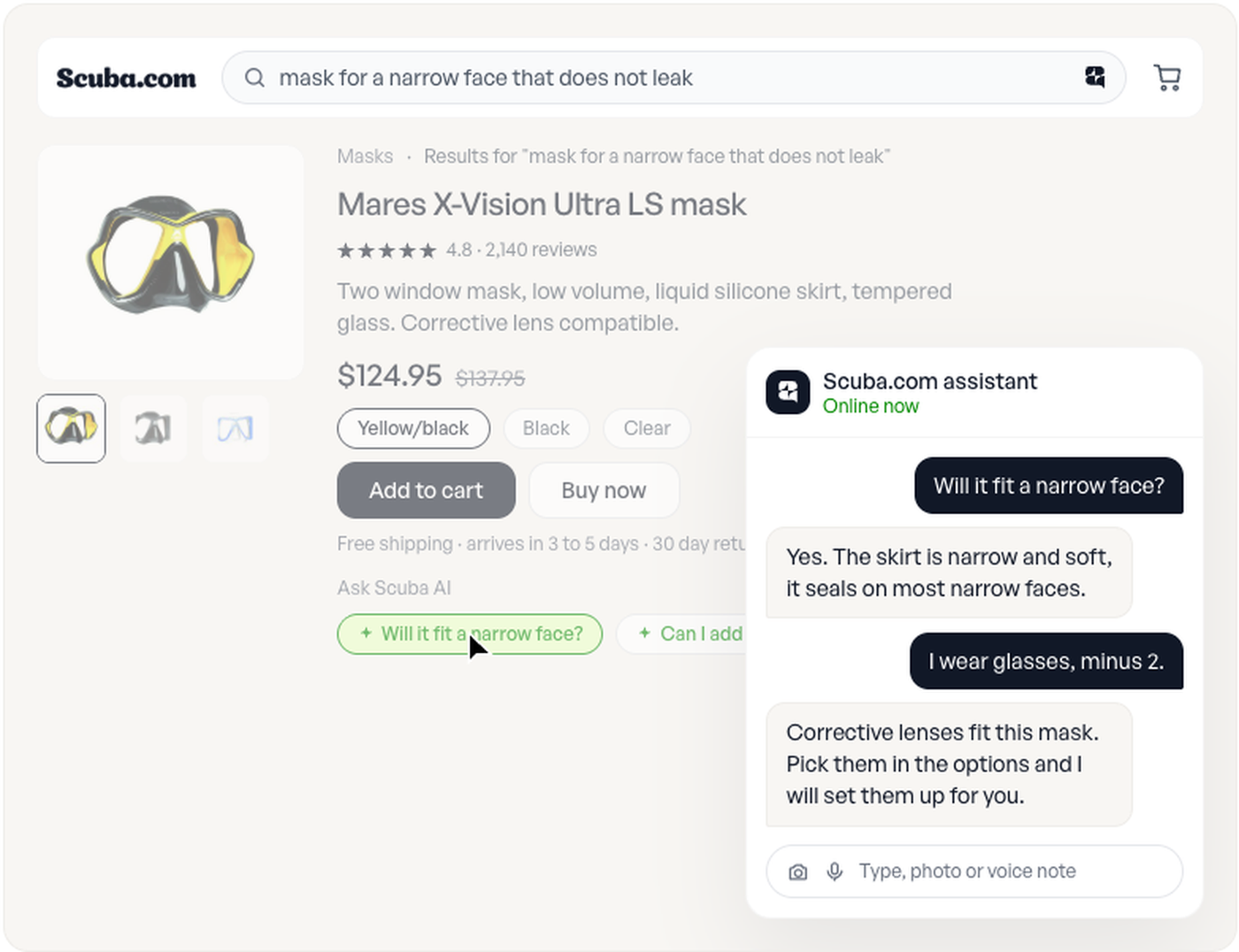
Zipchat sells one AI agent for the whole shopping journey, from the search bar and product pages to chat, email, WhatsApp, Instagram and Messenger. It is built for online stores and lists Shopify, WooCommerce and BigCommerce. The agent reads your live catalog to recommend items and can add one to the cart without leaving the chat. Its limit is cost: there is no free plan, and replies are metered.
Key features:
- Catalog recommendations from your live product data.
- Cart actions in the chat, plus abandoned-cart recovery.
- Returns and order changes for common post-purchase requests.
Pros
- Built for stores only, with catalog, cart and returns in one agent.
- Sales are attributed to the conversation that produced them.
Cons
- No free plan, and extra replies cost $49 per 250.
- The G2 sample is small, at 11 reviews.
Pricing (per month, billed annually): Starter $64 for 750 replies and one AI agent, Pro $240 for 3,000, Scale $480 for 6,000, Scale Plus $960 for 14,000. Unlimited starts at $2,100 through sales. 7-day free trial and a 30-day money-back guarantee.
Rating: G2 4.5/5 (11 reviews)
4. Rep AI
Best for: high-traffic Shopify stores that want AI sales and support agents

Rep AI splits its agent in two: an AI Sales Agent that watches behavior such as product comparisons, repeat browsing and abandoned carts, and an AI Support Agent that covers order status, order changes and returns. A Concierge plan bundles both. Pricing follows your monthly site sessions, so a busy store pays more.
Key features:
- Behavior triggers that step in when a visitor hesitates.
- Post-purchase support: tracking, returns, exchanges and order changes.
- Klaviyo sync for segmenting email by conversation.
Pros
- Covers sales and support, with a bundle price.
- Unlimited seats on every plan.
Cons
- Cost rises with traffic, and add-ons cost extra.
- G2 reviewers mention limited chatbot customization and about a month of setup and training.
Pricing: by monthly sessions. At 80,000 sessions on monthly billing, AI Support is $250 a month, AI Sales $578 and the Concierge bundle $726; yearly billing is 20% cheaper. We could not read the smaller tiers, so check the pricing page with your own traffic. 14-day trial on all plans.
Rating: G2 4.9/5 (66 reviews)
5. Skara AI agents
Best for: stores that sell and support over WhatsApp and email
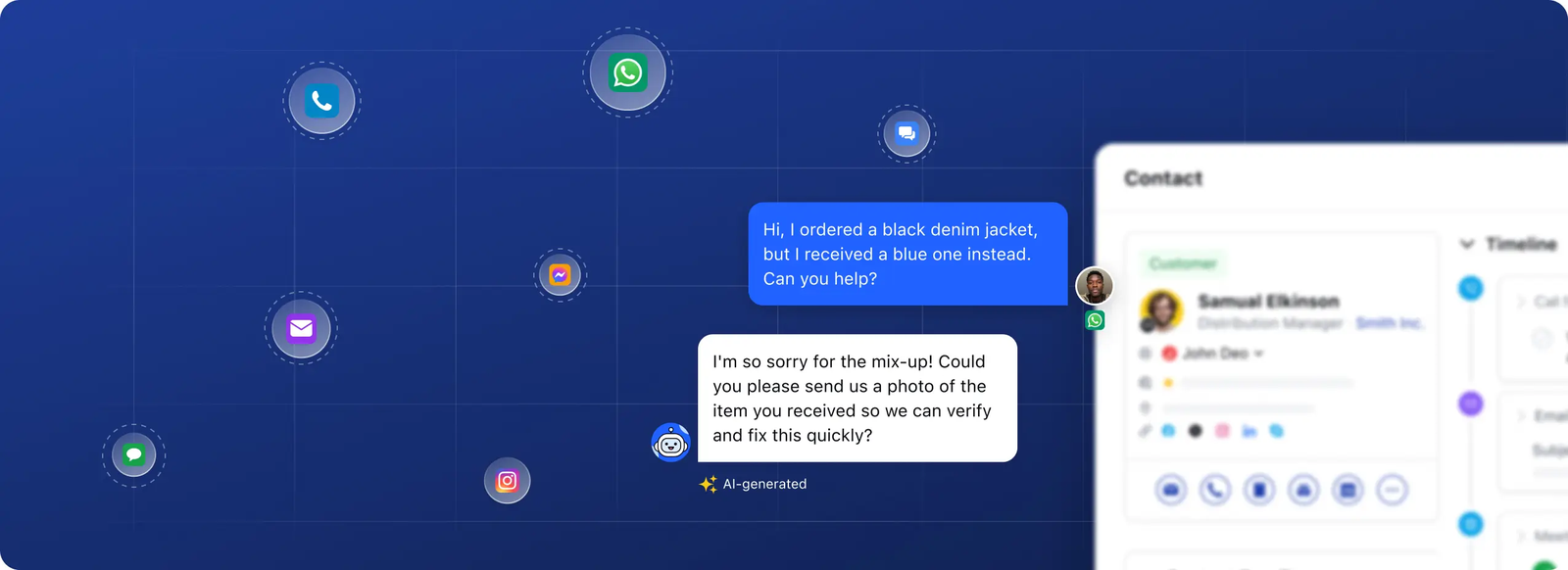
Skara AI agents, from Salesmate, are built for e-commerce first. The agent answers size, fit and availability questions, adds items to the cart in conversation and recovers abandoned checkouts over chat, WhatsApp, SMS and email. It can track orders and start return flows. The vendor lists web chat, Instagram, Facebook, WhatsApp and email as live, and marks SMS, voice and RCS as upcoming.
Key features:
- Catalog-aware answers on size, fit, ingredients and availability.
- Cart recovery by chat, WhatsApp, SMS and email.
- Order flows for tracking, returns and exchanges, with escalation to a person.
Pros
- Many messaging channels and over 100 languages.
- Plans state their user, agent and credit limits up front.
Cons
- Several channels are still marked upcoming.
- No independent rating, because Skara has no G2 listing.
Pricing: Lite $79 a month (3 users, 2 AI Pilots, 30,000 credits) and Plus $159 (10 users, 5 AI Pilots, 60,000 credits). Max is custom. The page does not say whether the prices assume annual billing, and AI product search costs extra per SKU.
Rating: no G2 listing for Skara.
6. Intercom Fin
Best for: digital-first stores that want the AI agent to lead support
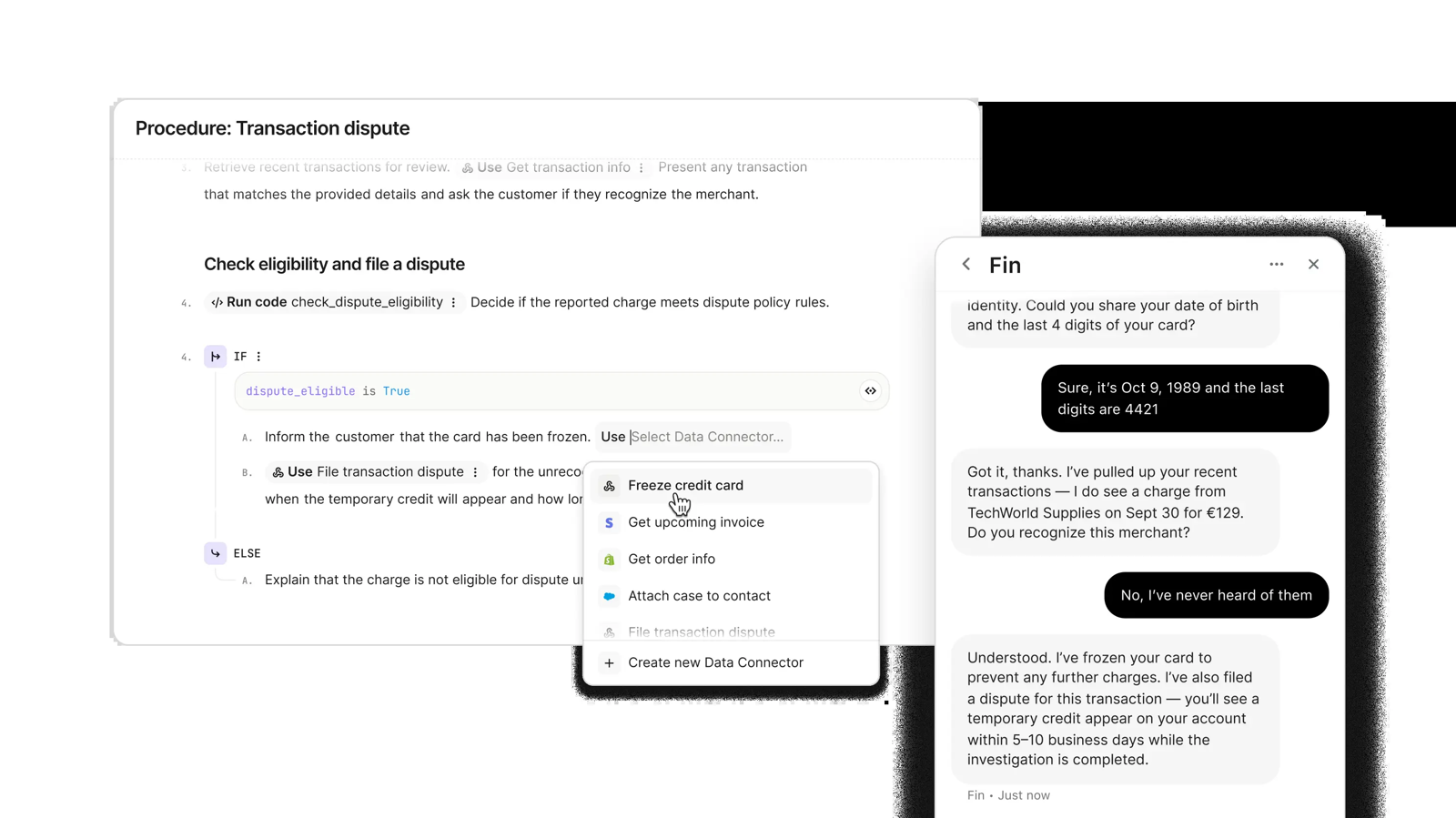
Fin is the AI agent Intercom built its help desk around, and Intercom now pitches it for service, sales and e-commerce. It answers from your knowledge base, follows step-by-step Procedures and acts in outside systems. It can also run on another help desk, such as Salesforce, with no Intercom seats. Seats and outcomes are billed separately, so the bill grows two ways.
Key features:
- Fin AI Agent across chat, email and other channels.
- Procedures for multi-step workflows, including handoffs.
- Workflows builder from the Advanced plan.
Pros
- One charge per conversation, even when Fin answers several questions.
- You can test it on your current help desk without migrating.
Cons
- Seat fees and outcome fees both rise with your team.
- Copilot for human agents is a separate add-on.
Pricing (per seat a month, billed annually; monthly in brackets): Essential $29 ($39), Advanced $85 ($99), Expert $132 ($139). Fin costs $0.99 per outcome, counted when the customer confirms the fix, asks for no more help, or Fin completes a Procedure. 14-day free trial.
Rating: G2 4.5/5 (3,930 reviews)
Read more: Intercom alternatives · Intercom review
7. Zendesk AI agents
Best for: large stores with big teams that need deep ticketing
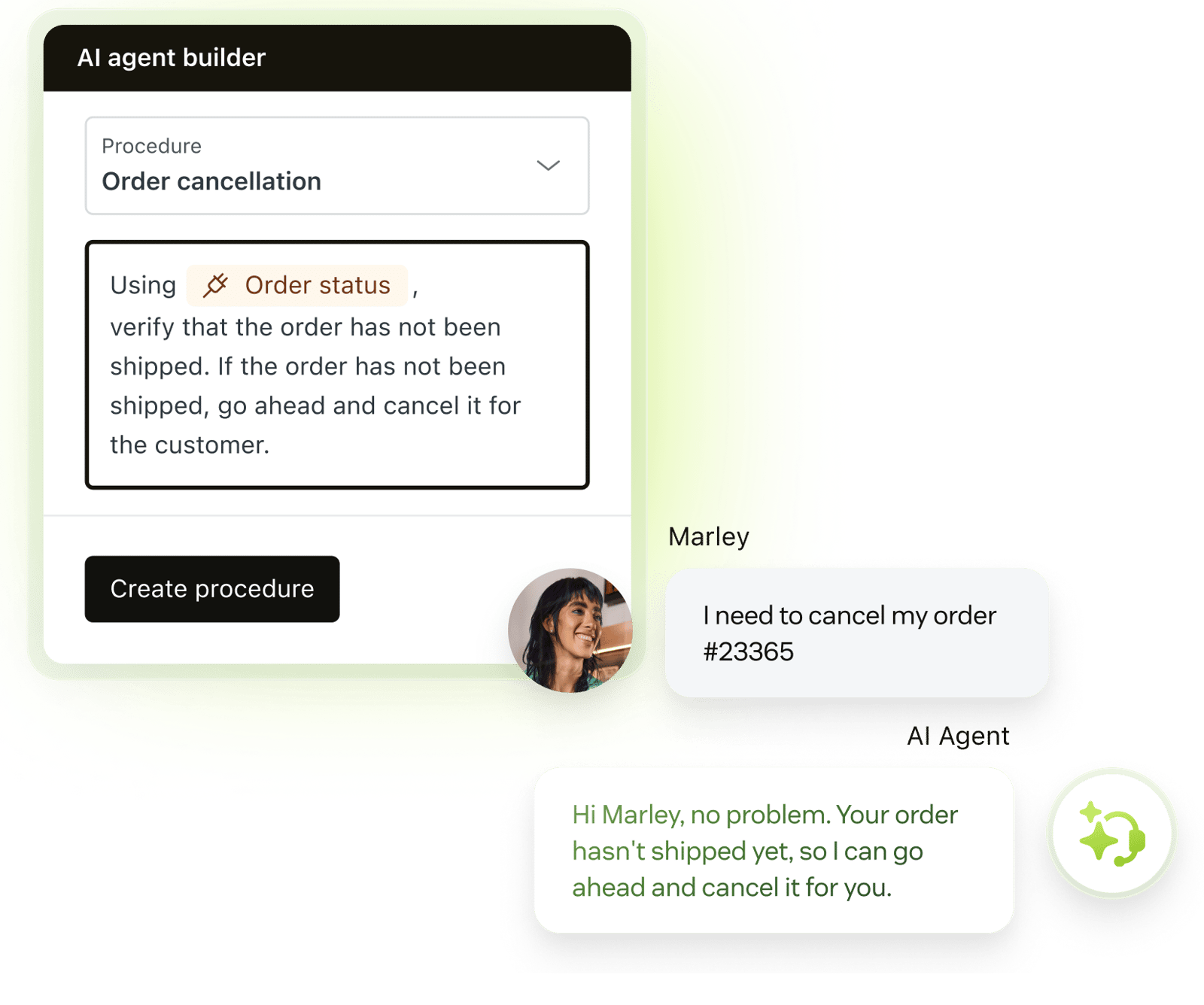
Zendesk includes AI agents in its plans and bills them per automated resolution, a request solved with no human escalation. They work across messaging, email and voice, and can pull in product and order data for context. The limit is the allowance: five resolutions per agent a month on the Team plans, so volume adds up quickly.
Key features:
- AI agent builder that turns a written procedure into a working agent.
- Actions to read, write and trigger tasks in outside systems.
- 80+ languages with reasoning controls.
Pros
- Deep ticketing, routing and reporting for large teams.
- Some automated resolutions come with every plan.
Cons
- Resolutions above the allowance add up at volume.
- Copilot is an add-on from Suite Professional.
Pricing (per agent a month, billed annually; monthly in brackets): Support Team $19 ($25), Suite Team $55 ($69), Suite Professional $115 ($149), Suite Enterprise through sales. Five resolutions per agent a month are included (10 on Suite Professional), then $1.50 each on a commitment or $2.00 pay-as-you-go. 14-day free trial.
Rating: G2 4.3/5 (7,097 reviews)
Read more: Zendesk alternatives · Zendesk review
8. Ada
Best for: enterprise retailers automating high contact volumes
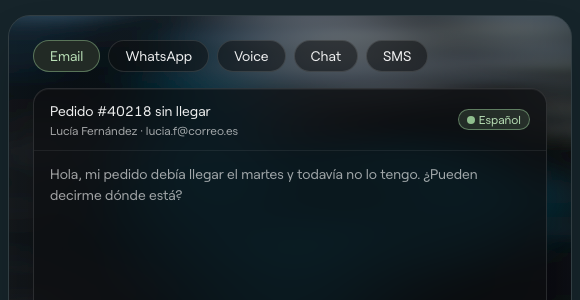
Ada sells AI agents for voice, messaging and email to large companies. Playbooks turn your standard operating procedures into automated workflows, and ready-made playbooks cover e-commerce among other industries. Pricing comes after a demo, sized by yearly contact volume, so it is not built for a five-person team.
Key features:
- Playbooks for multi-step procedures such as refunds.
- Voice, messaging and email agents on one platform.
- Testing and coaching to improve resolutions after launch.
Pros
- Handles multi-step jobs such as refunds or account changes.
- Ready-made playbooks for several industries, e-commerce included.
Cons
- No public pricing.
- A small G2 sample of 174 reviews for an enterprise product.
Pricing: custom, quoted after a demo from annual contact volume.
Rating: G2 4.6/5 (174 reviews)
Read more: Lyro vs Ada
9. HubSpot Customer Agent
Best for: stores whose customer data already lives in HubSpot's CRM
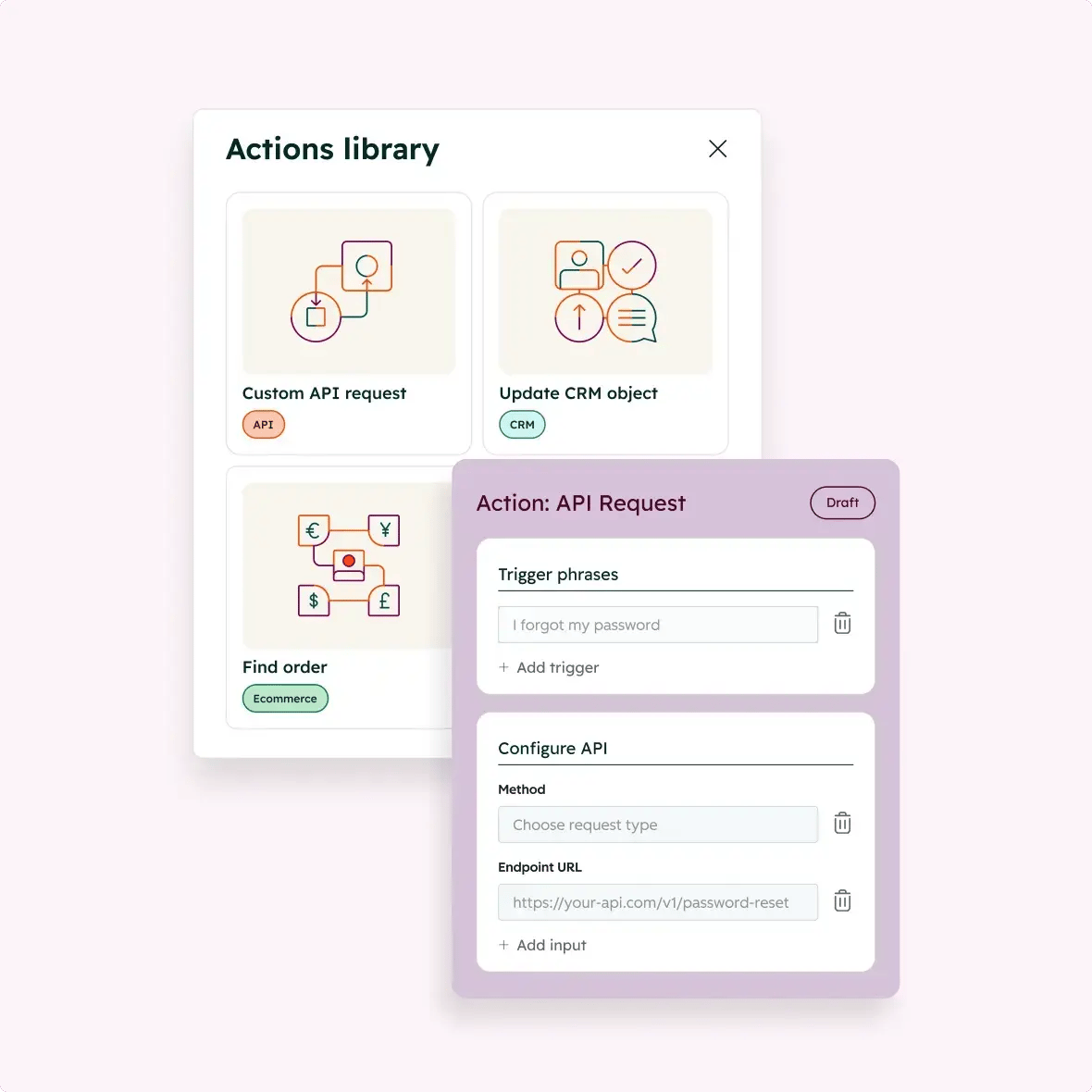
HubSpot's Customer Agent replies in chat, email, forms and calls with the customer's CRM history in view, then escalates to your team. Its actions library includes finding an order. HubSpot says it resolves 65% or more of conversations. It needs Service Hub Professional or Enterprise, so the entry cost is the seat price, not the AI.
Key features:
- Customer Agent trained on your content in minutes.
- Help desk workspace tied to CRM contacts, deals and tickets.
- HubSpot Credits with spend limits per feature.
Pros
- Answers draw on the same records as sales and marketing.
- Credit limits cap what the AI can spend.
Cons
- Not available on the free or Starter plans.
- Its order actions depend on how your store data reaches the CRM.
Pricing: free tools for up to two users; Starter from $7 a seat a month billed annually; Professional from $90 a seat billed annually ($100 monthly) plus $1,500 onboarding; Enterprise from $150 a seat plus $3,500 onboarding. Customer Agent costs $0.50 per messaging resolution and per voice minute, paid in HubSpot Credits (50 credits per resolved conversation); Professional includes 3,000 credits a month.
Rating: G2 4.4/5 (3,018 reviews)
Read more: HubSpot alternatives
10. Freshdesk (Freddy AI Agent)
Best for: growing stores that want AI on a per-agent budget
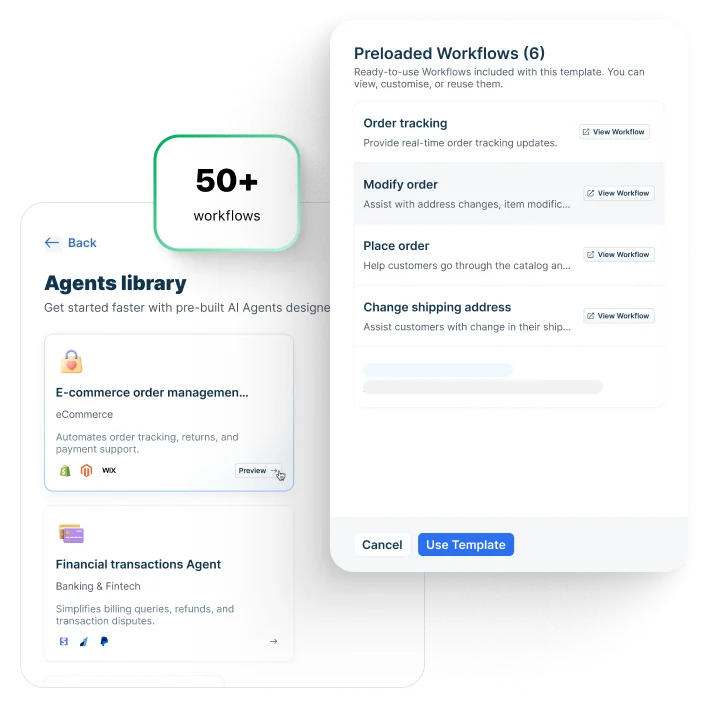
Freshdesk is a ticketing help desk with Freddy AI Agent for shoppers and Freddy AI Copilot for your team. Its agent library includes an e-commerce order management agent with preloaded workflows. It suits stores that have outgrown a shared inbox. The free plan is gone from the current pricing page, and AI sessions are sold in packs.
Key features:
- Freddy AI Agent for chat and email answers.
- Freddy AI Copilot with reply suggestions and summaries.
- Freddy AI Insights on the Enterprise plan.
Pros
- Low entry price per agent for a full help desk.
- Copilot can go to only the agents who need it.
Cons
- No free plan; only the 14-day trial is free.
- AI sessions and Copilot both add to the per-agent price.
Pricing (per agent a month, billed annually): Growth $19, Pro $55, Enterprise $89. Freddy AI Agent: first 500 sessions free once per account, then $49 per 100. Copilot: $29 per agent a month. 14-day free trial.
Rating: G2 4.4/5 (3,795 reviews)
Read more: Freshdesk alternatives · Freshdesk review
How to choose an AI agent for an online store
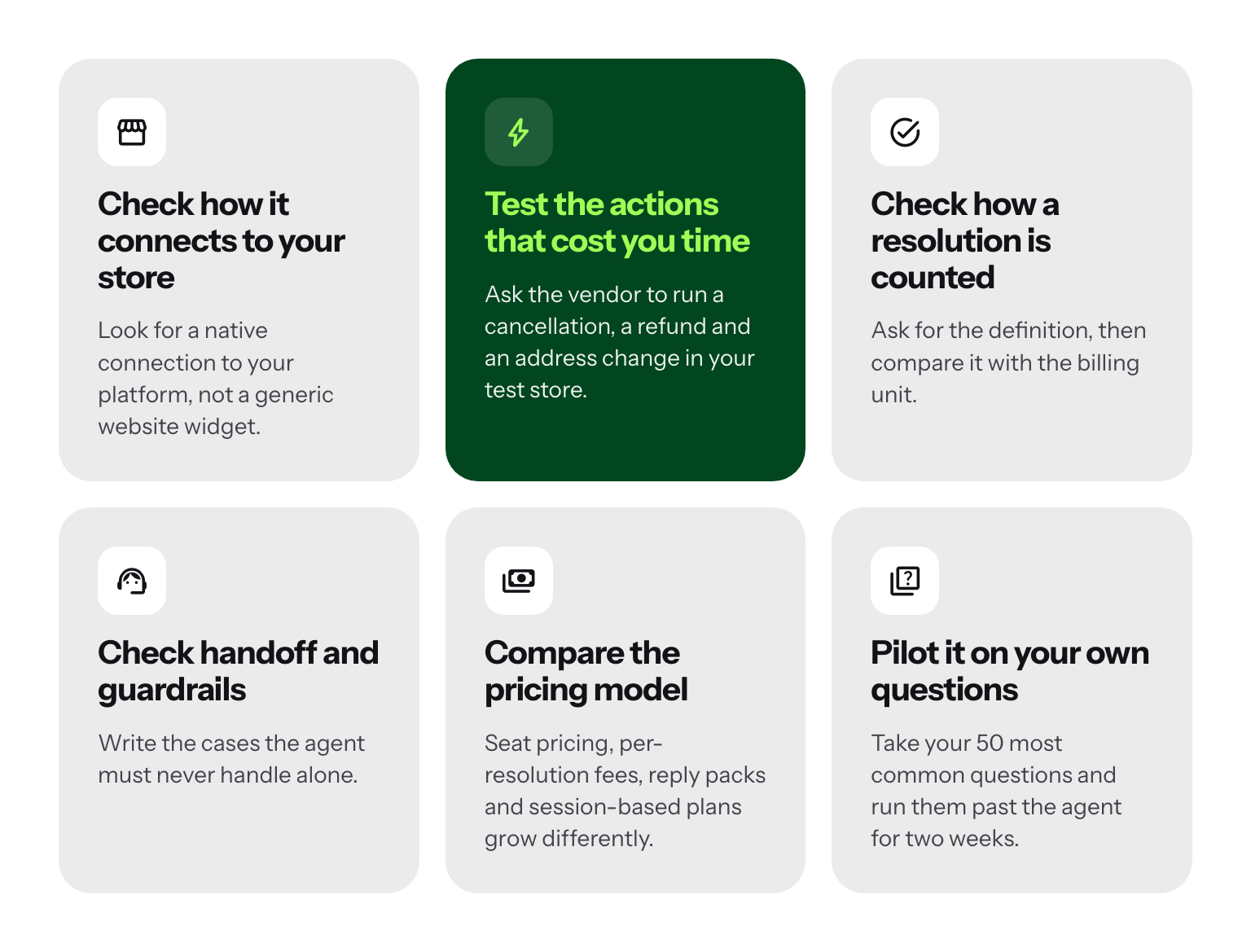
Buyers sort this decision by platform, order volume and channel. Run these checks before you book a demo.
Check how it connects to your store
Look for a native connection to your platform, not a generic website widget. The agent should read live orders, products and stock, so "where is my order?" gets a real answer instead of a link to your tracking page.
Test the actions that cost you time
Ask the vendor to run a cancellation, a refund and an address change in your test store. An agent that only answers questions deflects tickets; one that acts closes them. Check which actions work without a developer.
Check how a resolution is counted
Vendors count a resolution differently: a confirmed fix, no further reply, or no human touch within a set window. Ask for the definition, then compare it with the billing unit, because that is what you pay for.
Check handoff and guardrails
Write the cases the agent must never handle alone, such as chargebacks, large refunds and angry customers. Test that the chat reaches your team with the full history attached.
Compare the pricing model
Seat pricing, per-resolution fees, reply packs and session-based plans grow differently. At 1,000 AI resolutions a month, $0.99 each is about $990 and $1.50 each is $1,500, before seats. Model your own order-status volume, and read what counts as one resolution before you sign. Our chatbot pricing guide shows how the models compare.
Pilot it on your own questions
Take your 50 most common questions, such as shipping times, returns and sizing, and run them past the agent for two weeks. Count what it resolved without a person and what it got wrong. Your own test beats any vendor's number.
Which AI agent should you pick?
- Small or mid-size store on Shopify: Tidio, with Lyro on a paid plan. Cart preview, order history and order actions sit next to the chat, and Lyro answers from your help center. Gorgias is the specialist alternative if you only need a ticket desk.
- Shopify brand with thousands of tickets a month: Gorgias, if you want a help desk built around orders and accept per-interaction fees.
- You mainly want the AI to sell: Zipchat or Rep AI, then add a human inbox for support.
- Selling over WhatsApp: Skara AI agents, or Tidio if you also want live chat and email in the same inbox.
- Digital-first brand that wants the agent first: Intercom Fin, which also runs on your current help desk.
- Already on Zendesk, Freshdesk or HubSpot: the vendor's own AI agent; you keep your tickets and workflows.
- Enterprise retailer with a project team: Ada, after a pilot on your own questions.
Add Lyro to your Shopify store and compare Tidio plans
For more options, see our guides to the best AI agents for customer service, AI shopping assistants and e-commerce chatbots.
Frequently asked questions
It depends on your platform and size. Tidio's Lyro suits online stores that want AI and a shared inbox, Gorgias suits Shopify brands with high ticket volume, and Zipchat and Rep AI suit stores that want an AI sales assistant. Zendesk, Freshdesk and HubSpot agents suit teams already on those platforms.
Tidio and Gorgias both connect natively to Shopify and can act on orders. Tidio adds live chat, email and Lyro in one inbox, while Gorgias is a ticket desk with a per-interaction AI. Rep AI and Zipchat focus on selling.
Prices run from about $0.50 to $2.00 per resolution, plus a platform plan or seats. With Tidio, Lyro starts on the Starter plan at $33 a month billed annually, for 50 conversations in total. Zipchat starts at $64 a month for 750 replies, and Ada is quoted after a demo.
Yes, if it connects to your store and you allow the action. Tidio, Gorgias, Zipchat and Rep AI list refunds, cancellations or order changes. Set a rule for large refunds so the agent hands those to a person.
A chatbot follows scripted flows and keyword rules. An AI agent reads your catalog and policies, understands free-form questions and can take actions such as a refund. Read our comparison of chatbots and conversational AI.
No. Agents resolve repeat questions and routine actions, while people handle complex, emotional and high-value cases. Plan a handoff, and keep humans on the edge cases.
Use live chat to support your customers in real-time