Key takeaways:
- A chatbot is a product. Conversational AI is a technology. The chatbot is the interface your customer types into. Conversational AI is what interprets what they typed.
- Rule-based chatbots follow a script. They match keywords or walk a decision tree, and they break the moment a customer phrases something off-script.
- Conversational AI reads intent. NLP, NLU, and machine learning let it answer questions nobody wrote a rule for.
- Generative AI is not a fourth category. It’s the technology powering most conversational AI released since 2023, not a sibling of it.
- An AI agent goes one step past answering. It acts: checks an order, issues a refund, updates a record.
- The cost models differ more than the features. Rule-based bots are usually flat-fee or free. Conversational AI is priced per conversation, per resolution, or per usage.
A chatbot is software that holds a conversation with a customer. Conversational AI is the technology that lets software understand that conversation and answer it. One is the product you install, the other is the capability inside it. Every conversational AI chatbot is a chatbot, and plenty of chatbots have no conversational AI in them at all.
This guide sorts out the four terms buyers mix up in 2026: rule-based chatbot, AI chatbot, conversational AI, and AI agent. You get a comparison table you can take into a vendor call, named deployments on both sides, and a way to tell which one your support queue needs.
Use live chat to support your customers in real-time
Chatbot vs. conversational AI: comparison table
A chatbot is the product your customer talks to. Conversational AI is the technology that lets it understand them. Every chatbot either has conversational AI inside it or runs on a script, and that’s the whole distinction.
Quick test: if it can only answer what someone wrote in advance, it’s the script version.
The table below covers all nine differences that affect a buying decision. Pay attention to the last row. A rule-based chatbot fails by looping, so the customer rephrases and gets the same reply. Conversational AI fails by answering confidently out of a thin knowledge base.
| Chatbot | Conversational AI | |
|---|---|---|
| Underlying technology | Decision trees, keyword matching, preset flows. Some chatbots add a layer of NLP. | Natural language processing, natural language understanding, machine learning, and large language models. |
| Handles unscripted input | No. Anything off-script hits a fallback message. | Yes. Reads the intent behind phrasing it has never seen before. |
| Needs training data | Rule-based: none. AI chatbots: labeled intents and example phrases. | Yes. Learns from your help center, past tickets, or product catalog. |
| Setup effort | Minutes to a few hours in a visual builder. | Hours to weeks, depending on how clean the knowledge source is. |
| Cost model | Flat monthly fee, often with a free tier. | Per conversation, per resolution, or per unit of usage. |
| Escalation behavior | Hands off on set keywords or after a dead end. | Detects low confidence, frustration, or sensitive topics, then routes to a human. |
| Personalization | Same script for every visitor. | Adapts to conversation history, account data, and language. |
| Best-fit use case | High-volume, predictable requests with one correct answer. | Open-ended questions, multi-step problems, multilingual queues. |
| Typical failure mode | Loops. The customer rephrases and gets the same reply. | Confident wrong answers where the knowledge base has gaps. |
Two rows do most of the work in a vendor call. Ask how the tool behaves on input nobody built it for, and ask what happens when it doesn’t know. The rest is negotiable.
What is a chatbot?
A chatbot is a software program that simulates conversation with a person over text or voice. It can be rule-based, walking a fixed script, or AI-powered, interpreting what the customer means. The term describes the interface and the product category, not the intelligence behind it. A chatbot can be a form with a chat skin on it.
Two types of chatbots are in practical use.
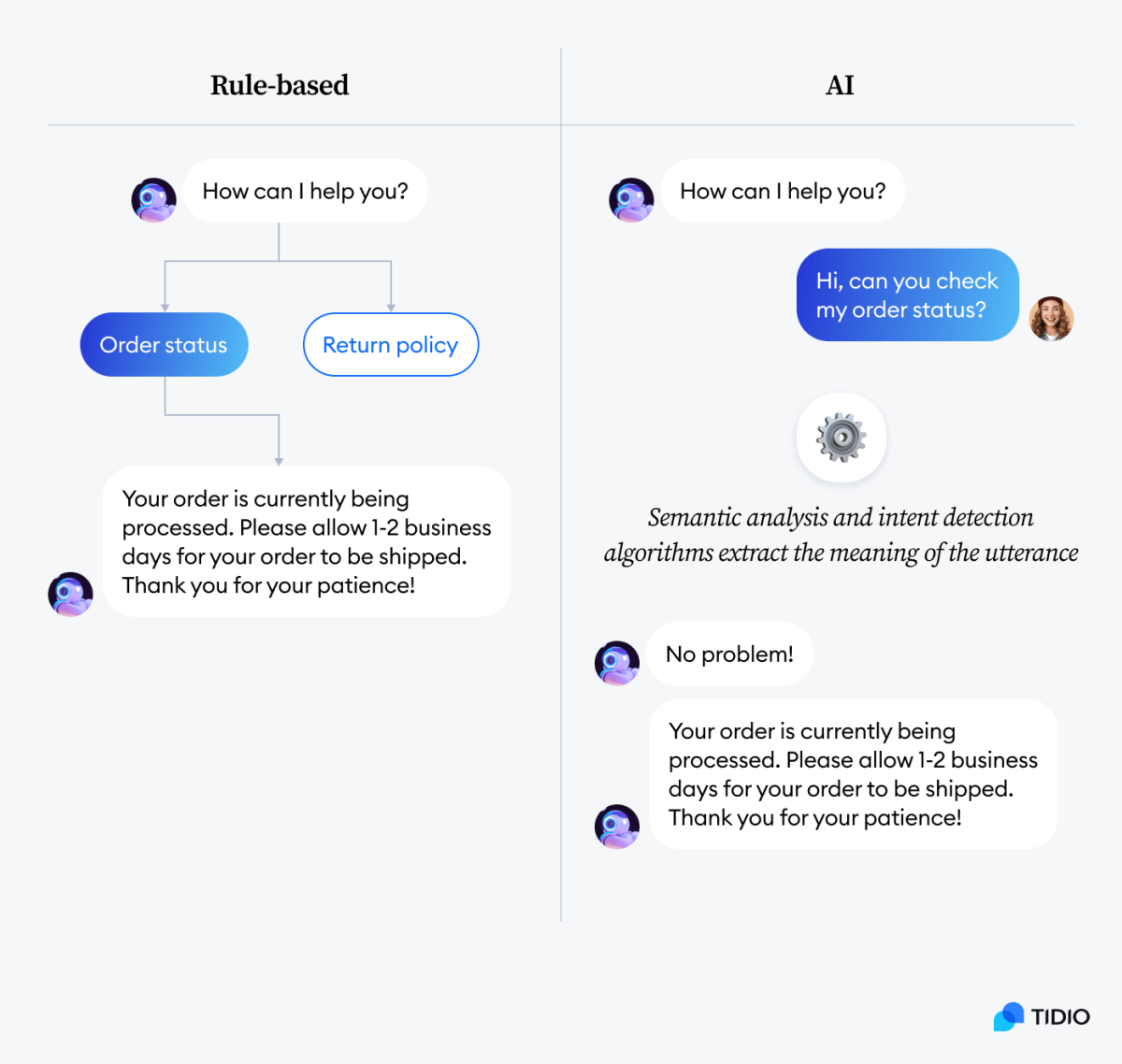
Rule-based chatbots walk a decision tree. Keyword triggers, buttons, branching flows, one answer per branch. They never surprise you, which is the whole point. A pizza chain that needs “track my order,” “store hours,” and “start a new order” gains nothing from a language model.
AI chatbots add natural language understanding on top. They map what the customer wrote to a trained intent, then return that intent’s answer. “Where’s my package” and “has my thing shipped yet” land on the same intent. Ask something outside the trained set and you’re back to a fallback message.
Rule-based is the right call more often than vendors admit. Pick it when the request list is short and stable, when the answer is a link or a form, or when a wrong answer carries a compliance cost.
Read more: Building your first one is a separate job from choosing a category. Start with our guide on how to create a chatbot for a website.
What is conversational AI?
Conversational AI is the set of technologies that lets a computer understand human language and reply in it. It combines natural language processing, natural language understanding, machine learning, and, since 2023, large language models. You don’t buy conversational AI as a product. You buy a product that has it inside.
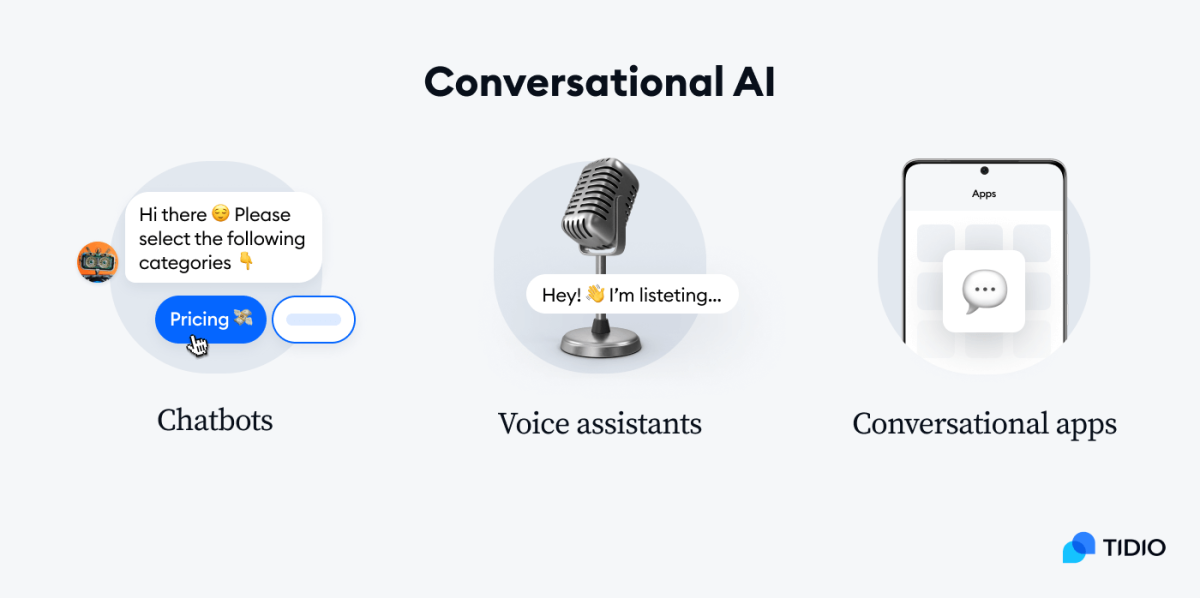
Three parts do the work:
- NLP turns a raw message into something a machine can parse.
- NLU works out what the person wants, regardless of phrasing. This is the layer NLP chatbots are named for.
- Machine learning sharpens that mapping as more conversations come in.
The same technology turns up in different conversational interfaces: a website widget, a phone line, an in-app search box. What changes is the input, not the understanding layer.
The money shows how fast this moved from novelty to infrastructure. Grand View Research put the conversational AI market at $17.7 billion in 2026, on the way to $78.9 billion by 2033 at a 23.8% CAGR[1]. It names AI-powered customer support as one of three main growth drivers, alongside falling development costs and omnichannel deployment.
You might be interested:
- Customer service chatbots: how they work and where they help
- How to train an AI chatbot on your own content
- Conversational AI platforms compared
Boost customer satisfaction with a professional AI agent
Where generative AI, LLMs, and AI agents fit
Generative AI is not a fourth category sitting next to chatbots and conversational AI. It’s the technology most conversational AI has run on since 2023. Large language models are the specific kind of generative AI built for text. An AI agent is conversational AI with permission to act in your systems instead of only answering.
| Term | What it is | Where it stops |
|---|---|---|
| Rule-based chatbot | Scripted flows, keyword triggers, decision trees | Anything the script doesn’t cover |
| AI chatbot | A chatbot with intent recognition on top | Questions outside its trained intents |
| Conversational AI | The technology layer: NLP, NLU, ML, and LLMs | Understanding and replying. It doesn’t act |
| AI agent | Conversational AI plus tools and permissions | Tasks you haven’t authorized it to perform |
Read it as a ladder, not four options. Each rung contains the one below it. An AI agent is conversational AI, and an AI chatbot is still a chatbot.
The practical test for an agent is whether it can change something. A tool that tells the customer how to return an item is conversational AI. A tool that starts the return, emails the label, and updates the ticket is an agent.
Conversational AI vs. virtual assistants and voice AI
A virtual assistant is a conversational AI application built around one person’s tasks rather than one company’s customers. Siri, Alexa, and Google Assistant go wide across calendars, music, calls, and search. A customer service AI agent goes deep on one domain instead, meaning your catalog and your order data. Breadth against depth, same underlying technology.
Voice AI is conversational AI with speech recognition in front and speech synthesis behind. Same understanding layer, different input. Domino’s runs AI voice ordering across phone and drive-thru lines, and in 2025 began giving those assistants region-specific accents through Rime Labs and ConverseNow. Voice gets its own label because a misheard word in text is visible on screen and a misheard word on a call is not.
Which tools are chatbots and which are conversational AI?
Most of the confusion here is vendor-made. Tools that work in completely different ways all get marketed as “AI chatbots.” The table sorts named 2026 products onto the four rungs.
| Category | How it works | Named tools (2026) |
|---|---|---|
| Rule-based chatbot | Scripted flows, buttons, keyword triggers. No language model. | ManyChat, Chatfuel, Landbot, Tidio Flows |
| Intent-based AI chatbot | Trained intents plus NLU. Usually built and maintained by developers. | Google Dialogflow, IBM watsonx Assistant, Amazon Lex, Rasa |
| Conversational AI support agent | LLM-based. Answers from your help center and product data. | Lyro, Intercom Fin, Zendesk AI agents, Ada, Forethought |
| General-purpose conversational AI | LLM-based, trained on public data. Answers about the world, not your business. | ChatGPT, Claude, Gemini |
| AI agent | Conversational AI plus tools and permissions to act in connected systems. | Lyro with Actions, Sierra, Decagon |
The billing unit places a tool faster than its docs do. Rule-based builders charge a flat monthly fee. Intent-based platforms charge per API request. Support agents charge per conversation or per resolution, which are not the same unit: Intercom Fin bills $0.99 per resolution, Lyro bills from $0.50 per conversation with unlimited replies inside it. Which works out cheaper depends on your resolution rate, so model both against your own volume.
Read more: If you’re shortlisting rather than defining, compare tools feature by feature in our roundups of the best AI chatbots and conversational AI platforms.
Real-world examples of chatbots and conversational AI
Three live deployments show where the line falls. The first answers from a fixed question list. The second interprets whatever a customer types. The third acts on store data instead of describing it.
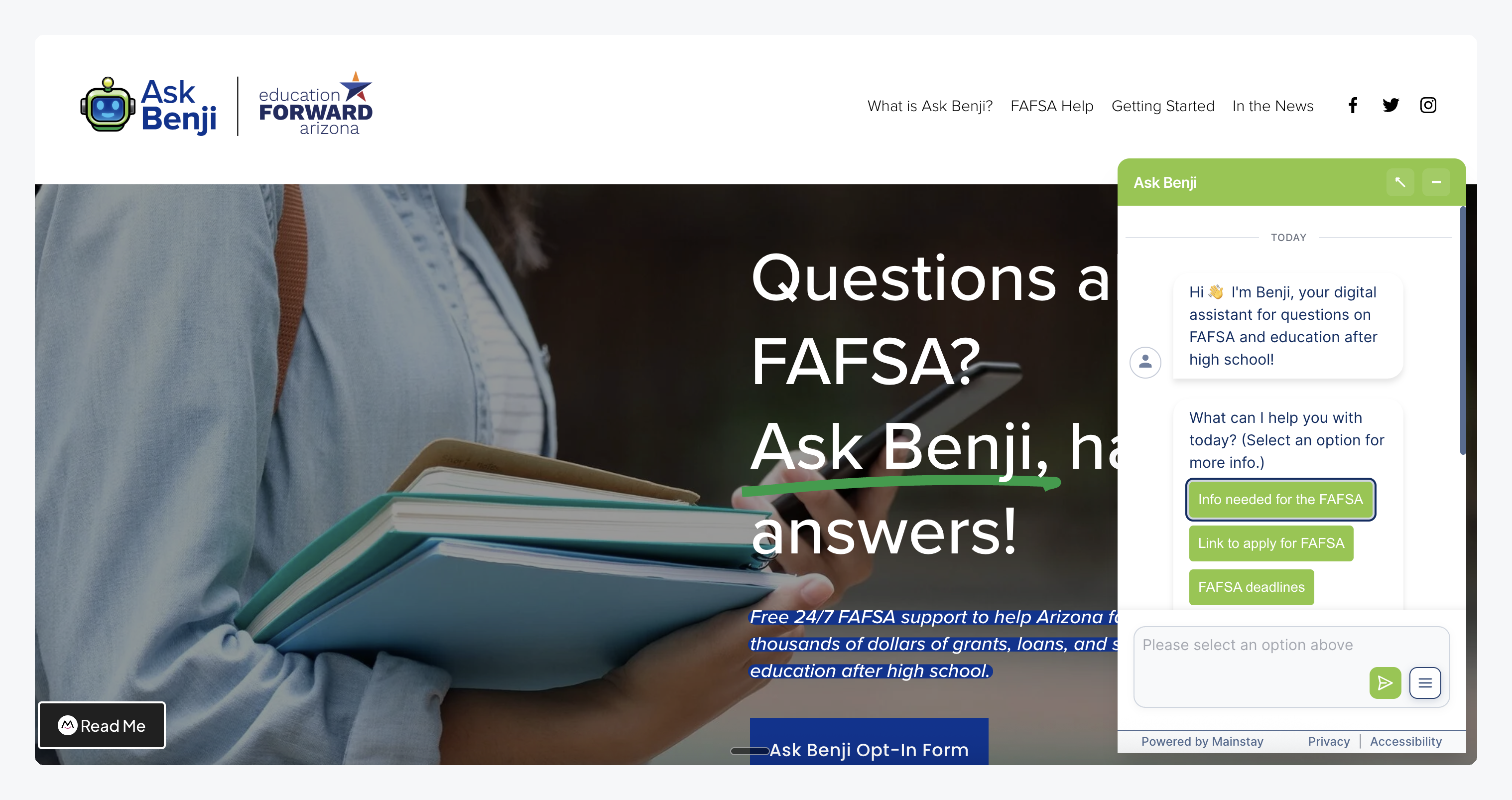
Ask Benji (chatbot). Education Forward Arizona and Arizona State University run a text-message bot answering roughly 1,000 set questions about FAFSA and financial aid. It helped nearly 40,000 Arizona high school seniors in one application cycle. Fixed answer set, nothing generated. It works because the question list barely changes year to year.
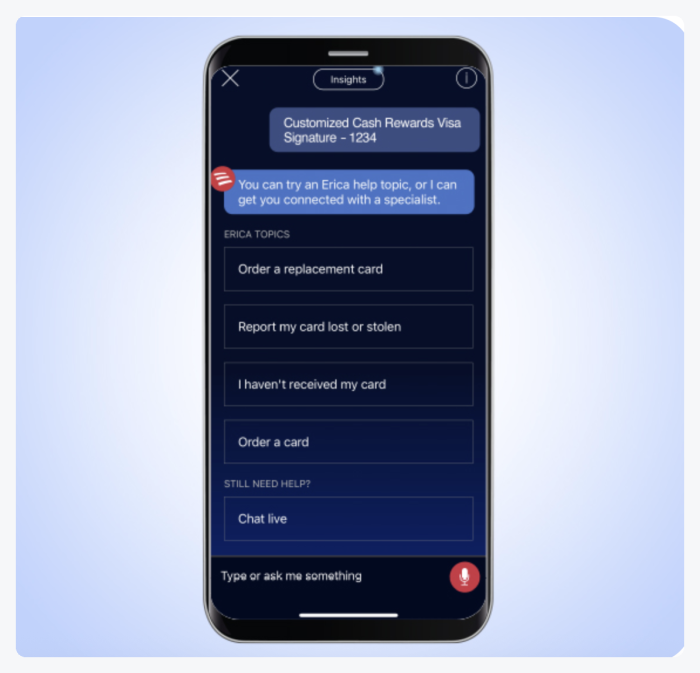
Bank of America’s Erica (conversational AI). Erica handled nearly 700 million interactions from 20.6 million users during 2025 and has passed 3.2 billion interactions since launching in 2018[2]. On its Q2 2026 earnings call, CFO Alastair Borthwick put active Erica users at more than 24 million[3]. Erica predates the LLM era by five years. Conversational AI is an approach, not a product category that appeared in 2023.
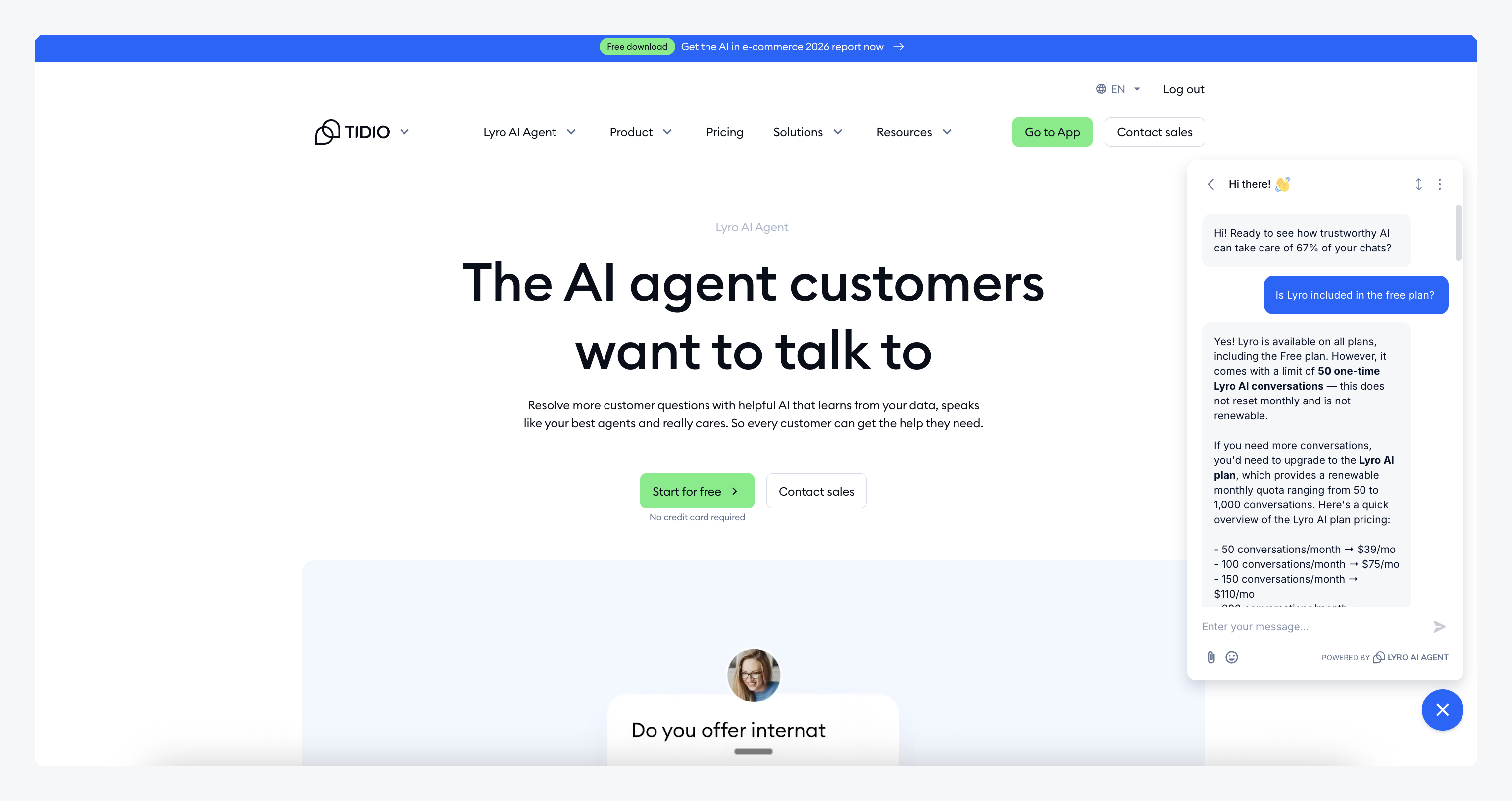
Lyro (AI agent). Lyro reads your help center and product data, replies in the customer’s language, and resolves 67% of incoming questions on average across Tidio accounts. It also acts: checking order status, qualifying leads, recommending products.
Read more: Browse more conversational AI examples across industries.
When should you use a chatbot vs. conversational AI?
Use a rule-based chatbot when the request list is short, stable, and has one correct answer per request.
Use conversational AI when customers phrase things unpredictably, ask multi-step questions, or write in several languages.
Four questions settle it:
- How predictable is the queue? Ten repeating questions, or a long tail nobody can list?
- What does a wrong answer cost? A regulated, medical, or financial answer belongs in scripted copy someone reviewed. A shipping question does not.
- Who maintains it? A flow builder needs someone editing flows every time a policy changes. Conversational AI needs someone keeping the help center accurate. Pick the maintenance you’ll actually do.
- How does the bill scale? Flat fees reward volume. Per-conversation pricing tracks it. Model your busiest month, not your average one.
Chatbot vs. conversational AI for ecommerce
Ecommerce queues split cleanly, which is why most stores end up running both. Order status and return policy questions are finite and repetitive, so flows handle them at a flat cost. Pre-purchase questions are the opposite: shoppers ask about fit, materials, compatibility, and substitutions in wording nobody scripts in advance, and a fallback message there costs you the sale rather than a support ticket.
Flows handle post-purchase, conversational AI handles pre-purchase. An agent wired to your catalog can also recommend products mid-conversation, turning a support reply into a second shot at the basket.
FAQ
Yes. ChatGPT is a conversational AI application built on a large language model. It’s general-purpose, so it answers about the world rather than your business. A customer service AI agent uses the same class of technology, restricted to your content.
Some are, some aren’t. A rule-based chatbot running keyword triggers and decision trees involves no AI. An AI chatbot uses natural language understanding to read intent. Both ship under the word “chatbot,” which is why the label alone tells you nothing about what you’re buying.
Only the ones built on generative models. Generative AI produces new text rather than retrieving a stored reply, so a bot that writes an answer from your help center is generative. A bot that returns pre-written responses attached to intents is not, even when it reads intent accurately.
No. Conversational AI describes the goal, holding a natural conversation. Generative AI is one method of getting there. Most conversational AI shipped since 2023 runs on generative models, but older intent-classification systems still qualify.
A chatbot replies. An AI agent replies and acts. Give an agent access to your order system and it can look up a shipment, start a return, or update a ticket without a human. A chatbot in the same situation tells the customer where to click.
No. A virtual assistant like Siri or Alexa is one application of conversational AI, built around a person’s general tasks. Conversational AI is the underlying technology, and it also powers customer service agents, intelligent virtual assistants, and in-app search.
Pricing runs per conversation, per resolution, or per unit of usage, so volume is the main variable. Lyro starts at $0.50 per conversation with unlimited replies inside each one. Enterprise platforms with custom model work reach five and six figures a year. Rule-based chatbots are often free. See our breakdown of chatbot pricing.
A conversational AI platform is software that gives you the understanding layer plus the tools around it: channel connections, a knowledge base, handoff rules, analytics, and integrations. You supply the content and the policies. The platform handles intent recognition, response generation, and routing.