
Key takeaways
- Entry plans run $0 to $45 a month. Five of the 10 platforms have a permanent free plan: Tidio, Freshchat, Crisp, ManyChat and Zoho SalesIQ.
- AI is billed on top, per conversation. $0.58 to $0.65 per Lyro conversation at Tidio, $0.99 per Fin outcome at Intercom, $0.85 to $1.00 per extra automated interaction at Gorgias, and $1.50 to $2.00 per automated resolution at Zendesk.
- Per-seat pricing grows with headcount. Eight agents on Zendesk Suite Professional cost $920 a month before AI; 40 Intercom Expert seats cost $5,280.
- Building costs $5,000 to $250,000 upfront, plus 15% to 20% of the build cost every year.
- Need predictable pricing for a small team? See how Tidio compares.
The price on a chatbot’s pricing page is rarely what you end up paying. One tool charges per agent, the next per conversation, a third per ticket, and almost all of them now bill AI separately, per answer. A plan that looks cheap at signup can double once your AI agent starts doing its job.
We analyzed the pricing of 10 platforms, and converted every plan into what a solo founder, a two-person team, an eight-agent team and a 40-seat operation would pay. You’ll also find what building your own chatbot costs, and where buying stops being cheaper.
Chatbot pricing comparison: 10 platforms at a glance
The billing unit in column two usually decides your bill more than the headline price does.
| Tool | Billing unit | Free plan | Entry paid plan | How AI is billed | G2 rating |
|---|---|---|---|---|---|
| Tidio | Conversations (10 seats included) | Yes, 50 conversations | $24.17/mo (Starter) | Lyro add-on from $32.50/mo for 50 AI conversations | 4.6 (1,962) |
| Zendesk | Per agent | No | $19/agent (Support Team) | 5 to 10 automated resolutions per agent included, then $1.50 to $2.00 each | 4.3 (7,082) |
| Intercom | Per seat | No | $29/seat (Essential) | $0.99 per Fin outcome | 4.5 (3,913) |
| Freshchat | Per agent | Yes, up to 10 agents | $19/agent (Growth) | 500 Freddy AI sessions included, then $49 per 100 | 4.4 (502) |
| LiveChat | Per seat | No | $19/seat (Starter) | Separate Text AI Agent plan from $19/user | 4.5 (813) |
| Gorgias | Tickets | No | $40/mo (Starter, monthly billing) | AI Agent bundled in plan; extra interactions $0.85 to $1.00 | 4.6 (582) |
| Crisp | Per workspace | Yes, 2 seats | $45/mo (Mini) | AI credits included: $5, $25 or $75 by plan | 4.5 (204) |
| ManyChat | Active contacts | Yes, 25 contacts | $14/mo (Essential) | AI features on higher plans | 4.5 (165) |
| Chatfuel | Plan + AI credits | No | $18/mo (Business) | $20 or $100 in monthly AI credits | 4.4 (45) |
| Zoho SalesIQ | Per operator | Yes, 3 operators | $7/operator (Basic) | Bot sessions included by plan; 5,000 more for $8 | 4.4 (256) |
How we compared chatbot prices
For each platform we recorded six things:
- Billing unit. Seats, conversations, tickets, contacts or a flat workspace fee.
- Entry price, on annual and monthly billing where both are published.
- How AI is charged, and what counts as a billable AI event.
- Seats included, because a “cheap” plan with one seat isn’t cheap for three people.
- Free plan limits, and whether the free plan is permanent or a trial.
- What triggers the next tier: a seat count, a conversation quota, a ticket limit.
Every price comes from the vendor’s own pricing page, and ratings come from G2. Where a vendor publishes no number, we say “contact sales” rather than estimating.
What we didn’t do: we didn’t run paid trials of every plan or negotiate quotes, so discounts for annual contracts or startups aren’t reflected. Usage-based totals depend on your volume, so treat them as starting points.
How do chatbot pricing models work?
Chatbot pricing models come in five shapes, and most platforms combine two of them: a base unit for the human side, and a usage meter for the AI.
| Pricing model | You pay for | Who uses it | Gets expensive when |
|---|---|---|---|
| Per seat or agent | Each person with a login | Zendesk, Intercom, Freshchat, LiveChat, Zoho SalesIQ | You hire faster than chat volume grows |
| Per conversation | Each billable conversation | Tidio | Chat volume grows faster than your team |
| Per ticket | Each ticket from any channel | Gorgias | Seasonal spikes and new channels add tickets |
| Per contact | Each active contact in a period | ManyChat | Your audience grows, even if most never buy |
| Per AI outcome | Each conversation the AI resolves | Intercom Fin, Zendesk AI agents, Gorgias AI Agent, Tidio Premium | Your AI agent performs well |
That last row is the one to model carefully. An outcome or automated resolution is a conversation the AI closes without a human. It’s a fair unit, because you pay for work done. It also means the bill grows fastest exactly when your AI performs well.
If you’re working out what a chatbot saves you, not only what it costs, the unit matters even more: per-seat pricing penalizes hiring, per-outcome pricing penalizes nothing but success.
What does each chatbot platform cost in 2026?
Each block below follows the same order: who it suits, how it bills, the plan prices, what to watch, and its G2 rating.
1. Tidio: best for ecommerce and SMB teams that want AI to handle repetitive support
Best for: ecommerce stores (especially on Shopify), small and mid-sized businesses, and teams with a high support volume that want AI to take over repetitive questions.
Tidio fits these teams best:
- Ecommerce businesses, especially Shopify stores. Native Shopify features let agents preview a shopper’s cart and see their order history without leaving the chat.
- Small and medium-sized businesses that want to streamline customer support without a large team, using automation and AI.
- Businesses with a high support volume that want to automate repetitive inquiries and cut ticket load. Tidio says Lyro can resolve up to 67% of support requests automatically.
- Companies across industries, from retail and SaaS to services, that talk to website visitors and want faster responses and higher conversion rates.
- Teams that manage several channels and want live chat, email, Messenger, Instagram and WhatsApp in one place.
Tidio combines live chat, a helpdesk, Flows automation and the Lyro AI agent in one inbox, with Instagram, Messenger and WhatsApp alongside website chat. Its support plans bill by conversation, not by seat, and the Free, Starter and Growth plans each include 10 seats. Adding a second or tenth operator costs nothing.
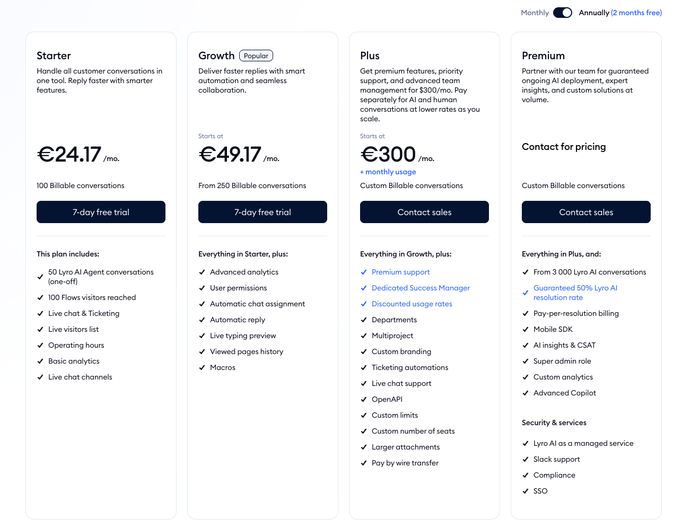
| Plan | Annual billing | Monthly billing | What you get |
|---|---|---|---|
| Free | $0 | $0 | 50 billable conversations, 10 seats |
| Starter | $24.17/mo | $29/mo | 100 conversations, 10 seats |
| Growth | From $49.17/mo | From $59/mo | From 250 conversations; $149.17/mo at 1,000 |
| Plus | From $300/mo + monthly usage | Custom quotas and seats | |
| Premium | Contact sales | From 3,000 Lyro conversations, guaranteed 50% Lyro resolution rate, pay-per-resolution billing |
AI and automation are separate quotas. Every account gets 50 Lyro conversations free, once. After that, the Lyro plan runs from 50 to 1,000 AI conversations a month:
| Lyro AI conversations a month | Monthly billing | Annual billing (2 months free) | Per conversation, annual |
|---|---|---|---|
| 50 | $39 | $32.50 | $0.65 |
| 200 | $140 | $116.67 | $0.58 |
| 500 | $350 | $291.67 | $0.58 |
| 1,000 | $700 | $583.33 | $0.58 |
A Lyro conversation is any conversation where Lyro replies at least once, however many replies it takes. That’s a different unit from Intercom’s or Zendesk’s, which bill only resolved conversations. Above 1,000 a month you move to Plus, where AI conversations are priced on request. Flows starts at $24.17 a month on annual billing. Teams that already run another help desk can buy Lyro on its own without a support plan.
Pros
- No seat fees on Free, Starter or Growth, so hiring doesn’t change the bill.
- A permanent free plan with 10 seats and 50 conversations, enough to run a small store’s chat.
- One inbox for chat, email and social messages, with Shopify and WordPress installs.
Cons
- Support conversations, Lyro AI and Flows are priced separately. You only pay for what you use, but there are a few quotas to keep an eye on.
- Growing teams that outgrow Growth move up to Plus, which starts at $300 a month plus usage.
- Plus and Premium are tailored to each team’s usage, so larger deployments get a quote from Tidio’s sales team instead of a list price.
Rating: G2 4.6/5 from 1,962 reviews, observed September 25, 2026. Full plan details: Tidio pricing plans.
See Tidio's plans and what each one includes
2. Zendesk: best for multi-agent teams that need structured workflows
Best for: support teams of 10 or more with SLAs, routing rules and several channels.
Zendesk is a full support suite: email, chat, voice, social, a help center and detailed reporting. It’s the reference point most other platforms price against, and its AI pricing is now among the most transparent in this list.
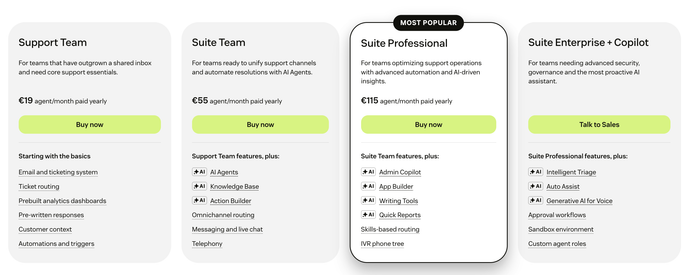
| Plan | Annual billing | Monthly billing | Automated resolutions included |
|---|---|---|---|
| Support Team | $19/agent | $25/agent | 5 per agent per month |
| Suite Team | $55/agent | $69/agent | 5 per agent per month |
| Suite Professional | $115/agent | $149/agent | 10 per agent per month |
| Suite Enterprise + Copilot | Contact sales | Contact sales |
AI agents are included on every plan and billed by automated resolution: a conversation the AI resolves without handing it to a person. Beyond the included allowance, committed resolutions cost $1.50 each and pay-as-you-go resolutions $2.00. Copilot, the assistant for human agents, is a separate $50 per agent per month on annual billing, available as an add-on from Suite Professional.
Pros
- Mature ticketing, routing and reporting.
- Published AI allowances, so you can model the bill.
Cons
- Seat costs compound quickly.
- The top tier no longer has a public price.
Watch for: eight agents on Suite Professional cost $920 a month before any AI overage or Copilot.
Rating: G2 4.3/5 from 7,082 reviews. Read more: our Zendesk review.
3. Intercom: best for SaaS teams that want the most capable AI agent
Best for: product-led SaaS companies with in-app messaging and a mature help center.
Intercom puts live chat, email, in-app messages and its Fin AI agent in one workspace. Fin is priced per outcome, and Intercom publishes exactly what counts as one, which few vendors do.
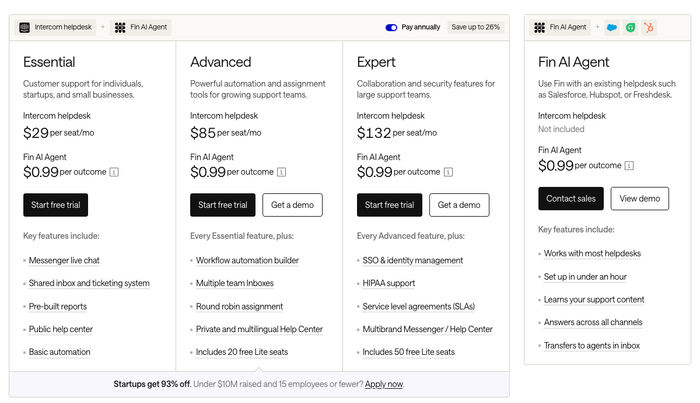
| Plan | Annual billing, per seat | 8 seats |
|---|---|---|
| Essential | $29 | $232/mo |
| Advanced | $85 | $680/mo |
| Expert | $132 | $1,056/mo ($5,280 at 40 seats) |
A Fin outcome costs $0.99 and is counted when a customer confirms the answer resolved their question, doesn’t ask for more help after Fin replies, or when Fin completes a workflow. It’s charged once per conversation. At 1,000 Fin outcomes a month, that’s $990 on top of seats. Copilot costs $29 per agent per month on annual billing ($35 monthly), with 10 free Copilot conversations per agent per month. Proactive Support Plus adds $99 a month for 500 messages.
Pros
- Strong AI agent with a clearly defined billing unit.
- In-app and outbound messaging in the same tool.
Cons
- You pay for seats and for AI, and the AI line grows as Fin gets better.
Rating: G2 4.5/5 from 3,913 reviews. Read more: our Intercom review.
4. Freshchat: best free plan for a whole team
Best for: small teams already using Freshdesk or Freshsales.
Freshchat is messaging-style live chat across web, mobile and social, with Freddy AI. Its free plan covers up to 10 agents, the most generous team allowance in this list.
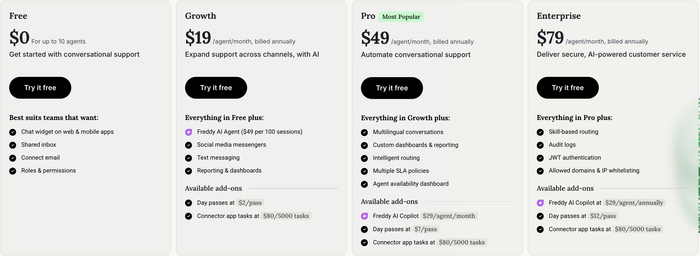
| Plan | Annual billing, per agent | 8 agents |
|---|---|---|
| Free | $0, up to 10 agents | $0 |
| Growth | $19 | $152/mo |
| Pro | $49 | $392/mo |
| Enterprise | $79 | $632/mo ($3,160 at 40 agents) |
Every paid plan includes the first 500 Freddy AI Agent sessions, and each extra 100 sessions costs $49. Freddy AI Agent is available from Growth up; Copilot for human agents costs $29 per agent from Pro.
Pros
- A real free plan for a team.
- Low per-agent entry price.
Cons
- AI sessions past 500 add up fast at $0.49 each.
- Best value only inside the Freshworks stack.
Rating: G2 4.4/5 from 502 reviews. Read more: our Freshchat review.
5. LiveChat: best for support that’s led by human agents
Best for: teams where people, not bots, handle most chats.
LiveChat is focused, well-made human chat: canned responses, message sneak peeks, chat ratings and a large app marketplace. Its maker renamed itself Text in 2023, and automation is now sold as a separate Text AI Agent plan rather than inside LiveChat.
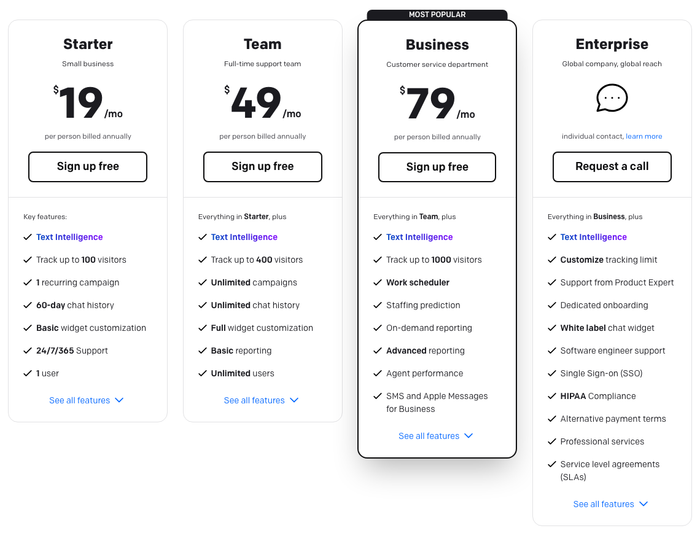
| Plan | Annual billing, per seat | Monthly billing, per seat |
|---|---|---|
| Starter | $19 | $25 |
| Team | $49 | $59 |
| Business | $79 | $89 |
| Enterprise | Contact sales | Contact sales |
The AI side, sold on chatbot.com and text.com, starts with Essential at $19 per user per month on annual billing ($25 monthly) with 10 AI resolutions. Growth costs $79 annual ($99 monthly) with 200. Extra packs of 50 AI resolutions cost $49.50.
Pros
- Polished agent experience.
- Clear seat pricing on both billing bases.
Cons
- Two subscriptions for chat plus AI.
- Eight Business seats cost $632 a month, and adding Essential AI for the same eight people takes it to $784.
Rating: G2 4.5/5 from 813 reviews.
Read more: our LiveChat review.
6. Gorgias: best for Shopify stores with order-heavy support
Best for: Shopify and BigCommerce stores where most questions are about orders.
Gorgias is a help desk built for ecommerce, with order editing, refunds and shipping updates inside the ticket. It prices by ticket, never by seat, and since this year its AI Agent is part of every plan price.
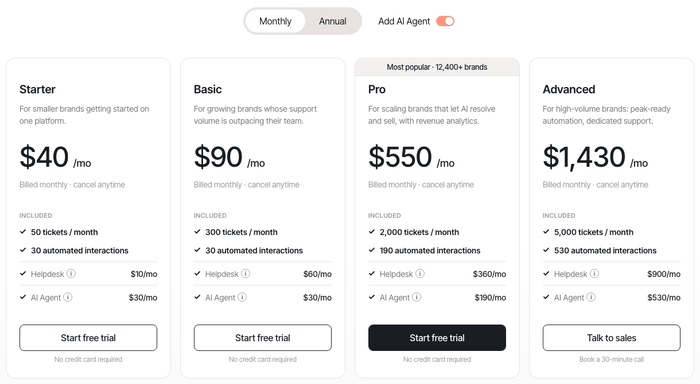
| Plan | Annual billing | Monthly billing | Tickets | Automated interactions |
|---|---|---|---|---|
| Starter | $40 | 50 | 30 | |
| Basic | $77 | $90 | 300 | 30 |
| Pro | $471 | $550 | 2,000 | 190 |
| Advanced | $1,227 | $1,430 | 5,000 | 530 |
Each plan price is two parts: help desk plus AI Agent. On monthly billing, the help desk share is $10 on Starter, $60 on Basic, $360 on Pro and $900 on Advanced. Those are the figures many older comparisons still quote as the whole price. Extra tickets cost $40 per 100 on Basic and $36 per 100 on Pro and Advanced. Extra automated interactions cost $0.90 on annual plans and $1.00 on monthly ones ($0.85 on Advanced).
Pros
- Deep store integration.
- No seat fees.
Cons
- Every channel message counts as a ticket, so adding Instagram DMs raises the bill even when sales don’t.
Watch for: Black Friday. A spike that triples ticket volume triggers overage on every ticket-based plan.
Rating: G2 4.6/5 from 582 reviews. Read more: our Gorgias review.
7. Crisp: best for many seats on a fixed budget
Best for: startups that want the whole team in the inbox for one flat fee.
Crisp is a shared inbox for chat, email, Instagram, WhatsApp and Messenger, priced per workspace instead of per seat.
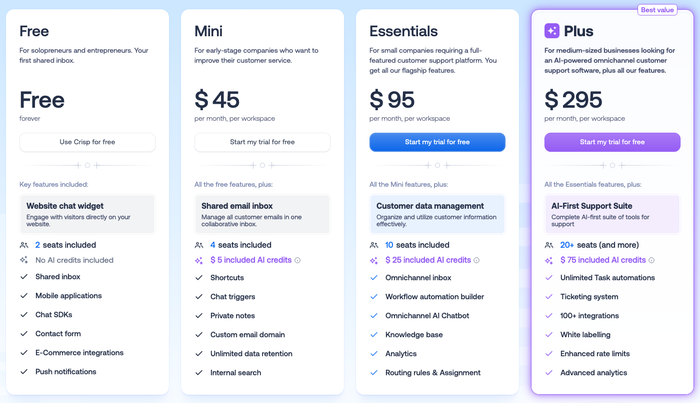
| Plan | Monthly price | Seats | AI credits per month |
|---|---|---|---|
| Free | $0 | 2 | None |
| Mini | $45 | 4 | $5 |
| Essentials | $95 | 10 | $25 |
| Plus | $295 | 20 | $75 |
AI runs on credits that come with each plan. Extra agents cost $10 a month each on any paid plan, so 40 people on Plus comes to about $495.
Pros
- Predictable flat pricing.
- Many seats for the money.
Cons
- AI capacity is tied to a dollar credit, so heavy automation means topping up or moving up a plan.
Rating: G2 4.5/5 from 204 reviews. Read more: our Crisp review.
8. ManyChat: best for Instagram and social DM funnels
Best for: creators and social-first brands running lead capture and broadcasts in DMs.
ManyChat automates Instagram, TikTok, WhatsApp, Messenger, Telegram, SMS and email. It’s built for marketing funnels, not support ticketing, and bills by active contacts: people you interact with in a billing period.
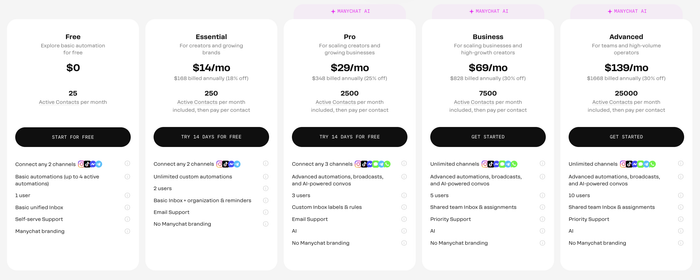
| Plan | Annual billing | Active contacts |
|---|---|---|
| Free | $0 | 25 |
| Essential | $14/mo ($168/yr) | 250 |
| Pro | $29/mo ($348/yr) | 2,500 |
| Business | $69/mo ($828/yr) | 7,500 |
| Advanced | $139/mo ($1,668/yr) | 25,000 |
The free plan now covers 25 active contacts, down from the 1,000 our previous edition listed. That makes it a way to try the builder rather than a tier you can run on. WhatsApp messages also carry Meta’s own per-message fees on top of any platform plan.
Pros
- The lowest cost per contact for social automation.
- Wide channel coverage.
Cons
- No human support desk.
- Contact counts grow with your audience, not your revenue.
Rating: G2 4.5/5 from 165 reviews. Read more: our ManyChat review.
9. Chatfuel: best for agencies running DM automation for clients
Best for: marketers and agencies managing Instagram, Messenger and WhatsApp bots.
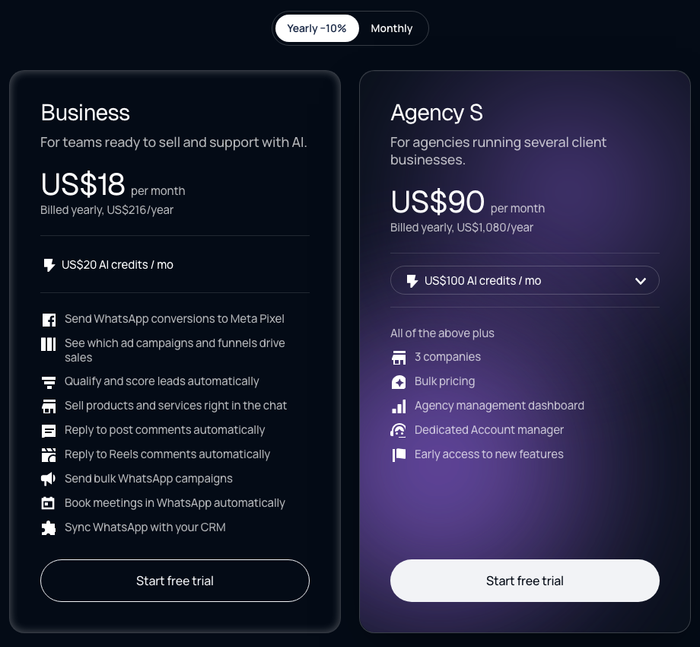
Chatfuel has replaced its old conversation-volume tiers with two plans that include monthly AI credits.
| Plan | Annual billing | AI credits per month |
|---|---|---|
| Business | $18/mo ($216/yr) | $20 |
| Agency S | $90/mo ($1,080/yr), 3 companies | $100 |
Pros
- Simple two-plan pricing.
- AI credits included.
Cons
- No human agent ticketing, so support teams pair it with another tool.
Rating: G2 4.4/5 from 45 reviews. Read more: our Chatfuel review.
10. Zoho SalesIQ: best low-cost option for Zoho users
Best for: teams already on Zoho CRM or Zoho Desk.
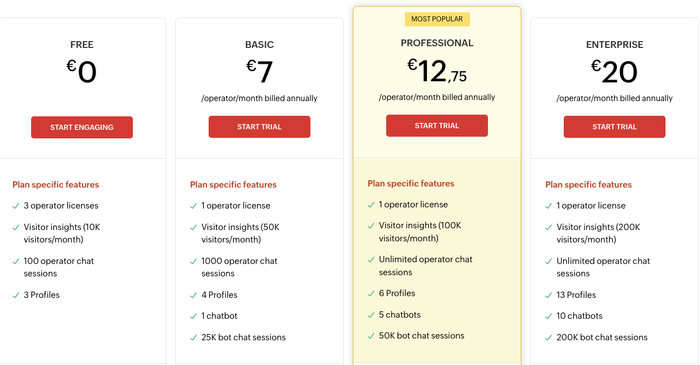
Zoho SalesIQ combines live chat, visitor tracking and bots, with the lowest per-operator price in this list.
| Plan | Annual billing, per operator | Monthly billing, per operator |
|---|---|---|
| Free | $0, 3 operators, 100 chat sessions | $0 |
| Basic | $7 | $10 |
| Professional | $12.75 | $17 |
| Enterprise | $20 | $25 |
Add-ons are priced separately: an extra brand costs $16 a month, an extra chatbot $8, 5,000 more bot sessions $8, and visitor tracking starts at $90 per 100,000 visitors. Forty operators on Enterprise cost $800 a month.
Pros
- Lowest entry price.
- Linear, easy-to-predict costs.
Cons
- The add-on list grows quickly for multi-brand setups.
Rating: G2 4.4/5 from 256 reviews.
How much does it cost to build a chatbot?
A custom chatbot typically costs $5,000 to $15,000 for a scripted bot, $30,000 to $120,000 for an AI chatbot that answers from your own content, and $80,000 to $250,000 for an enterprise AI agent that takes actions in your systems.[1][2][3][4]
| Build type | Typical cost (median range) | Widest range quoted |
|---|---|---|
| Scripted, rule-based bot | $5,000 to $15,000 | $2,000 to $80,000 |
| AI chatbot on your own content | $30,000 to $120,000 | $20,000 to $250,000+ |
| Enterprise AI agent | $80,000 to $250,000 | $50,000 to $500,000+ |
The build is only the first bill. Maintenance typically runs 15% to 20% of the build cost a year[4]. total running costs come to $1,000 to $10,000 a month[3], and AI model fees alone run $200 to $1,500 a month for 10,000 conversations[1]. Who builds it moves the price most: engineer rates range from $35 to $40[1] an hour to $140 to $260 an hour for senior US LLM engineers[2].
That’s why buying is cheaper for most support teams. On Tidio’s build-vs-buy model, a typical $90,000 build costs about $4,900 a month before it answers a single question: the build spread over three years, 15% a year in maintenance, about $300 for hosting and about $1,000 of engineer time. Against the platform AI prices above ($0.58 to $2.00 per AI conversation), it only pays off at roughly 2,600 to 10,000 AI conversations a month, and it still needs a live chat or help desk for handoff to a person. Build when the chatbot is your product or compliance rules out third-party tools. Buy when it’s your support channel, and if you want to try one first, see how to create a chatbot for your website.
How much does a chatbot cost for an ecommerce store?
An online store handling 1,000 conversations a month with two people on support pays $110 to $360 a month in platform fees. Let AI handle half of those conversations and the total rises to about $440 to $845, because the AI line is now the bigger one. Order status, returns and shipping questions make up most of that volume, and they’re the easiest to automate, so the AI price matters more than the seat price.
| Tool, 2 people, 1,000 conversations, 500 handled by AI | Platform, monthly | AI, monthly | Total, monthly |
|---|---|---|---|
| Tidio Growth + Lyro | $149.17 | $291.67 (500 Lyro conversations) | $440.84 |
| Intercom Advanced | $170 (2 seats at $85) | up to $495 (500 Fin outcomes at $0.99) | up to $665 |
| Gorgias Basic | $357 ($77 + 700 extra tickets at $40 per 100) | $423 (470 interactions past the 30 included, at $0.90) | $780 |
| Zendesk Suite Team | $110 (2 agents at $55) | up to $735 (490 resolutions past the 10 included, at $1.50) | up to $845 |
What hidden costs raise a chatbot bill?
The subscription is the floor, not the total. Five costs move the real number, and the first two cause most surprise invoices:
- AI usage. Almost every platform bills AI per conversation. At $0.99 per outcome, 1,000 AI-resolved conversations add $990 a month, whatever your seat count.
- Overages. Ticket, contact and conversation quotas all have overage prices. A seasonal spike can cost more than a month’s subscription.
- Seat creep. Going from two agents to eight multiplies a per-seat bill by four. Conversation-based plans don’t move.
- Channels. Instagram, WhatsApp, SMS and extra brands often need a higher plan or an add-on, and WhatsApp adds Meta’s own messaging fees.
- Setup time. This is the cost of implementing a chatbot that pricing pages leave out: custom flows, ticket rules and AI training take someone’s hours before the tool does anything. Enterprise suites often need a consultant.
If your bill went up without adding agents, check those first two. One cost works in your favor: a bot that resolves most repeat questions saves more than the difference between any two plans on this page.
Which chatbot plan fits your team?
Match the tool to what grows fastest in your business:
- You run a small online store and want AI without seat fees. Choose Tidio Free or Growth, because hiring doesn’t change the price.
- You need a free plan for a whole team. Choose Freshchat Free, which covers up to 10 agents.
- You’re on Shopify with order-heavy support and a steady volume. Choose Gorgias, because its help desk edits orders inside the ticket.
- You’re a SaaS company that wants the strongest AI agent and in-app messaging. Choose Intercom, and budget for Fin outcomes.
- You run 10 or more agents with SLAs and structured workflows. Choose Zendesk Suite Professional.
- Your customers live in Instagram DMs. Choose ManyChat for funnels, and add a support tool if you need tickets.
- You want the lowest possible entry price and already use Zoho. Choose Zoho SalesIQ.
Start on Tidio's free plan with 10 seats included
Frequently asked questions
Most AI chatbots cost $0 to $45 a month for one person, $25 to $360 for a two-person team and $100 to $1,230 for eight agents, based on vendor pricing pages checked in September 2026. AI usage comes on top, at roughly $0.58 to $2.00 per AI-handled conversation. Several vendors no longer publish enterprise prices.
Zoho SalesIQ is the cheapest paid option at $7 per operator per month on annual billing, followed by ManyChat Essential at $14 a month. Among free plans, Freshchat covers up to 10 agents and Tidio Free includes 10 seats and 50 conversations a month, which makes them the most useful no-cost options in this comparison.
Yes. Tidio, Freshchat, Crisp, Zoho SalesIQ and ManyChat all have permanent free plans, not trials. Freshchat’s covers 10 agents, Tidio’s 10 seats and 50 conversations, Zoho’s three operators and Crisp’s two seats. ManyChat’s free plan now stops at 25 active contacts, so it’s for trying the builder, not running a business.
Both. Zendesk, Intercom, Freshchat, LiveChat and Zoho SalesIQ charge per seat or operator. Tidio charges per conversation, Gorgias per ticket and ManyChat per active contact. Most also charge per AI conversation on top. Per-seat pricing suits stable teams with growing volume; per-conversation pricing suits small teams with a lot of chat.
A custom chatbot typically costs $5,000 to $15,000 for a scripted bot, $30,000 to $120,000 for an AI chatbot that answers from your own content, and $80,000 to $250,000 for an enterprise AI agent. Those are the median ranges in Tidio’s 2026 build-cost benchmark of 11 published estimates. Maintenance adds 15% to 20% of the build cost a year.
Buying is cheaper for most teams, according to Tidio’s build-vs-buy model. A typical $90,000 custom AI chatbot costs about $4,900 a month in fixed costs before it answers anything. Against platforms charging $0.58 to $2.00 per AI conversation, it breaks even only at about 2,600 to 10,000 AI conversations a month. Build when the chatbot is your product.
A Shopify store with two support people and about 1,000 conversations a month pays $110 to $360 in platform fees. If AI handles 500 of them, the total is about $440 to $845 on annual billing: $441 on Tidio Growth with Lyro, up to $665 on Intercom, $780 on Gorgias and up to $845 on Zendesk. Budget extra for Black Friday.
Usage charges are the usual cause. AI is billed per conversation at Intercom ($0.99 per Fin outcome), Zendesk ($1.50 to $2.00 per automated resolution past the allowance) and Gorgias ($0.85 to $1.00 per extra automated interaction). Ticket overages, active-contact growth on ManyChat and WhatsApp messaging fees also raise the bill without any change to headcount.
Compare Tidio's plans for your conversation volume