
Key takeaways
- Best for small teams and online stores: Tidio. Its Lyro AI agent sits in the same inbox as live chat and email, with Shopify order actions, from $33 a month billed annually for Starter With Lyro AI, which covers 50 conversations.
- Best for SaaS teams that want the agent at the center: Intercom Fin, at $0.99 per outcome, on Intercom or another help desk.
- Already on Zendesk, HubSpot, or Freshdesk? Start with that vendor's own AI agent; it reads your tickets and contacts without a migration.
- Best for phone support: Retell AI, priced per minute. Sierra, Decagon, and Ada are enterprise projects sold through sales.
- Price per resolution, not per seat. Most AI agents bill each resolved conversation on top of the plan, so model both.
A shopper asks a vendor's AI agent for a refund, and the demo ends at a help center answer. Many agents only answer questions. Fewer change an order, pass the chat to a person with its history attached, or tell you what one resolution costs. This guide shows what each AI agent resolves without a person, which actions it can take in your systems, how it hands off, and what you pay per resolution.
The best AI agents for customer service at a glance
Our top picks: Tidio for small teams and Shopify stores, Intercom Fin for SaaS teams that want the AI agent at the center, and Retell AI for phone support. The table lists every tool with the price you pay to start and how its AI is billed.
Tidio suits small and midsize teams and Shopify stores because Lyro, live chat, and email share one inbox, with cart preview and order history beside the chat. Voice-first contact centers and large multi-department deployments fit the phone and enterprise platforms further down the list better.
| Tool | Best for | Starting price | How the AI agent is billed | Free plan / trial | G2 rating |
|---|---|---|---|---|---|
| Tidio | Small teams and e-commerce, especially Shopify | $24/mo (Human only), billed annually ($29 monthly) | Included in With Lyro AI plans, from $33/mo for 50 conversations | Free plan · 7-day trial | 4.6 (2,167) |
| eesel | Teams keeping their current help desk | Free plan, then $299/mo for 500 credits | 1 credit per ticket or chat; $0.80 per extra credit | Free plan | 4.6 (20) |
| Macha | Teams that want AI agents in the help desk they already use | $299/mo for 750 tickets | About $0.40 per ticket | Free trial, no credit card | No reviews yet |
| Gorgias | Shopify brands with high ticket volume | $10/mo for 50 tickets | $0.85 to $1.00 per automated interaction | Free trial | 4.6 (582) |
| Intercom Fin | SaaS and digital-first teams | $29/seat/mo, billed annually | $0.99 per outcome | 14-day trial | 4.5 (3,913) |
| Zendesk AI agents | Large teams that need ticketing depth | $19/agent/mo, billed annually | 5 to 10 resolutions per agent/mo included, then $1.50 to $2.00 each | 14-day trial | 4.3 (7,082) |
| HubSpot Customer Agent | Teams that keep customer data in HubSpot | $90/seat/mo, billed annually (Professional) | $0.50 per resolution, paid in HubSpot Credits | Free tools (no AI agent) | 4.4 (3,017) |
| Freshdesk (Freddy AI Agent) | Growing teams that budget per agent | $19/agent/mo, billed annually | First 500 sessions free once, then $49 per 100 | 14-day trial | 4.4 (3,773) |
| Retell AI | Phone support and call automation | Pay as you go, $10 free credits | $0.07 to $0.31 per voice minute | Free credits | 4.8 (2,639) |
| Ada | Enterprise teams with high contact volume | Custom | Custom | Demo | 4.6 (174) |
| Sierra | Large consumer brands | Custom | Outcome-based | Demo | No validated listing |
| Decagon | Enterprises that test before rollout | Custom | Custom | Demo | 4.8 (29) |
| Fini | Regulated industries | $0.89 per resolved ticket | $0.89, $0.69, or $0.49 per resolved ticket by plan | 90-day pilot (Enterprise) | 4.8 (15) |
| ClickPost Ally | D2C brands on Shopify | Custom | Custom | Demo | 4.8 (148, ClickPost) |
| Sobot | Chat, voice, WhatsApp, and ticketing on one platform | Not published | Not published | Free trial · demo | 4.9 (40) |
| ClearFeed | Support inside Slack or Teams | $20/mo for 20 Slack channels | $2 per 10 extra AI credits | 14-day trial | 4.6 (163) |
Prices change often. Confirm each one with the vendor before you commit.
What is an AI agent for customer service?
An AI agent for customer service is software that resolves a customer's request itself instead of only suggesting an answer. It reads your help center and customer records, replies in natural language, takes an action such as a refund or an address change, and passes the chat to a person when it should. A chatbot that follows button menus does none of the last three. Analysts expect agents like these to handle most routine requests: Gartner predicts agentic AI will resolve 80% of common customer service issues without human intervention by 2029[1]. For the concept in depth, see our guide to agentic customer service.
How we chose these AI agents
We started from the tools that today's search results, AI assistants' answers, and G2 category pages name for this topic, and kept 16 that sell an AI agent a business can buy and test. We left out general chatbot builders and tools with no public product page for the agent. We judged each on six criteria:
- Resolution: what the vendor says the agent resolves, and how it counts a resolution.
- Actions: whether it can change an order, a subscription, or a booking, not just answer.
- Handoff and guardrails: escalation rules, human takeover, and what the agent may not do alone.
- Channels: chat, email, social, WhatsApp, and voice.
- Pricing: public prices and the billing unit for AI.
- Reviews: G2 rating and review count.
G2 also runs hands-on evaluations of AI customer experience agents, scored out of 250 points. In its October 2026 results, Retell AI led the board with 242.5 points, Tidio's Lyro scored 218.8 with 93% accuracy and 92% policy compliance, and HubSpot's Breeze Customer Agent scored 92.5 and Freshworks 91.3. Zendesk, Sierra, and Gorgias hadn't been scored. We treat that as one input, not a ranking.
The list is ordered by fit for small teams and online stores, then by company size, not by rating, which is why Tidio is first. We didn't test resolution rates ourselves. Where a vendor publishes one, it appears as the vendor's claim.
The 16 best AI agents for customer service in 2026
1. Tidio
Best for: small teams and online stores that want AI and human support in one inbox
Tidio's AI agent, Lyro, answers from your help center, FAQs, and website, and sits next to live chat and an email help desk, so a handoff keeps the whole conversation. Lyro can resolve up to 75% of support requests. On Shopify, your team sees the shopper's cart and order history beside the chat. With Lyro Actions, the agent can also handle order updates and lead qualification, and it connects to outside systems over MCP.
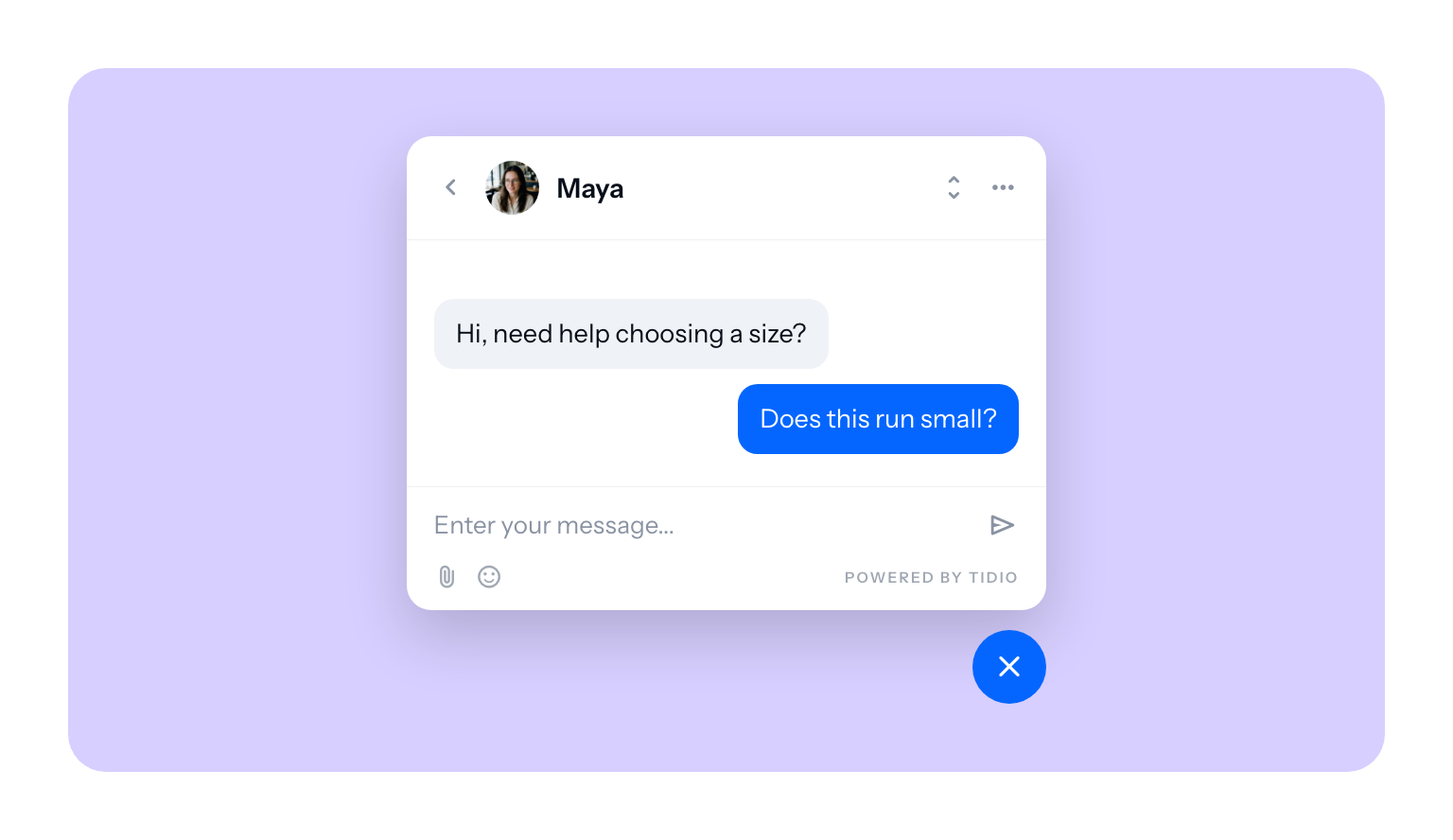
Tidio fits teams like these:
- Shopify and other online stores that want cart preview and order history next to every chat.
- Small and medium-sized businesses that need more tickets closed without hiring.
- High-volume inboxes with many repeat questions that an agent can take over.
- Several channels at once: live chat, email, Messenger, Instagram, and WhatsApp in one place.
Skip Tidio if you run a voice-first contact center; a phone platform such as Retell AI or Ada covers calls in more depth.
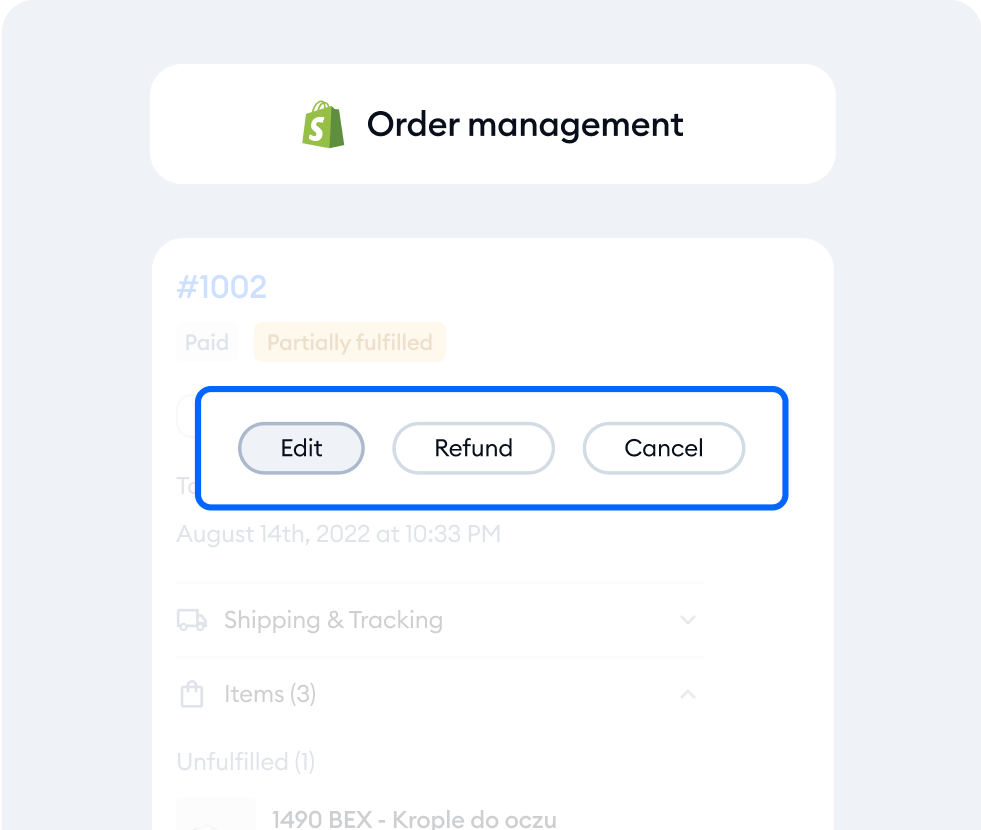
Quick facts: AI is billed inside the plan, from $33 a month for 50 conversations (annual). Channels: live chat, email, Messenger, Instagram, and WhatsApp. Handoff: Lyro alerts your team, and the chat keeps its history in the same inbox.
Best use cases: order status and shipping questions, repeat FAQs, order edits and refunds, and lead qualification.
Key features:
- Lyro AI agent: replies in the customer's language and follows escalation rules you set with Lyro Guidance, covering tone and when to hand off.
- Shopify order tools: see the cart and order history, then cancel, refund, or change an address.
- Plugs into other help desks: Lyro can run on Zendesk, Intercom, or Salesforce.
- Analytics and Flows: reports on resolution and satisfaction, and automations that greet visitors or recover carts.
Pros
- Lyro answers from your own knowledge base with guardrails and is built on Claude from Anthropic.
- Chat, email tickets, and the AI agent share one inbox, so nothing restarts at handoff.
- Tidio's Lyro also took part in G2's agent evaluation, with 92% policy compliance.
Cons
- Advanced analytics and automatic assignment come with Growth, so Starter suits simpler setups.
- Larger deployments with departments, custom limits, or a resolution guarantee run on Plus or Premium, where Tidio's sales team shapes the quote with you.
Pricing:
- Free: 50 human conversations/month, 100 Flows visitors/month + 50 one-time Lyro AI conversations.
- Starter: Human only: from $24/month for 100 conversations. With Lyro AI: from $33/month for 50 conversations shared by AI and your team.
- Growth: from $41/month for 200 human conversations or $63/month for 100 AI + human conversations; scalable to 1,000/month.
- Plus: from $300/month + usage. Premium: custom pricing.
- Optional add-ons: Flows, Inbox AI, Help Center, Voice, and branding removal.
- 7-day free trial: Growth features with Lyro AI and 100 AI + human conversations, no card required; moves to Free unless you choose a paid plan.
Starting prices shown with annual billing.
See Tidio pricing.
Rating: G2 4.6/5 (2,167 reviews)
Add Lyro to your support and compare Tidio plans
2. eesel
Best for: teams that want to keep their current help desk and add an AI layer on top
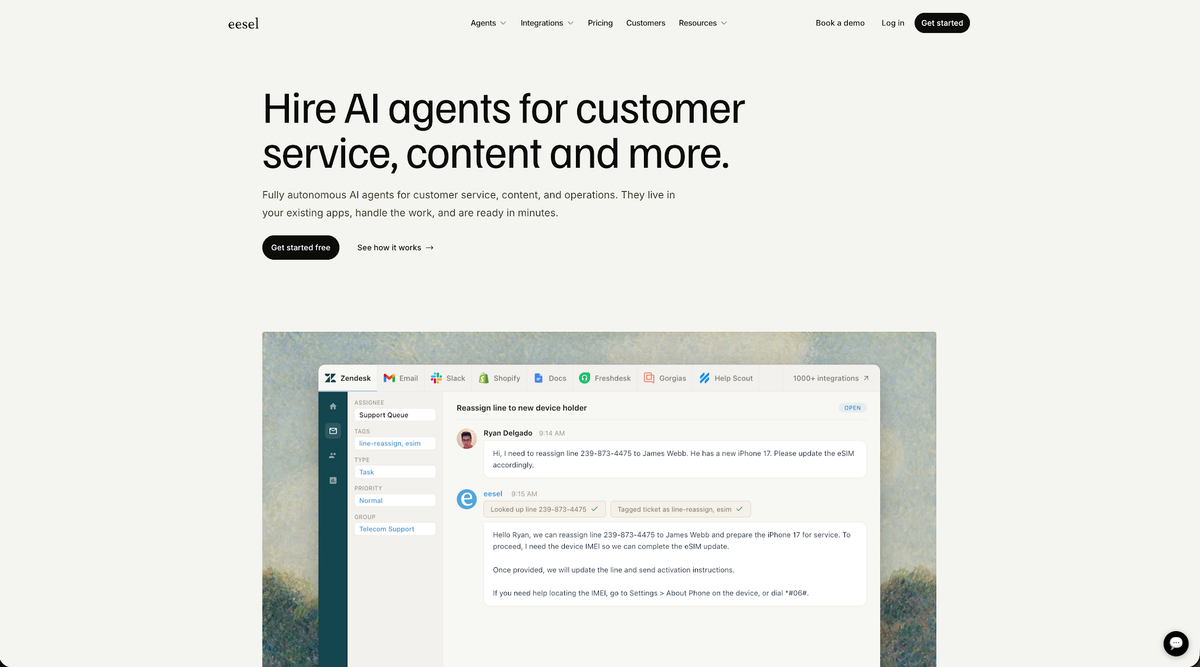
eesel is an AI agent you connect to the tools you already use, so there is no migration. It learns from your help center and documents, answers and triages tickets in helpdesks such as Zendesk, Intercom, Freshdesk, Gorgias, and Help Scout, and hands a case to your team when it should. The same agent can also answer internal questions in Slack or Teams.
Quick facts: Billing: one credit per ticket or chat. Channels: inside your current help desk, plus Slack and Teams for internal questions. Handoff: hands the case to your team.
Best use cases: answering and triaging tickets in the help desk you already use.
Key features:
- Helpdesk integrations that work inside your existing ticket queue.
- Knowledge sources such as help centers, Google Drive, Confluence, and Notion.
- Testing before launch, so you can check answers before customers see them.
Pros
- No migration, and unlimited agents and seats on every plan.
- A free plan with 100 credits and every feature, no card needed.
Cons
- Paid plans start at $299 a month, which is a lot for a small team with low volume.
- Only 20 G2 reviews, a thin sample.
Pricing: free plan with 100 credits; Teammate from $299 a month for 500 credits, $499 for 1,000, up to $1,749 for 5,000. One credit covers one ticket or chat, and extra credits cost $0.80 each if you turn overage on. A year paid upfront gets two months free. Enterprise is custom.
Rating: G2 4.6/5 (20 reviews)
3. Macha
Best for: support teams that want AI agents built for them inside the help desk they already use
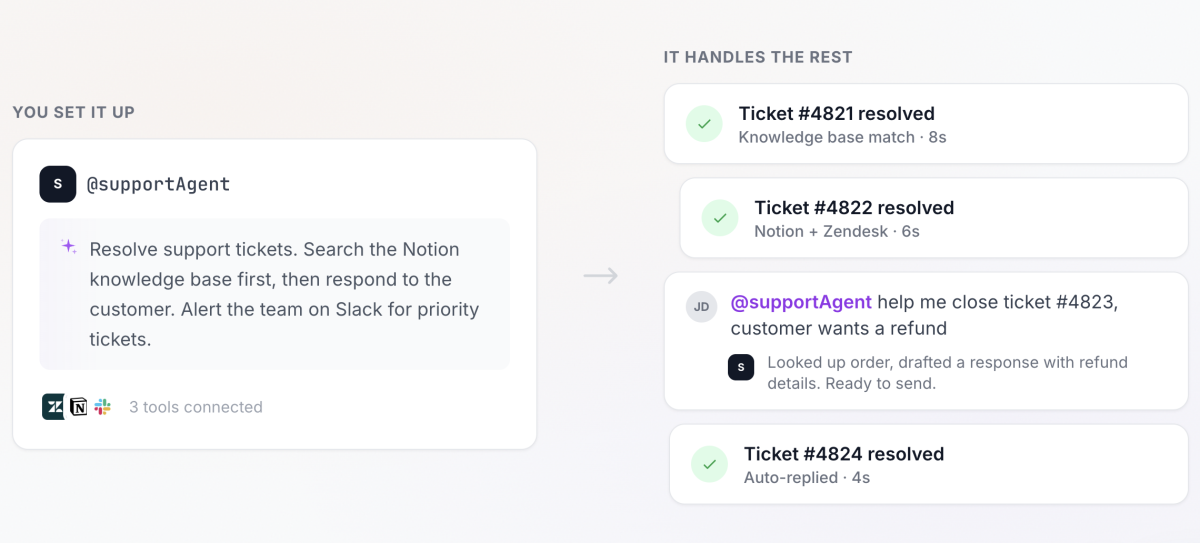
Macha adds AI agents to Zendesk, Freshdesk, Gorgias, Intercom, HubSpot, or Front, so there is no help desk to replace. The agents read each ticket, look up the order or account, and reply, tag, route, or escalate. The Macha team builds and tests the first agents from your help content and past tickets, then launches them in safe mode, as internal notes, until the answers are right.
Quick facts: Billing: about $0.40 a ticket. Channels: inside your current help desk. Handoff: agents escalate to your team, and a person approves each action until you switch on autonomy.
Best use cases: replying to, routing, and tagging tickets in the help desk you already use.
Key features:
- AI agents inside your existing help desk.
- Actions such as refunds, order changes, and subscription updates through Shopify, Stripe, or your own APIs, with a person approving each one until you switch on autonomy.
- Done-for-you setup and a dedicated success manager for changes after go-live, on every plan.
Pros
- No migration; your team keeps its current help desk.
- Unlimited seats, no per-agent fees.
Cons
- Needs an existing help desk; it doesn't replace one.
- The first agents are only as good as the help content and ticket history they're built from.
Pricing: about $0.40 a ticket, from $299 a month for 750 tickets. Setup is included on every plan, including the free trial (no credit card). If the agents aren't live in safe mode within seven days, the first month is free.
Rating: listed on G2, no reviews yet.
4. Gorgias
Best for: Shopify brands with thousands of tickets a month
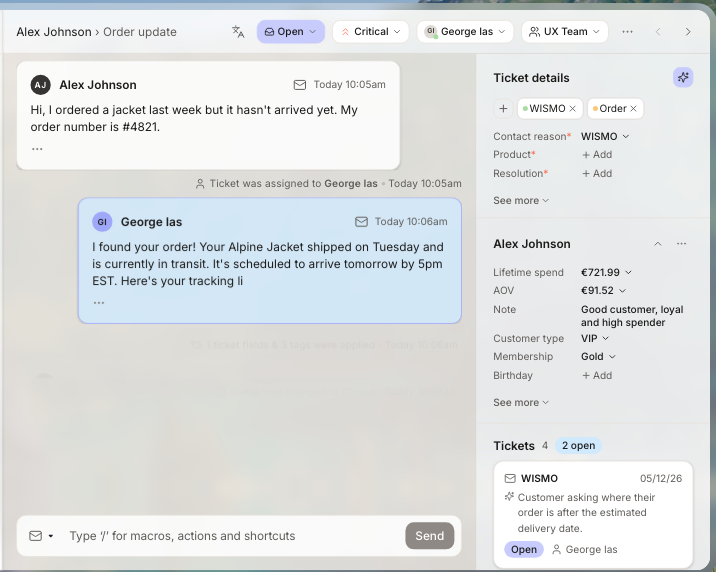
Gorgias is a help desk for online stores, and its AI Agent answers questions, recommends products, and handles returns, tracking, and cancellations through native Shopify, BigCommerce, Magento, and WooCommerce connections. Plans follow ticket volume rather than seats. Outside e-commerce it has little to offer.
Quick facts: Billing: $0.85 to $1.00 per automated interaction on top of the ticket plan. Channels: email, chat, social, and the help center, with Voice and SMS as add-ons.
Best use cases: order tracking, returns, cancellations, and product recommendations for online stores.
Key features:
- AI Agent pre-trained on 18+ store verticals, with brand voice and guardrails.
- Order actions inside each ticket: cancel, refund, discount, track.
- Shopping Assistant for pre-sales questions.
Pros
- No per-agent fees; plans from Basic include 500 user seats.
- Connectors for Klaviyo, Yotpo, Recharge, and Smile.
Cons
- Each automated interaction is billed on top of the plan.
- AI actions such as cancellations aren't on Starter.
Pricing (monthly; annual in brackets): Starter $10 for 50 tickets (monthly only), Basic $60 ($50) for 300, Pro $360 ($300) for 2,000, Advanced $900 ($750) for 5,000. The AI Agent costs $1.00 per automated interaction on Starter, $0.90 on Basic and Pro, and $0.85 on Advanced. Free trial, no credit card.
Rating: G2 4.6/5 (582 reviews)
Read more: Gorgias alternatives · Gorgias review
5. Intercom Fin
Best for: SaaS teams that want the AI agent to lead support
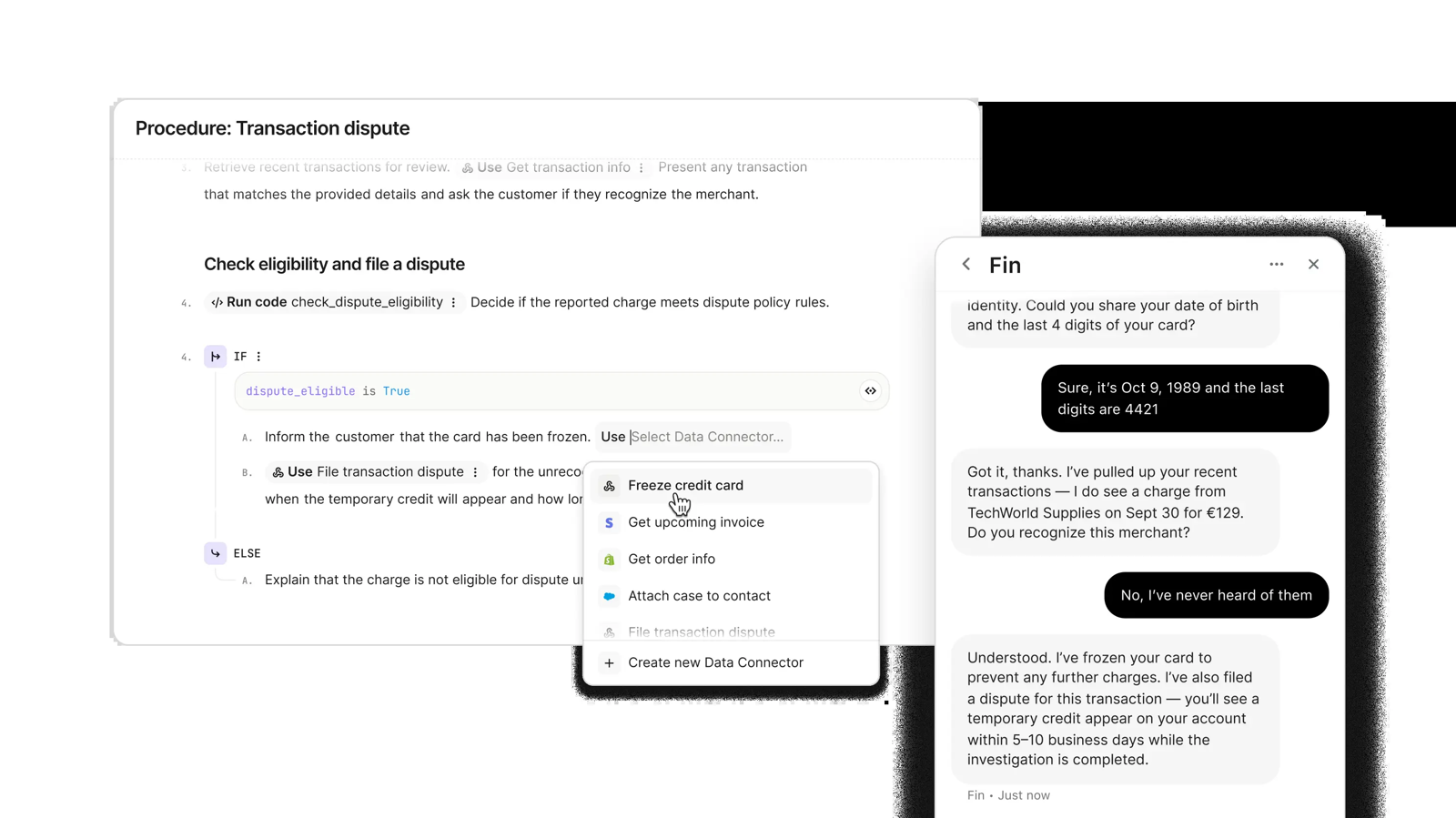
Fin is the AI agent Intercom built its help desk around. It answers from your knowledge base, follows step-by-step Procedures, and acts in outside systems. It also runs on top of another help desk, such as Salesforce, with no Intercom seats. The cost to watch is that seats and outcomes are billed separately.
Quick facts: Billing: $0.99 per outcome on top of seats. Channels: live chat, email, and in-app chats, with SMS, WhatsApp, and phone billed as you go.
Best use cases: help-center answers, multi-step procedures such as card disputes, and an agent on top of another help desk.
Key features:
- Fin AI Agent across chat, email, and other channels.
- Procedures that run multi-step workflows, including handoffs.
- Workflows builder from the Advanced plan.
Pros
- One charge per conversation, even when Fin answers several questions.
- You can test it on your current help desk without migrating.
Cons
- Seat fees and outcome fees both grow with the team.
- Copilot for human agents is a separate add-on.
Pricing (per seat a month, billed annually; monthly in brackets): Essential $29 ($39), Advanced $85 ($99), Expert $132 ($139). Fin costs $0.99 per outcome, counted when the customer confirms the fix, asks for no more help, or Fin completes a Procedure. Copilot is $29 per agent a month billed annually. 14-day free trial.
Rating: G2 4.5/5 (3,913 reviews)
Read more: Intercom alternatives · Intercom review
6. Zendesk AI agents
Best for: large teams that need deep ticketing on every channel
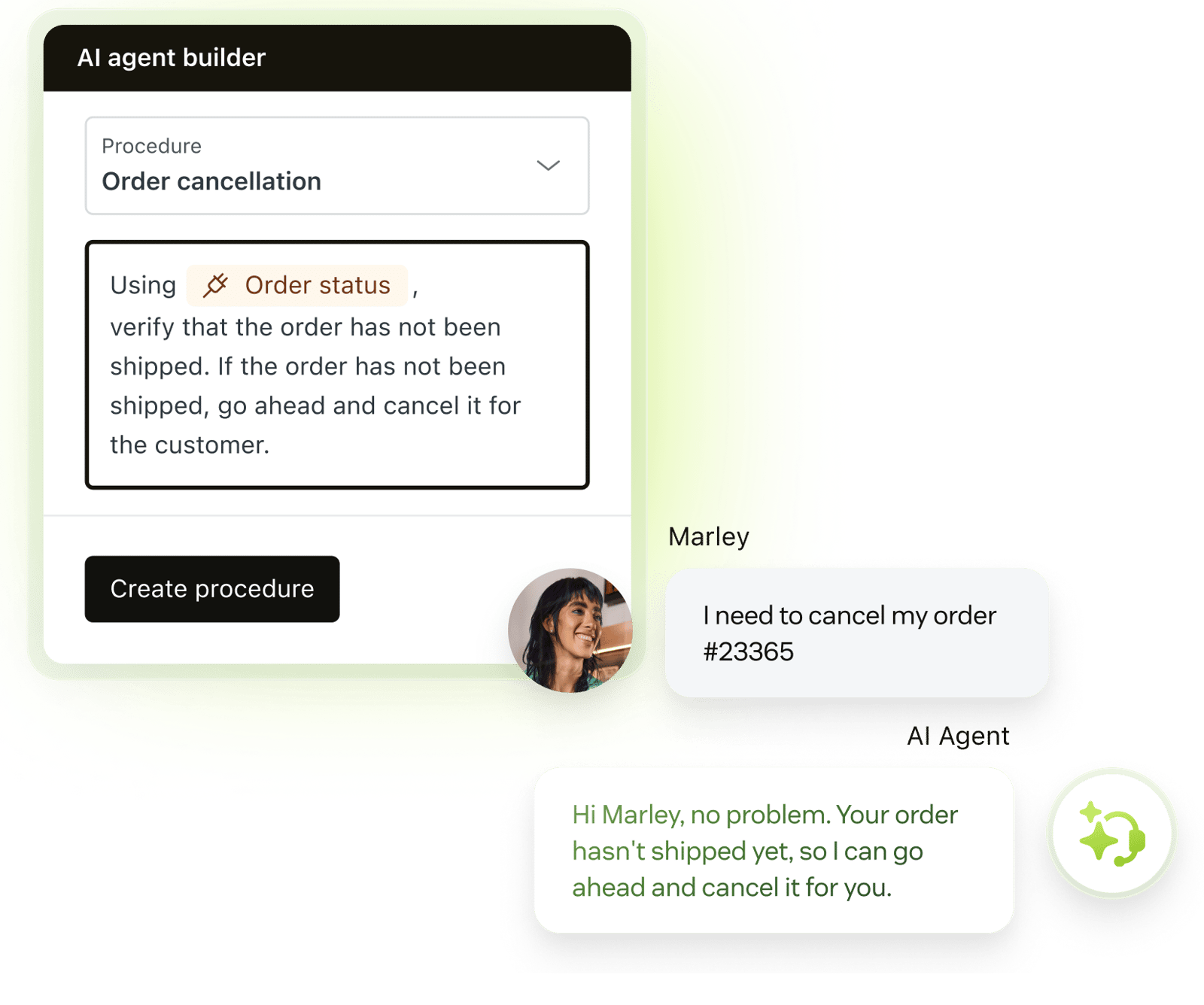
Zendesk includes AI agents in its plans and bills them per automated resolution, a request solved with no human escalation. They work across messaging, email, and voice. The limit is the allowance: five resolutions per agent a month on the Team plans, so volume adds up fast.
Quick facts: Billing: $1.50 to $2.00 per resolution beyond the included allowance. Channels: messaging, email, and voice.
Best use cases: ticket routing and reporting at volume, multichannel support, and procedures such as order cancellations.
Key features:
- AI agent builder that turns a written procedure into a working agent.
- Actions to read, write, and trigger tasks in outside systems.
- Support for 80+ languages with reasoning controls.
Pros
- Deep ticketing, routing, and reporting for large teams.
- Some automated resolutions are included in every plan.
Cons
- Resolutions above the allowance add up at volume.
- Copilot is an add-on from Suite Professional.
Pricing (per agent a month, billed annually; monthly in brackets): Support Team $19 ($25), Suite Team $55 ($69), Suite Professional $115 ($149), Suite Enterprise through sales. Included: five resolutions per agent a month (10 on Suite Professional), then $1.50 each on a commitment or $2.00 pay-as-you-go. 14-day free trial.
Rating: G2 4.3/5 (7,082 reviews)
Read more: Zendesk alternatives · Zendesk review
7. HubSpot Customer Agent
Best for: teams whose customer data already lives in HubSpot's CRM
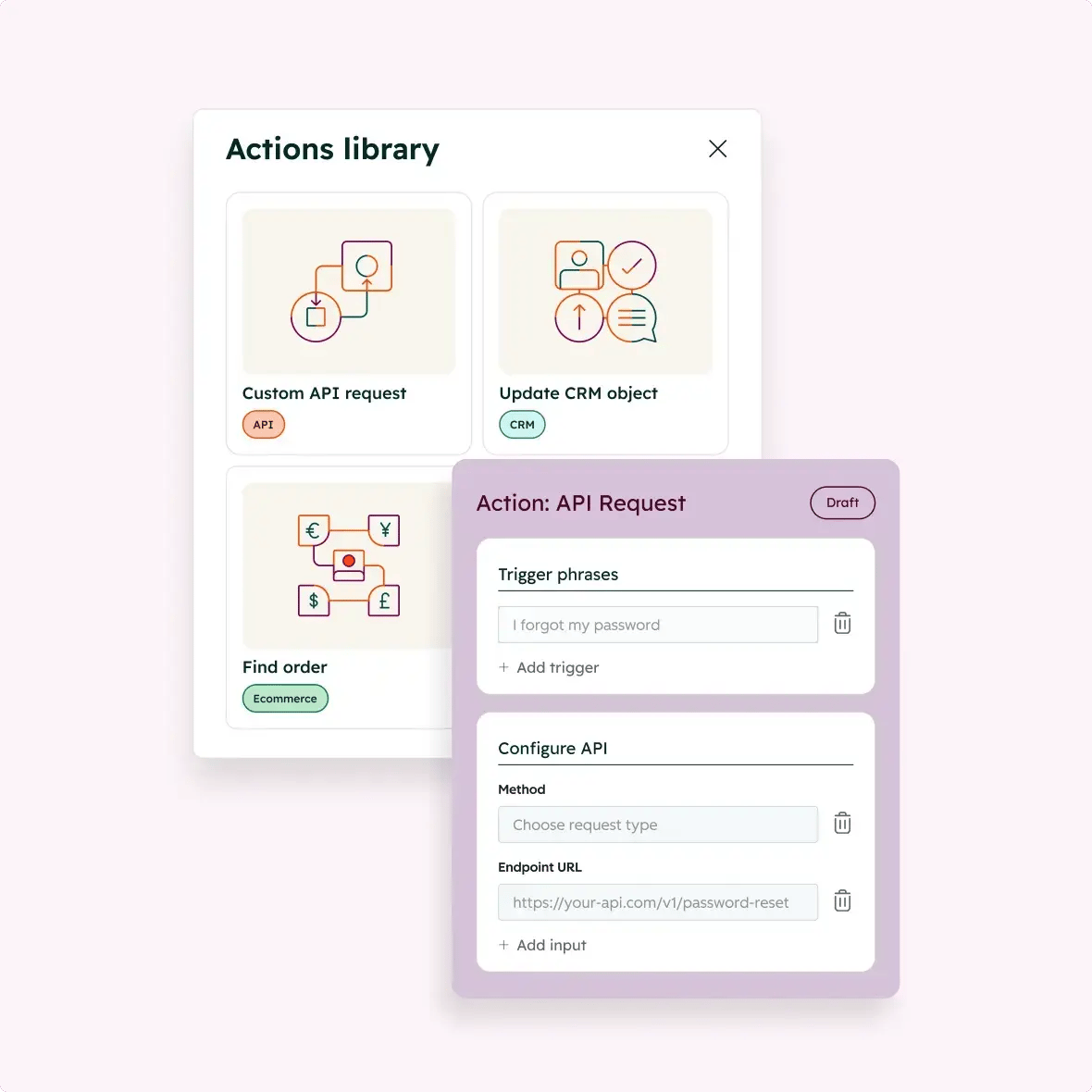
HubSpot's Customer Agent replies in chat, email, forms, and calls with the customer's CRM history in view, then escalates to your team. HubSpot says it resolves 65% or more of conversations. It needs Service Hub Professional or Enterprise, so the entry cost is the seat price, not the AI.
Quick facts: Billing: $0.50 per resolution, paid in HubSpot Credits. Channels: chat, email, forms, and calls. Handoff: escalates to your team with the CRM record in view.
Best use cases: CRM-aware replies, order lookups, and escalations with the contact's history attached.
Key features:
- Customer Agent trained on your content in minutes.
- Help desk workspace tied to CRM contacts, deals, and tickets.
- HubSpot Credits with spend limits per feature.
Pros
- Answers draw on the same records as sales and marketing.
- Credit limits cap what the AI can spend.
Cons
- Not available on the free or Starter plans.
- G2's October 2026 evaluation scored HubSpot's Breeze Customer Agent near the bottom of its board, at 92.5 of 250 points.
Pricing: free tools for up to two users; Starter from $7 a seat a month billed annually; Professional from $90 a seat billed annually ($100 monthly) plus $1,500 onboarding; Enterprise from $150 a seat plus $3,500 onboarding. Customer Agent costs $0.50 per messaging resolution and per voice minute, paid in HubSpot Credits (50 credits per resolved conversation); Professional includes 3,000 credits a month.
Rating: G2 4.4/5 (3,017 reviews)
Read more: HubSpot alternatives
8. Freshdesk (Freddy AI Agent)
Best for: growing teams that want AI on a per-agent budget
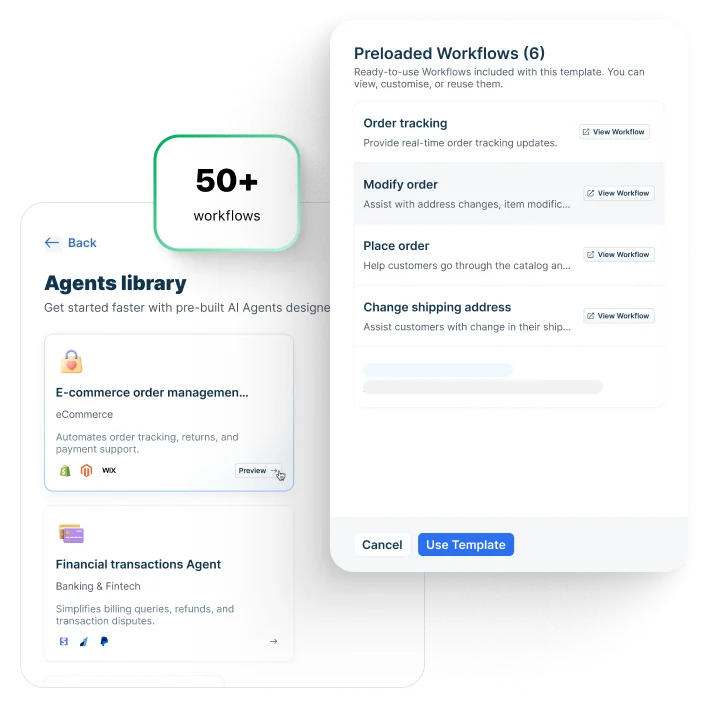
Freshdesk is a ticketing help desk with Freddy AI Agent for customers and Freddy AI Copilot for your team. It suits teams that have outgrown a shared inbox. The free plan is gone from the current pricing page, and AI sessions are sold in packs.
Quick facts: Billing: first 500 sessions free once, then $49 per 100. Channels: chat and email. Handoff: to a Freshdesk agent.
Best use cases: chat and email answers, order tracking workflows, and reply suggestions for agents.
Key features:
- Freddy AI Agent for chat and email answers.
- Freddy AI Copilot with reply suggestions and summaries.
- Freddy AI Insights on the Enterprise plan.
Pros
- Low entry price per agent for a full help desk.
- Copilot can go to only the agents who need it.
Cons
- No free plan; only the 14-day trial is free.
- AI sessions and Copilot both add to the per-agent price.
Pricing (per agent a month, billed annually): Growth $19, Pro $55, Enterprise $89. Freddy AI Agent: first 500 sessions free once per account, then $49 per 100. Copilot: $29 per agent a month. 14-day free trial.
Rating: G2 4.4/5 (3,773 reviews)
Read more: Freshdesk alternatives · Freshdesk review
9. Retell AI
Best for: teams that want an AI agent to answer and place phone calls
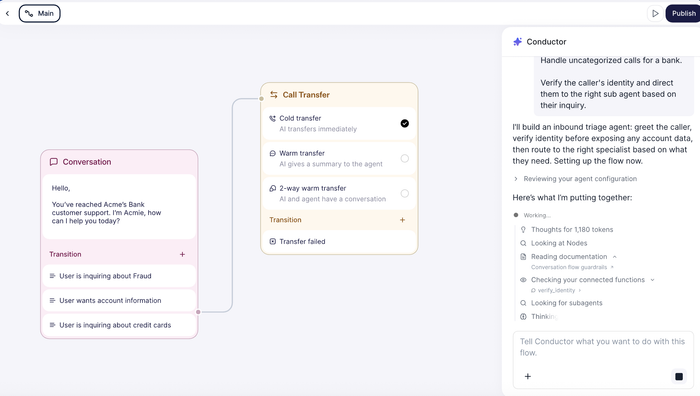
Retell AI builds voice agents that handle inbound and outbound calls, book appointments, transfer to a person, and navigate phone menus. It also sells chat agents. It is the one phone-first tool here, and it led G2's October 2026 agent evaluation with 242.5 of 250 points. It is a build-it-yourself platform for teams with a developer, not an inbox for your support team.
Quick facts: Billing: $0.07 to $0.31 per voice minute. Channels: inbound and outbound phone calls, plus chat agents. Handoff: call transfer to a person.
Best use cases: answering inbound calls, placing outbound calls, booking appointments, and navigating phone menus.
Key features:
- Call transfer between the AI agent and a human.
- Knowledge base the agent answers from, plus appointment booking.
- Post-call analysis, simulation testing, and AI quality assurance to tune the agent.
Pros
- Pay as you go with no annual contract.
- Highest overall score on G2's October 2026 agent evaluation.
Cons
- No help desk, so tickets and email live elsewhere.
- Per-minute costs vary with the language model and voice you pick.
Pricing: pay as you go, from $0.07 to $0.31 a minute for voice agents and from $0.002 a message for chat agents, with $10 in free credits and 20 concurrent calls included. Enterprise pricing is custom.
Rating: G2 4.8/5 (2,639 reviews)
10. Ada
Best for: enterprise teams automating high contact volumes
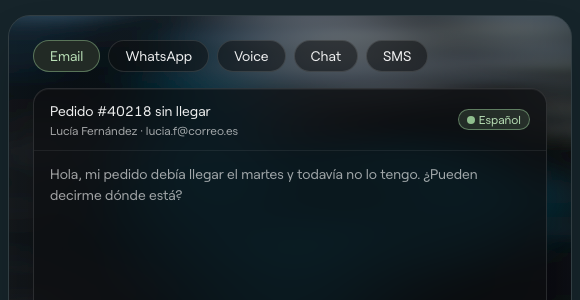
Ada sells AI agents for voice, messaging, and email to large companies. Playbooks turn your standard operating procedures into automated workflows, and Ada Computer lets the agent finish tasks in your systems. Pricing comes after a demo, sized by yearly contact volume, so it isn't built for a five-person team.
Quick facts: Billing: custom, sized by yearly contact volume. Channels: voice, messaging, and email.
Best use cases: refunds and account changes, plus high-volume voice, messaging, and email queues.
Key features:
- Playbooks for complex procedures.
- Voice, messaging, and email agents on one platform.
- Testing and coaching to improve resolutions after launch.
Pros
- Handles multi-step jobs such as refunds or account changes.
- Ready-made playbooks for e-commerce, finance, gaming, insurance, SaaS, and travel.
Cons
- No public pricing.
- A small G2 sample of 174 reviews for an enterprise product.
Pricing: custom, quoted after a demo from annual contact volume.
Rating: G2 4.6/5 (174 reviews)
Read more: Lyro vs Ada
11. Sierra
Best for: big consumer brands that want a single agent on every channel
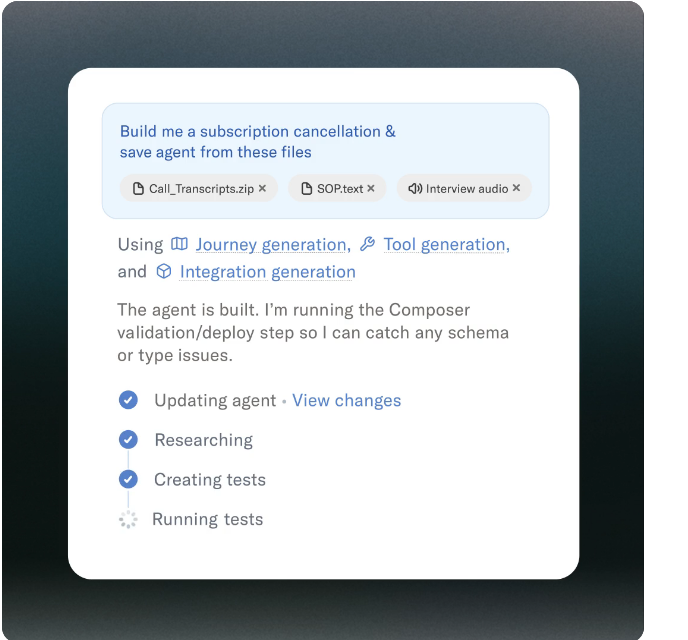
Sierra builds branded agents for large companies and runs one agent across chat, SMS, WhatsApp, email, voice, and ChatGPT. Its Ghostwriter tool builds an agent from SOPs, transcripts, or a plain-English goal. There is no public price or self-serve plan.
Quick facts: Billing: outcome-based, through sales. Channels: chat, SMS, WhatsApp, email, voice, and ChatGPT.
Best use cases: multi-step jobs such as subscription cancellations, built from your SOPs and call transcripts.
Key features:
- Ghostwriter to build and update agents from your own documents.
- One agent across six channels, including voice and ChatGPT.
- Outcome-based pricing.
Pros
- You pay for outcomes, not seats.
- Multilingual, multichannel agents built from your own material.
Cons
- No self-serve plan or published price.
- No G2 listing we could validate.
Pricing: custom and outcome-based, through sales.
Rating: no G2 listing we could validate.
12. Decagon
Best for: enterprises that want to stress-test an agent before launch
Decagon builds voice, chat, and email agents around AOPs, agent operating procedures written in plain language. Its strength is quality control: simulations, live A/B tests, and always-on QA called Watchtower show how a change behaves before every customer sees it. It is sold to large companies through sales.
Quick facts: Billing: custom, through sales. Channels: voice, chat, and email.
Best use cases: workflows written as AOPs and tested with simulations before launch.
Key features:
- AOPs that describe workflows in plain language.
- Testing and QA: simulations, live experiments, and Watchtower.
- Insights on what customers ask and why.
Pros
- Lets you check a change before customers see it.
- Voice, chat, and email run on the same agent logic.
Cons
- No public pricing.
- Only 29 G2 reviews, a thin sample.
Pricing: custom, through sales.
Rating: G2 4.8/5 (29 reviews)
13. Fini
Best for: regulated industries such as banking, healthcare, and insurance
Fini builds AI agents for enterprise support teams that need compliance controls. It connects to your knowledge base and helpdesk, resolves tickets over chat, email, and voice, and offers a Slack agent on its higher plans. It lists SOC 2 Type II, ISO 27001, HIPAA-eligible handling, GDPR, and CCPA, and says customer data is never used to train foundation models.
Quick facts: Billing: $0.49 to $0.89 per resolved ticket by plan. Channels: chat, email, and voice, with a Slack agent on higher plans.
Best use cases: resolving tickets under compliance controls in banking, healthcare, and insurance.
Key features:
- Chat, email, and voice on one platform.
- Compliance controls for regulated teams.
- Dedicated AI engineer and onboarding on the Scale plan.
Pros
- You pay per resolved ticket, with no seat fees.
- A 90-day money-back guarantee for eligible new enterprise customers: if Fini misses 90% resolution, you pay $0.
Cons
- The free pilot is for Enterprise only; smaller plans have no trial.
- Only 15 G2 reviews.
Pricing: $0.89 per resolved ticket on Growth (up to 3,000 a month), $0.69 on Scale (up to 10,000), and $0.49 on Enterprise. Voice is $0.89 per answered call for the first 10,000 calls a month.
Rating: G2 4.8/5 (15 reviews)
14. ClickPost Ally
Best for: D2C brands on Shopify with many shipping and return questions
ClickPost Ally is the AI support agent from ClickPost, a logistics platform. It reads live carrier data, your Shopify catalog, and earlier conversations to answer order status, failed delivery, return, and refund questions across web chat, WhatsApp, email, and voice. When a request is outside what it may do, it passes the thread to a person with the order history attached. ClickPost says Ally resolves 90% of order status questions without a human; that figure is the vendor's claim.
Quick facts: Billing: custom, not stated for Ally. Channels: web chat, WhatsApp, email, and voice. Handoff: passes the thread to a person with the order history.
Best use cases: order status, failed delivery, return, and refund questions.
Key features:
- Live carrier and order data behind every answer.
- Returns, refunds, and replacements handled in the conversation.
- Pre-purchase product advice from your catalog.
Pros
- Answers come from real shipment data, not just a help center.
- Escalations keep the full thread and order history.
Cons
- Built for D2C brands on Shopify, so it is a narrow fit for other businesses.
- No public price.
Pricing: not stated for Ally. ClickPost quotes custom pricing based on your needs, shipment volume, and modules.
Rating: G2 4.8/5 (148 reviews), for the ClickPost platform; we found no separate Ally listing.
15. Sobot
Best for: teams that want chat, voice, WhatsApp, and ticketing on one platform
Sobot sells messaging and voice AI agents, plus Nexus, a workspace where your human agents handle chat, voice, WhatsApp, and tickets next to the AI. It serves retail and e-commerce, financial services, gaming, and education, among others. Sobot advertises going live in two weeks, a claim we did not test.
Quick facts: Billing: not published. Channels: messaging, voice, WhatsApp, and ticketing in one workspace.
Best use cases: one workspace where AI and your team handle chat, voice, WhatsApp, and tickets.
Key features:
- Messaging and voice AI agents, including inbound and outbound calls.
- Nexus workspace with messaging, voice, WhatsApp API, and ticketing.
- Multilingual agents that run around the clock.
Pros
- One platform covers the AI agent and your human team's tools.
- A free trial is offered from the site.
Cons
- No prices on Sobot's site; you book a demo for a quote.
- Trial terms are not stated.
Pricing: not published on Sobot's website. A free trial and a demo are offered.
Rating: G2 4.9/5 (40 reviews)
16. ClearFeed
Best for: support inside Slack or Microsoft Teams
ClearFeed runs support where your team and requesters already talk. Its helpdesk handles requests from Slack channels, email, web chat, and Teams, and its AI agents answer from your knowledge sources, use connected tools, and report on deflection. Professional adds IT and HR tools. It suits internal IT, HR, and customer channels more than a public web widget.
Quick facts: Billing: from $20 a month for 20 Slack channels, with 100 AI credits. Channels: Slack, Microsoft Teams, email, and web chat.
Best use cases: IT, HR, and customer requests that arrive in Slack or Teams.
Key features:
- Custom AI agents with knowledge sources and tool integrations.
- Deflection reports on AI answers.
- Slack and Teams helpdesk for external and internal requests.
Pros
- Works in the channels your team already uses.
- A 14-day free trial with no card, and 15% off annual plans.
Cons
- AI agents are usually bought with the helpdesk, not standalone.
- Professional and Enterprise prices are not listed.
Pricing: Starter is priced by Slack channel count, from $20 a month for 20 channels, and includes 100 AI credits. Extra credits cost $2 per 10 for the first 500. Professional and Enterprise are not priced publicly.
Rating: G2 4.6/5 (163 reviews)
How to choose an AI agent for customer service
Buyers sort this decision by company size, existing software, and channel. Run these checks before you book a demo.
Check what it can do
Ask the vendor to run a refund, an address change, and a cancellation in your test account. An agent that only answers questions deflects tickets; one that acts closes them. Check which actions work without a developer.
Check the resolution rate and how it is counted
Vendors count a resolution differently: a confirmed fix, no further reply, or no human touch within 72 hours. Ask for the definition, then compare it with the billing unit, because that is what you pay for.
Check handoff and guardrails
Write the cases the agent must never handle alone, such as legal threats, large refunds, and angry customers. Test that the chat reaches your team with the history attached.
Check channels and your current stack
List where customers write today: chat, email, WhatsApp, Instagram, or phone. If you already run Zendesk, HubSpot, or Freshdesk, price that vendor's own agent against a standalone one such as Lyro or Fin, which can sit on top of your help desk.
Compare the pricing model
Seat pricing, per-resolution fees, and per-minute voice billing grow differently. For 1,000 AI resolutions a month, $0.99 each is about $990 and $1.50 each is $1,500, before seats. Model your own volume, and read what counts as one resolution before you sign. Our chatbot pricing guide shows how the models compare.
Check security and run a pilot
Ask where customer data is stored, whether it trains the model, and what access controls exist. Then pilot the agent on your 50 most common tickets for two weeks and count what it resolved without a person.
Which AI agent should you pick?
- Small team or Shopify store: Tidio, with Lyro on a paid plan. Cart preview and order history sit next to the chat, and Lyro answers from your help center.
- Shopify brand with thousands of tickets: Gorgias, if you want a help desk built around orders and are fine paying per automated interaction.
- SaaS company that wants the agent first: Intercom Fin, since it runs on your current help desk.
- Already on Zendesk or Freshdesk: the vendor's own AI agent; you keep your tickets and workflows.
- CRM-centered team: HubSpot Customer Agent, once you are on Service Hub Professional.
- Phone support: Retell AI for calls; add a chat tool for tickets.
- Enterprise with a project team: Ada, Sierra, or Decagon, after a pilot on your own tickets.
Put Lyro on your store and see what it resolves
For Salesforce Agentforce, Kore.ai, and other enterprise options, see our guide to the best agentic customer service software. For related reading, see AI customer service agents and AI customer support software.
Frequently asked questions
It depends on your size and stack. Tidio's Lyro suits small teams and Shopify stores, Intercom Fin suits SaaS teams, and Zendesk or HubSpot agents suit teams that already run those platforms. Retell AI leads for phone calls.
Pick one that works inside the tool you already use and publishes its price. Tidio's cheapest plan with Lyro is $33 a month billed annually for 50 conversations, and Intercom Fin charges $0.99 per outcome on top of its seat price.
Prices run from about $0.50 to $2.00 per resolution, plus seats or a platform plan. Retell AI bills $0.07 to $0.31 per voice minute. Enterprise agents such as Ada, Sierra, and Decagon are quoted after a demo.
A chatbot follows scripted flows and keyword rules. An AI agent reads your knowledge base, understands free-form requests, and can take actions such as a refund. Read our comparison of chatbots and conversational AI.
No. Agents resolve repeat questions and routine actions, and people handle complex, emotional, and high-value cases. Plan a handoff, and keep humans on edge cases.
Yes. Intercom Fin and Tidio's Lyro can run on top of other help desks such as Zendesk and Salesforce, so you can test an agent without migrating tickets.
Use live chat to support your customers in real-time