Key takeaways
- Human-plus-bot customer service conversations reached a 57% resolution rate, against 29% for bots alone, across 22 million conversations. (Contentsquare, in Tidio's AI in E-Commerce report, 2026)[3]
- 91% of customer service and support leaders report pressure from executives to implement AI. (Gartner, 2026)[1]
- Only 7% of customers used a chatbot or digital assistant in their last service interaction, and 49% said they would have been willing to. (Gartner, 2026)[2]
- 87% of customers say it is essential to reach a human agent when a company uses generative AI for service. (Gartner, 2026)[4]
- Customer service spending on AI rose 38% while overall service budgets grew 2%. (Gartner, 2026)[5]
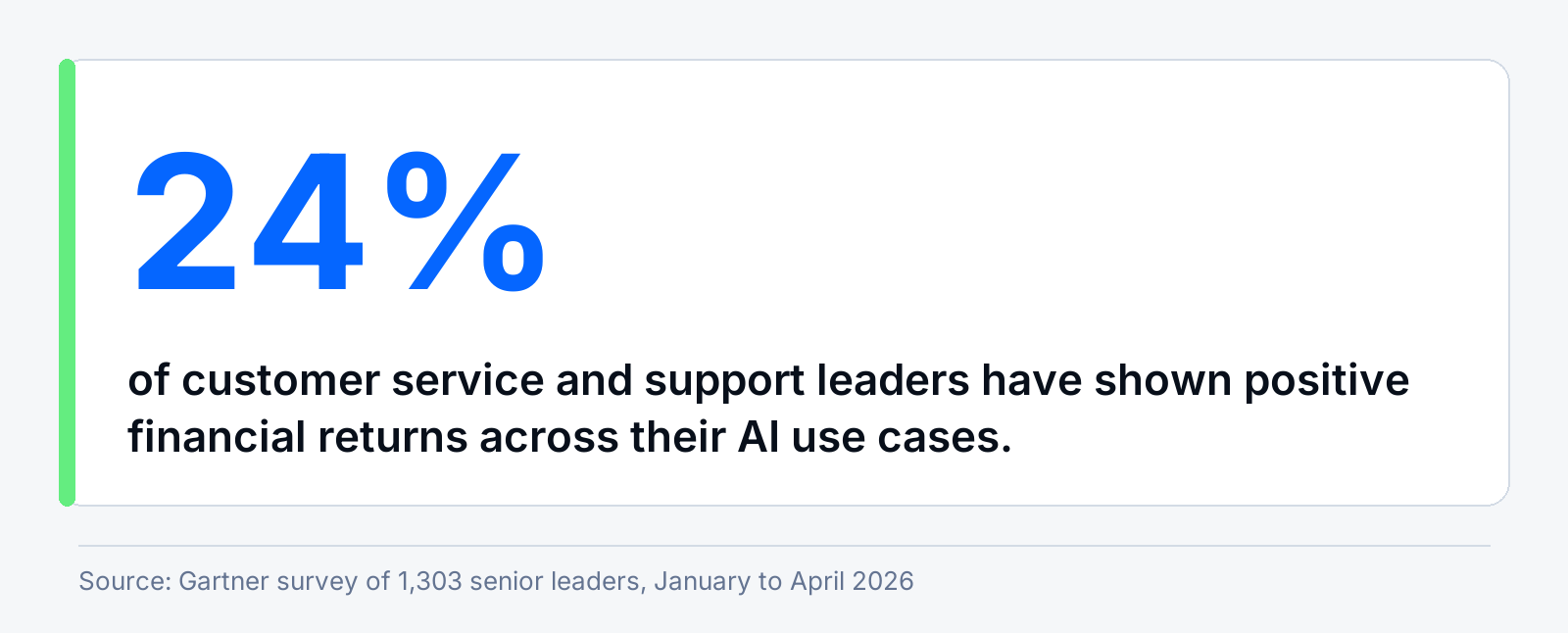
- Only 24% of customer service leaders have shown positive financial returns across their AI use cases. (Gartner, 2026)[6]
- Only 20% of customer service leaders have cut agent staffing because of AI. (Gartner, 2025)[7]
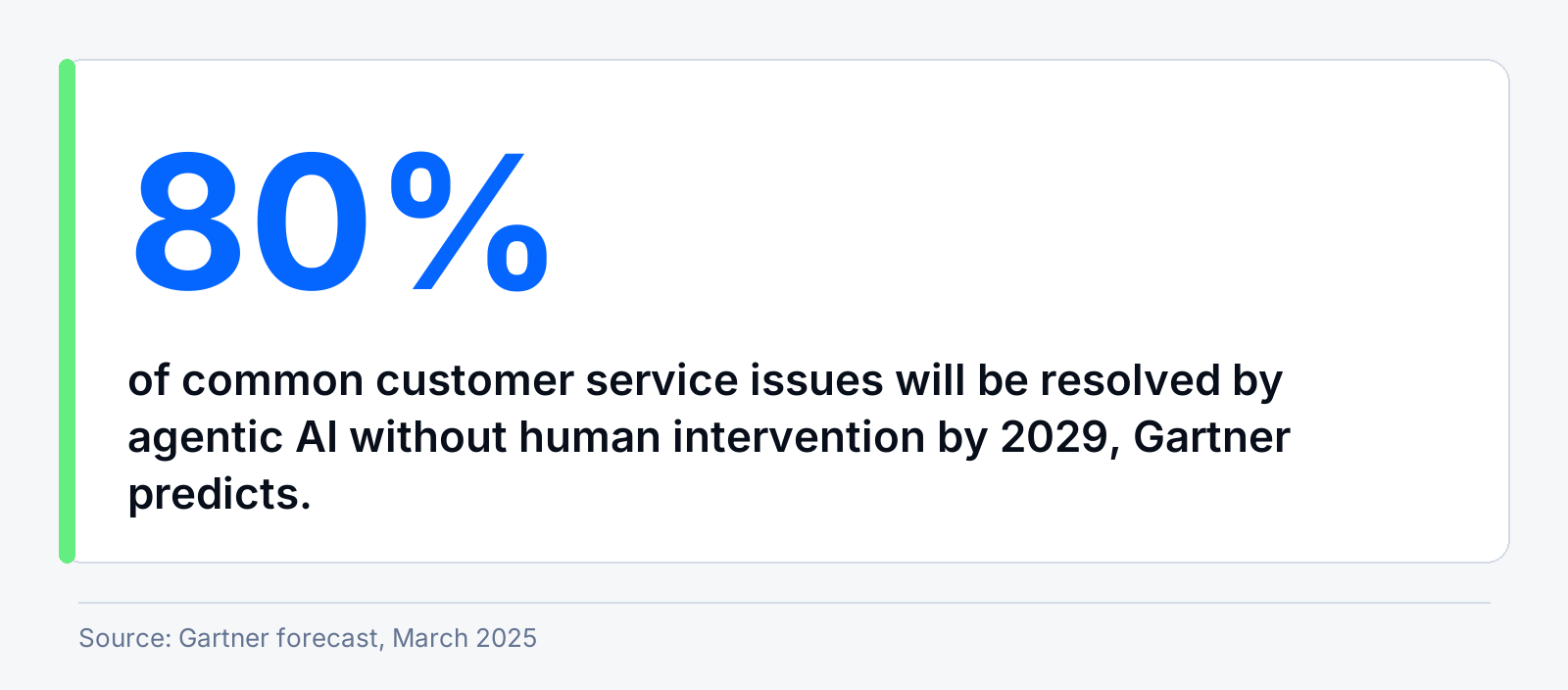
- Gartner predicts agentic AI will resolve 80% of common customer service issues without human intervention by 2029. (Gartner, 2025)[8]
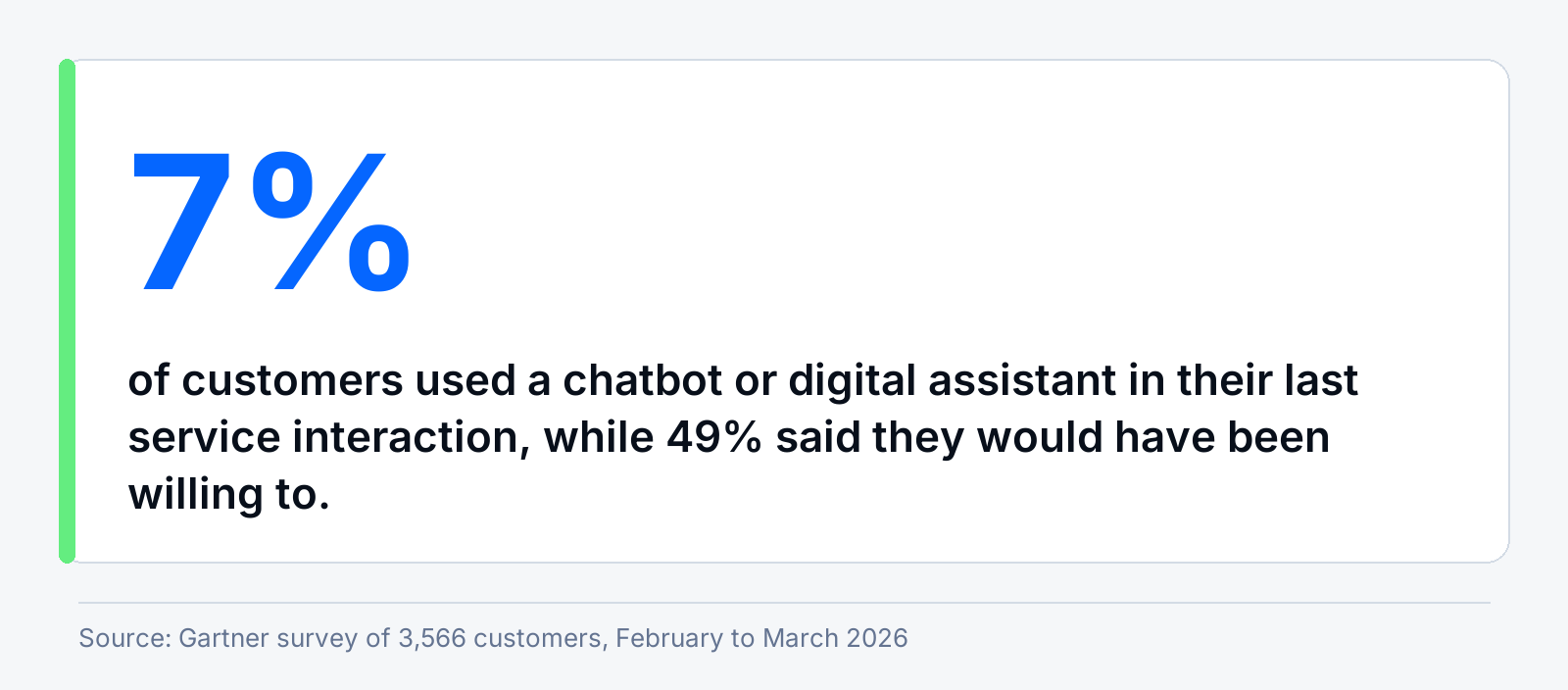
Companies are putting AI in front of customers faster than customers are using it. In a 2026 Gartner survey, 91% of customer service leaders said they were under pressure to implement AI, yet only 7% of customers had used a company chatbot in their last service interaction.[1][2] That gap between investment and use shapes most of this year's data.
This page combines the 2026 research we published in our free reports with 30+ third-party reports from 2024 to 2026. Every number names the organization that collected it, and each footnote leads to the report that published it.
Use live chat to support your customers in real-time
AI customer service adoption statistics
Most large companies are already running or building AI for service, but the numbers depend on who is counted. Surveys of big organizations show majority adoption, while counts that include every small firm are far lower.
- 91% of customer service and support leaders report pressure from executive leadership to implement AI (survey of 321 leaders, October 2025). (Gartner, 2026)[1]
- 69% of service professionals say their organizations use AI, and 39% say they use agentic AI. (Salesforce, in Tidio's AI in E-Commerce report, 2026)[3]
- 62% of U.S. organizations with $1 billion or more in revenue are building, deploying or developing AI agents, up from 53% a quarter earlier (survey of 314 leaders, July to August 2026). (KPMG, 2026)[9]
- 40% of respondents at organizations with revenue above $1 billion report scaling AI agents, up from 27% a year earlier, and 22% at smaller firms (all functions, not only customer service). (McKinsey, 2026)[10]
- Only 49% of organizations consider themselves prepared to offer AI-powered customer service (survey conducted November to December 2024). (Capgemini Research Institute, 2025)[11]
- 88% of organizations used AI in at least one business function in the prior year. (Stanford HAI, 2026)[12]
- About 18% of U.S. firms had adopted AI as of year-end 2025, based on Census Bureau data cited by the Federal Reserve. (Federal Reserve Board, 2026)[13]
- 19.95% of EU enterprises with 10 or more employees used AI technologies in 2025, up 6.47 percentage points from 2024. (Eurostat, 2025)[14]
Reality check: the 88% and the 18% describe the same economy. Stanford's figure reflects organizations surveyed about any AI use in any function, while the Census-based figure counts all U.S. firms, including very small ones. Neither measures customer service alone, so quote the customer service figures above when your topic is support.
What this means: adoption among large service teams is no longer the question. The open question is whether the AI works for customers once it is live. Read more: AI customer service.
AI customer service spending and market size
Budgets are moving toward AI faster than the rest of the service function, and research firms size the market very differently depending on what they count.
- Customer service spending on AI rose 38% while overall service and support function budgets grew 2% (survey of 199 leaders, April to May 2026). (Gartner, 2026)[5]
- Service and support leaders put a median 12% of their 2025 budget into AI, the highest of 10 business functions assessed (survey of 1,303 senior leaders, January to April 2026). (Gartner, 2026)[6]
- The global conversational AI market was valued at $14.3 billion in 2025 and is projected to reach $78.9 billion by 2033. (Grand View Research, 2026)[15]
- The conversational AI market is set to grow from $17.05 billion in 2025 to $49.80 billion by 2031, a 19.6% CAGR. The estimate covers AI chatbots, voice bots, virtual assistants and generative AI agents. (MarketsandMarkets, 2026)[16]
- The global chatbot market was valued at $9.6 billion in 2025 and is projected to reach $41.2 billion by 2033, a 19.6% CAGR from 2026 to 2033. (Grand View Research, 2026)[17]
- The global chatbot market was $1.42 billion in 2025 and is forecast to reach about $7.96 billion by 2035, an 18.81% CAGR from 2026 to 2035. (Precedence Research, 2026)[18]
| Source and market | 2025 value | Forecast |
|---|---|---|
| Precedence Research, chatbot market | $1.42 billion | $7.96 billion by 2035 |
| Grand View Research, chatbot market | $9.6 billion | $41.2 billion by 2033 |
| Grand View Research, conversational AI market | $14.3 billion | $78.9 billion by 2033 |
| MarketsandMarkets, conversational AI market | $17.05 billion | $49.80 billion by 2031 |
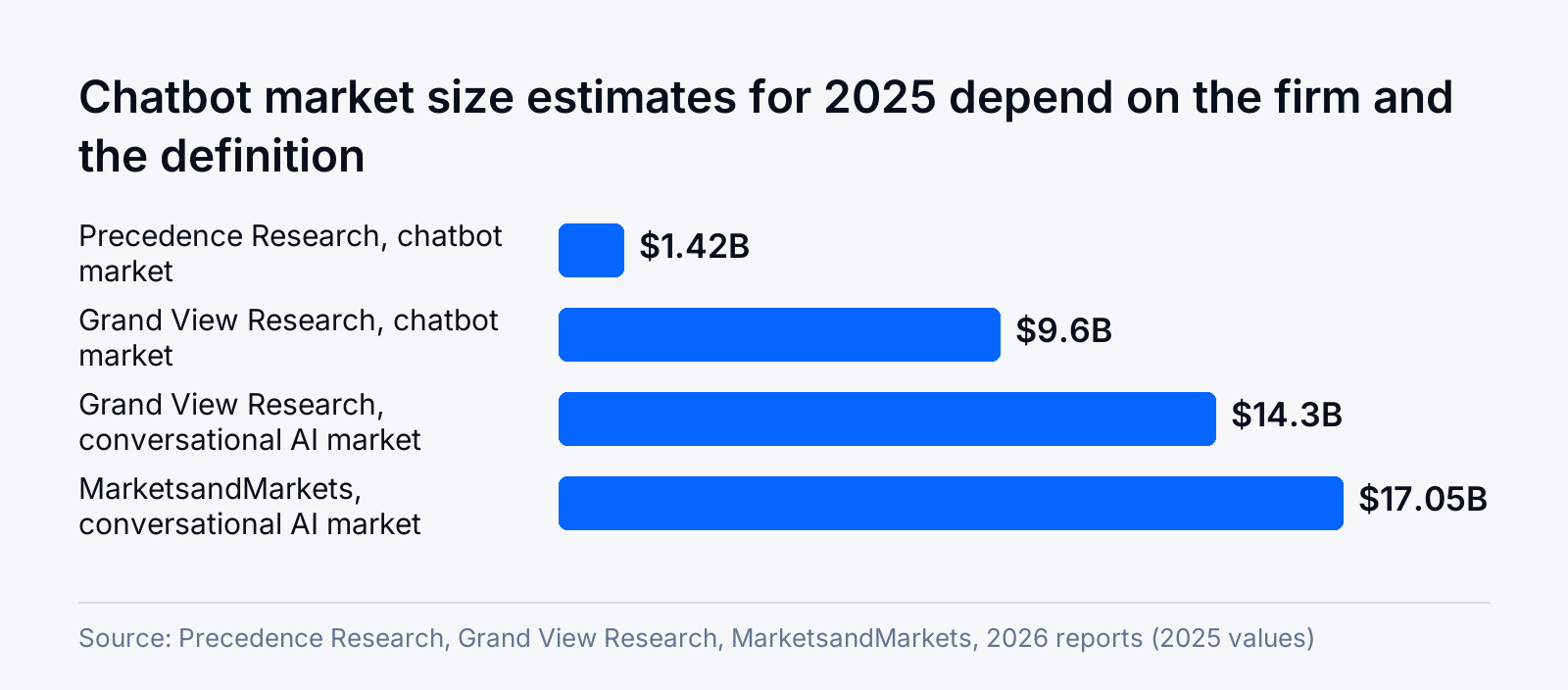
Reality check: we found no independent primary source that sizes "AI customer service" as a market on its own. The figures above are the nearest published definitions, and they differ by a factor of twelve. Quote one firm per sentence and name what it counted.
What this means: every forecast points to growth of roughly 19% to 25% a year, and Gartner's figures show the money is already moving. Check what a vendor's market figure includes before you build a business case on it. Read more: customer service automation.
Customer attitudes toward AI customer service
Customers are open to AI in service, but they hold back after a failure and want a person within reach. Most of the data below comes from one Gartner survey of 3,566 B2B and B2C customers, fielded in February and March 2026.
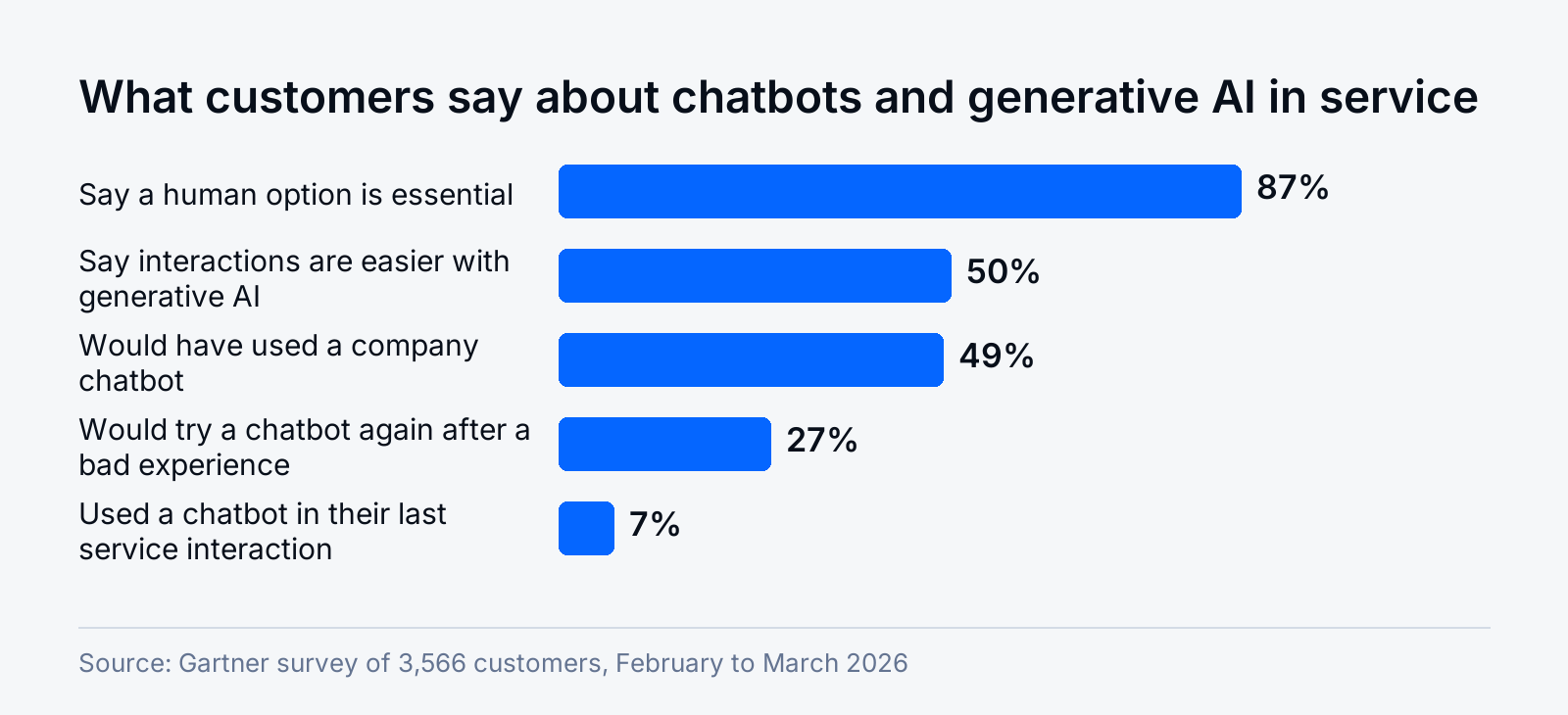
- 49% of customers would have been willing to use a company chatbot, but only 7% did in their most recent service interaction. (Gartner, 2026)[2]
- Only 27% of customers would try a chatbot again after a negative experience. (Gartner, 2026)[2]
- 87% of customers say it is essential that companies offer a way to reach a human agent when they use generative AI for customer service. (Gartner, 2026)[4]
- 50% of customers say their interactions are easier when companies use generative AI. (Gartner, 2026)[4]
- Customers are about three times more likely to use third-party generative AI tools than company-provided chatbots to resolve service issues. Use of company chatbots is statistically unchanged since 2022. (Gartner, 2026)[6]
- 58% of customers who use generative AI have used it to complete a task on their behalf, and 74% in B2B. (Gartner, 2026)[6]
Other recent surveys show the same split between willingness and preference.
- 79% of U.S. adults strongly prefer interacting with a human over an AI agent for customer service (survey of 2,017 U.S. adults, December 2025). (SurveyMonkey, 2025)[19]
- 82% of consumers prefer human customer support even when the outcome and the wait time are identical, from 73% of Gen Z to 91% of Boomers (global study of over 15,000 consumers). (HubSpot and SurveyMonkey, in Tidio's AI in E-Commerce report, 2026)[3]
- 54% of U.S. customers trust human agents more than AI for product or service recommendations, and 32% trust AI more (survey of 5,801 U.S. customers, early 2025). (Gartner, 2025)[20]
- 71% of consumers feel chatbots have improved in quality over the past one to two years, but more than 70% still prefer human agents for empathy and creative problem-solving. (Capgemini Research Institute, 2025)[11]
- 30% of consumers trust AI search results "a lot" or "completely," and 28% have already stopped buying from a brand because of its AI use. (HubSpot and SurveyMonkey, in Tidio's AI in E-Commerce report, 2026)[3]
- After a negative experience, 63% of customers switch providers and 61% reduce their spending. (Capgemini Research Institute, 2026)[21]
- 64% of customers said they would prefer that companies did not use AI for customer service (survey of 5,728 customers, December 2023). This is the older baseline that the 2026 data above updates. (Gartner, 2024)[22]
Reality check: Gartner's 2024 release found 64% of customers would rather companies not use AI in service, while its 2026 survey finds 49% would use a company chatbot and 50% say generative AI makes interactions easier. The surveys ask different questions in different years, but the direction is clear: attitudes have softened, and the demand for a human option has not.
What this means: customers accept AI in service, and they stop using it once it has failed them. Give the AI a narrow job, make the handoff to a person one click, and track failures separately from deflections. Read more: how bad customer service costs you repeat purchases.
AI customer service performance statistics
Resolution rates are where AI customer service is won or lost. The independent data shows AI works best with a person behind it, and worst on the issues that carry the most risk.
- Human-plus-bot conversations reached a 57% resolution rate, nearly double the 29% that bots achieved alone (analysis of 22 million customer service conversations). (Contentsquare, in Tidio's AI in E-Commerce report, 2026)[3]
- Bot-only resolution drops to 18% for refunds, 15% for technical issues and 14% for security issues. (Contentsquare, in Tidio's AI in E-Commerce report, 2026)[3]
- Shoppers used retailer AI and agents for customer service 126% more during the 2025 holiday season than in the two months before, and those agents took 142% more direct actions such as starting returns and updating delivery addresses (dataset of more than 1.5 billion shoppers in more than 89 countries). (Salesforce, in Tidio's AI Shopping Assistants report, 2026)[23]
- Shoppers trust AI agents run by retailers about three times more than third-party agents. (Bain, in Tidio's AI in E-Commerce report, 2026)[3]
- Customer support agents resolved 14% more issues per hour on average after getting a generative AI assistant, and 34% more for novice and low-skilled agents (5,179 agents at one company, a 2023 study). (NBER, 2023)[24]
- Only 14% of customer service issues were fully resolved in self-service, and 36% even for very simple issues (survey of 5,728 customers, December 2023). This is the older baseline for self-service containment. (Gartner, 2024)[25]
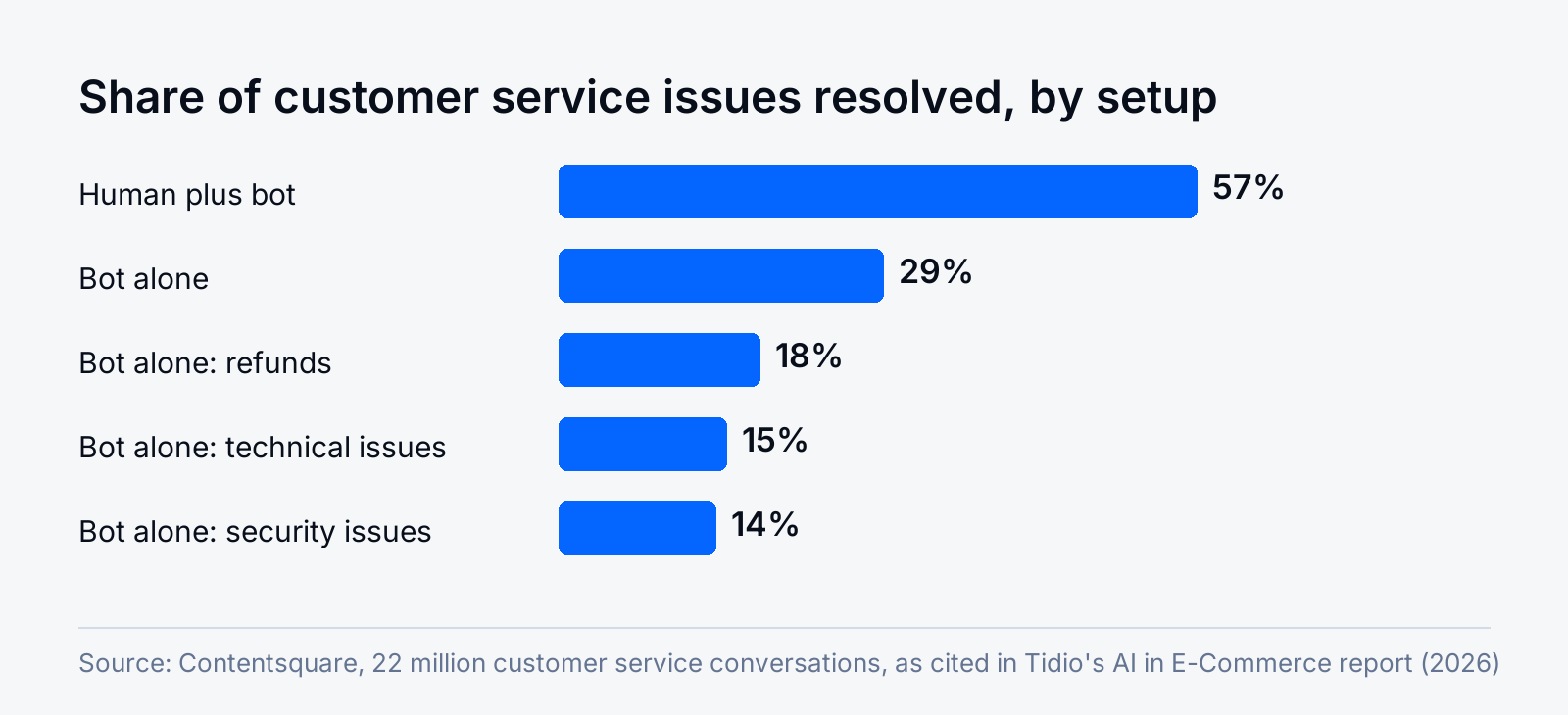
What this means: our reports point the same way as the rest of this page. A bot alone resolves far fewer issues than a bot with a person behind it, and the gap is widest for refunds, technical problems and security. Lyro, Tidio's AI agent, can resolve up to 75% of support requests, and Live Chat takes over the rest. Read more: customer service chatbots.
AI customer service ROI and workforce statistics
Spending on AI in service is rising fast, but proof of financial return is still thin, and most leaders are not cutting staff.
- 24% of customer service and support leaders have demonstrated positive financial returns across their AI use cases. (Gartner, 2026)[6]
- Only 28% of companies have unlocked measurable business value from generative AI in customer service (survey of 180 customer service leaders worldwide). (BCG, 2025)[26]
- Only 20% of customer service leaders have reduced agent staffing because of AI, and 55% report stable staffing while handling higher volumes (survey of 321 leaders, October 2025). (Gartner, 2025)[7]
- 85% of service and support leaders are adding new tasks to frontline agent roles, and 31% have implemented or plan AI-driven layoffs through the first quarter of 2027. (Gartner, 2026)[20]
- 37% of respondents say AI contributed to their organization's EBIT, and 80% say AI improved their individual productivity (1,719 participants in 97 countries, all functions). (McKinsey, 2026)[10]
What this means: the teams that show a return automate a narrow, high-volume slice of questions and count resolved conversations rather than chats started. Start with the five questions your team answers most. Read more: chatbot ROI.
AI customer service statistics by industry
E-commerce
AI is changing where shoppers start, and chat is where they ask follow-up questions.
- Traffic to U.S. retail sites from generative AI tools increased 693.4% year over year in the 2025 holiday season (November 1 to December 31). (Adobe Analytics, 2026)[27]
- AI-referred visits to U.S. retail sites converted 31% better than other traffic sources in the 2025 holiday season. (Adobe Analytics, 2026)[28]
- Amazon's shopping assistant, Rufus, was used by more than 300 million customers in 2025 and helped deliver nearly $12 billion in what Amazon calls incremental annualized sales. This is Amazon's own claim, and Amazon has not disclosed a holdout method. (Amazon, in Tidio's AI Shopping Assistants report, 2026)[23]
Reality check: Adobe's conversion finding flipped within a year. In July 2025, traffic from generative AI sources was 23% less likely to convert than other traffic,[29] and by the 2025 holiday season it was 31% more likely to.[28] Cite the period, not a single "AI traffic converts better" claim.
Banking
- About 37% of the U.S. population, over 98 million users, engaged with a bank's chatbot in 2022. This is the most recent official count, so treat it as a baseline. (Consumer Financial Protection Bureau, 2023)[30]
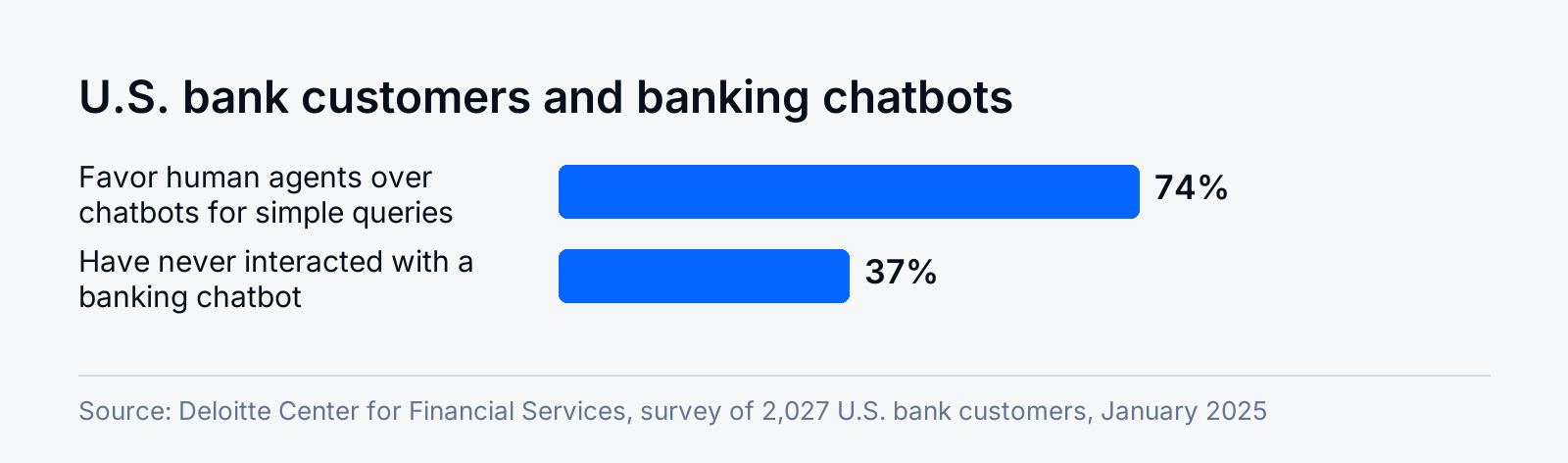
- 74% of 2,027 U.S. bank customers favored human agents over chatbots for simple queries, and 37% had never interacted with a banking chatbot (survey, January 2025). (Deloitte, 2025)[31]
Insurance
These figures come from our AI in insurance report.
- Only 29% of insurance customers are comfortable with generative AI virtual agents handling customer service (survey of 4,700 insurance customers in nine countries, 2024). (IBM Institute for Business Value, in Tidio's AI in Insurance report, 2026)[32]
- 75% of consumers prefer speaking to a live agent over a chatbot. (Five9, in Tidio's AI in Insurance report, 2026)[32]
- Customer service is the first AI priority for 67% of insurers, ahead of claims processing at 45% (survey of 150 carriers, 2024). (Gallagher Bassett, in Tidio's AI in Insurance report, 2026)[32]
- Ping An's AI service representatives were reached about 1.8 billion times in 2024, covering 80% of its total customer service volume. (Ping An, in Tidio's AI in Insurance report, 2026)[32]
What this means: the industry data is thinnest where the stakes are highest. Banking and insurance customers still want a person for simple questions. An AI agent in a regulated industry needs clear limits on what it answers and a visible way to reach a human. Read more: e-commerce live chat.
AI customer service trends and forecasts
Forecasts are labeled as forecasts. Check the target year before you reuse one.
- Gartner predicts agentic AI will autonomously resolve 80% of common customer service issues without human intervention by 2029, cutting operational costs by 30%. (Gartner, forecast for 2029)[8]
- Gartner predicts that by 2030 the cost per resolution for generative AI will exceed $3, higher than many B2C offshore human agents. (Gartner, forecast for 2030)[33]
- Gartner predicts that by 2028 AI regulation will increase assisted service volume by 30% as customers exercise a right to talk to a human. (Gartner, forecast for 2028)[33]
- Gartner predicts over 40% of agentic AI projects will be canceled by the end of 2027, because of escalating costs, unclear business value or inadequate risk controls. (Gartner, forecast for 2027)[34]
- Forrester predicts one third of companies will harm customer experiences with frustrating AI self-service in 2026. (Forrester, forecast for 2026)[35]
- Only 21% of companies planning agentic AI report a mature agent governance model (survey of 3,235 leaders, August to September 2025). (Deloitte, 2025)[36]
- Trust in fully autonomous AI agents fell from 43% to 27% in a year (survey of 1,500 executives, April 2025). (Capgemini Research Institute, 2025)[37]
What this means: the forecasts are bullish on automation and cautious on cost and governance. Plan for AI agents that act as well as answer, and agree on what they may do without a person before you switch them on. Read more: agentic AI and customer service trends.
Put an AI agent on your site with Tidio
Methodology and sources
Every statistic comes from the organization that collected it, such as a research firm's report, a press release, a government release or a peer-reviewed working paper, and we opened each source and found the number on the page. The exception is the lines marked "in Tidio's report": those quote the primary source as Tidio's report prints it, and each footnote leads to the report. Tidio's own usage data is left out because it has no published sample or period. We did not cite statistics roundups. Market-size figures name one research firm each and are never blended. Forecasts name the forecaster and target year. Where two sources disagree, we print both and explain the difference. Data is from 2024 to 2026 unless the sentence says it is a baseline.
AI customer service statistics: key takeaways
- Large service teams are adopting AI, with 91% of leaders under pressure to implement it, but only 7% of customers used a company chatbot last time.
- 87% of customers say a way to reach a human agent is essential, so design the handoff before the bot.
- Human-plus-bot setups resolved 57% of issues against 29% for bots alone, and bots alone do worst on refunds, technical and security issues.
- Only 24% of service leaders have shown positive financial returns from AI, so start narrow and measure resolved conversations.
- Gartner expects agentic AI to resolve 80% of common service issues by 2029, and also expects over 40% of agentic AI projects to be canceled by the end of 2027.
FAQ
Among large organizations, most. 62% of U.S. companies with $1 billion or more in revenue are building, deploying or developing AI agents (KPMG, 2026). Across all U.S. firms the share is much lower, about 18% for any AI use (Federal Reserve, 2026).
They are open to it but want a human option. 49% would have used a company chatbot and 50% say generative AI makes interactions easier, while 87% say access to a human agent is essential (Gartner, 2026).
Independent proof is limited. Only 24% of customer service leaders have shown positive financial returns across their AI use cases (Gartner, 2026). Agents using a generative AI assistant resolved 14% more issues per hour in one large study (NBER, 2023).
It depends on the setup. Human-plus-bot conversations reached a 57% resolution rate against 29% for bots alone in an analysis of 22 million conversations (Contentsquare, 2026). Gartner predicts agentic AI will resolve 80% of common issues by 2029 (Gartner, forecast for 2029).
Not in the current data. Only 20% of customer service leaders have reduced agent staffing because of AI (Gartner, 2025). 85% are adding new tasks to frontline agent roles (Gartner, 2026).
Start with Lyro, Tidio's AI agent