
Key takeaways
- Only 7% of customers used a company chatbot for service, but 49% were willing to. (Gartner, 2026)[1]
- 49% of U.S. adults use AI chatbots, and 24% use them daily. (Pew Research Center, 2026)[3]
- The global chatbot market reached $9.6 billion in 2025. (Grand View Research, 2026)[4]
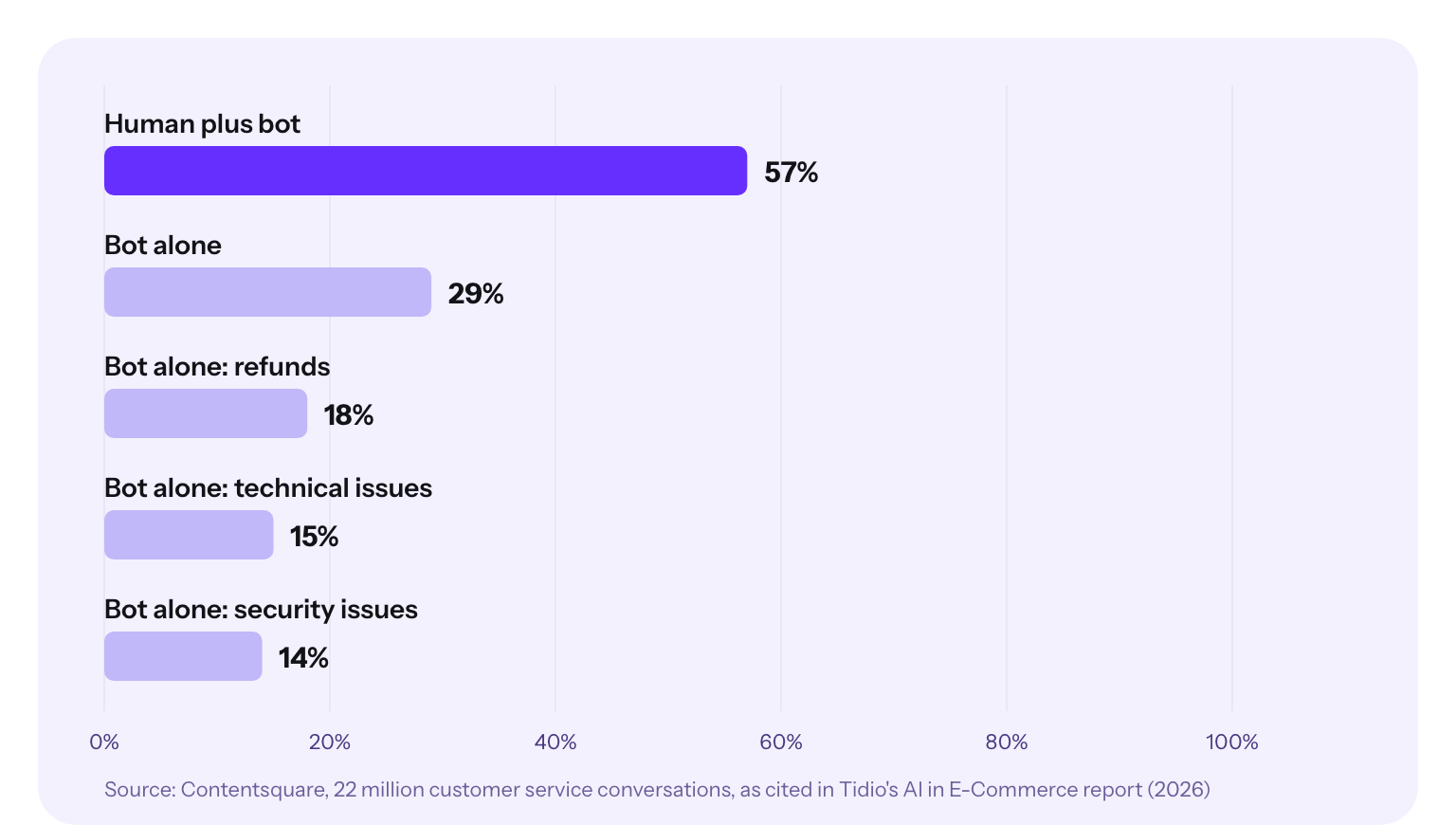
- Bots alone resolve 29% of service issues, and 57% with a human behind them. (Contentsquare, 2026)[5]
- 87% of customers say a way to reach a human agent is essential. (Gartner, 2026)[6]
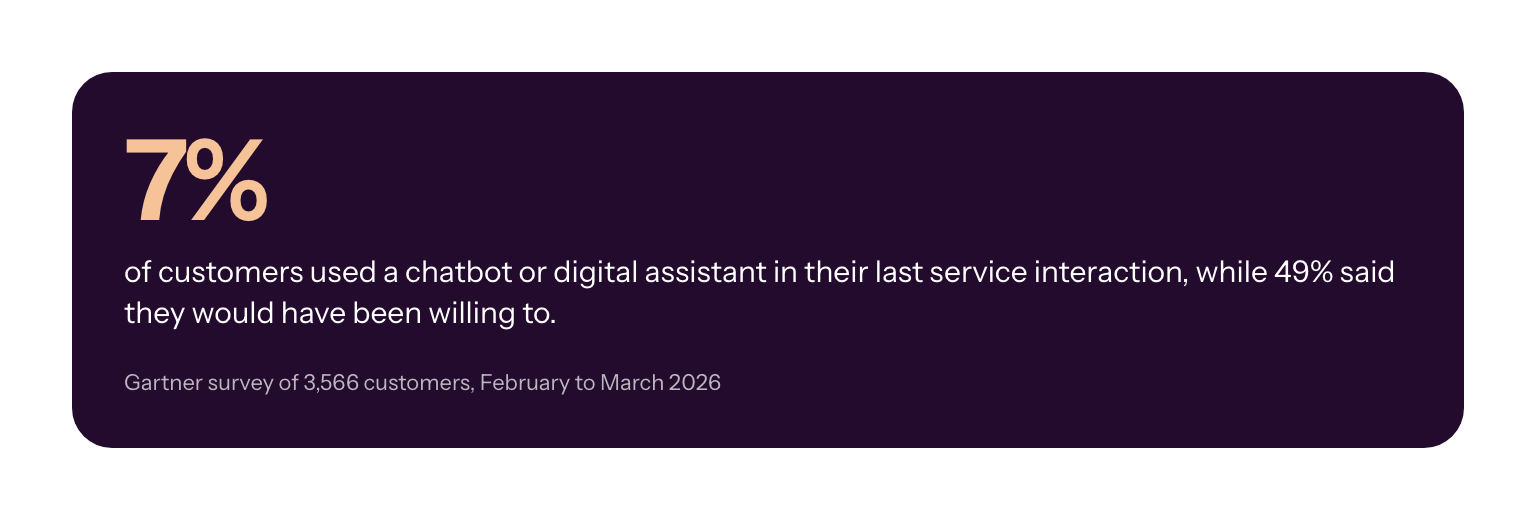
Chatbot statistics for 2026 show a gap between AI adoption and customer use. In a 2026 Gartner survey, only 7% of customers had used a company chatbot in their last customer service interaction, while 49% said they would have been willing to.[1] Chatbot adoption also depends on company size: 37% of U.S. firms with 250 or more employees use AI, against under 20% of firms with four or fewer.[2]
This page covers chatbot market size, adoption, customer trust, ROI and conversion rate data. It combines the 2026 research we published in our free reports with 40+ third-party reports and surveys from 2024 to 2026. Every number names the organization that collected it and links to the report that published it.
Use live chat to support your customers in real-time
Chatbot market size statistics
The chatbot market and the wider conversational AI market are each forecast to grow more than fourfold by 2033.
- The global chatbot market was valued at $9.6 billion in 2025 and is projected to reach $41.2 billion by 2033, a 19.6% CAGR from 2026 to 2033. (Grand View Research, 2026)[4]
- The global conversational AI market was valued at $14.3 billion in 2025 and is projected to reach $78.9 billion by 2033. (Grand View Research, 2026)[7]
What this means: growth is fast, but neither figure tells you how much your customers will use a chatbot. Read the next sections for that. For a plain-language overview, see our guide to AI chatbots and conversational AI.
Chatbot adoption and usage statistics
Chatbot adoption is high when you ask large organizations about any AI use, and much lower when you count every firm. Company size and the definition drive the number.
- 88% of organizations used AI in at least one business function in the prior year. (Stanford HAI, 2026)[8]
- Between 17% and 20% of U.S. businesses used AI from December 2025 to May 2026, and 20% to 23% expected to within six months (Business Trends and Outlook Survey). (U.S. Census Bureau, 2026)[2]
- 37% of U.S. firms with at least 250 employees and 32% of firms with 100 to 249 employees use AI, compared with less than 20% of firms with four or fewer employees. (U.S. Census Bureau, 2026)[2]
- Half of all workers at U.S. small businesses already use AI at work. Use rises with company size, from 43% at businesses with two to nine employees to 59% at businesses with 100 to 249 (survey of 1,070 adults, May 2026). (U.S. Chamber of Commerce Foundation and Ipsos, 2026)[9]
- 19.95% of EU enterprises with 10 or more employees used AI technologies in 2025, up 6.47 percentage points from 2024. (Eurostat, 2025)[10]
- 52% of U.S. employees use AI at work a few times a year or more, 30% a few times a week or more, and 15% daily. (Gallup, 2026)[11]
- 49% of U.S. adults say they use AI chatbots such as ChatGPT, Gemini or Copilot, up from 33% in 2024, and 24% use them daily. The 2024 question was asked only of people who had heard of chatbots, so the two years are not strictly comparable. (Pew Research Center, 2026)[3]
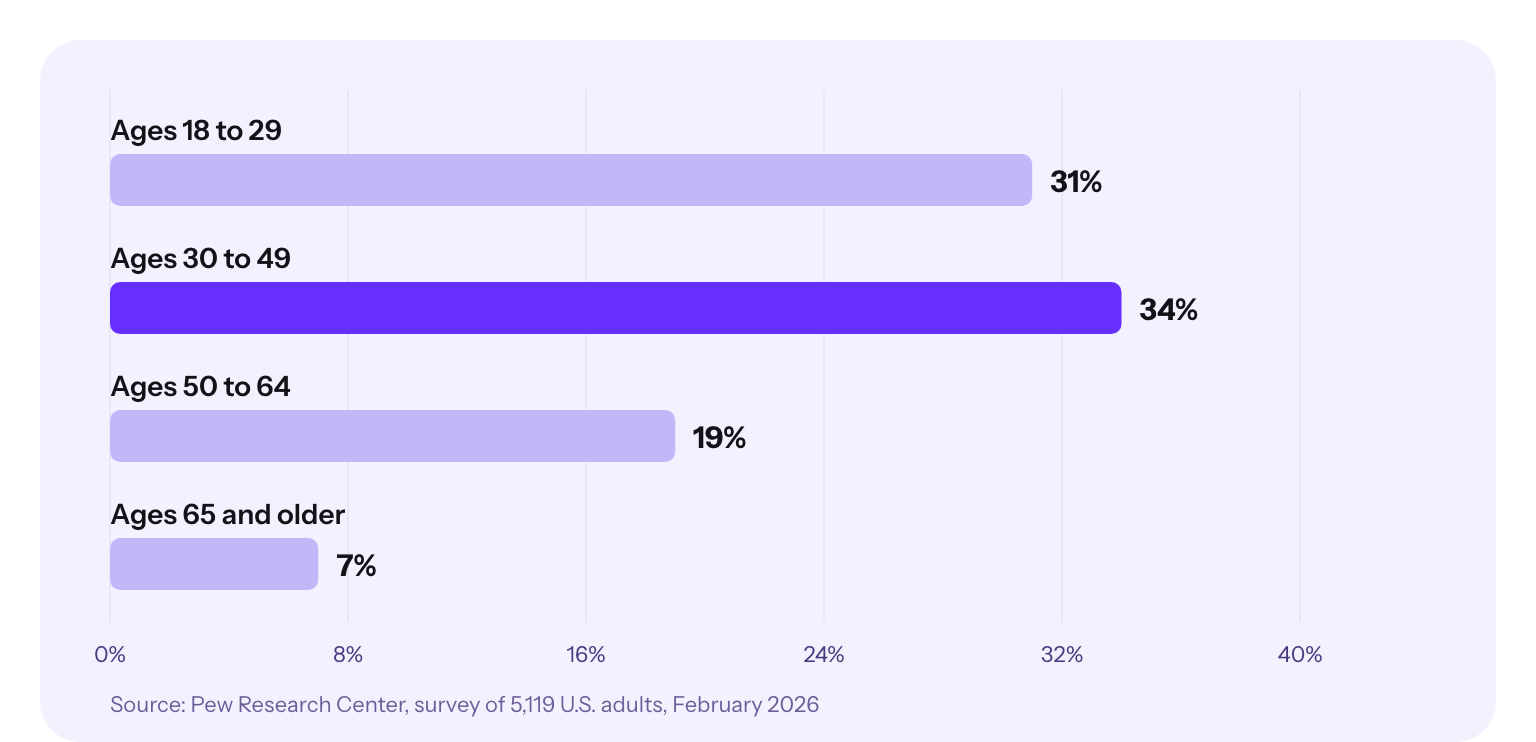
- 31% of U.S. adults aged 18 to 29 use AI chatbots daily, compared with 34% of those aged 30 to 49, 19% of those aged 50 to 64 and 7% of those 65 and older. (Pew Research Center, 2026)[3]
- 61% of U.S. adults used AI in the past six months and 19% use it daily (survey of 5,031 adults, April 2025). (Menlo Ventures, 2025)[12]
- Weekly use of generative AI nearly doubled from 18% to 34% between 2024 and 2025 across six countries. (Reuters Institute, 2025)[13]
Reality check: the 88% and the Census Bureau’s 17% to 20% describe the same economy. Stanford’s figure reflects organizations surveyed about any AI use in any function, while the Census survey counts all U.S. firms, including very small ones. Neither measures chatbots alone.
What this means: daily use of AI chatbots peaks between 18 and 49, and it falls sharply after 65. If your customers skew older, keep a clear route to a person next to the bot. Read more: chatbots for business.
Statistics from our research reports
We publish free research reports at getayro.ai/reports. The figures below come from four of them. Each report cites the primary source behind every number, and the lines here name that source and the report that carries it.
How well chatbots resolve customer service issues
These figures come from our AI in E-Commerce report on the new shopping funnel, built from almost 70 sources.
- Human-plus-bot conversations reached a 57% resolution rate, nearly double the 29% that bots achieved alone (analysis of 22 million customer service conversations). (Contentsquare, in Tidio’s AI in E-Commerce report, 2026)[5]
- Bot-only resolution drops to 18% for refunds, 15% for technical issues and 14% for security issues. (Contentsquare, in Tidio’s AI in E-Commerce report, 2026)[5]
- 82% of consumers prefer human customer support even when the outcome and the wait time are identical, from 73% of Gen Z to 91% of Boomers (global study of over 15,000 consumers). (HubSpot and SurveyMonkey, in Tidio’s AI in E-Commerce report, 2026)[5]
- 30% of consumers trust AI search results “a lot” or “completely,” and 28% have already stopped buying from a brand because of its AI use. (HubSpot and SurveyMonkey, in Tidio’s AI in E-Commerce report, 2026)[5]
- Shoppers trust AI agents run by retailers about three times more than third-party agents. (Bain, in Tidio’s AI in E-Commerce report, 2026)[5]
- Reluctance to let AI handle transactions fell from 66% in February 2025 to 32% in July 2025 (longitudinal survey of 4,000 consumers in the U.S., UK, Canada and Australia). (Omnisend, in Tidio’s AI in E-Commerce report, 2026)[5]
- 47% of consumers would trust a digital assistant to buy household essentials within a set budget. (Walmart Retail Rewired survey, in Tidio’s AI in E-Commerce report, 2026)[5]
- 69% of service professionals say their organizations use AI, and 39% say they use agentic AI. (Salesforce, in Tidio’s AI in E-Commerce report, 2026)[5]
How shoppers use retailer AI assistants
These figures come from our AI shopping assistants report. The report labels which numbers are measured and which are company claims, and so do the lines below.
- Amazon’s shopping assistant, Rufus, was used by more than 300 million customers in 2025 and helped deliver nearly $12 billion in what Amazon calls incremental annualized sales. This is Amazon’s own claim, and Amazon has not disclosed a holdout method. (Amazon, in Tidio’s AI Shopping Assistants report, 2026)[14]
- 250 million customers had used Rufus in 2025 as of Amazon’s Q3 report, and shoppers using it were 60% more likely to complete a purchase. This is an association between use and purchase, not proof that Rufus caused the extra sales. (Amazon, in Tidio’s AI Shopping Assistants report, 2026)[14]
- Shoppers used retailer AI and agents for customer service 126% more during the 2025 holiday season than in the two months before, and those agents took 142% more direct actions such as starting returns and updating delivery addresses (dataset of more than 1.5 billion shoppers in more than 89 countries). (Salesforce, in Tidio’s AI Shopping Assistants report, 2026)[14]
- Magalu’s WhatsApp shopping assistant reported conversion three times higher than its app and an NPS of 90. The company reported the result itself, so it shows what is possible, not a benchmark you can expect. (Magalu, in Tidio’s AI Shopping Assistants report, 2026)[14]
How employees use public chatbots at work
These figures come from our shadow AI report.
- 73.8% of workplace ChatGPT accounts are personal, non-corporate accounts without enterprise security or privacy controls. (Cyberhaven, in Tidio’s Shadow AI report, 2026)[15]
- 78% of AI users bring their own AI tools to work, and 80% do at small and mid-sized companies (survey of 31,000 people in 31 countries). (Microsoft, in Tidio’s Shadow AI report, 2026)[15]
- 48% of employees admit to using AI in ways that go against company policy, such as uploading sensitive company information into free public tools (study of 48,340 people in 47 countries). (KPMG and the University of Melbourne, in Tidio’s Shadow AI report, 2026)[15]
What this means: our reports point the same way as the rest of this page. A bot alone resolves far fewer issues than a bot with a person behind it, and the gap is widest for refunds, technical problems and security. Shoppers also warm to AI quickly when a retailer runs it. Lyro, the best AI agent for e-commerce stores and growing support teams, can resolve up to 75% of support requests, and Live Chat takes over the rest. Read more: customer service chatbots.
Chatbot customer preferences and trust statistics
Customers say they are open to chatbots, but they hold back when a bot has failed them or when no human is available. Most of the data below comes from one Gartner survey of 3,566 B2B and B2C customers, fielded in February and March 2026.
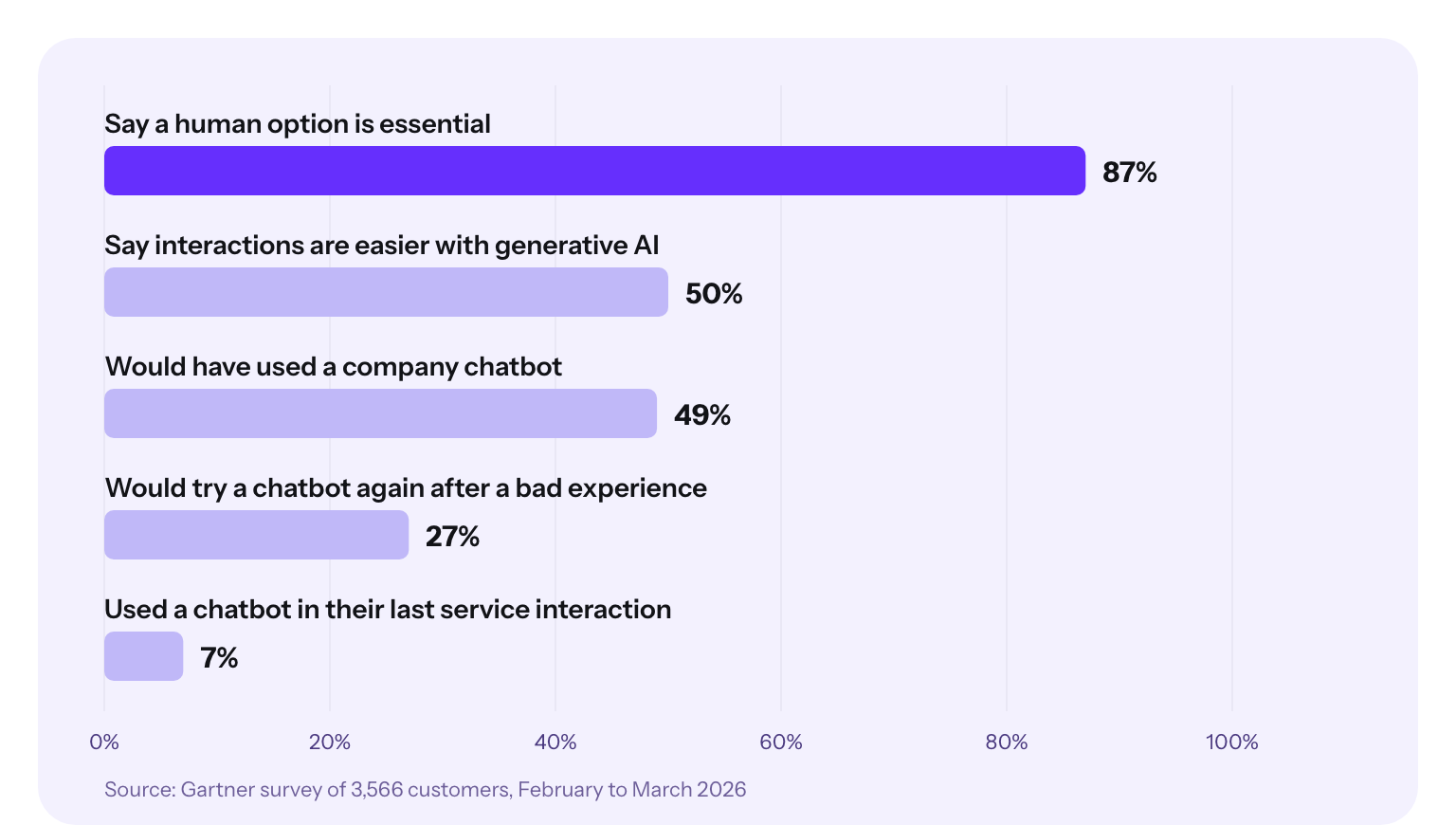
- 49% of customers would have been willing to use a company chatbot, but only 7% did in their most recent service interaction. (Gartner, 2026)[1]
- Only 27% of customers would try a chatbot again after a negative experience. (Gartner, 2026)[1]
- 87% of customers say it is essential that companies offer a way to reach a human agent when they use generative AI for customer service. (Gartner, 2026)[6]
- 50% of customers say their interactions are easier when companies use generative AI. (Gartner, 2026)[6]
- Customers are about three times more likely to use third-party generative AI tools than company-provided chatbots to resolve service issues. Use of company chatbots is statistically unchanged since 2022. (Gartner, 2026)[16]
- 58% of customers who use generative AI have used it to complete a task on their behalf, and 74% in B2B. (Gartner, 2026)[16]
Other recent surveys show the same split between willingness and preference.
- 79% of U.S. adults strongly prefer interacting with a human over an AI agent for customer service (survey of 2,017 U.S. adults, December 2025). (SurveyMonkey, 2025)[17]
- 54% of U.S. customers trust human agents more than AI for product or service recommendations, and 32% trust AI more (survey of 5,801 U.S. customers, early 2025). (Gartner, 2025)[18]
- 58% of consumers trust content written by generative AI, down from 72% two years earlier (survey of 10,027 consumers aged 18 to 80). (Capgemini Research Institute, 2025)[19]
- 42% of Gen Z consumers trust AI recommendations, compared with 34% of all consumers. (Capgemini Research Institute, 2025)[19]
- 71% of consumers feel chatbots have improved in quality over the past one to two years, but more than 70% still prefer human agents for empathy and creative problem-solving. (Capgemini Research Institute, 2025)[20]
- After a negative experience, 63% of customers switch providers and 61% reduce their spending. (Capgemini Research Institute, 2026)[21]
- 64% of customers said they would prefer that companies did not use AI for customer service (survey of 5,728 customers, December 2023). This is the older baseline that the 2026 data above updates. (Gartner, 2024)[22]
Reality check: Gartner’s 2024 release found 64% of customers would rather companies not use AI in service, while its 2026 survey finds 49% would use a company chatbot and 50% say generative AI makes interactions easier. The surveys ask different questions in different years, but the direction is clear: attitudes have softened, and the demand for a human option has not.
What this means: customers in this data accept chatbots, and they stop using one that has failed them. Give the bot a narrow job, make the handoff to a person one click, and measure failures separately from deflections. Read more: how bad customer service costs you repeat purchases.
Chatbot ROI and business impact statistics
Spending on AI in customer service is rising fast, but proof of financial return is still thin. Read the figures below as a status report.
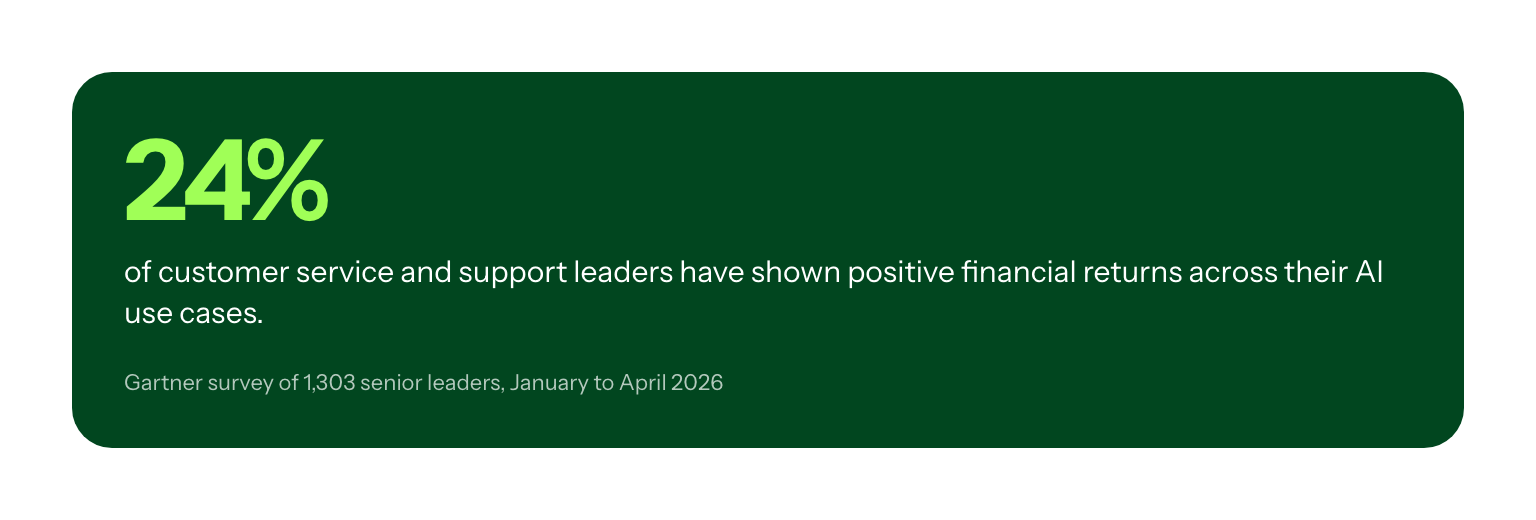
- 24% of customer service and support leaders have demonstrated positive financial returns across their AI use cases (survey of 1,303 senior leaders, January to April 2026). (Gartner, 2026)[16]
- Service and support leaders put a median 12% of their 2025 budget into AI, the highest of 10 business functions. (Gartner, 2026)[16]
- Customer service spending on AI rose 38% while overall service and support budgets grew 2% (survey of 199 leaders, April to May 2026). (Gartner, 2026)[23]
- 91% of customer service leaders report pressure from executive leadership to implement AI (survey of 321 leaders, October 2025). (Gartner, 2026)[24]
- Only 20% of customer service leaders have reduced agent staffing because of AI, and 55% report stable staffing while handling higher volumes. (Gartner, 2025)[25]
- Only 28% of companies have unlocked measurable business value from generative AI in customer service (survey of 180 customer service leaders worldwide). (BCG, 2025)[26]
- 37% of respondents say AI contributed to their organization’s EBIT, and 80% say AI improved their individual productivity (1,719 participants in 97 countries, all functions). (McKinsey, 2026)[27]
- Customer support agents resolved 14% more issues per hour on average after getting a generative AI assistant, and 34% more for novice and low-skilled agents (5,179 agents at one company, a 2023 study). (NBER, 2023)[28]
- Only 14% of customer service issues were fully resolved in self-service, and 36% even for very simple issues (survey of 5,728 customers, December 2023). This is the older baseline for self-service containment. (Gartner, 2024)[29]
What this means: the winners in this data automate a narrow, high-volume slice of questions and track resolved conversations rather than chats started. Start with the five questions your team answers most. Read more: chatbot ROI and customer service automation.
Chatbot statistics by industry
E-commerce chatbot statistics
AI is changing where shoppers start, and chat is where they ask follow-up questions.
- Traffic to U.S. retail sites from generative AI tools increased 693.4% year over year in the 2025 holiday season (November 1 to December 31). (Adobe Analytics, 2026)[30]
- AI-referred visits to U.S. retail sites converted 31% better than other traffic sources in the 2025 holiday season. (Adobe Analytics, 2026)[31]
- Generative AI traffic to U.S. retail sites grew 4,700% year over year in July 2025. (Adobe Analytics, 2025)[32]
- 38% of 5,000 U.S. consumers said they had used generative AI for online shopping, and 52% planned to this year. (Adobe, 2025)[32]
- AI-referred traffic grew 539% for travel and 266% for financial services in the 2025 holiday season. (Adobe Analytics, 2026)[31]
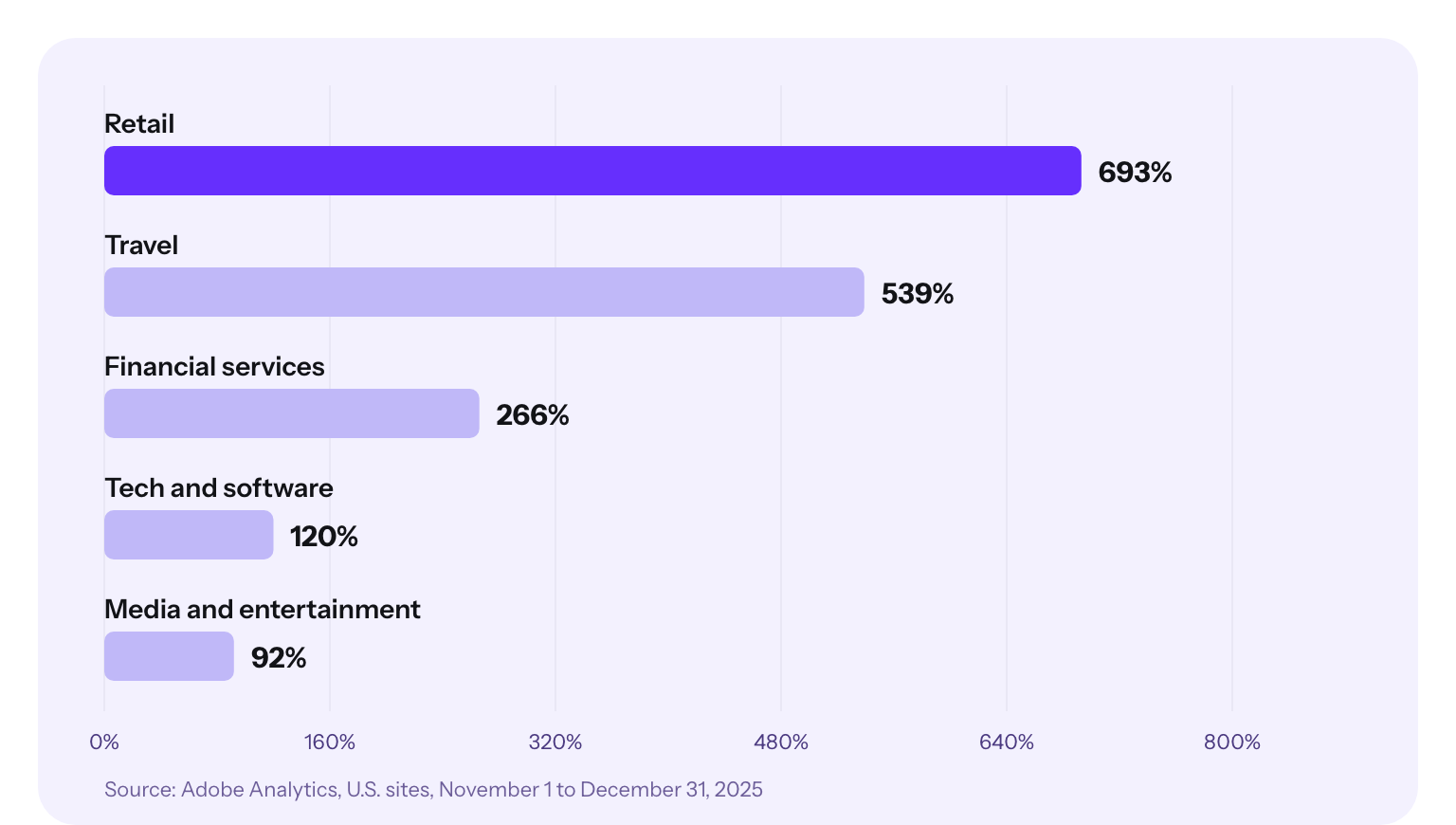
Reality check: Adobe’s conversion finding flipped within a year. In July 2025, traffic from generative AI sources was 23% less likely to convert than other traffic,[32] and by the 2025 holiday season it was 31% more likely to.[31] Cite the period, not a single “AI traffic converts better” claim.
No independent primary source publishes a cross-industry chatbot conversion rate. Vendor case studies exist, but we do not quote them as benchmarks. Read more: e-commerce live chat and retail chatbots.
Banking chatbot statistics
- About 37% of the U.S. population, over 98 million users, engaged with a bank’s chatbot in 2022. This is the most recent official count, so treat it as a baseline. (Consumer Financial Protection Bureau, 2023)[33]
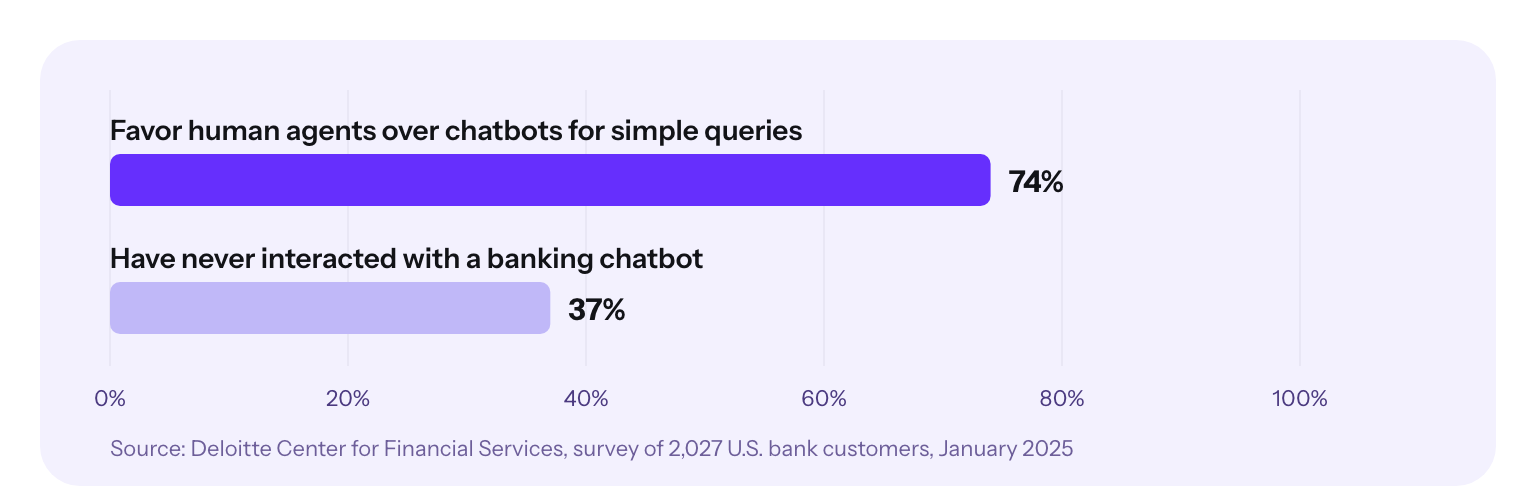
- 37% of 2,027 U.S. bank customers said they had never interacted with a banking chatbot (survey, January 2025). (Deloitte, 2025)[34]
- 74% of the same bank customers favored human agents over chatbots for simple queries. (Deloitte, 2025)[34]
Healthcare chatbot statistics
- 32% of U.S. adults turned to AI chatbots for health information in the past year (1,343 adults surveyed, February 24 to March 2, 2026). (KFF, 2026)[35]
- 41% of U.S. adults who use AI chatbots for health information have uploaded personal medical information such as test results, which is 13% of all adults. (KFF, 2026)[35]
Insurance chatbot statistics
These figures come from our AI in insurance report.
- Only 29% of insurance customers are comfortable with generative AI virtual agents handling customer service, and 26% trust the reliability of generative AI advice (survey of 4,700 insurance customers in nine countries, 2024). (IBM Institute for Business Value, in Tidio’s AI in Insurance report, 2026)[36]
- 20% of Americans consider it a good idea for property and casualty insurers to use AI, down from 29% a year earlier. (Insurity, in Tidio’s AI in Insurance report, 2026)[36]
- 75% of consumers prefer speaking to a live agent over a chatbot. (Five9, in Tidio’s AI in Insurance report, 2026)[36]
- Customer service is the first AI priority for 67% of insurers, ahead of claims processing at 45% (survey of 150 carriers in North America, the UK, Australia and New Zealand, 2024). (Gallagher Bassett, in Tidio’s AI in Insurance report, 2026)[36]
- Ping An’s AI service representatives were reached about 1.8 billion times in 2024, covering 80% of its total customer service volume. (Ping An, in Tidio’s AI in Insurance report, 2026)[36]
HR chatbot statistics
- 38% of HR leaders were piloting, planning or had implemented generative AI (survey of 179 HR leaders, January 2024), up from 19% in June 2023. (Gartner, 2024)[37]
- An employee-facing chatbot was the top generative AI priority for HR leaders, chosen by 43%. (Gartner, 2024)[37]
What this means: the industry data is thinnest where the stakes are highest. Banking and insurance customers still want a person for simple questions, and one in three adults already asks chatbots about health. A chatbot in a sensitive industry needs clear limits on what it answers and a visible way to reach a human.
Chatbot trends and forecasts
Forecasts are labeled as forecasts. Check the target year before you reuse one.
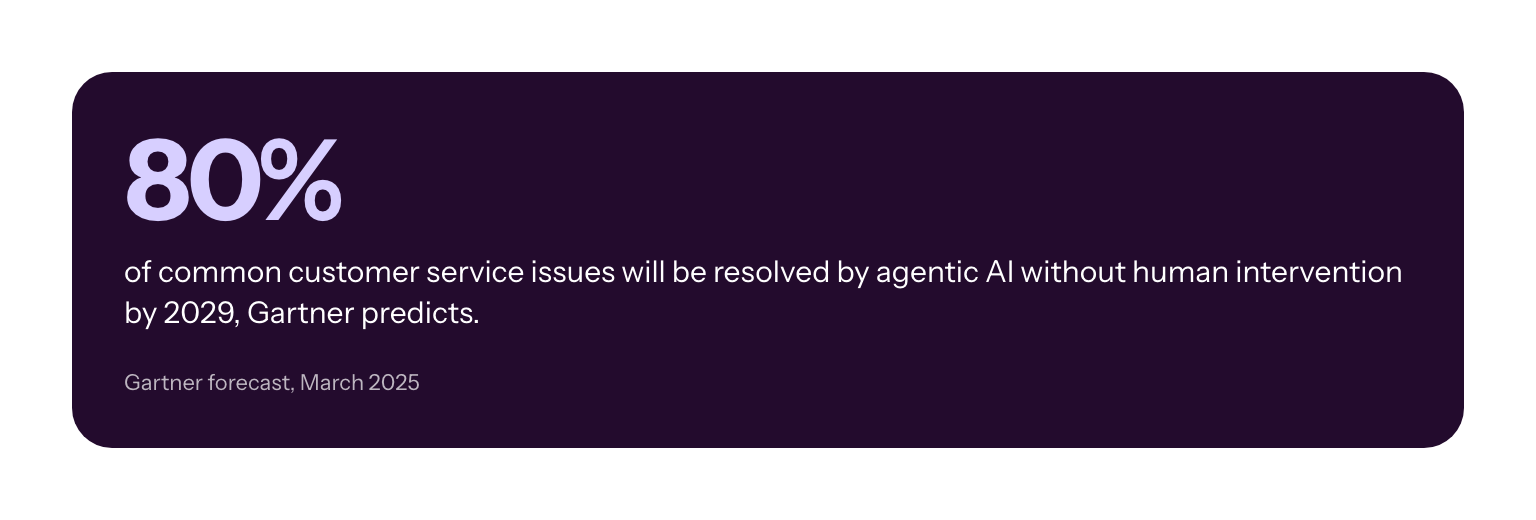
- Gartner predicts agentic AI will autonomously resolve 80% of common customer service issues without human intervention by 2029, cutting operational costs by 30%. (Gartner, forecast for 2029)[38]
- Gartner predicts that by 2030 the cost per resolution for generative AI will exceed $3, higher than many B2C offshore human agents. (Gartner, forecast for 2030)[39]
- Gartner predicts that by 2028 AI regulation will increase assisted service volume by 30% as customers exercise a right to talk to a human. (Gartner, forecast for 2028)[39]
- Gartner predicts over 40% of agentic AI projects will be canceled by the end of 2027, because of escalating costs, unclear business value or inadequate risk controls. (Gartner, forecast for 2027)[40]
- Forrester predicts one third of companies will harm customer experiences with frustrating AI self-service in 2026. (Forrester, forecast for 2026)[41]
- 40% of respondents at organizations with revenue above $1 billion report scaling AI agents, up from 27% a year earlier, and 22% at smaller firms (all functions, not only customer service). (McKinsey, 2026)[27]
- 62% of U.S. organizations with $1 billion or more in revenue are building, deploying or developing AI agents, up from 53% a quarter earlier (survey of 314 leaders, July to August 2026). (KPMG, 2026)[42]
- Only 21% of companies planning agentic AI report a mature agent governance model (survey of 3,235 leaders, August to September 2025). (Deloitte, 2025)[43]
- Trust in fully autonomous AI agents fell from 43% to 27% in a year (survey of 1,500 executives, April 2025). (Capgemini Research Institute, 2025)[44]
- Only 49% of organizations consider themselves prepared to offer AI-powered customer service (survey conducted November to December 2024). (Capgemini Research Institute, 2025)[20]
What this means: the forecasts are bullish on automation and cautious on cost and governance. Plan for AI agents that act as well as answer, and agree on what they may do without a person before you switch them on. Read more: agentic AI and customer service trends.
Put an AI agent on your site with Tidio
Chatbot statistics: key takeaways
- The chatbot market was worth $9.6 billion in 2025, and the conversational AI market $14.3 billion.
- Only 7% of customers used a company chatbot in their last service interaction, although 49% would have been willing to.
- 87% of customers say a way to reach a human agent is essential.
- Only 24% of service leaders have shown positive financial returns from AI, so start narrow and measure resolved conversations.
- Agentic AI is the main forecast to watch, and Gartner expects it to resolve 80% of common service issues by 2029.
FAQ
Grand View Research valued the global chatbot market at $9.6 billion in 2025 and projects $41.2 billion by 2033.[4] It puts the wider conversational AI market at $14.3 billion in 2025.[7]
49% of U.S. adults say they use AI chatbots such as ChatGPT, Gemini or Copilot, and 24% use them daily (Pew Research Center, 2026).[3] Customer service use is lower: only 7% of customers used a company chatbot in their last service interaction (Gartner, 2026).[1]
Between 17% and 20% of U.S. businesses used AI in the first half of 2026, and adoption rises with company size, to 37% of firms with 250 or more employees (U.S. Census Bureau, 2026).[2] Among larger organizations surveyed about any AI use, 88% used it in at least one business function (Stanford HAI, 2026).[8]
Customers are open to them but want a human option. 49% would have used a company chatbot and 50% say generative AI makes interactions easier, while 87% say access to a human agent is essential (Gartner, 2026).[6]
Independent data is limited. Only 24% of customer service leaders have shown positive financial returns across their AI use cases (Gartner, 2026).[16] Agents using a generative AI assistant resolved 14% more issues per hour in one large study (NBER, 2023).[28]
No independent primary source publishes one benchmark. The closest verified figure is Adobe’s: AI-referred visits to U.S. retail sites converted 31% better than other traffic in the 2025 holiday season.[31] Measure your own bot against your own baseline.
Start with Lyro, the AI agent for growing support teams