Key takeaways
- Best for small teams and online stores that need human handoff: Tidio. The Lyro AI agent passes the whole chat to your team in one inbox with live chat, email tickets and social channels. Starter with Lyro runs $33/month billed annually with up to 10 seats included on self-serve plans; Lyro and human replies share one conversation quota. A free plan exists too.
- Closest low-cost swap for a website bot: Chatling. A no-code bot trained on your content, live chat on every plan, from $25 a month.
- Best for developers: Botpress. A free plan with 100 conversations a month and a builder for custom agents and integrations.
- Best for support-heavy SaaS teams: Intercom. The Fin AI agent costs $0.99 per outcome on top of seat plans.
- Check the billing unit, not only the price. Chatbase counts message credits, and the credits a reply uses depend on the AI model you pick. Rivals count conversations, queries, replies or outcomes.
Tidio is the Chatbase alternative we'd start with for small support teams and online stores that want an AI chatbot and live chat with human handoff in one inbox. You get up to 10 seats included on self-serve plans with Starter with Lyro, at $33/month billed annually, and Lyro and human replies draw on one conversation quota of 50 a month. Per Chatbase's pricing page, it has no free plan, starts at $120 a month billed yearly for 4,000 message credits, and charges $99 a month to remove its branding. If you only need a low-cost website bot, Chatling is the closer swap, and developers will find more room in Botpress.
Tidio is our product; here's how we compared. Each tool's billing unit and price come from its own pricing page, the knowledge base training and handoff features were checked in its docs, and Tidio's cons sit in the same format as every rival's. How we chose.
Chatbase alternatives at a glance
Entry paid plans per month, billing basis in each cell.
| Tool | Best for | Starting price | Free plan / trial | Live chat with humans | G2 rating |
|---|---|---|---|---|---|
| Tidio | Small teams and online stores that want AI and a human inbox in one plan | $24/mo billed annually (Human only), $33/mo for Starter with Lyro; up to 10 seats included on self-serve plans | Free plan · 7-day trial | Yes, every plan | 4.6 (2,169)[1] |
| Chatling | A low-cost no-code website bot | $25/mo billed monthly ($250/yr) | Free plan (200 credits) | Yes, every plan | 4.7 (83)[2] |
| Wonderchat | A docs-trained bot with a shared inbox | $32.50/mo billed yearly, $39 monthly | Free plan (50 AI replies) | Yes, every plan | 4.9 (25)[3] |
| Botpress | Developers building custom agents | Plus $150/mo billed annually, $189 monthly | Free plan (100 conversations) | Yes, via Botpress Desk | 4.5 (519)[4] |
| Intercom | Support-heavy SaaS teams | $19/seat billed annually for new customers ($29 list), plus $0.99 per Fin outcome | 14-day trial | Yes | 4.5 (3,981)[5] |
| SiteGPT | A simple bot trained on your website | $39/mo billed yearly, $59 monthly | 7-day trial (card) | From Growth, in its iOS app | 4.9 (12)[6] |
| CustomGPT.ai | Large document libraries | $89/mo billed yearly, $99 monthly | 7-day trial (card) | Not on the pricing page | 4.8 (11)[7] |
| Crisp | Live chat first, AI second, on a flat price | Mini $45/mo per workspace, 4 seats | Free plan (2 seats) · 14-day trial | Yes | 4.5 (207)[8] |
| Zendesk | Large teams on chat, email and phone | Support Team $19/agent billed annually | 14-day trial | Yes | 4.3 (7,130)[9] |
| Botsonic | The lowest entry price | $16/mo billed annually, $19 monthly | 7-day trial | Through a Zendesk handoff add-on | 4.6 (107)[10] |
| Voiceflow | Enterprise and agency teams designing custom agents | Contact sales | Free trial (agencies) | Not on the pricing page | 4.5 (115)[11] |
Chatbase itself holds a 4.7 on G2 from 41 reviews.[12] Prices change often, so confirm each one with the vendor.
Why teams look for a Chatbase alternative
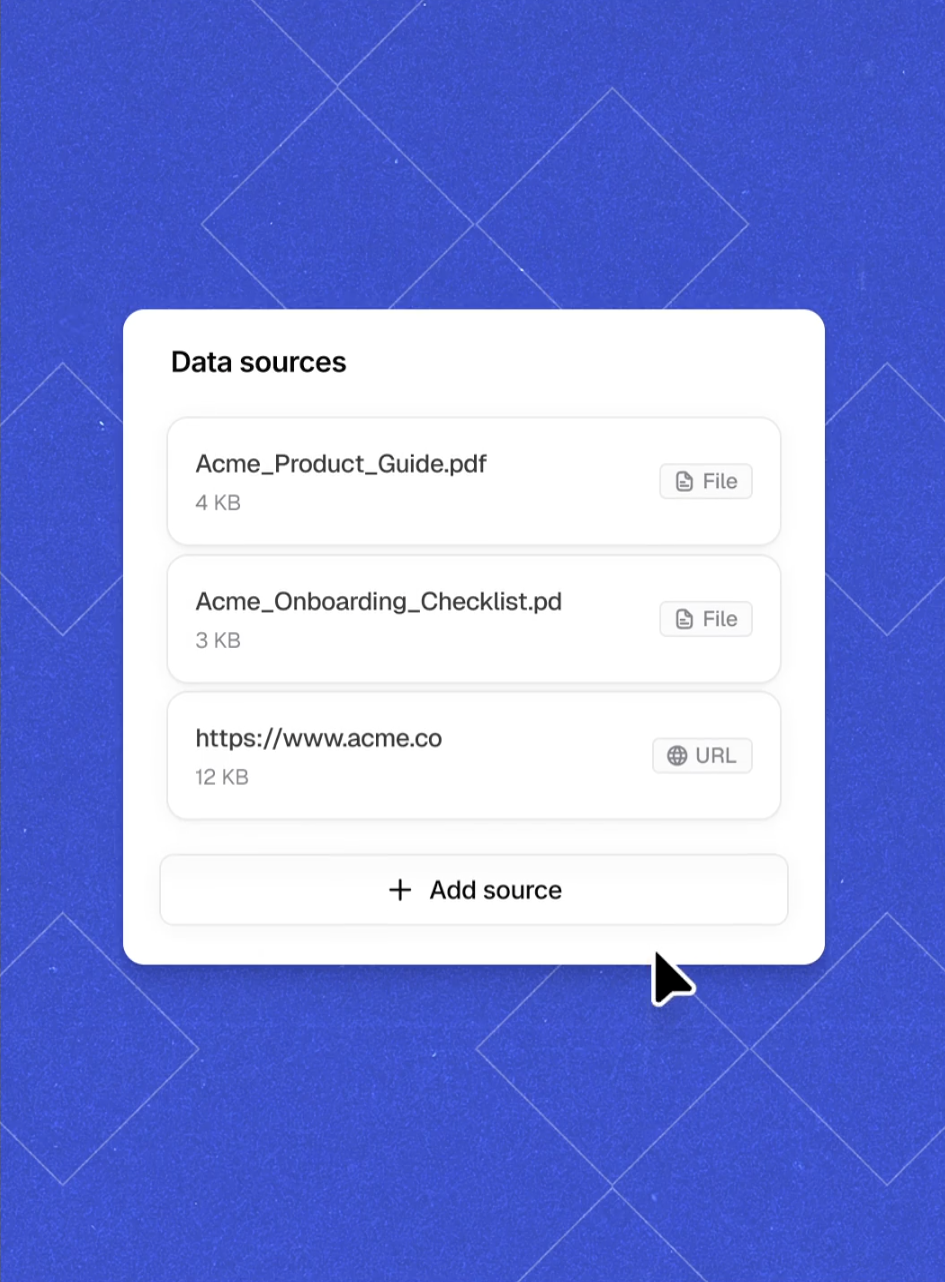
Chatbase does a lot well. Point it at your website, files or Notion pages and you have an AI agent that answers in your customers' language. It ships its own helpdesk inbox with live chat and routing, works on WhatsApp, Instagram, Messenger, email and phone, lets you pick models from OpenAI, Anthropic, Google Gemini and others, and includes unlimited team members.
The reasons people leave all show up on Chatbase's own pricing page:
- The entry price went up. The cheapest plan is Basic at $120 a month billed yearly ($150 monthly), and there is no free plan, only a 7-day trial. Older reviews mention a $40 Hobby plan that the page no longer lists.
- Credits are hard to budget. Each AI request costs message credits, and how many depends on the model you choose. Actions can use several requests per reply. Basic includes 4,000 credits a month, and extra credits cost $40 per 1,000.
- Branding removal is a separate bill. Removing "Powered by Chatbase" costs $99 a month on top of the plan.
- One AI agent per plan. Basic and Business include one agent each; a second one costs $25 a month.
How we chose these alternatives
A tool made the list only if it does Chatbase's core job (an AI agent trained on your own website and documents that answers customers on your site), publishes its prices or a free plan, and gives a Chatbase customer a clear reason to switch: a lower entry price, a free plan, live chat with human handoff, simpler AI billing, Shopify tools or deeper build control. Voiceflow is the one exception on prices; it's included for agencies and enterprise teams. We then compared entry price, billing unit, human handoff, fit and G2 rating (a score from a dozen reviews says less than one from several hundred).
This comparison is published by Tidio, which also appears in it, first for one segment (small teams and online stores) and with cons like every other entry. No paid plans were bought for it: the review used vendor pricing pages and documentation for prices and features, and G2 for ratings.
The 11 best Chatbase alternatives in 2026
1. Tidio
Best for: small and mid-sized teams and online stores that want an AI agent and a human support inbox in one plan.
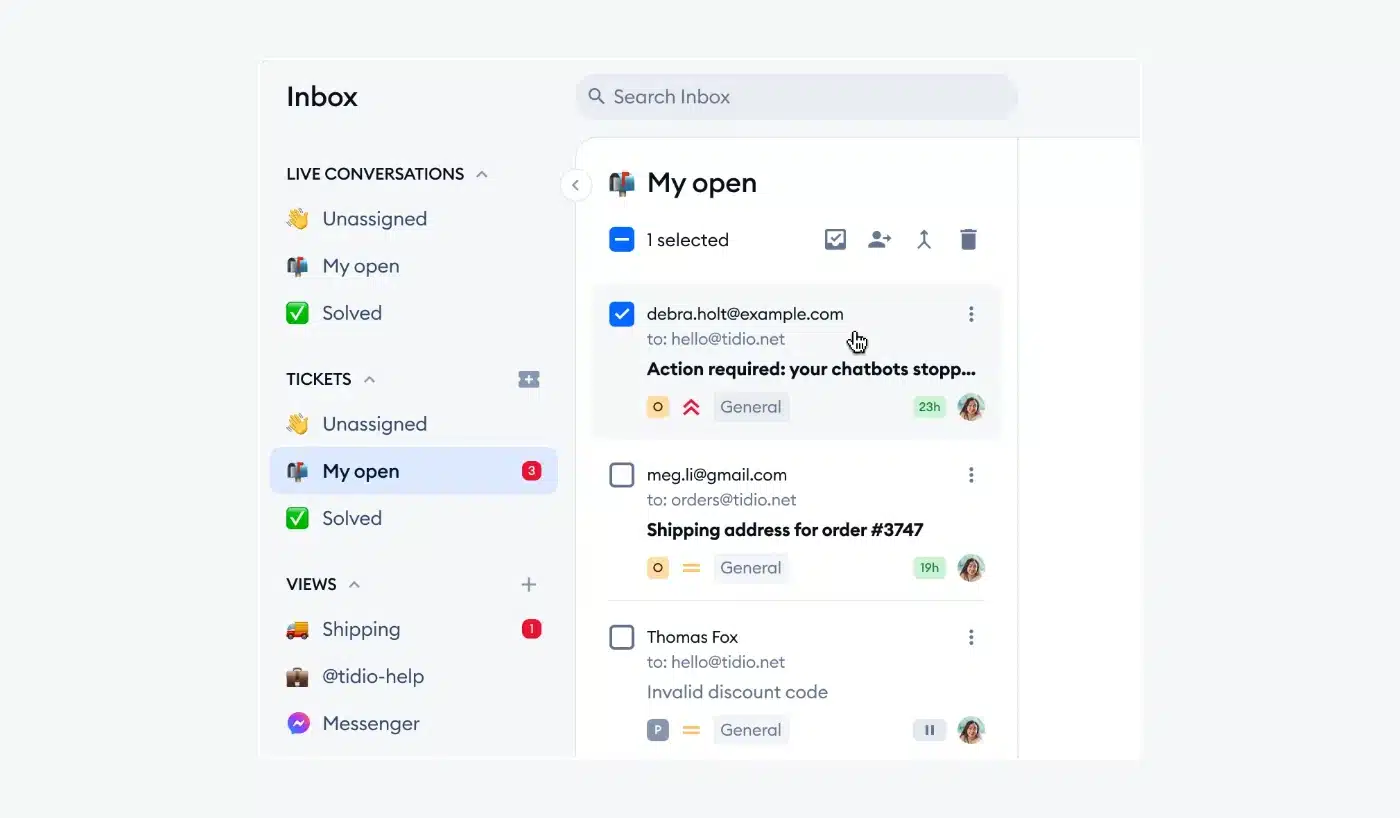
Chatbase starts from the AI agent and added a helpdesk around it. Tidio started from live chat and an inbox, then added AI. The Lyro AI agent learns from your website and help content, answers in 51 languages and passes the entire conversation to your team when it can't help. Outside your hours, it can instead collect the visitor's email and open a ticket with the transcript. Lyro works on live chat, email, Messenger, Instagram and WhatsApp, and the WhatsApp integration is available on every plan. Every reply lands in the same inbox your agents use.
Pricing follows conversations, not credits or messages. Lyro and human replies share one conversation quota, and a conversation counts once, however many messages it has (how the limit works). Shopify sellers get a native integration: agents see what is in the shopper's cart during the chat, and from Growth up they can open order history and edit orders without leaving the inbox.
Pros
- AI agent, live chat, email tickets and social channels in one plan, with no per-model credit math.
- Starter with Lyro from $33/month billed annually, up to 10 seats included on self-serve plans, a free plan and a 7-day trial with Lyro and no card.
- Built-in e-commerce tools for Shopify stores.
Cons
- Lyro and your team draw on one shared conversation quota, with Flows on its own limit, so a busy season means watching a couple of numbers.
- Self-serve plans fit up to 10 seats; bigger teams move to Plus or Premium, which are set up with the sales team.
Pricing:
- Free: 50 human conversations/month, 100 Flows visitors/month + 50 one-time Lyro AI conversations.
- Starter: Human only: from $24/month for 100 conversations. With Lyro AI: from $33/month for 50 conversations shared by AI and your team.
- Growth: from $41/month for 200 human conversations or $63/month for 100 AI + human conversations; scalable to 1,000/month.
- Plus: from $300/month + usage. Premium: custom pricing.
- Optional add-ons: Flows, Inbox AI, Help Center, Voice, and branding removal.
- 7-day free trial: Growth features with Lyro AI and 100 AI + human conversations, no card required; moves to Free unless you choose a paid plan.
Starting prices shown with annual billing.
See Tidio pricing for every tier.
Rating: G2 4.6/5 (2,169 reviews)
What a G2 reviewer says: "The interface feels clean, conversations are easy to organize and manage, and it’s simple to switch from automated replies to a live agent whenever needed." (4.5-star review of the AI-to-agent handoff)
Versus Chatbase: you gain a free plan, a lower entry price, a support inbox built around live chat and e-commerce tools in the chat. You give up unlimited team members and the option to pick models from several AI providers.
Try Tidio free
2. Chatling
Best for: small sites that want a no-code bot trained on their content, at a low price.
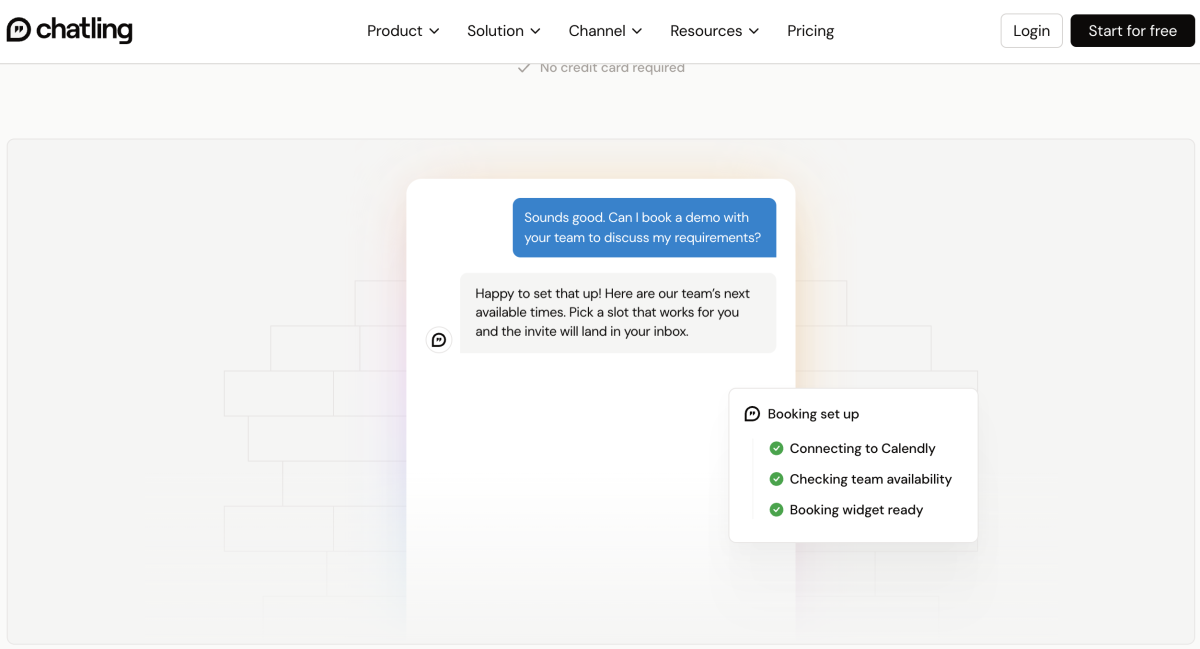
Chatling works like Chatbase did for small sites: add your website or files, style the widget, embed it. It includes live chat on every plan, Free included.
Pros
- Free plan with 200 AI credits a month, enough to test on real traffic.
- Starter costs a fraction of Chatbase Basic.
Cons
- Credits run out fast on busy sites; extra credits cost $10 per 1,000.
- Branding removal is a $35 add-on below the Scale plan.
Pricing: Starter $25 a month billed monthly ($250 a year) with 1,750 credits and 2 seats; Growth $75 a month with 6,000 credits; Scale $295 a month with 35,000 credits and branding removed, per its pricing page.
Rating: G2 4.7/5 (83 reviews)
Versus Chatbase: you gain a free plan and a much lower entry price. You give up the voice, outbound campaigns and larger credit allowance that Chatbase Basic includes.
3. Wonderchat
Best for: teams that want a docs-trained bot with a shared inbox and helpdesk from the free plan up.
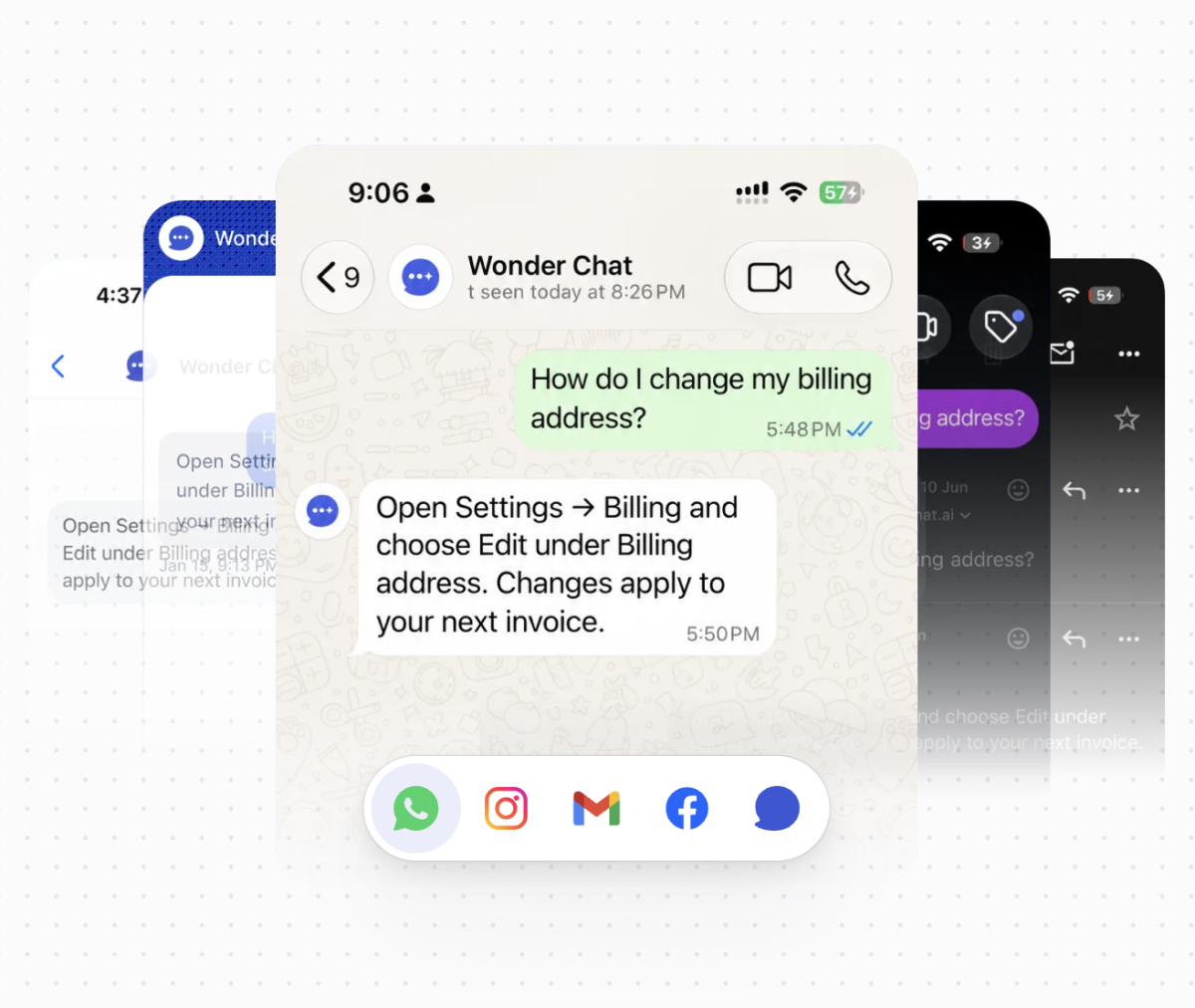
Wonderchat trains on your website and documents and wraps the bot in a helpdesk: live chat handover, a shared inbox and tickets, on every plan.
Pros
- Free plan with 50 AI replies a month and 2 seats.
- Starter includes unlimited seats, so a growing team doesn't pay per person.
Cons
- Starter's 500 AI replies a month suit a small site; the next plan, Basic, jumps to $125 a month billed yearly.
- The G2 score comes from a small sample (25 reviews).
Pricing: Starter $32.50 a month billed yearly ($39 monthly) with 500 AI replies; Basic $125 a month billed yearly ($149 monthly) with 3,000 replies, per its pricing page.
Rating: G2 4.9/5 (25 reviews)
Versus Chatbase: you gain a free plan, a cheaper first paid tier and unlimited seats from Starter. You give up Chatbase's choice of AI models and the larger allowance on its entry plan.
4. Botpress
Best for: developers and technical teams that want to build custom agents with their own logic and integrations.
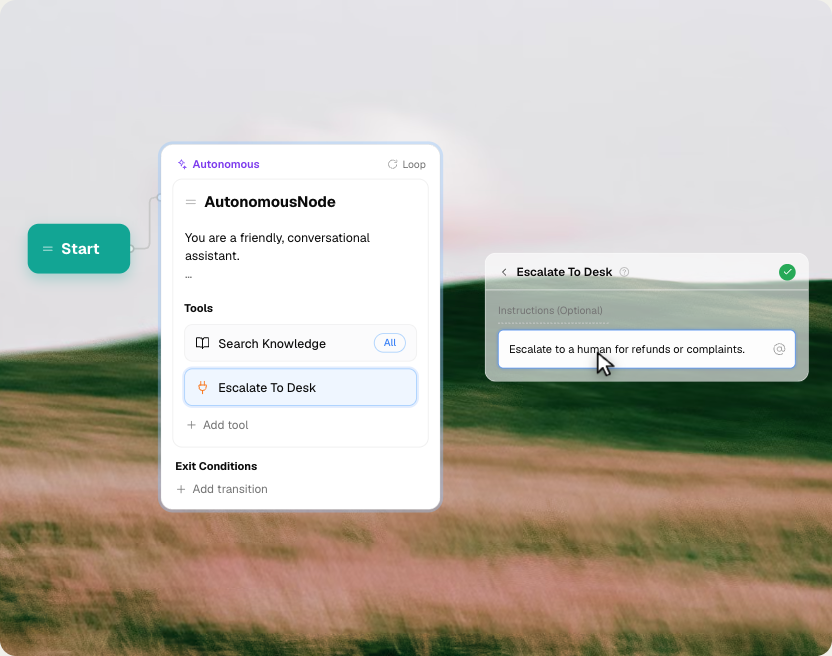
Botpress is a builder, not a plug-and-play bot: a visual studio, code where you need it, a knowledge base and CRM and helpdesk integrations. Botpress Desk adds human handoff.
Pros
- Free plan with 100 conversations a month and up to 3 AI agents.
- Billed per conversation, with AI usage included up to a limit, so costs track traffic.
Cons
- Plus costs as much as Chatbase Basic ($150 a month billed annually), so it is not a cheaper option on paid plans.
- A steeper learning curve than no-code website bots.
Pricing: Plus $150 a month billed annually ($189 monthly) with 250 conversations and $25 of AI usage; Team $750 a month billed annually with 1,500 conversations, per its pricing page. Extra conversations come in packs of 100.
Rating: G2 4.5/5 (519 reviews)
Versus Chatbase: you gain more control over logic, integrations and deployment, plus a usable free plan. You give up the ten-minute setup.
5. Intercom
Best for: support-heavy SaaS teams that want an AI agent inside a full customer service platform.
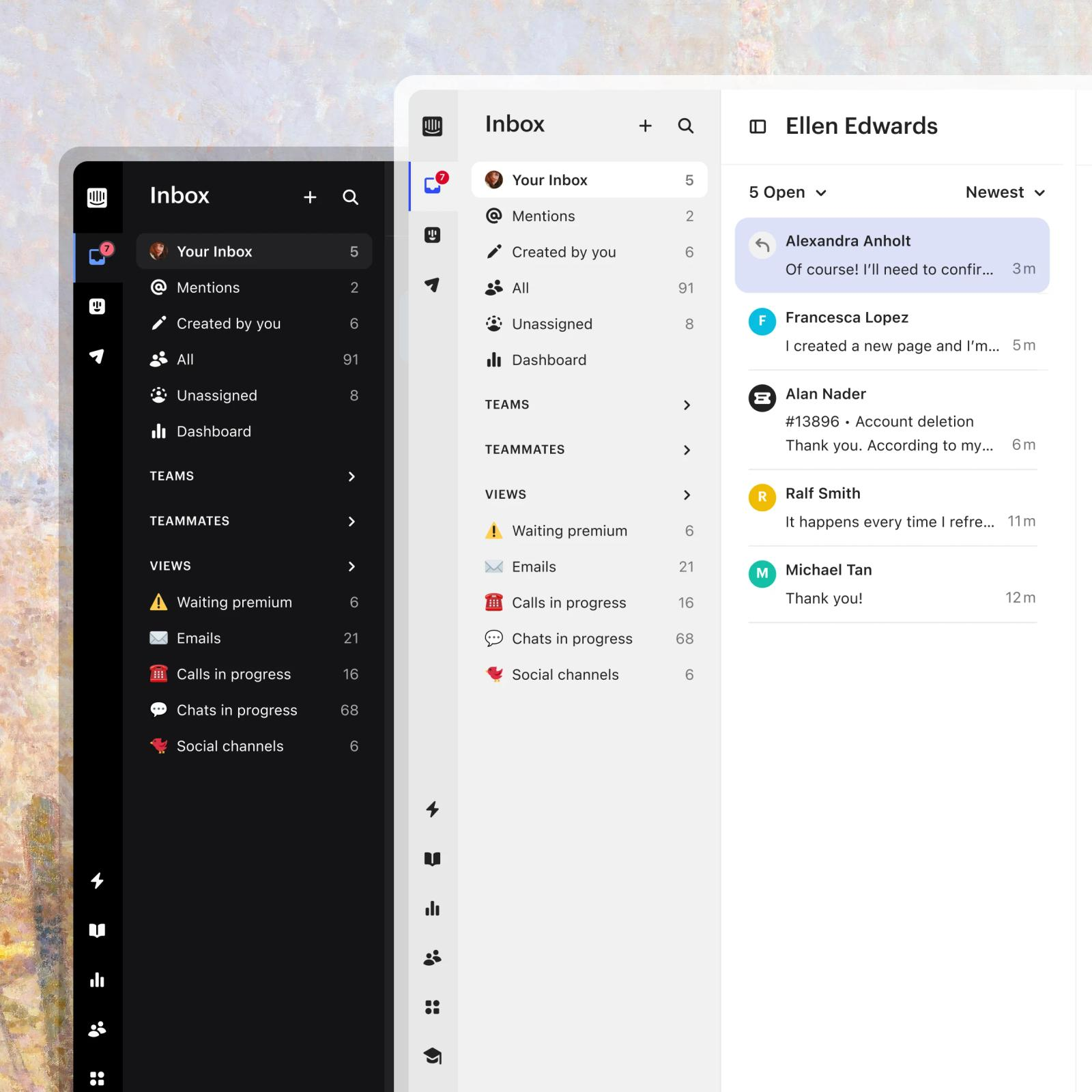
Intercom pairs the Fin AI agent with a mature inbox, tickets, a help center and reporting. Fin is billed per outcome rather than per message, at most once per conversation.
Pros
- Mature support tooling for teams with a large ticket load.
- No Fin charge when it can't answer or when the customer asks for a person.
Cons
- Seats plus outcomes add up fast for a growing team.
- No free plan, only a 14-day trial.
Pricing: Essential $19 per seat a month billed annually for new customers ($29 list), Advanced $85 and Expert $132, plus $0.99 per Fin outcome, per its pricing page.
Rating: G2 4.5/5 (3,981 reviews)
Versus Chatbase: you gain a full support platform with years of tooling behind it. You give up flat monthly pricing; Intercom's bill moves with seats and AI outcomes.
6. SiteGPT
Best for: site owners who want a simple bot trained on their website and little else.
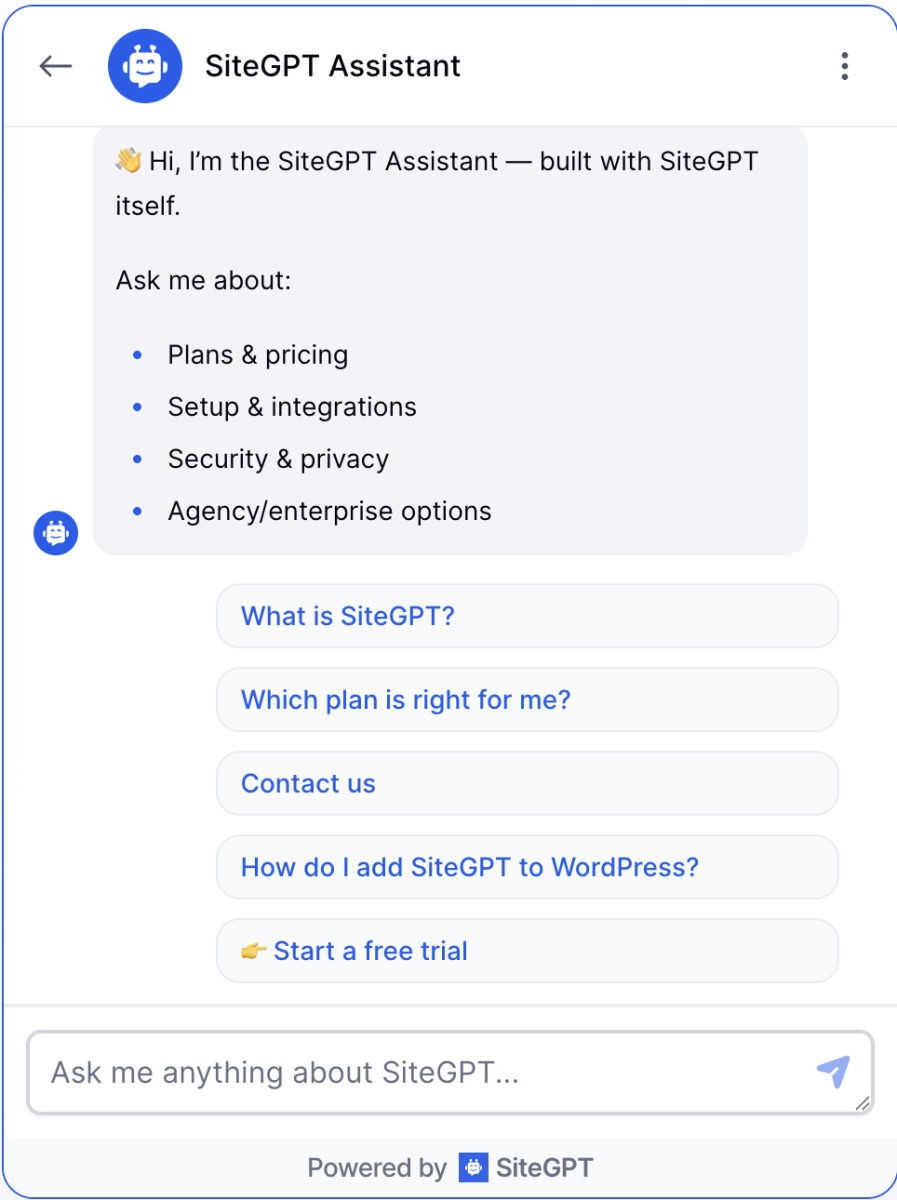
SiteGPT crawls your site, trains a bot on up to 1,000 pages on Starter and gives you a widget to embed. Human takeover arrives on Growth through its iOS app, and WhatsApp is an add-on.
Pros
- Cheaper than Chatbase Basic on yearly billing.
- Simple setup for a single website.
Cons
- No human handoff on Starter, and WhatsApp and branding removal cost $39 a month each, billed yearly.
- No free plan; the 7-day trial needs a card.
Pricing: Starter $39 a month billed yearly ($59 monthly), 1 chatbot and 1 seat; Growth $79 billed yearly ($129 monthly), per its pricing page.
Rating: G2 4.9/5 (12 reviews)
Versus Chatbase: you gain a lower price for a website-only bot. You give up Chatbase's helpdesk, channels and actions.
7. CustomGPT.ai
Best for: organizations with large document libraries that need answers grounded in many sources.
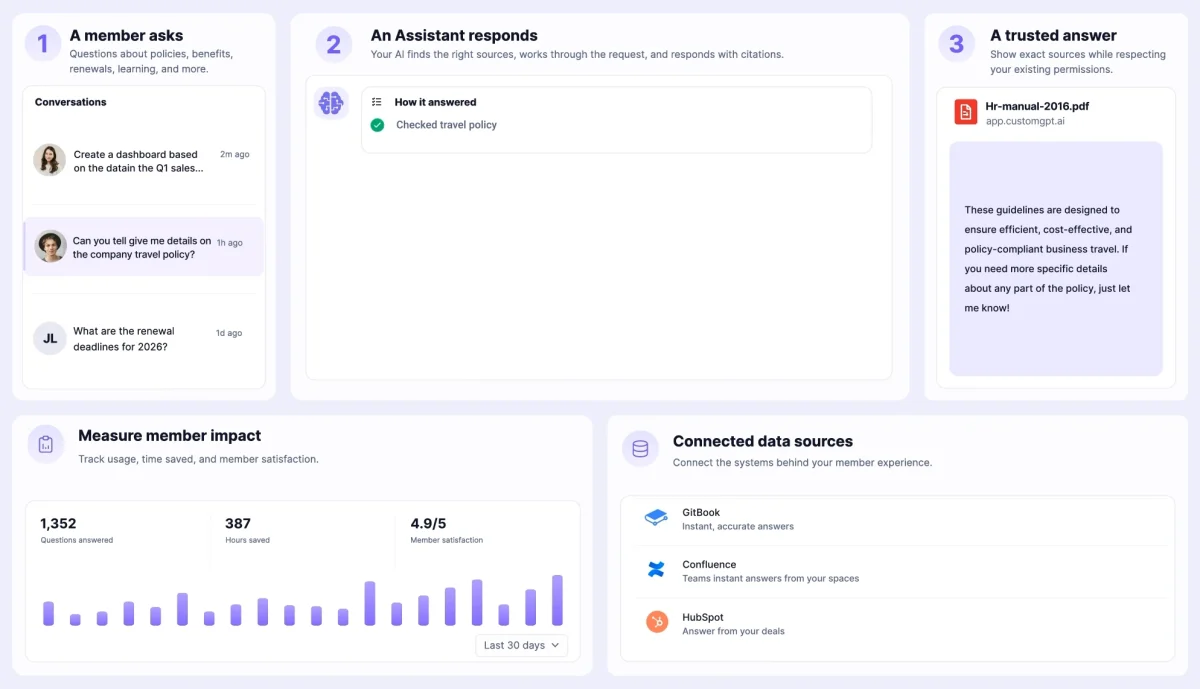
CustomGPT.ai focuses on retrieval from large knowledge sets. Standard allows 10 agents and 5,000 documents per agent, with sources such as sitemaps, Google Drive and Notion.
Pros
- Room for many agents and large document sets on the entry plan.
- Usage counted in queries, not model-weighted credits.
Cons
- Live chat with a human team isn't described on its pricing page.
- No free plan; the 7-day trial needs a card.
Pricing: Standard $89 a month billed yearly ($99 monthly) with 1,000 queries and 3 seats; Premium $449 billed yearly ($499 monthly) with 5,000 queries, per its pricing page.
Rating: G2 4.8/5 (11 reviews)
Versus Chatbase: you gain more agents and sources for the money. You give up a built-in support inbox.
8. Crisp
Best for: small teams that want live chat first, with an AI agent on a flat workspace price.
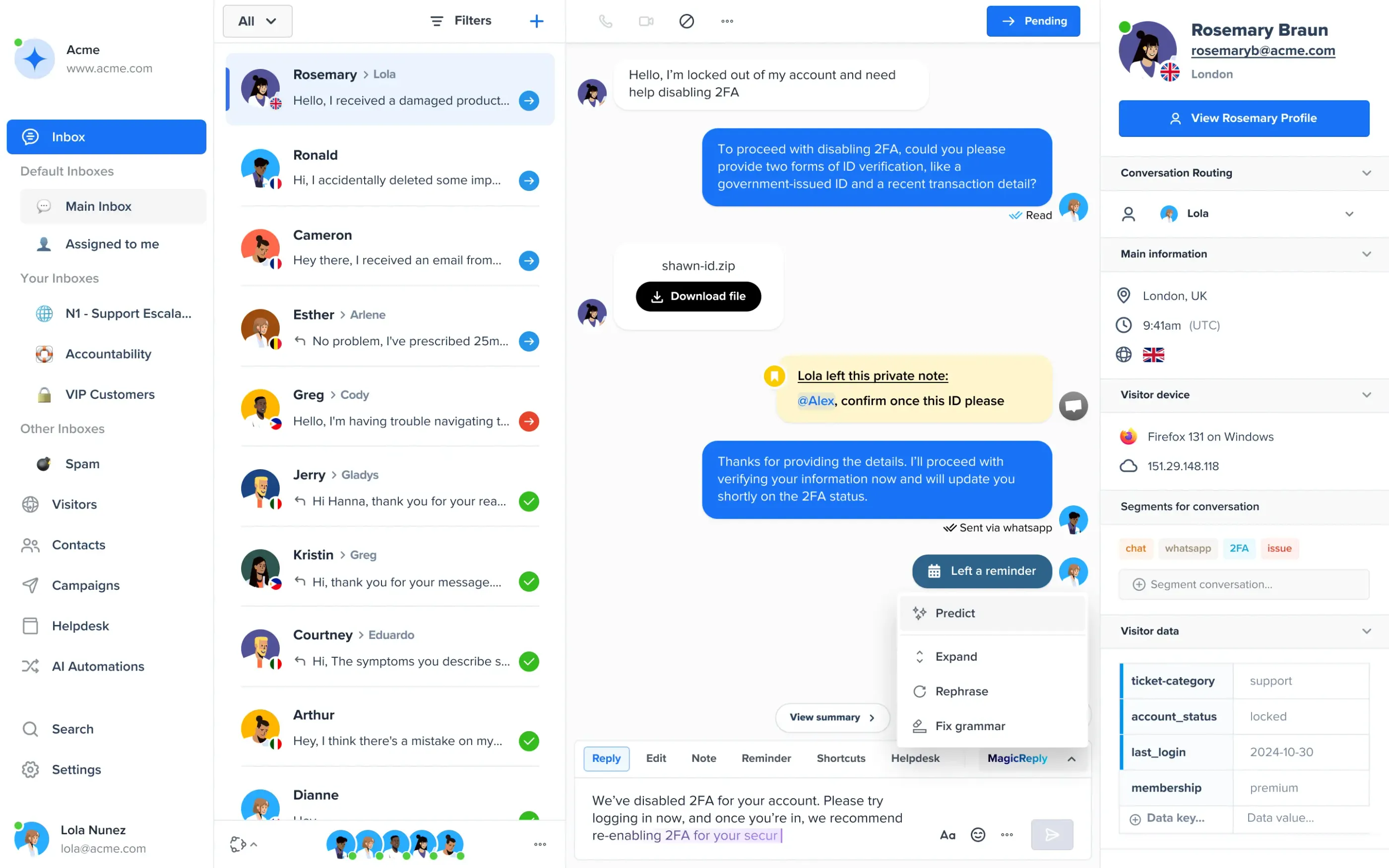
Crisp is a messaging platform: shared inbox, chat widget, email and a long list of channels, with the Hugo AI agent answering first and handing off with context. Plans are priced per workspace, not per agent, and include AI credits. Our Crisp review covers it in detail.
Pros
- Free plan for 2 seats and a 14-day trial with no card.
- Many messaging channels in one inbox.
Cons
- Mini includes only $5 of AI credits, about 90 automated conversations, so AI-heavy sites need Essentials or Plus.
- Yearly prices aren't listed on the pricing page.
Pricing: Mini $45 a month per workspace with 4 seats, Essentials $95 with 10 seats, Plus $295 with 20 seats (monthly prices), per its pricing page.
Rating: G2 4.5/5 (207 reviews)
Versus Chatbase: you gain a fuller live chat and messaging inbox and a free plan. You give up the AI-first setup and the AI volume Chatbase Basic includes.
9. Zendesk
Best for: large support teams that run chat, email and phone together and want AI agents inside that suite.
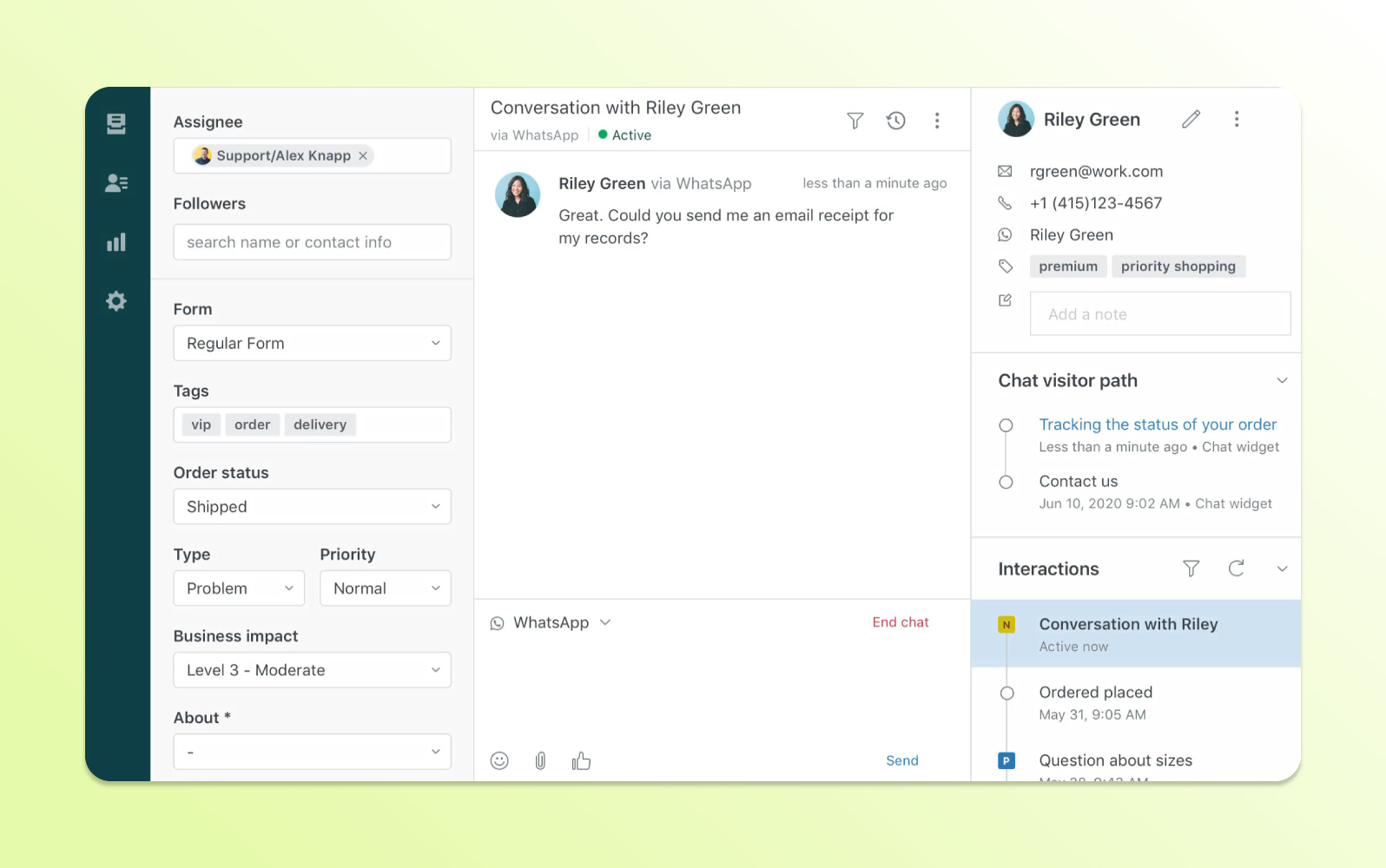
Zendesk is a full service suite. AI agents come with every Support and Suite plan, billed per automated resolution, with an allowance per agent.
Pros
- Mature tooling for large, multichannel teams.
- AI agents included, with a published per-resolution price beyond the allowance.
Cons
- Per-agent pricing plus resolution fees add up for a small team.
- No free plan, only a 14-day trial.
Pricing: Support Team $19 per agent a month billed annually ($25 monthly); Suite Team $55 billed annually; extra automated resolutions $1.50 committed or $2.00 pay-as-you-go, per its pricing page.
Rating: G2 4.3/5 (7,130 reviews)
Versus Chatbase: you gain an enterprise service desk. You give up a quick, low-cost setup.
10. Botsonic
Best for: the lowest entry price for a bot trained on your website or docs.
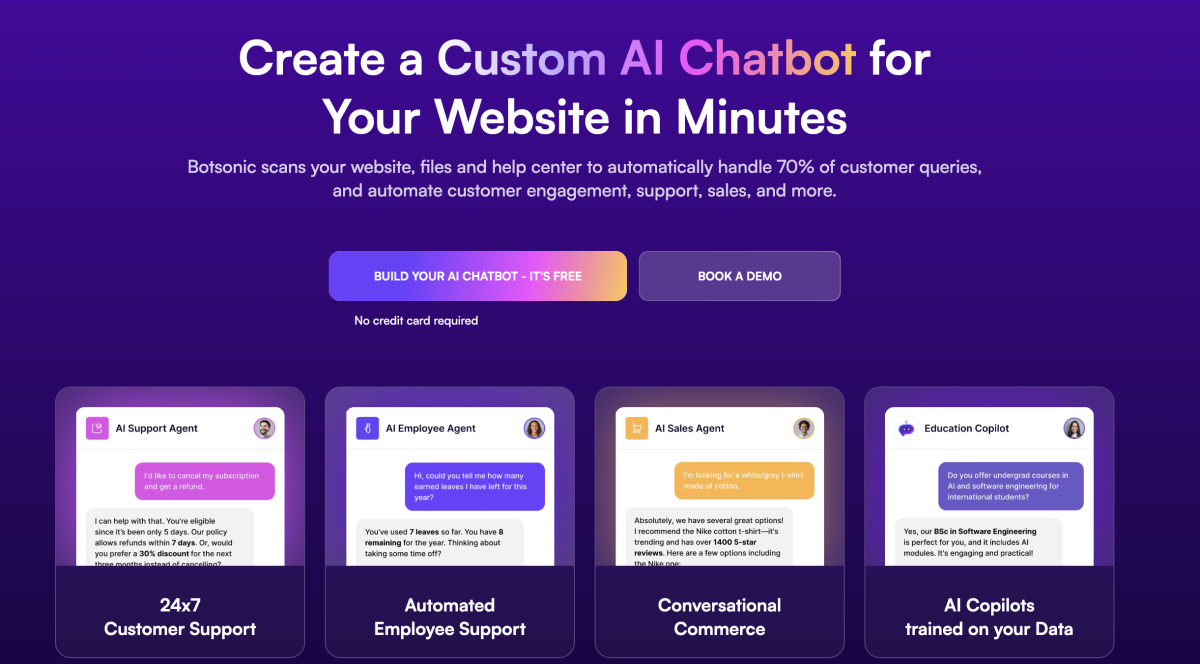
Botsonic, from Writesonic, is a no-code bot builder: upload docs or add URLs, customize the widget, deploy. Handing chats to people runs through Zendesk, sold as a separate add-on.
Pros
- Starter costs $16 a month billed annually.
- Message-based plans that are easy to read.
Cons
- No native live chat inbox; Zendesk handoff costs $199 a month.
- Branding removal is a $49 a month add-on.
Pricing: Starter $16 a month billed annually ($19 monthly) with 1,000 messages; Professional $41 billed annually ($49 monthly) with 3,000 messages, per its pricing page.
Rating: G2 4.6/5 (107 reviews)
Versus Chatbase: you gain a far lower entry price. You give up a built-in human inbox and Chatbase's actions.
11. Voiceflow
Best for: enterprise CX teams and agencies designing complex chat and voice agents.
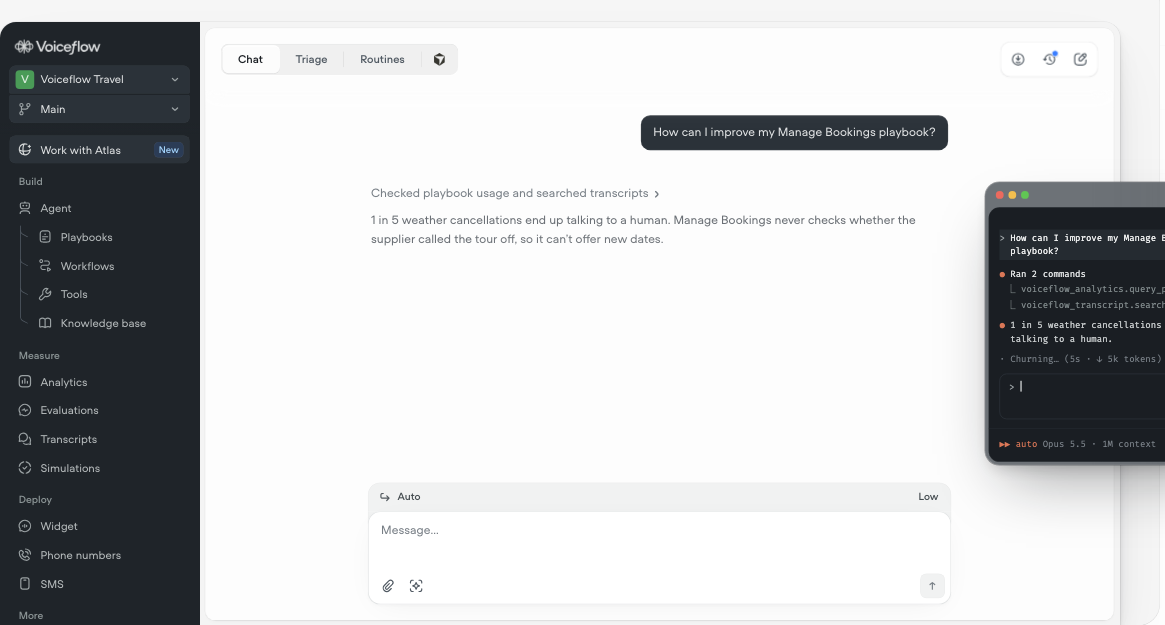
Voiceflow is a design and build platform for chat and voice agents. It no longer lists self-serve prices: businesses request pricing, and agencies get a free trial with usage-based billing.
Pros
- Deep control over conversation design and testing.
- Built for teams that maintain many agents.
Cons
- No public prices; you talk to sales.
- A human support inbox isn't mentioned on the pricing page.
Pricing: request pricing for businesses; free trial with usage-based billing for agencies, per its pricing page.
Rating: G2 4.5/5 (115 reviews)
Versus Chatbase: you gain design depth for complex agents. You give up transparent, self-serve pricing.
How each alternative bills
Each row shows the unit a tool bills on, what its cheapest paid plan includes and what happens past that. The tools count usage in different units, so a price list alone misleads.
| Tool | Billing unit | Entry plan includes | What happens past it |
|---|---|---|---|
| Chatbase | Message credits, weighted by AI model | 4,000 credits/mo on Basic | $40 per 1,000 extra credits |
| Tidio | Conversations, shared by Lyro and your team | 50 (With Lyro AI) or 100 (Human only) on Starter | Move to a larger quota, up to 1,000/mo on Growth |
| Chatling | AI credits | 1,750 credits/mo on Starter | $10 per 1,000 extra credits |
| Wonderchat | AI replies | 500 replies/mo on Starter | Move to Basic (3,000) |
| Botpress | Conversations | 250/mo on Plus | Packs of 100 conversations |
| Intercom | Seats plus Fin outcomes | Per seat; $0.99 per outcome | Pay per outcome |
| SiteGPT | Messages, weighted by model | 4,000 smaller-model messages/mo on Starter | Move to Growth |
| CustomGPT.ai | Queries | 1,000 queries/mo on Standard | Move to Premium |
| Crisp | Workspace price plus AI credits | $5 of AI credits/mo on Mini | Move to Essentials ($25 of credits) |
| Zendesk | Agents plus automated resolutions | 5 resolutions per agent/mo on Team plans | $1.50 to $2.00 per resolution |
| Botsonic | Messages | 1,000/mo on Starter | Move to Professional |
What AI volume does to the bill. Take a website with about 300 AI-answered conversations a month, billed annually:
- Chatbase: Basic, $120. Its 4,000 credits last if conversations average about 13 credits or fewer; past that, extra credits cost $40 per 1,000. Removing the branding adds $99.
- Tidio: Growth with Lyro for 300 conversations, $175 a month billed annually ($210 monthly), with the human inbox included. Lyro and your team draw on the same 300; branding removal is a $20 add-on.
- Intercom: Essential, $29 per seat billed annually, plus $0.99 for each conversation Fin resolves. If Fin resolves half (150), two seats come to about $207.
Tidio vs Chatbase
| Tidio | Chatbase | |
|---|---|---|
| Starting price | Free plan; Starter from $24/mo (Human only) or $33/mo for Starter with Lyro, billed annually; Lyro and human replies share one conversation quota | Basic $120/mo billed yearly, $150 monthly |
| Free plan / trial | Free plan · 7-day trial, no card | 7-day trial, no free plan |
| Billing unit | Conversations; one conversation counts once however many messages it has | Message credits; cost per reply depends on the AI model |
| AI agent | Lyro answers first on chat, email, Messenger, Instagram and WhatsApp, then hands off to your team | AI agent trained on your content, with custom actions |
| Choice of AI model | Lyro runs on Claude (Anthropic) | Models from OpenAI, Anthropic, Google Gemini and others |
| Human inbox | Live chat, email tickets, Messenger, Instagram, WhatsApp | Chatbase Helpdesk with routing; escalation to Zendesk, Freshdesk or Salesforce |
| Team size | Up to 10 seats included on self-serve plans (Free, Starter, Growth) | Unlimited members, no seat fees |
| E-commerce | Shopify cart preview; order history and order edits on Growth and up | Shopify Actions |
| Branding removal | $20/mo add-on on Growth; included on Plus and Premium | $99/mo add-on |
| G2 rating | 4.6 (2,169) | 4.7 (41) |
Chatbase fits better for model choice, many custom actions or a large team without seat limits. Tidio fits better when the bot is one part of a support inbox, when you sell on Shopify, or when the budget is under $120 a month.
See Tidio pricing
How to switch from Chatbase
- List your knowledge sources. Note every page, file and source your Chatbase agent uses. Lyro scans up to 100 priority pages per website import.
- Write down your actions and instructions. Record the system prompt, custom actions and escalation rules, and check which the new tool supports.
- Rebuild handoff first. Decide who gets a chat when the AI can't answer, whether the agent sees the AI conversation, and how the bot collects an email when nobody is online.
- Run both side by side. For a week, compare answers to the same customer questions on a few pages, and rate each answer.
- Check your billing dates. On yearly billing, plan the move around your renewal date.
- Swap the widget. Review unanswered questions and handoffs, and fill the gaps in the knowledge base.
Choose by your reason for leaving Chatbase
Start from what's pushing you off Chatbase:
- You want a lower bill or a free plan. Botsonic starts at $16 a month billed annually, without a human inbox, and Chatling at $25 a month with live chat. Tidio has a free plan, and Starter with Lyro costs $33/month billed annually, with up to 10 seats included on self-serve plans.
- You want human handoff in a support inbox. In Tidio, Lyro passes the whole conversation to an agent, or opens a ticket with the transcript when nobody is online (more in the FAQ below).
- You run a Shopify store. Tidio shows the shopper's cart next to the chat, and from Growth agents see order history and cancel, refund or edit orders without leaving the conversation.
- You want AI billing you can plan for. Chatbase credits depend on the model you pick. Tidio counts one conversation however many messages it has, Wonderchat counts AI replies, and CustomGPT.ai counts queries.
For other reasons, see the entries above: Botpress and Voiceflow for custom builds, CustomGPT.ai for large document libraries, Intercom and Zendesk for large support teams.
Bottom line
A team that uses Chatbase's model choice, actions and unlimited members has good reasons to stay. Switching makes sense when the $120 entry price, model-weighted credits or the $99 branding fee don't fit, or when the bot should sit inside your team's live chat inbox. Tidio covers that from Starter with Lyro at $33/month billed annually, with up to 10 seats included and one conversation quota shared by Lyro and your team.
Try Tidio free
Related guides
- Chatbot alternatives
- Best chatbot platforms
- Chatbot pricing
- Intercom alternatives
- ManyChat alternatives
- Lyro review
Plans and prices change often, so check them with each vendor before you sign up.
Frequently asked questions
For small teams and online stores, Tidio: the Lyro AI agent, live chat and email tickets in one inbox, with a free plan and up to 10 seats included on self-serve plans. Chatling is the closest low-cost website bot, Botpress suits developers, and Intercom suits support-heavy SaaS teams.
Basic costs $120 a month billed yearly or $150 monthly, with 4,000 message credits; Business costs $400 yearly or $500 monthly, with 15,000. Branding removal is $99 a month extra. There's no free plan, only a 7-day trial. Tidio, Chatling, Wonderchat, Botpress and Crisp have free plans.
Botsonic has the lowest paid plan, $16 a month billed annually for 1,000 messages, but no built-in human inbox. Chatling starts at $25 a month with live chat. Tidio has a free plan and Starter from $24 a month billed annually for human support, or $33 for Starter with Lyro, where Lyro and human replies share one conversation quota.
Tidio, Chatling, Wonderchat, Crisp, Intercom and Zendesk include live chat with a human team. Botpress offers it through Botpress Desk. SiteGPT adds human takeover from its Growth plan, and Botsonic hands chats to Zendesk through a paid add-on.
Before launch, ask it your 20 most common questions in the words customers use. After launch, review answers weekly and add missing content. In Tidio, agents rate each Lyro reply with a thumbs up or down, and Lyro lists unanswered questions as suggestions to fill.
On Chatbase you buy extra credits at $40 per 1,000. On Tidio, monthly plans move to the next tier at 95% of the conversation quota unless you switch that off; at 100%, Lyro and your team stop replying until the next cycle or an upgrade.
Tidio is AI customer service software built for small and mid-sized companies and e-commerce stores. It combines the Lyro AI agent, live chat, a ticketing inbox and messaging channels (email, Messenger, Instagram, WhatsApp) in one place.
Use live chat to support your customers in real-time