
Generative AI agents are built to carry out tasks based on goals, not scripts. They use large language models to understand requests and decide on next steps.
The best part?
They can generate full responses without needing detailed instructions each time.
According to McKinsey, generative AI could automate up to 71%[0] of the tasks customer service agents perform today, depending on the complexity of the request. That shift opens up new possibilities for faster resolutions and fewer manual handoffs, naturally leading to stronger customer experiences.
This time around, you’ll learn how generative AI agents work and where they’re most useful. We’ll also cover the types of generative agents you’ll come across and highlight a few real-world examples to help you spot what’s possible.
Try Lyro and see how simple AI automation can be
What’s the difference between gen AI agents, assistants, and bots?
People often lump these terms together, but they refer to very different types of technology. Knowing how each one works can help you choose the right solution for your support flow, depending on how much autonomy, memory, or decision-making you need.
Here’s a quick breakdown:
- Chatbots most often respond to specific triggers, like clicks or exact phrases. They’re simple and rule-based, usually built to walk users through flows or FAQs.
- AI assistants, or AI customer service copilots, can understand prompts and generate helpful responses. They’re good at supporting agents or users with suggestions or text-based tasks, but they don’t act on their own.
- Gen AI agents are designed to take action. They can understand goals, make decisions, and carry out tasks across steps and tools, without needing constant input from a human.
To make it easier, here’s a simple comparison table:
| Type | How it works | Example use case |
|---|---|---|
| Bot | Scripted, flow-based responses | FAQ widget, order status checker |
| AI assistant | Responds to prompts, supports with generated text | Inbox copilot, email summarizer |
| AI agent | Plans and acts autonomously to complete tasks | Canceling subscriptions, routing tickets, upselling in chat |
Read more: Here’s all you need to know about AI customer service agents.
What are the types of generative AI agents?
Not all generative AI agents work the same way. Some are built for short conversations, others for action, and a few can handle more advanced workflows. Instead of dividing them by vague technical categories, it’s more useful to look at how they actually behave in real-world use.
Here are the main types of generative AI agents, based on what they’re built to do:
Conversational agents
These agents are trained to understand what users are asking and generate helpful replies, often pulling from help center articles or documentation. They’re common in customer support and designed to sound natural without needing a live agent to step in.
Lyro AI is a good example of a conversational AI agent. It pulls answers from your knowledge base and responds in a brand-consistent voice. It also helps customers check shipping policies, recommends products, and carries out other repetitive tasks.
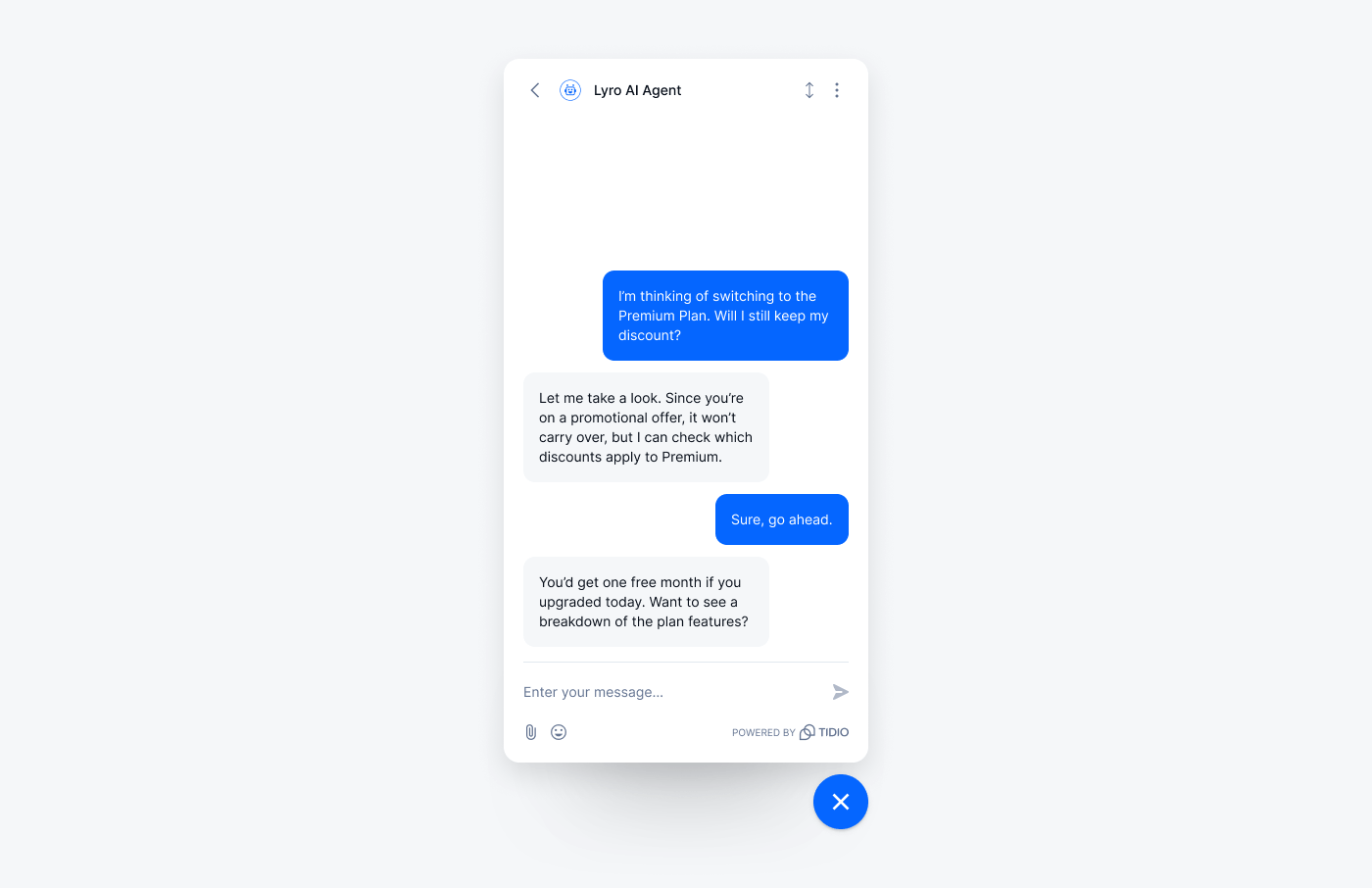
Read more: Learn all about Lyro product recommendations and make sure to explore how to build a product recommendation chatbot for your needs.
Task-executing agents
Instead of just responding, these agents perform a specific action based on the query. They might update an order, pull account info, or trigger a flow.
For example, if someone asks, “Can you cancel my subscription?”, a task-executing agent could instantly fetch the cancellation steps or handle it automatically via integration.
Multi-step agents
These are built to handle longer conversations that require more than one turn. They guide users through processes like booking, onboarding, or lead qualification without losing context.
As an example, Lyro can walk customers through choosing the right product tier, gathering details like company size and use case before recommending a plan or sending a handoff to sales.
Hybrid agents
These agents combine generative replies with structured flows or API actions. They’re flexible enough to answer open-ended questions while still following business logic and rules behind the scenes.
Let’s imagine that a visitor asks, “What’s the best plan for my business?” and the agent answers conversationally. But, it also pulls plan comparisons and checks eligibility using API calls or conditional logic set in the backend.
How generative AI agents work
Generative AI agents follow a clear process that helps them stay useful across different types of conversations. They take in what a person says, decide what to do, and respond with something that fits the moment. The best ones can also improve over time by using past interactions and internal feedback.
Here’s how generative AI works and what the process is like:
- Pulling input from the conversation and past interactions
The agent starts by capturing what the user said, and recalls earlier messages in the thread. This helps avoid repeating answers and makes multi-step interactions possible.
For example, if a user asks about a shipping delay, then follows up with “Actually, can I change the address?”, the agent connects both parts without asking the user to repeat themselves.
- Generating a response based on internal data and context
Once the intent is clear, the agent drafts a response. It pulls from your AI knowledge base or other connected sources and adapts the tone as well as details depending on the user’s query.
Lyro might use a help article to explain how to cancel a subscription, but phrase it naturally, using the customer’s name and an empathetic tone if the conversation started with a complaint.
Read more: Find out how to craft a compelling chatbot persona.
- Triggering workflows or taking real action inside the chat
Instead of just talking, generative AI agents can perform small tasks on their own. This includes submitting forms, updating info, or triggering other apps they’re connected to.
For example, if someone asks, “Can you send me the invoice for July?”, the agent could fetch it or initiate the correct flow, no human needed unless something goes wrong.
- Learning from feedback or improving with review loops
After the interaction, the system stores insights or flags anything uncertain. Over time, these flagged cases help improve future replies, either through human review or automated learning systems, depending on the setup.
Say that multiple users ask the same question, and the agent gives a generic response. The system might flag it so your team can add a better answer to its knowledge base.
Read more: Here’s all you need to know about knowledge base chatbots.
Use cases of generative AI agents in customer service
Generative AI agent examples are already showing up in day-to-day support. The way they’re used can vary a lot depending on the setup, but some use cases are proving their value. Here’s a look at where these agents are making the biggest impact in AI customer service.
Providing self-service
Generative AI agents can guide users to answers without needing a live conversation. They pull from help center content and check confidence levels before replying, which helps prevent misunderstandings or false info.
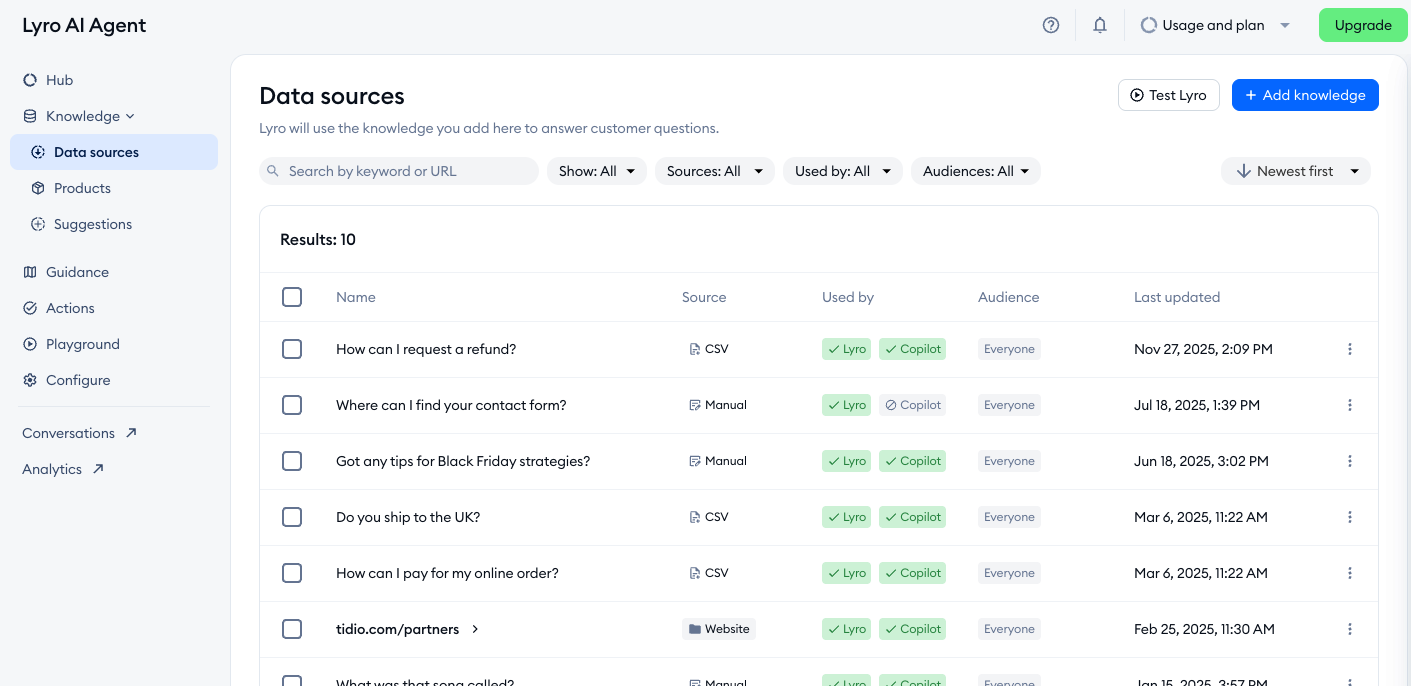
Lyro, for example, is one of the generated AI solutions that responds using your uploaded knowledge base and shows a fallback or flags questions when it’s unsure of the answer.
Give customers instant answers with Lyro’s generative AI
Managing customer requests
AI agents can handle simple transactional tasks that don’t need a human touch. Whether it’s canceling a subscription, updating delivery info, or checking an order status, the agent walks the customer through the steps in real time.
AI agents like Lyro connect with Shopify and similar tools to help shoppers get updates or change their orders inside the chat.
Read more: Learn how to build a Shopify AI agent to automate customer support.
Personalizing every reply
Each message can reflect the customer’s history, preferences, or tone of past interactions. This adds a layer of familiarity and trust, especially in repeat conversations.
Lyro uses visitor details and your brand voice to generate replies that match both the customer and the moment.
Passing conversations with full context
When a case needs escalation, generative AI agents can summarize the exchange or provide full context for the human agent. That way, no one has to repeat themselves or start from scratch.
Lyro passes along the transcript and adds notes or suggested answers, making it easier for your team to pick up where the conversation left off.
Benefits of using generative AI agents
Generative AI agents take on parts of the conversation that used to need manual input, using available context to guide each reply and keep the interaction focused. The shift feels natural because it solves real problems without changing the entire process.
As adoption grows, teams are starting to see clearer results in response quality and team capacity.
Here are some of the benefits gen AI agents bring to the table:
- Delivering faster, more consistent replies: AI agents use help content and context to keep replies accurate and efficient. Research shows that businesses using generative AI in customer service have seen up to a 14% improvement in issue resolution speed[0].
- Reducing manual work and repetitive tasks: agents save time when common questions can be handled without intervention, and that extra time helps them focus on cases that need personal attention. In fact, 80% of CS agents[0] say AI tools have improved the quality of their work.
- Keeping service personalized, even with smaller teams: generative agents adjust tone and content based on user data. That makes the conversation feel more natural, even at scale. Customers respond better when replies match their situation and past activity.
- Improving handoffs and shortening resolution cycles: when an agent steps in, AI can provide a quick summary or share the chat transcript. That keeps the context clear and avoids repeated questions, which leads to smoother user experiences.
Challenges of using gen AI agents
Generative AI agents can handle a lot of the heavy lifting in support, but they still need the right setup and oversight. Like any system designed to act independently, their performance depends on how they’re trained and what data they rely on, as well as being regularly reviewed.
Here’s what to keep in mind:
Responses must be grounded in your content to stay accurate
Even the most advanced AI agents rely on the input you give them. If the knowledge base is outdated or incomplete, the system can struggle to respond correctly.
That’s why Lyro is built to stay grounded in your uploaded content, which helps reduce AI hallucinations and keeps the answers consistent with your brand.
Human review is still needed for edge cases or tone-sensitive replies
AI can manage repetitive or straightforward requests well, but some conversations need a human touch. Questions with emotional weight or high-stakes issues may require judgment and empathy.
Lyro works well here as it’s designed to hand off conversations to a live agent when confidence is low or when tone sensitivity matters. This helps keep the experience smooth and on-brand.
Read more: Explore the top agentic AI companies.
Gen AI agents may need tuning over time (e.g., updating training sources)
Generative AI doesn’t thrive on a “set it and forget it” approach. Your content will change, and so will the types of questions customers ask.
That’s why Lyro lets you update inputs anytime, and it flags uncertain responses for review. With regular tweaks, the system stays relevant and continues improving with each interaction.
How to choose the right generative AI agent
Not every generative AI agent will fit your setup or support goals. What works well for one team might fall short for another, depending on how your support systems are built and how complex your workflows are.
These questions can help narrow down the options and make sure the tool will actually improve the way your team works:
- Can it access your content or knowledge base?
For an agent to give helpful answers, it needs the right source material. If it can’t read from your help center or internal documentation, it’s more likely to make things up or miss the mark. Look for agents that pull from structured data like FAQs, guides, or uploaded docs and stick to that information.
- Does it support the channels your customers use most?
Some agents only work inside live chat. Others can handle conversations across email, customer messaging apps, and more. Consider where your customers reach out most often, and whether the agent can support those channels without needing extra integrations.
Lyro works across live chat, email, and Messenger, keeping conversations consistent even if people switch between platforms.
- Can you train or refine it based on real conversations?
Even with strong inputs, an AI agent needs feedback to stay sharp. You should be able to review conversations, catch errors, and adjust what it learns from. Some platforms offer training loops or confidence thresholds you can tweak.
- Is there an option for human oversight or editing?
No matter how accurate the agent is, there will be moments when a real person needs to step in. Whether that’s reviewing a draft or taking over a tricky conversation, the tool should make that easy to do without starting from scratch.
Generative AI is a new standard in customer support
Generative AI agents are becoming a practical way to offer smarter, more responsive customer service without reworking your entire tech stack. With the right setup, they respond in context and keep conversations moving while taking pressure off your team during busy hours.
Lyro helps support teams do exactly that. It works directly in your help desk, using your own content, and giving agents full control over every reply.
Ready to streamline support with AI that actually works?
Skip the clunky setup and start solving real problems faster, smarter, and with your brand voice in every reply.
Give customers instant answers with Lyro’s generative AI
FAQ
The main difference between AI agents and generative AI is that gen AI is the underlying technology that creates new content. These include text, images, or code, based on patterns in the data it was trained on. On the other hand, an AI agent uses generative AI as one of its components, but adds logic, context retention, and action-taking abilities to achieve specific goals.
Not always. AI agents can work with different types of AI, including rule-based systems. Generative AI agents are a subset that use models like LLMs to create responses and plan actions. All generative AI agents are AI agents, but not all AI agents are generative AI.
ChatGPT is a generative AI model that can be used as part of a generative AI agent, but on its own, it isn’t an “agent”. An AI agent pairs a generative model with additional capabilities like memory, decision-making, and the ability to take actions or trigger workflows without constant human input.
Tidio is a customer experience platform designed for small and medium-sized businesses, combining live chat, help desk tools, and AI-powered automation to streamline customer support.
Yes. Tidio’s Lyro AI Agent uses generative AI systems and automation to answer customer questions and handle repetitive tasks across live chat, email, and social channels.
Businesses use Tidio to improve customer service, automate common support tasks, and provide fast, personalized help without increasing team workload.