Key takeaways
- Best for small teams and online stores: Tidio. Live chat, email, Messenger, Instagram, and WhatsApp land in one inbox, and Lyro can resolve up to 75% of support requests.
- Best for WhatsApp-led teams: Respond.io. It prices by active contacts, and WhatsApp fees from Meta are billed on top.
- Best for a phone system with texting: RingCentral or Nextiva. Both start with calls, then add SMS and team chat.
- Best for building your own: MirrorFly. It is an SDK, not a ready inbox, and its price is by quote.
- Four of the ten have a free plan or a free tier: Tidio, Crisp, Freshchat, and Rocket.Chat. Check the limits before you rely on one.
“Unified messaging” means three different products, and most lists mix them up: one inbox for customer chats, a phone system with texting, and a chat API you build on. We compared ten platforms across all three on their public pricing pages, documentation, and G2 reviews, and checked every price in October 2026. You get what each one does well, where it stops, and what the bill looks like. Tidio is listed first because the list is ordered for small teams and online stores, and it gets the same template and the same drawbacks section as every other tool.
The best unified messaging platforms at a glance
A unified messaging platform brings messages from several channels into one place, so your team replies from one screen instead of five apps. Which channels depends on the family:
- Customer inbox: live chat, email, WhatsApp, Instagram, and Messenger in a shared inbox, usually with an AI agent. Tidio, Respond.io, Crisp, Freshchat, and Front.
- Phone-first communications (UCaaS): business calls, SMS, video, and team chat in one app. Dialpad, RingCentral, and Nextiva.
- Build-your-own: chat and call APIs or self-hosted software that your developers shape. Rocket.Chat and MirrorFly.
Our short list: Tidio for small teams and online stores, Respond.io for WhatsApp-led sales and support, and RingCentral for teams that start from a phone system.
| Tool | Best for | Starting price (paid) | Free plan / trial | G2 rating |
|---|---|---|---|---|
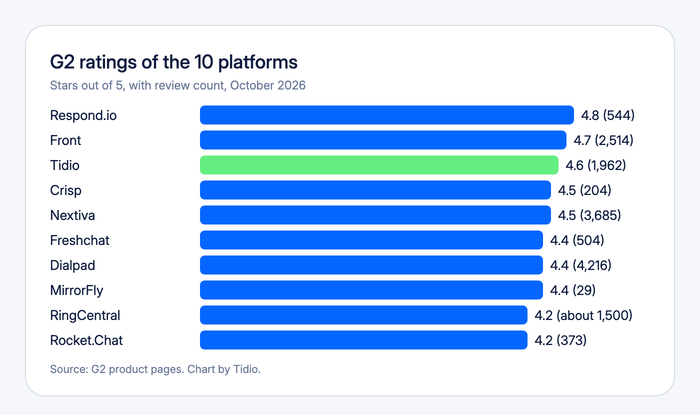
| Tidio | Small teams and online stores | $24.17/mo, billed annually | Free plan · 7-day trial | 4.6 |
| Respond.io | WhatsApp-led sales and support | $79/mo, billed yearly | No free plan · 7-day trial | 4.8 |
| Crisp | One flat price per workspace | $45/workspace/mo | Free plan · 14-day trial | 4.5 |
| Freshchat | Per-agent pricing with a free tier | $19/agent/mo, billed annually | Free for 10 agents · 14-day trial | 4.4 |
| Front | Shared inbox for busy teams | $25/seat/mo, billed annually | No free plan · 14-day trial | 4.7 |
| Dialpad | Calls, texts, and AI in one app | Not listed (talk to sales) | Not listed | 4.4 |
| RingCentral | Replacing a phone system | $30/user/mo (G2 list price) | 14-day trial | 4.2 |
| Nextiva | Phone plus messaging for SMBs | $15/user/mo, annual terms | Not listed | 4.5 |
| Rocket.Chat | Self-hosted, regulated teams | $0 Starter inbox, self-managed | Free Starter tier | 4.2 |
| MirrorFly | Developers who build in-app chat | Custom quote | No free plan or trial | 4.4 |
How we chose these platforms
We started from the 12 tools in the previous version of this list and the platforms that recur in AI answers and review roundups, 14 in all. We kept ten that unify messages across more than one channel and publish enough to compare. GoToConnect, Grasshopper, Dialaxy, and KrispCall left the list, because they are mainly phone services. Each platform got the same checks:
- Channels: live chat, email, Messenger, Instagram, WhatsApp, SMS, voice.
- AI: what the AI agent or assistant does, and how it is billed.
- Inbox and routing: assignment, notes, and automation rules.
- Integrations: Shopify and other stores, CRM, APIs.
- Pricing model: per seat, contact, workspace, conversation, or quote.
- Fit: who it suits, especially small teams and online stores.
The order follows fit for small teams and online stores, not rating. We did not test every platform on one set of conversations. Details about rivals come from vendor pricing pages, documentation, and G2, and we label a claim as the vendor’s where it is one.
The 10 best unified messaging platforms in 2026
1. Tidio
Best for: small teams and online stores that want AI on repeat questions
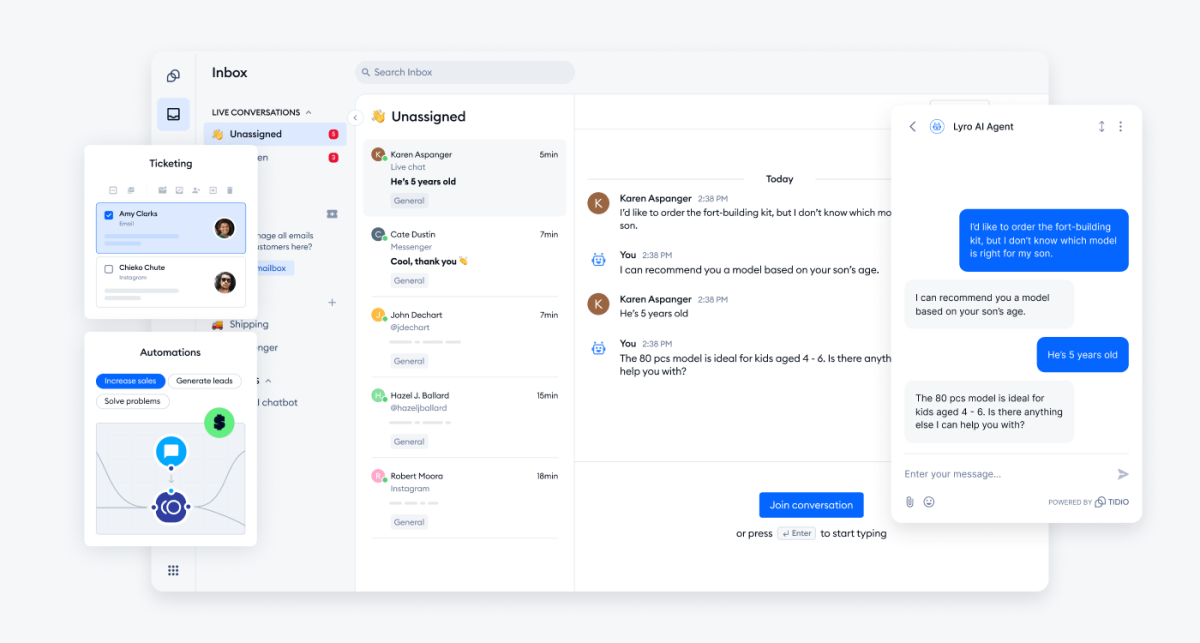
Tidio puts website chat, email, Messenger, Instagram, and WhatsApp into a single inbox. Agents reply to every channel from the same screen. Lyro, the AI agent, can resolve up to 75% of support requests and passes the rest to your team with the full conversation. Flows add rule-based chat for greetings, lead capture, and FAQs.
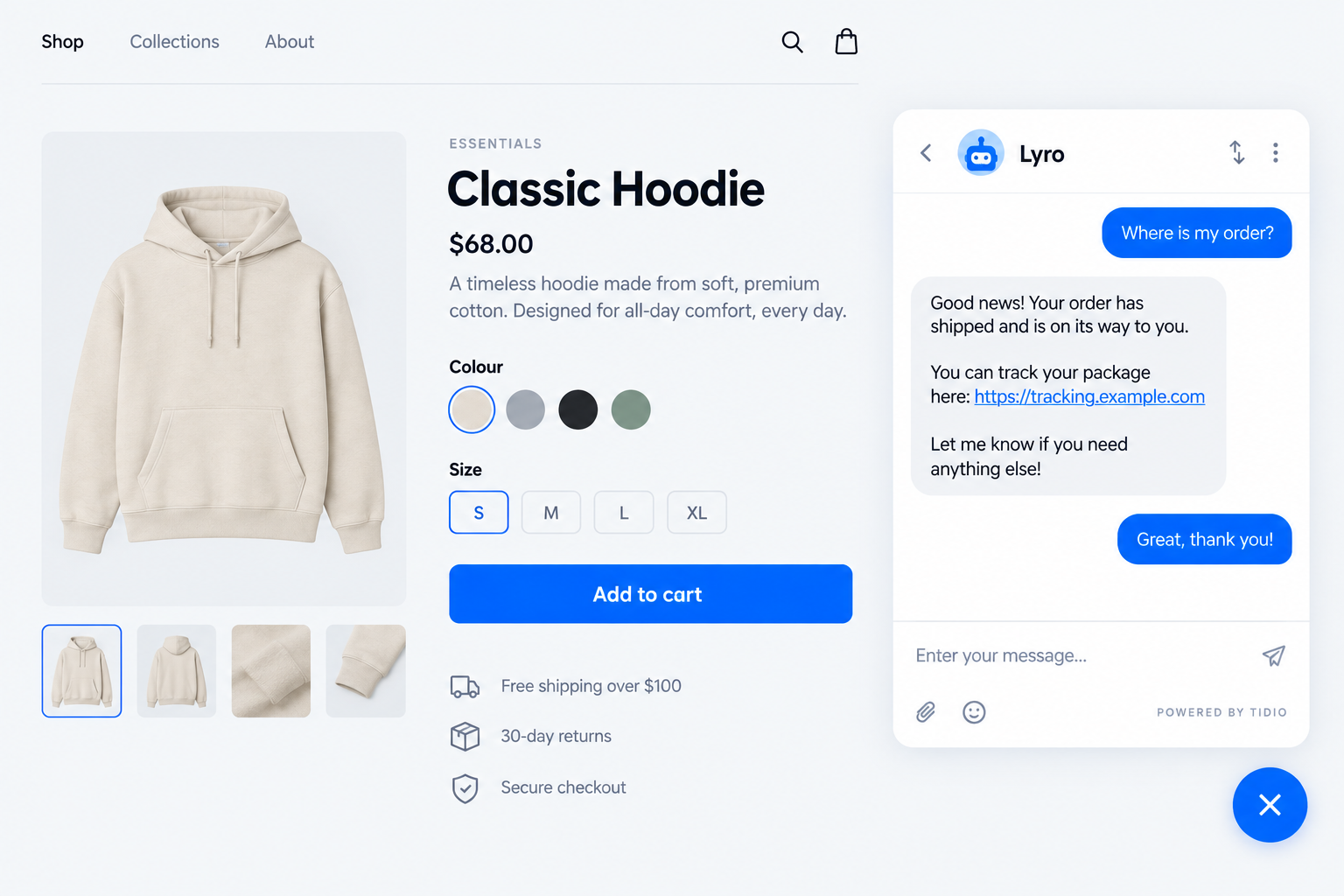
For Shopify stores, agents see the cart and order history beside the chat, and Lyro can answer “where is my order?” from store data. Growth and up add Shopify actions from the inbox.
Who Tidio suits:
- Online stores, especially on Shopify, that want order details next to the chat.
- Small and mid-sized teams that handle a growing inbox with AI instead of new hires.
- Teams on several channels who want chat, email, and social messages in one view.
- Busy inboxes where most messages repeat the same questions.
Skip Tidio if you need a phone system with desk phones, or a developer SDK to embed chat inside your own app. Dialpad, RingCentral, and MirrorFly cover those.
Key features:
- Shared inbox: website chat, email, Messenger, Instagram, and WhatsApp conversations side by side.
- Lyro AI agent: answers from your help articles, then hands over with the chat history attached.
- Flows: a visual builder for greetings, lead capture, and FAQ paths.
- Shopify tools: cart preview and order history beside the chat.
Pros
- A free plan that includes up to 10 seats and 50 billable conversations a month.
- AI, human chat, and tickets share one inbox, so a handoff keeps the whole conversation.
- Native Shopify actions on Growth and up.
Cons
- Conversations, Lyro, and Flows are priced separately, which keeps you paying for only what you use, though each has a quota to watch as volume grows.
- Analytics, permissions, and macros sit on Growth and up.
- Self-serve plans stop at 10 seats, and larger teams get a quote for Plus or Premium.
Pricing: the pricing page shows annual prices first, with monthly prices in brackets:
- Free: $0, with 50 billable conversations a month and up to 10 seats.
- Starter: $24.17 a month ($29), 100 conversations.
- Growth: from $49.17 a month ($59) for 250 conversations, up to 2,000 conversations on the largest tier.
- Plus: from $300 a month plus usage. Premium: by quote.
- Lyro: from $32.50 a month ($39) for 50 AI conversations. Flows: from $24.17 a month ($29).
- 7-day free trial, no card.
Rating: G2 4.6/5 (1,962 reviews)
See which Tidio plan fits your message volume
2. Respond.io
Best for: sales and support teams that work mostly in WhatsApp
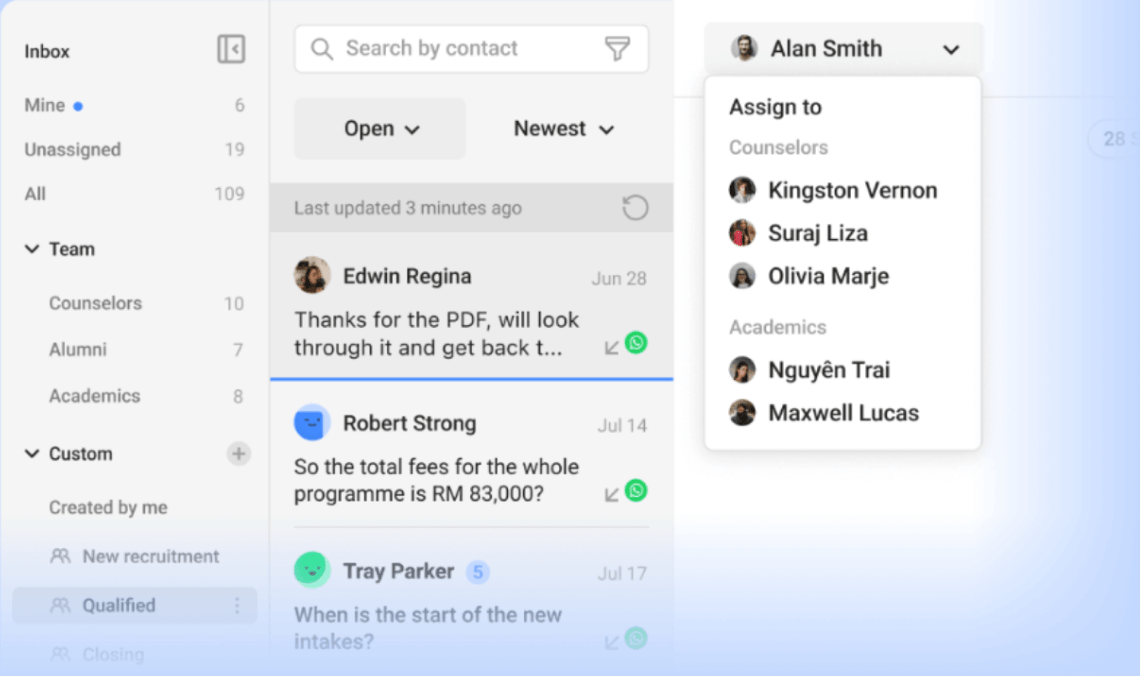
Respond.io is built around messaging apps. Conversations from WhatsApp and other channels land in team and custom inboxes, and Growth and up add broadcasts, workflow automation, and AI Agents. Pricing follows monthly active contacts, not seats, so a growing team does not pay more per person. It suits sales-led teams that close deals in chat.
The trade-off is cost. The first paid tier is $79 a month billed yearly, and Meta’s WhatsApp fees are not in any subscription.
Key features:
- Team inboxes: assignment and custom inboxes across messaging apps.
- Workflows and broadcasts: automation and campaigns on Growth and up.
- AI Agents: included on self-service Growth, Advanced, and Enterprise plans under fair use.
Pros
- Pricing by contact, with extra users at $12 to $24 a month.
- AI usage is included on Growth and up.
Cons
- WhatsApp fees from Meta are billed on top of the subscription.
- No free plan, and the cheapest tier does not include AI Agents.
Pricing: Starter $79, Growth $159, and Advanced $279 a month billed yearly (monthly billing is $99, $199, and $349), for 1,000 active contacts. Enterprise is by quote. 7-day trial.
Rating: G2 4.8/5 (544 reviews)
3. Crisp
Best for: small teams that want one flat price per workspace
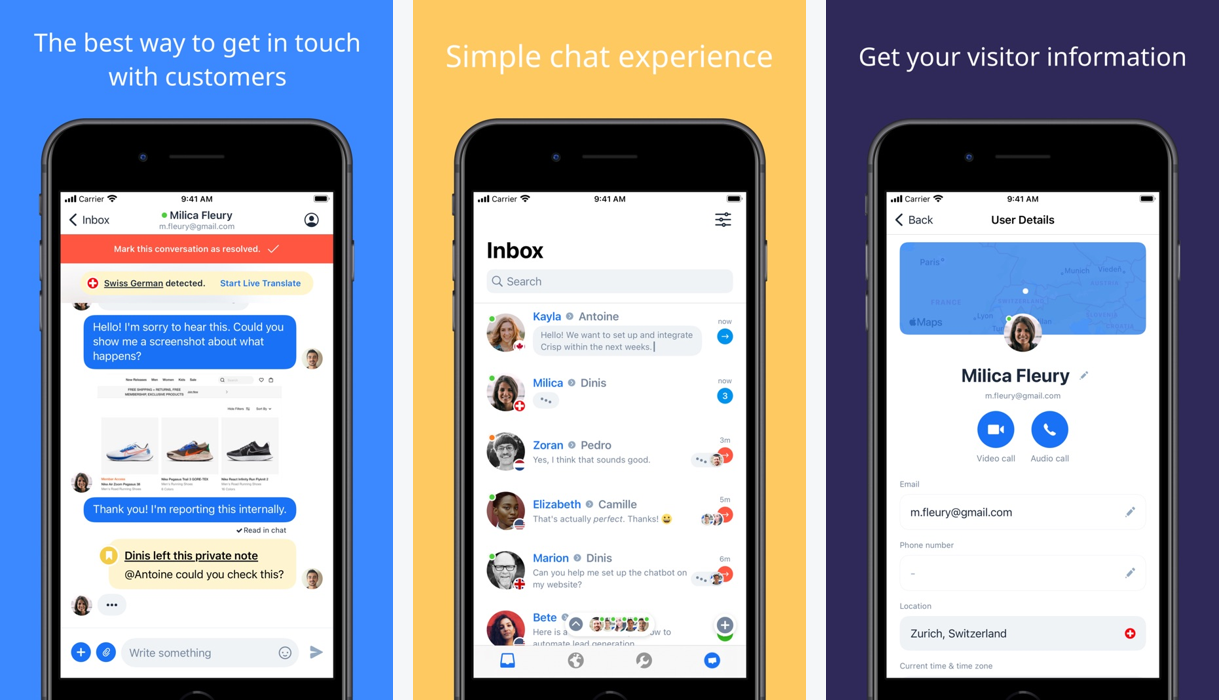
Crisp charges per workspace, not per seat or per conversation, so the bill stays flat as volume grows. The free plan gives two seats and a website chat widget. Mini ($45) adds a shared email inbox, and Essentials ($95) opens the omnichannel inbox with WhatsApp Business, Instagram DMs, SMS, Line, and Viber.
The limit is the AI allowance. Each plan includes AI credits, about 90 automated conversations on Mini and 450 on Essentials.
Key features:
- Omnichannel inbox: WhatsApp, Instagram, SMS, and more on Essentials.
- Workflow builder and AI chatbot: visual rules plus an omnichannel bot.
- Shared inbox: private notes, shortcuts, and chat triggers.
Pros
- A free plan and a 14-day trial with every feature.
- Flat workspace pricing is easy to forecast.
Cons
- Channels beyond live chat and email start on Essentials.
- AI credits cap automated conversations on each plan.
Pricing: Free (2 seats). Mini $45, Essentials $95, Plus $295 per workspace a month. Plus adds ticketing and white labelling. 14-day trial. Read more: Crisp review and Tidio vs Crisp.
Rating: G2 4.5/5 (204 reviews)
4. Freshchat
Best for: support teams that want per-agent pricing and a free tier
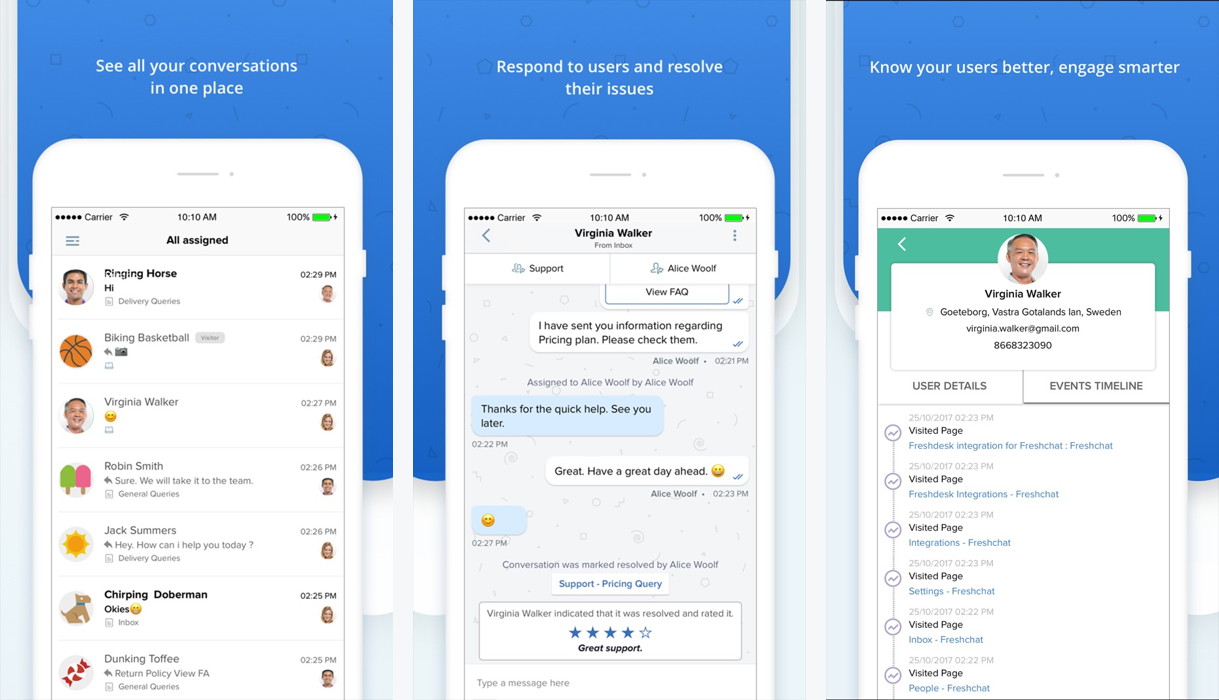
Freshchat is Freshworks’ conversational support tool. Website chat and email are on every plan, including a free tier for up to 10 agents. Growth ($19 per agent a month, billed annually) adds Facebook, Instagram, SMS, WhatsApp, and Line, and a conversation can start on SMS and finish on WhatsApp or email.
AI and voice are metered. The Freddy AI Agent includes 500 sessions once per account, then costs $49 per 100 sessions, and voice calling is a separate product.
Key features:
- Channel inbox: chat, email, social, and messaging apps in one view.
- Freddy AI Agent: answers customers, billed per session.
- Copilot: reply help for agents, $29 per agent a month on Pro and up.
Pros
- A free tier for 10 agents with chat widget, shared inbox, and email.
- A 14-day trial of the Enterprise plan.
Cons
- The free plan has no social, SMS, WhatsApp, or AI.
- Voice is a separate paid product, from $15 per agent a month.
Pricing: Free for up to 10 agents. Growth $19, Pro $49, Enterprise $79 per agent a month, billed annually (the page does not show monthly prices). Add-ons: Freddy AI Agent $49 per 100 sessions after 500, Copilot $29 per agent. Read more: Freshchat review.
Rating: G2 4.4/5 (504 reviews)
5. Front
Best for: teams of 10 or more that share an email-first inbox
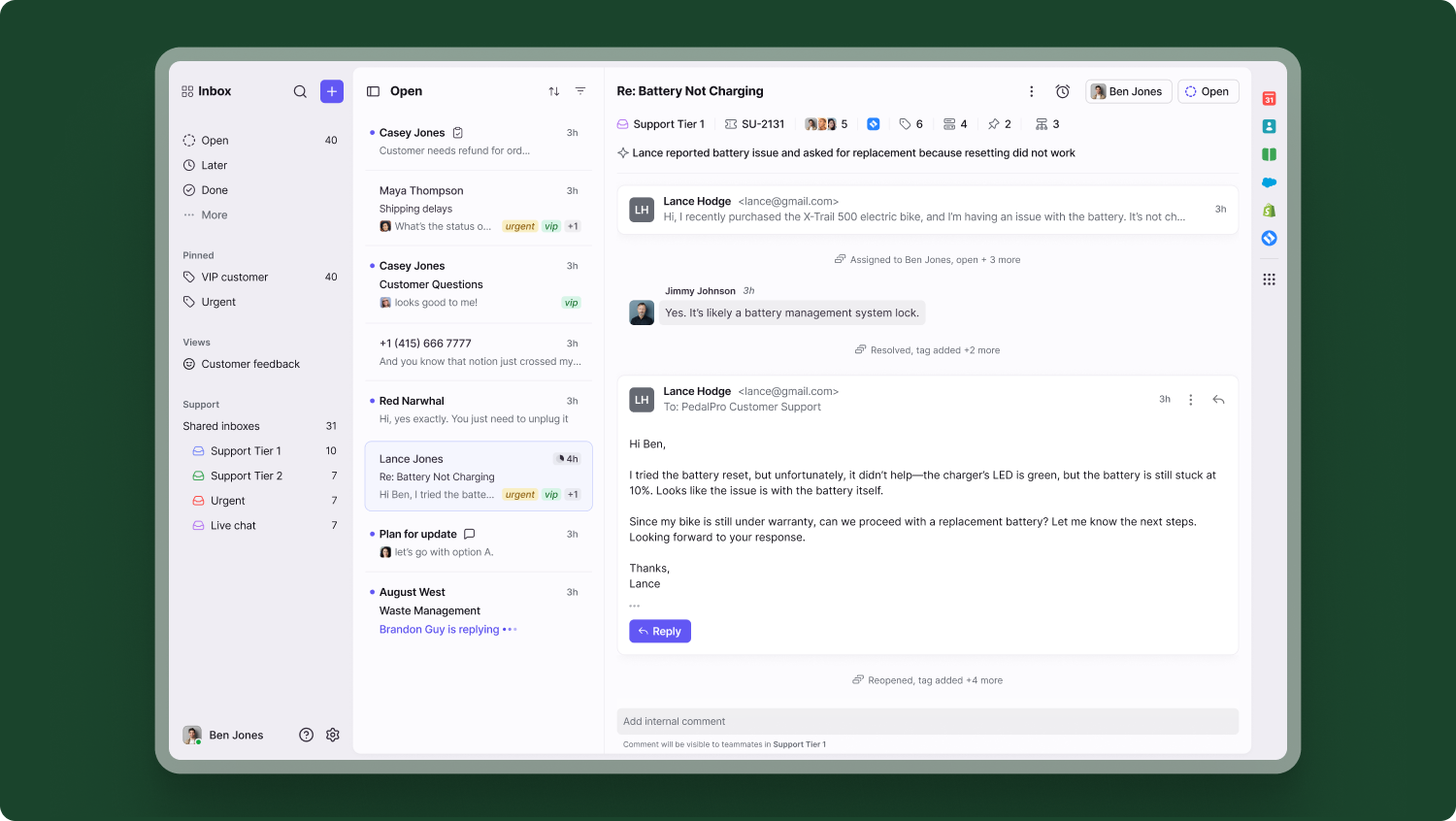
Front turns shared mailboxes into a collaborative inbox, with comments, assignment, and rules for each conversation. Starter ($25 per seat a month, billed annually) supports a single channel type, so email plus SMS, social, and WhatsApp starts on Professional ($65). That makes it a fit for larger teams that live in email.
AI comes as add-ons: Copilot is $20 per seat a month, and Autopilot starts at $0.05 per conversation.
Key features:
- Shared inbox: internal comments and assignment on each thread.
- Automation rules: 10 on Starter and 20 on Professional.
- Copilot and Autopilot: AI help for agents and for first replies.
Pros
- Strong collaboration inside a conversation.
- Professional covers email, SMS, social, and WhatsApp.
Cons
- Starter is limited to one channel type, with up to 10 seats.
- Native WhatsApp costs Meta’s fees plus a 20% admin fee.
Pricing: Starter $25, Professional $65, Enterprise $105 per seat a month, billed annually. 14-day trial, no card. Read more: Front review.
Rating: G2 4.7/5 (2,514 reviews)
6. Dialpad
Best for: teams that want calls, texts, and team chat in one app
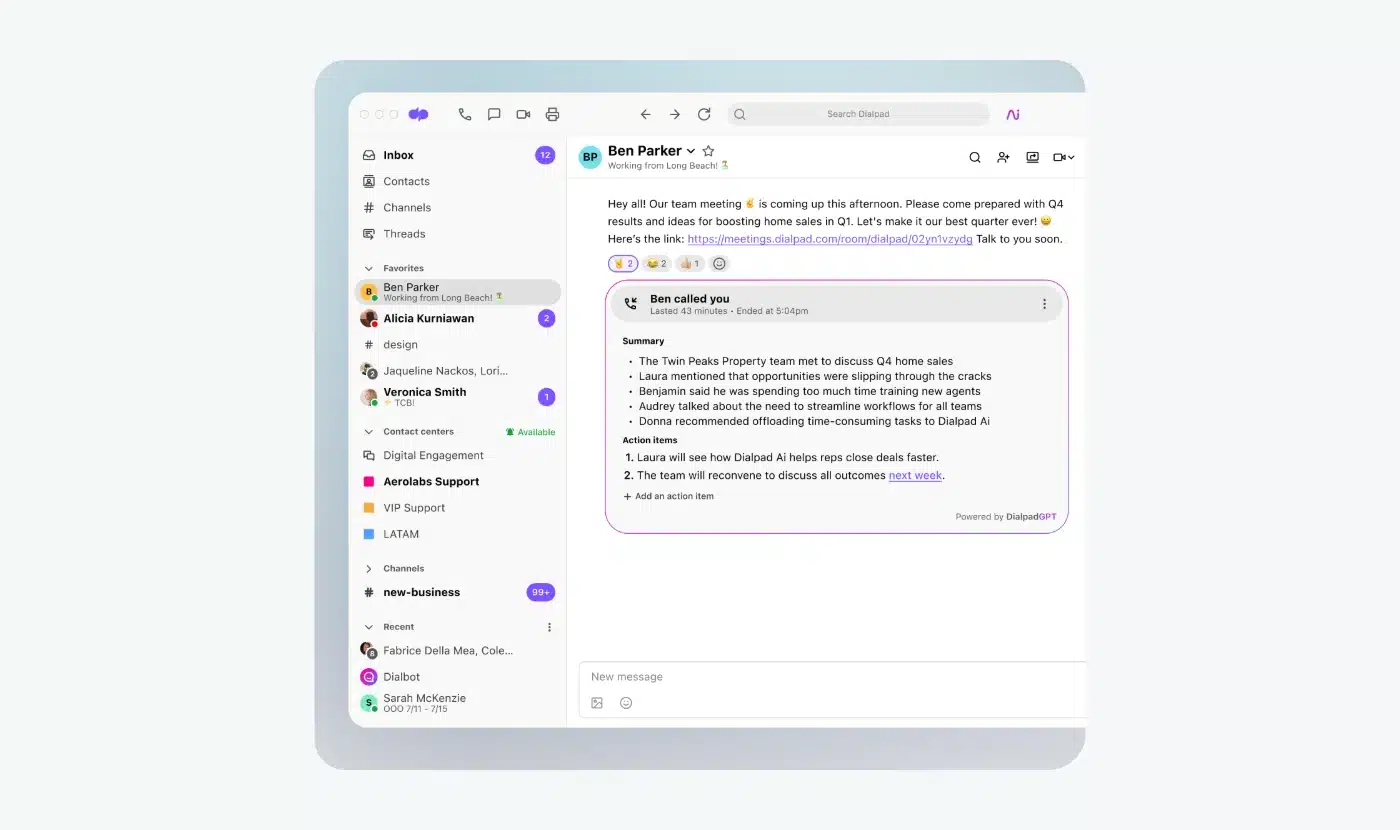
Dialpad is phone-first. Its Connect product brings business phone, SMS, team messaging, video meetings, and AI into one app. That suits teams where calls and texts matter more than website chat. A customer-facing AI agent is sold separately as Dialpad Resolve.
Dialpad does not publish plan prices. Its pricing page shows Resolve as custom-priced, with AI Agent Credits that are used only when the AI retrieves information or takes an action, and sends other plans to sales.
Key features:
- Voice and SMS: business calling and texting in one app.
- AI summaries: call recaps and action items.
- Contact center: queues for support teams.
Pros
- Calls, texts, video, and team chat share one app.
- AI recaps for calls.
Cons
- No plan prices on the page, so you need a sales call to budget.
- WhatsApp and Instagram in one inbox are not shown on the vendor’s pages.
Pricing: not listed. Resolve is custom-priced by AI Agent Credits; other plans are by sales. Read the vendor’s current page before you plan a budget.
Rating: G2 4.4/5 (4,216 reviews)
7. RingCentral
Best for: companies replacing a phone system that also want texting
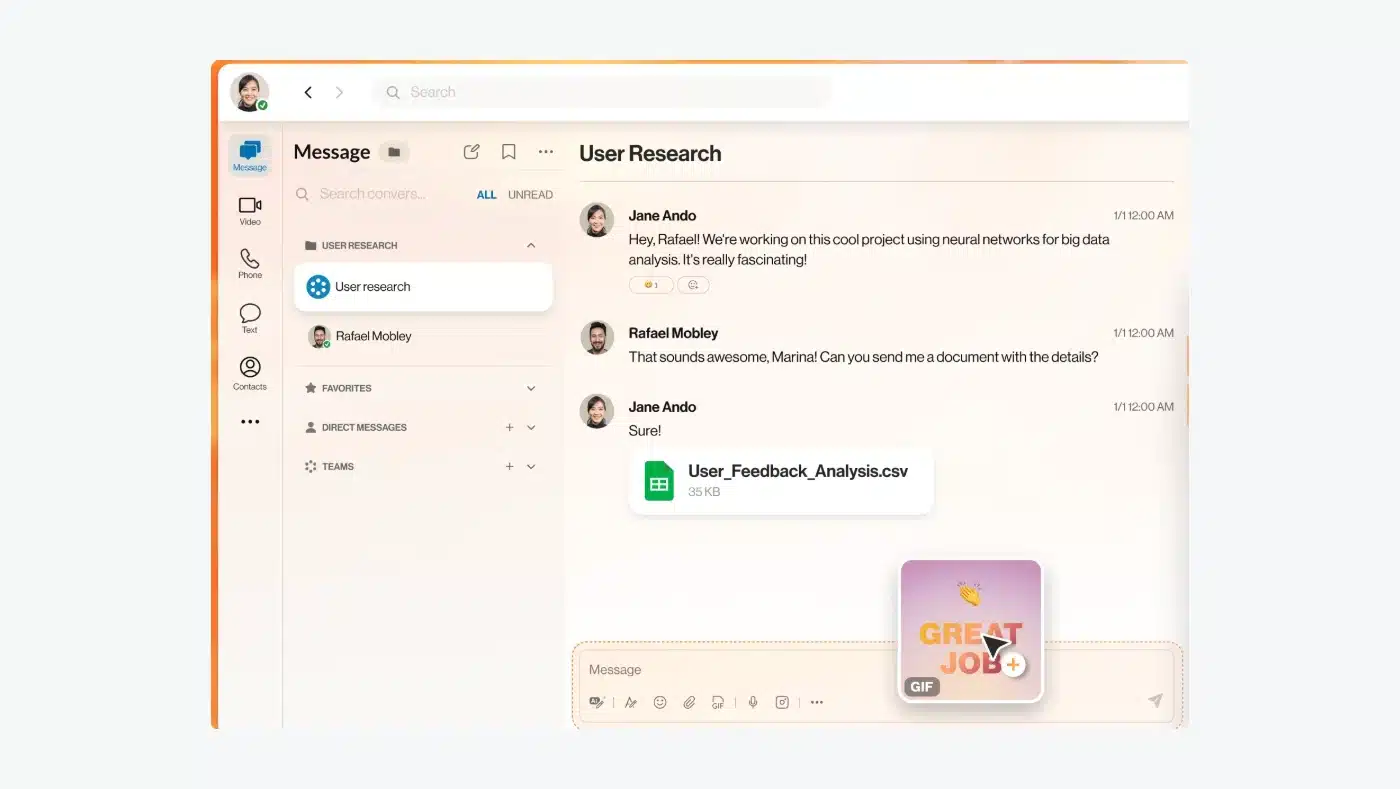
RingCentral’s RingEX brings calls, texts, video, fax, and team messaging into one app, with a Personal AI Assistant for notes and summaries. It is a phone system first. Chat, email, and social customer channels sit in RingCX, a separate contact center product with no public price.
Per G2’s copy of its list prices, RingEX is $30 (Core), $35 (Advanced), and $45 (Ultra) per user a month. The vendor page says paying annually saves up to 33% but does not show the plan cards in its text, so confirm the billing period.
Key features:
- Voice, SMS, and video: one app for calls, texts, and meetings.
- Team messaging: chat, file sharing, and project spaces.
- AI assistant: notes, message writing, and meeting summaries.
Pros
- Calls, texts, video, and team chat in one platform.
- A 14-day trial.
Cons
- Business SMS and high-volume texting cost extra, with carrier registration fees.
- G2 reviewers say costs add up as you add users and advanced features.
Pricing: RingEX Core $30, Advanced $35, Ultra $45 per user a month (G2 list; billing period not stated). Add-ons: AI Receptionist from $39, Business SMS Booster $25. 14-day trial, SMS excluded.
Rating: G2 4.2/5 (about 1,500 reviews)
8. Nextiva
Best for: small and mid-sized businesses that want phone and messaging in one bill

Nextiva’s NEXT platform includes business phone and team messaging on every plan. Core adds SMS and MMS, a shared inbox, and a basic CRM and ticketing system, and Engage adds live chat and a chatbot. Contact center plans add omnichannel routing for larger support teams.
The pricing page shows $15 (Core), $25 (Engage), and $75 (Scale) per user a month on annual terms for 1 to 100 employees. It also shows $23 and $50 figures for Core and Engage without naming the period.
Key features:
- Voice, video, and SMS: calling plus text messaging.
- Shared inbox: a team and personal inbox on Core.
- XBert AI: an AI agent for phone, chat, and SMS.
Pros
- Phone, messaging, and a basic CRM in one platform.
- Live chat and a chatbot arrive on Engage.
Cons
- SMS is capped at 100 per user a month on Core and 500 on Engage.
- XBert AI is billed at $1.50 per conversation, with no free plan or trial shown.
Pricing: Core $15, Engage $25, Scale $75 per user a month, annual terms. Contact center from $75 per agent. Demo-led, no trial listed.
Rating: G2 4.5/5 (3,685 reviews)
9. Rocket.Chat
Best for: regulated and IT-led teams that host their own messaging
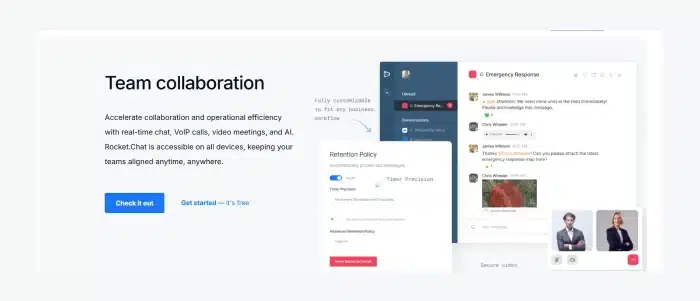
Rocket.Chat is open-source communications software that you can run in the cloud, on your own servers, or air-gapped. Its free Starter omnichannel tier connects WhatsApp, email, SMS, and live chat in one inbox for up to 100 monthly active contacts, self-managed. Contact merge, cross-channel history, and AI features need Enterprise.
It is built for government and regulated industries. Setup and upkeep need technical staff.
Key features:
- Omnichannel inbox: WhatsApp, email, SMS, and live chat on Starter.
- Deployment control: cloud, on-premises, or air-gapped.
- Team chat: messaging and calls between your own staff.
Pros
- A free self-managed Starter inbox.
- Full control over where data lives.
Cons
- Starter covers up to 100 monthly active contacts.
- G2 reviewers describe self-hosted setup and updates as demanding.
Pricing: Starter omnichannel $0 per user, self-managed, up to 100 monthly active contacts. Enterprise and team plans are by quote. No trial listed.
Rating: G2 4.2/5 (373 reviews)
10. MirrorFly
Best for: developers who build chat and calls into their own app
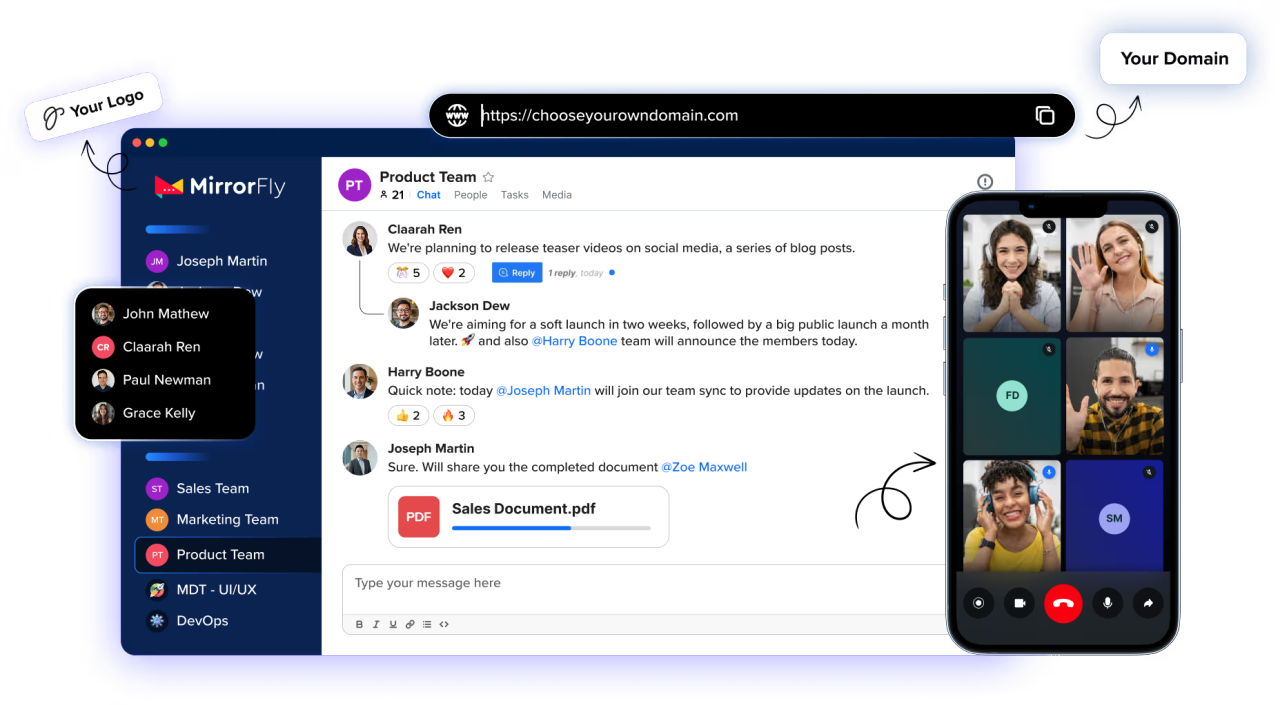
MirrorFly is a CPaaS provider: APIs and SDKs for chat, voice, video, and AI agents that you build into your own web or mobile app, with self-hosting for data control. It is not a ready inbox for a support team, and its pages do not show WhatsApp, SMS, or email channels.
It suits product teams and regulated businesses that need a messaging layer with their own brand and servers.
Key features:
- Chat, voice, and video SDKs: for web and mobile apps.
- Self-hosting: your servers, your data.
- AI chatbots and voice agents: tools you build and host.
Pros
- Full white-label control.
- Self-hosted deployment.
Cons
- All pricing is custom, with no trial.
- Needs developers; advanced features have a learning curve, per G2 reviewers.
Pricing: custom quote, with a one-time license for self-hosting. No price is listed, and there is no free plan or trial, only a demo.
Rating: G2 4.4/5 (29 reviews)
How to choose a unified messaging platform
Match the family to your job
If your customers write to you on chat, email, and social, you want a customer inbox. If most contact is phone calls, a UCaaS platform fits. If you want chat inside your own app, you need an API. Picking the wrong family is the most expensive mistake on this list.
List the channels you need in the inbox
Start with where messages arrive today: website chat, email, Instagram, Messenger, WhatsApp, SMS. Check which plan includes each channel, because Crisp, Freshchat, and Front gate theirs. For a wider view of channels, see our guide to omnichannel customer service.
Compare the AI billing unit
AI is billed per session (Freshchat), per conversation (Nextiva, Tidio’s Lyro), from a credit pool (Crisp, Dialpad), or included in the plan under fair use (Respond.io). Ask what counts as one unit, and how a handoff to a person is billed.
Match the pricing model to your volume
Per-seat pricing suits a small team with high volume. Per-contact pricing follows your audience. Flat workspace pricing is the easiest to forecast. Quote-only pricing means you cannot compare before a sales call.
Check that a human can take over
Test your ten most common questions. A good handoff passes the whole conversation to an agent, so the customer never repeats themselves.
Unified messaging vs unified communications
Unified messaging brings messages from many channels into one inbox. Unified communications adds voice, video, and meetings. Many tools above do both, but they start from one side. For a deeper look at customer channels, read our list of customer messaging platforms.
Which unified messaging platform should you pick?
- You run a small team or a Shopify store → Tidio Growth with Lyro. Cart and order history sit next to the chat, and Lyro takes the repeat questions. Bigger teams can move up to Plus. See Tidio pricing.
- You sell over WhatsApp → Respond.io. Its inbox is built for messaging apps, and Meta’s fees are extra.
- You want one flat bill → Crisp. You pay per workspace, so more messages do not raise the price.
- You want per-agent pricing with a free start → Freshchat. The free tier covers 10 agents on chat and email.
- You live in email → Front. It suits teams of 10 or more.
- You are replacing a phone system → RingCentral, Nextiva, or Dialpad. Compare the SMS limits and AI fees first.
- You must self-host → Rocket.Chat. Plan for technical staff.
- You build chat into your own app → MirrorFly. Expect a quote and a build.
Automate your Shopify store's customer messages with Lyro
Frequently asked questions
For small teams and online stores, Tidio is the strongest fit: chat, email, Messenger, Instagram, and WhatsApp share one inbox, and Lyro can resolve up to 75% of support requests. Crisp works if you want a flat workspace price, and Respond.io if WhatsApp leads.
A unified messaging platform collects messages from several channels, such as live chat, email, social media, and messaging apps, in one place. Some also include voice and video. Teams reply, assign, and automate from there.
Unified messaging focuses on written conversations across channels. Unified communications adds calls, video meetings, and team chat in one platform. Dialpad, RingCentral, and Nextiva start from unified communications.
Yes. Tidio, Respond.io, Crisp (Essentials), Freshchat (Growth and up), and Front (Professional) bring WhatsApp and Instagram into a shared inbox. WhatsApp message fees are billed by Meta.
Entry prices run from free to about $79 a month for a small team. Tidio, Crisp, and Freshchat have free plans, and paid plans start at $15 to $25 per seat or $45 to $79 per workspace. AI fees come on top.
Yes. MirrorFly sells chat, voice, and video SDKs for your own app, priced by quote. A ready-made inbox such as Tidio does not need development work.
Try Tidio for your customer messages