
Key takeaways
- Mid-sized teams and online stores: Tidio. The Lyro AI agent, live chat and tickets in one inbox. Starter with Lyro is $33/month billed annually, up to 10 seats included on self-serve plans, and Lyro and human replies share one conversation quota.
- Enterprise swap with outcome billing: Sierra. Branded AI agents across chat, voice and messaging, billed per completed task, sold through sales like Decagon.
- Public price per resolution: Fin by Intercom. $0.99 per outcome, with a $49 monthly minimum, and it runs on top of Zendesk or Salesforce without Intercom seats.
- Already on Zendesk or Salesforce? Their own AI agents (Zendesk AI agents, Agentforce) act on the data you already keep there.
For a mid-sized customer support team or online store that wants an AI agent live this week, without a sales cycle, Tidio is the Decagon alternative to try first. Starter with Lyro runs $33/month billed annually; self-serve plans include up to 10 seats, and Lyro shares one conversation quota of 50 a month with your human replies. Decagon, an enterprise AI agent platform, publishes no pricing, offers no trial and starts every deal with a demo. If you need an enterprise platform with the same sales-led setup, Sierra is the closest swap, and Fin by Intercom publishes its price per outcome.
The tables below compare how 11 Decagon alternatives bill their AI agents.
Tidio is our product; here's how we compared. Every platform's billing model was read from its pricing page or documentation, Tidio gets no softer treatment than the enterprise tools, and where one is the better buy, we say so. How we chose.
Decagon alternatives at a glance
Entry prices, billed annually unless the cell says otherwise. How each one bills for AI is in the pricing table below.
| Tool | Best for | Public price | Free plan / trial | G2 rating |
|---|---|---|---|---|
| Tidio | Mid-sized teams and online stores, or Lyro on an existing help desk | Starter with Lyro, $33/mo for 50 conversations shared by Lyro and your team | Free plan · 7-day trial | 4.6 (2,169)[1] |
| Sierra | Large consumer brands that want a like-for-like swap | No, contact sales | Demo | 4.5 (135)[2] |
| Fin by Intercom | A public per-resolution price | $0.99 per outcome, $49/mo minimum on another help desk | 14-day trial | 4.5[3] |
| Zendesk AI agents | Large teams already on Zendesk | Suite Team $55/agent, resolutions included | 14-day trial | 4.3 (7,082)[4] |
| Ada | High-volume enterprise support | No, demo | Demo | 4.6 (183)[5] |
| Salesforce Agentforce | Companies running service on Salesforce | $2 per conversation | Contact sales | 4.4 (8,432)[6] |
| Kore.ai | Contact centers that orchestrate several agents | No, contact sales | Contact sales | 4.6 (509)[7] |
| Parloa | Voice-first contact centers | No, custom plans | Demo | 4.3 (108)[8] |
| Freshdesk (Freddy AI) | Growing teams on a per-agent budget | $19/agent + $49 per 100 AI sessions | 14-day trial | 4.4 (3,773)[9] |
| Gorgias | Shopify brands with a large ticket queue | From $10/mo for 50 tickets, monthly | Free trial | 4.6 (582)[10] |
| Yellow.ai | Starting free, growing into enterprise | $0.99 per resolution above the free plan | Free plan | 4.4 (107)[11] |
For comparison, Decagon has no public pricing, no free trial and no self-serve plan. It holds a 4.4 on G2 from 161 reviews.[12] Prices change often, so confirm them with each vendor.
Why teams look for a Decagon alternative
Decagon's agents handle chat, email and voice from one logic layer, and workflows are written as AOPs (agent operating procedures): plain-language steps the agent follows like code. Before a change goes live, teams can run simulations, live A/B experiments and always-on QA (Watchtower). Its customers include Duolingo, Chime, Notion and Deutsche Telekom, and its latest round valued it at $4.5 billion.[13] If you run a large, complex support operation and value testing before rollout, staying is a reasonable call.
The reasons teams look elsewhere come from Decagon's own site and its G2 reviews:
- No public price. Decagon has no pricing page. Its blog post on pricing AI agents describes two models, a fixed rate for every incoming conversation or a higher rate for each fully resolved one, and says most customers pick per conversation. A verified G2 reviewer calls the pricing "steep, enterprise-focused, and opaque" for smaller setups.
- No trial, and setup is a project. Every path on Decagon's site begins with a demo. Its blog says teams deploy "within weeks". G2 users report about two months to implement on average, and one reviewer wrote that "it was not a pure plug-and-play experience".
- Its integrations favor enterprise stacks. Decagon's integrations page lists Salesforce, Zendesk, Intercom and Kustomer for ticketing, plus Amazon Connect and RingCentral for voice. Gorgias, Freshdesk and HubSpot aren't on it.
How we chose these alternatives
A tool made the list only if it does Decagon's core job (an AI agent that answers customers, takes actions in your systems and hands off to people) and gives a Decagon customer a clear reason to switch: a published price or free plan, a self-serve start, a fit with the help desk or CRM they already run, a different billing unit, or a voice focus. We then compared each one on billing unit, public price, time to first answer, channels and G2 rating.
We didn't run trials. Prices and features come from vendor pricing pages and documentation, ratings from G2.
The 11 best Decagon alternatives in 2026
1. Tidio
Best for: mid-sized teams and online stores that want an AI agent live in days, and teams that want to add an AI agent to the help desk they already use.
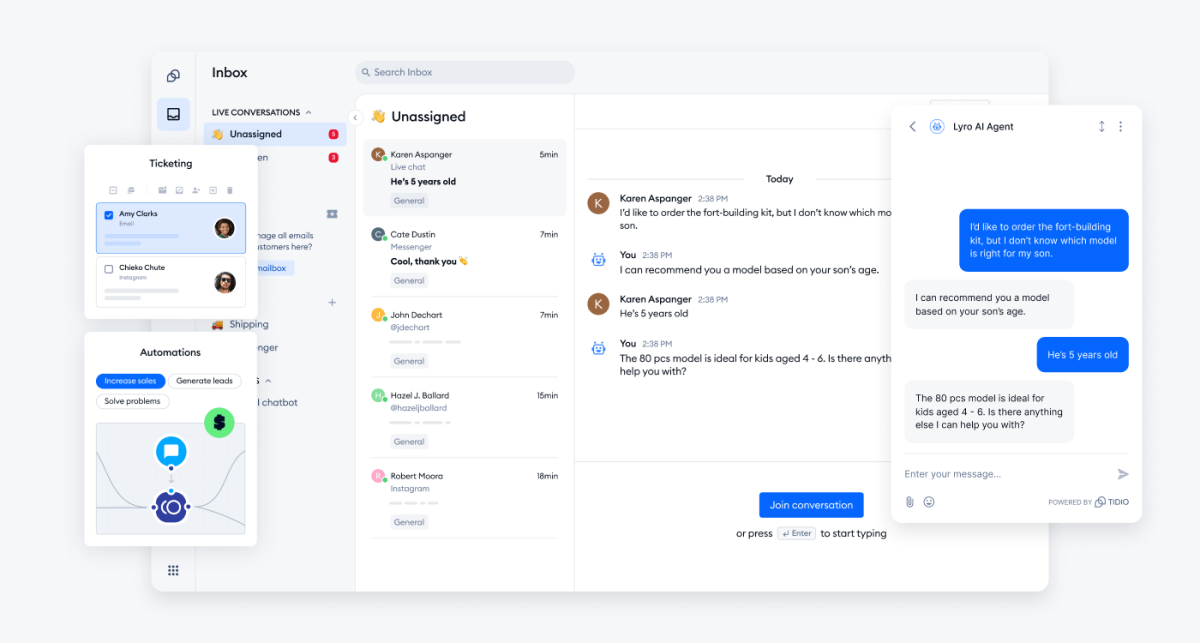
Where Decagon starts with a sales cycle, Tidio starts with a sign-up: you point the Lyro AI agent at your help center, FAQs and website, and it starts answering on chat, email, Messenger, Instagram and WhatsApp (the WhatsApp integration is on every plan). Lyro answers in 51 languages and hands anything it can't solve to your team with the conversation attached. Lyro and human replies share one conversation quota, and a conversation counts once, however long it runs (how the limit works). Lyro Guidance sets tone and escalation rules in plain language, close to what AOPs do in Decagon.
Lyro Actions let it handle order updates and lead qualification and connect to external systems over MCP. If you already run Zendesk, Intercom or Salesforce, Lyro can plug into it, so you can test an AI agent without moving the team.
On Shopify, the shopper's cart shows next to the chat, and Growth adds order history and order actions. Phone calls come in through the Voice add-on.
Pros
- Starter with Lyro from $33/month billed annually, with up to 10 seats included on self-serve plans and a 7-day trial with Lyro, so you can test on your own traffic first.
- When Lyro hands over, your agent picks up in the same inbox with the full chat history.
- Premium offers a guaranteed 50% Lyro resolution rate and pay-per-resolution billing by agreement.
Cons
- The quota counts every conversation Lyro or your team replies to, and Flows has its own visitor limit, so a busy month means keeping an eye on both numbers.
- Plus and Premium are priced with Tidio's sales team, which suits rollouts that need custom limits.
- Built for small and mid-sized teams; multi-agent orchestration across many systems is a job for an enterprise platform such as Kore.ai or Decagon.
Pricing:
- Free: 50 human conversations/month, 100 Flows visitors/month + 50 one-time Lyro AI conversations.
- Starter: Human only: from $24/month for 100 conversations. With Lyro AI: from $33/month for 50 conversations shared by AI and your team.
- Growth: from $41/month for 200 human conversations or $63/month for 100 AI + human conversations; scalable to 1,000/month.
- Plus: from $300/month + usage. Premium: custom pricing.
- Optional add-ons: Flows, Inbox AI, Help Center, Voice, and branding removal.
- 7-day free trial: Growth features with Lyro AI and 100 AI + human conversations, no card required; moves to Free unless you choose a paid plan.
Starting prices shown with annual billing.
See Tidio pricing for every tier.
Rating: G2 4.6/5 (2,169 reviews)
What a G2 reviewer says: "The AI chatbot is helpful so that customers are not kept waiting for extended periods of time during peak times." (4-star review of the AI chatbot at peak times)
Versus Decagon: you gain a public price, a free trial, setup you run yourself and live chat and tickets in the same tool.
Try Tidio free
2. Sierra
Best for: large consumer brands that want an enterprise AI agent like Decagon's, billed on outcomes.
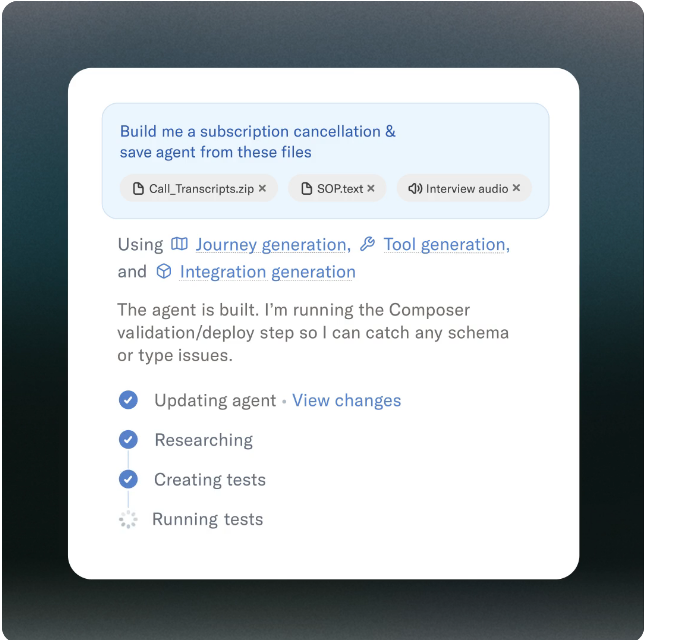
Sierra sells the same kind of product as Decagon, through sales: branded AI agents for large companies. One agent runs one agent across chat, SMS, WhatsApp, email, voice and ChatGPT. Ghostwriter turns your SOPs, call transcripts or a plain-English goal into a working agent.
Key features:
- Ghostwriter to build and update agents from your own documents.
- One agent across six channels, including voice and ChatGPT.
Pros
- Pricing tied to completed tasks rather than every conversation.
- Multilingual, multichannel agents built from your own material.
Cons
- No self-serve plan, trial or published rate.
- Built and priced for large companies, like Decagon.
Pricing: custom and outcome-based, through sales.
Rating: G2 4.5/5 (135 reviews)
Versus Decagon: you gain outcome-based billing and ChatGPT as a channel. You give up little in scale, but the buying process is just as sales-led.
3. Fin by Intercom
Best for: teams that want an AI agent with a price on the page.
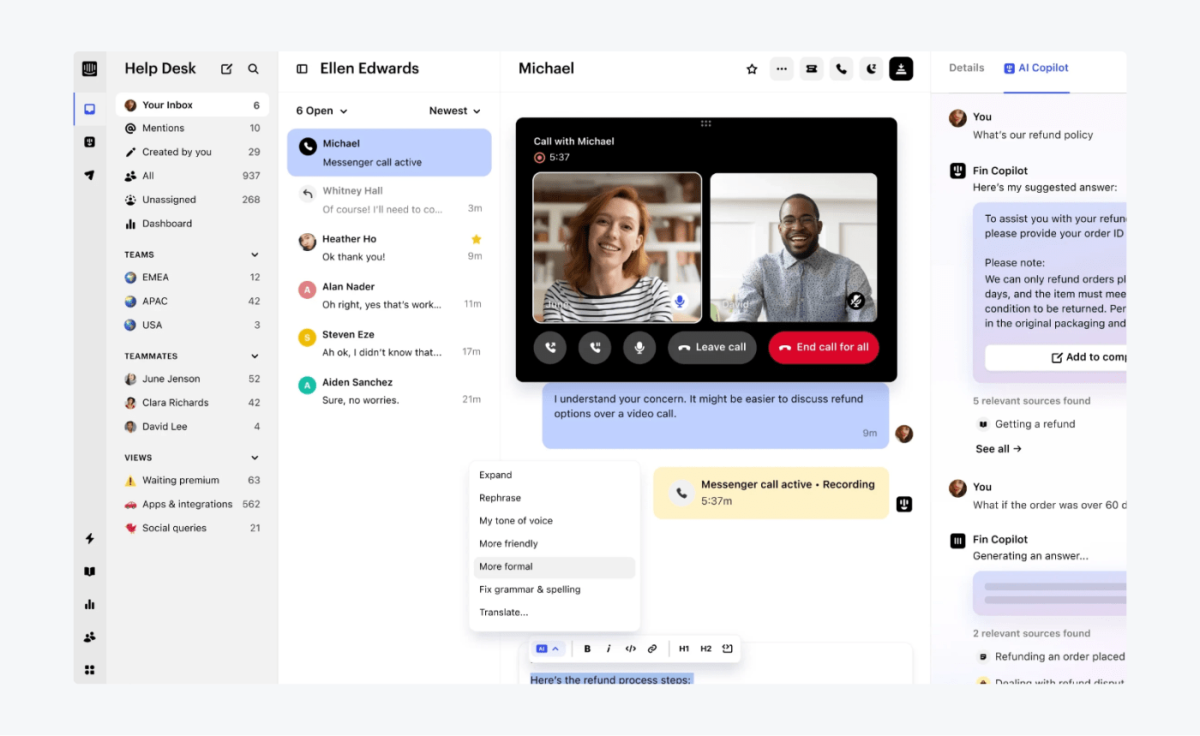
Fin is Intercom's AI agent. It answers from your knowledge base, follows step-by-step Procedures and takes actions in external systems. Fin runs on Zendesk, Salesforce and other help desks without Intercom seats, so you can try it without a migration.
Key features:
- Fin AI Agent across chat, email and voice.
- Procedures for multi-step workflows, including handoffs.
Pros
- A public rate: $0.99 per outcome, charged at most once per conversation.
- No charge when Fin can't answer or the customer asks for a person.
Cons
- On Intercom's own help desk, seat fees and outcome fees stack as the team grows.
- Voice outcomes cost twice as much as chat.
Pricing: $0.99 per outcome. On another help desk, a $49 monthly minimum that includes 50 outcomes, with no setup fee. Fin Voice: $1.99 per voice outcome. With Intercom's help desk, seats start at $29 per seat a month billed annually. 14-day free trial, no card.
Rating: G2 4.5/5
Versus Decagon: you gain a published price, a trial and a start in days on the desk you already use. You give up Decagon's large-scale simulation and A/B testing tools.
4. Zendesk AI agents
Best for: large support teams that already run on Zendesk.
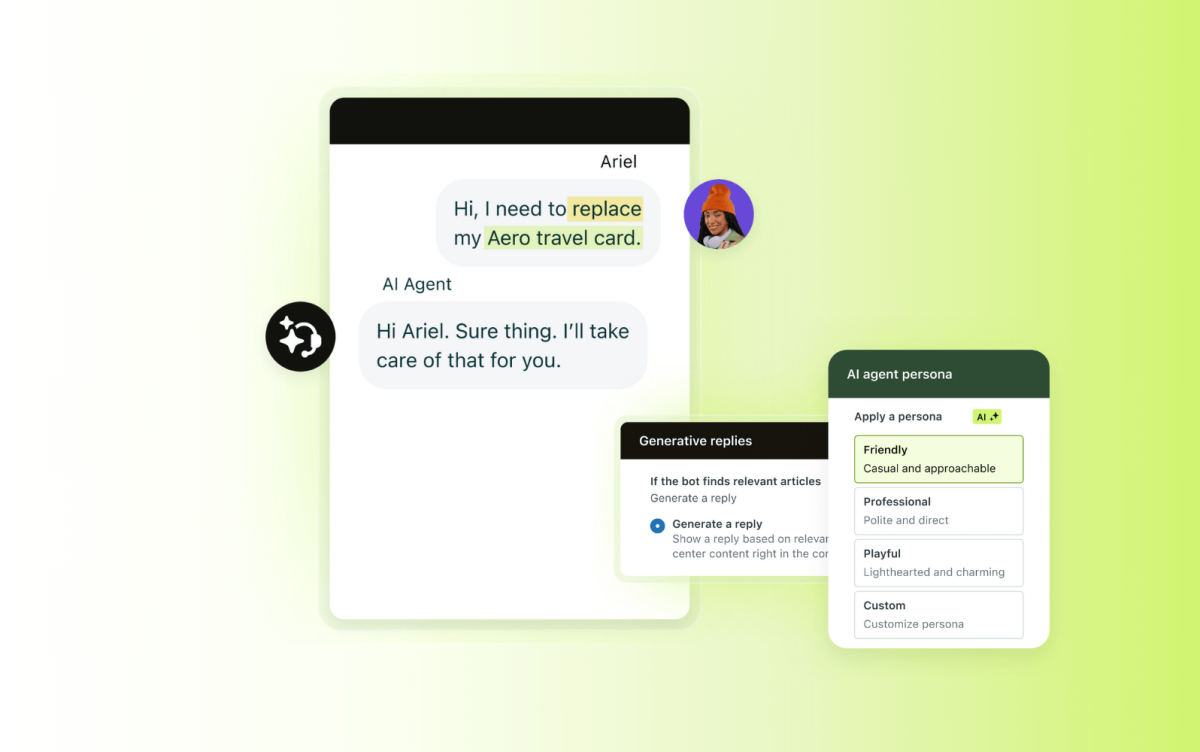
Zendesk includes AI agents in every plan and bills them per automated resolution, a request solved with no human escalation. Agents work across messaging, email and voice.
Key features:
- AI agents built from procedures you describe in plain language, with actions in external systems.
- Ticketing, routing and reporting for large teams, plus 80+ languages.
Pros
- AI agents and some resolutions come with every plan.
- The agent works on the same tickets and customer data as your team.
Cons
- Resolutions beyond the allowance add up at volume.
- Copilot for human agents is an add-on, from Suite Professional.
Pricing (per agent a month, billed annually): Suite Team $55 and Suite Professional $115; Enterprise through sales. Five automated resolutions per agent a month included (10 on Suite Professional), then $1.50 each committed or $2.00 pay-as-you-go. 14-day free trial.
Rating: G2 4.3/5 (7,082 reviews)
Versus Decagon: you gain one vendor for the help desk and the AI agent, with public prices. You give up Decagon's procedure testing and its focus on the AI layer alone.
5. Ada
Best for: enterprise support teams automating very high contact volumes.
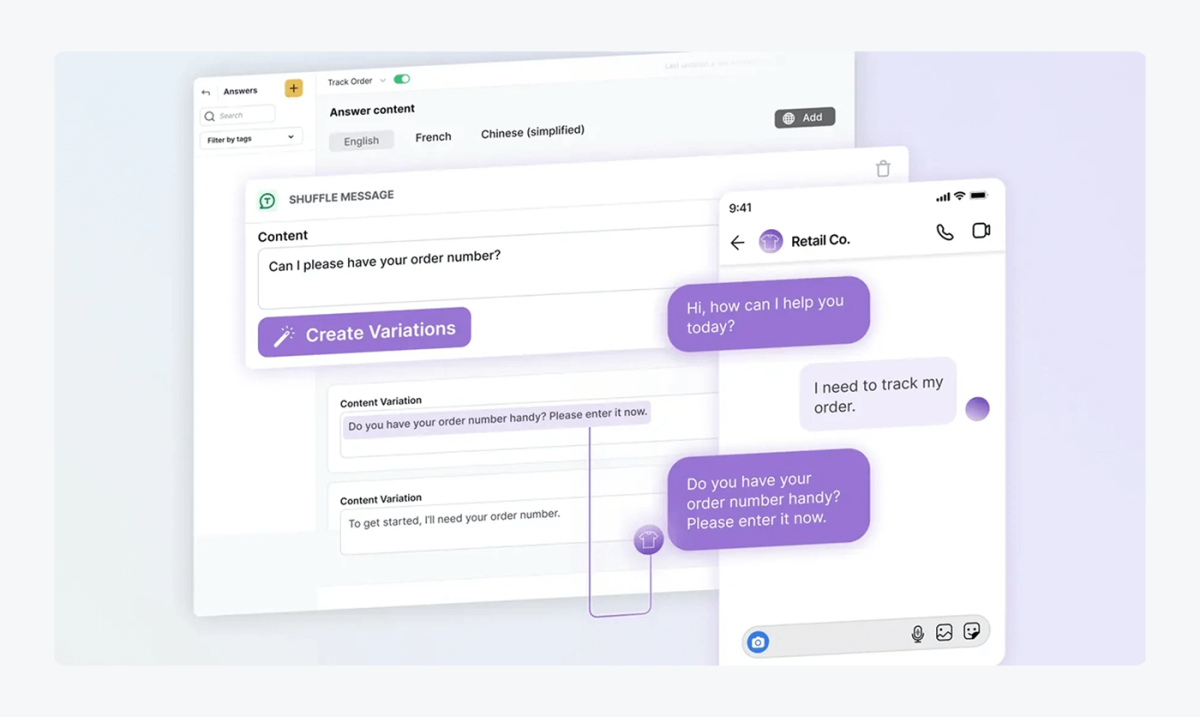
Ada sells AI customer service to large companies. Its agents cover voice, messaging and email, Playbooks turn standard operating procedures into automated workflows, and Ada Computer gives the agent tools to finish tasks in your systems. Ada says conversation-based pricing is its default and that most customers choose it.
Key features:
- Playbooks that automate complex SOPs.
- Voice, messaging and email agents on one platform.
Pros
- Ready-made playbooks for sectors such as travel, insurance and e-commerce.
- A choice of conversation-based or resolution-based billing.
Cons
- No public pricing; quotes follow a demo.
- Not built for a small team.
Pricing: custom, quoted after a demo; conversation-based by default, resolution-based on request.
Rating: G2 4.6/5 (183 reviews)
Versus Decagon: you gain ready-made industry playbooks. Neither publishes a price.
6. Salesforce Agentforce
Best for: companies that run customer service on Salesforce.
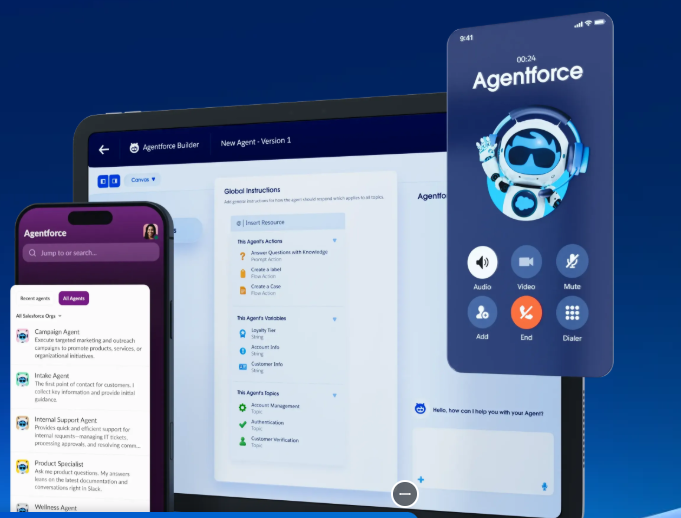
Agentforce agents live inside Salesforce and work directly on cases, accounts and orders. Decagon connects to Salesforce too; Agentforce simply removes the second vendor for teams whose service already runs there.
Key features:
- Customer-facing service agents, plus Agentforce Voice.
- Actions on Salesforce records, prompts and flows.
Pros
- Agents work on the same CRM data as your service team.
- Two consumption models to choose from.
Cons
- Best value only if you are already on Salesforce.
- Per-action metering makes the monthly bill harder to predict.
Pricing: $2 per conversation, or Flex Credits at $500 per 100,000 credits (a standard action uses 20, about $0.10). Agentforce editions and volume terms through sales.
Rating: G2 4.4/5 (8,432 reviews, listed under Service Cloud)
Versus Decagon: you gain one platform for CRM, cases and AI, with a published per-conversation rate. You give up the option to run the same agent on a non-Salesforce desk.
7. Kore.ai
Best for: enterprise contact centers that orchestrate several AI agents.
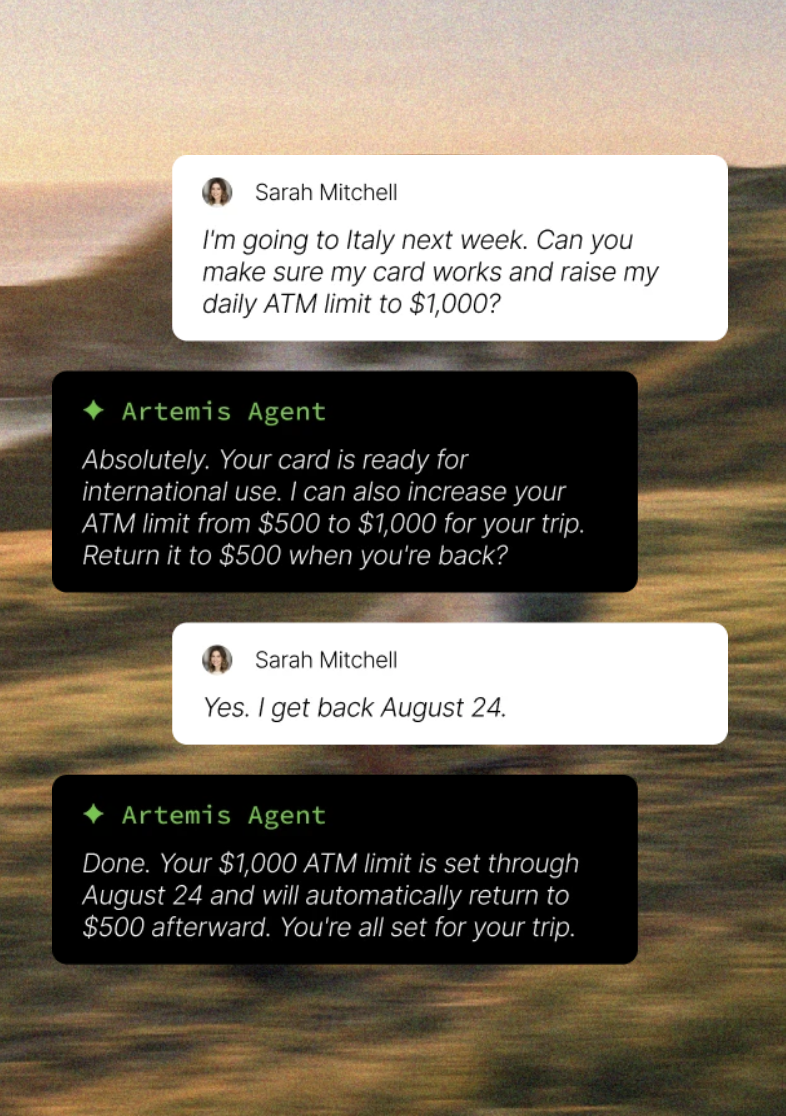
Kore.ai is an enterprise agent platform. Its AI for Service product covers customer-facing agents, agent assist and QA, and orchestration routes each request to a specialized agent.
Key features:
- Multi-agent orchestration across specialized agents.
- Agentic contact center with assist for human reps.
Pros
- Built for large operations with many use cases.
- No-code and pro-code tools for teams with developers.
Cons
- Needs an implementation team and time to deploy.
- No public price list.
Pricing: custom, contact sales.
Rating: G2 4.6/5 (509 reviews)
Versus Decagon: you gain one platform for building many agents, including internal ones. You give up a product built only for customer support.
8. Parloa
Best for: contact centers where phone is the main channel.
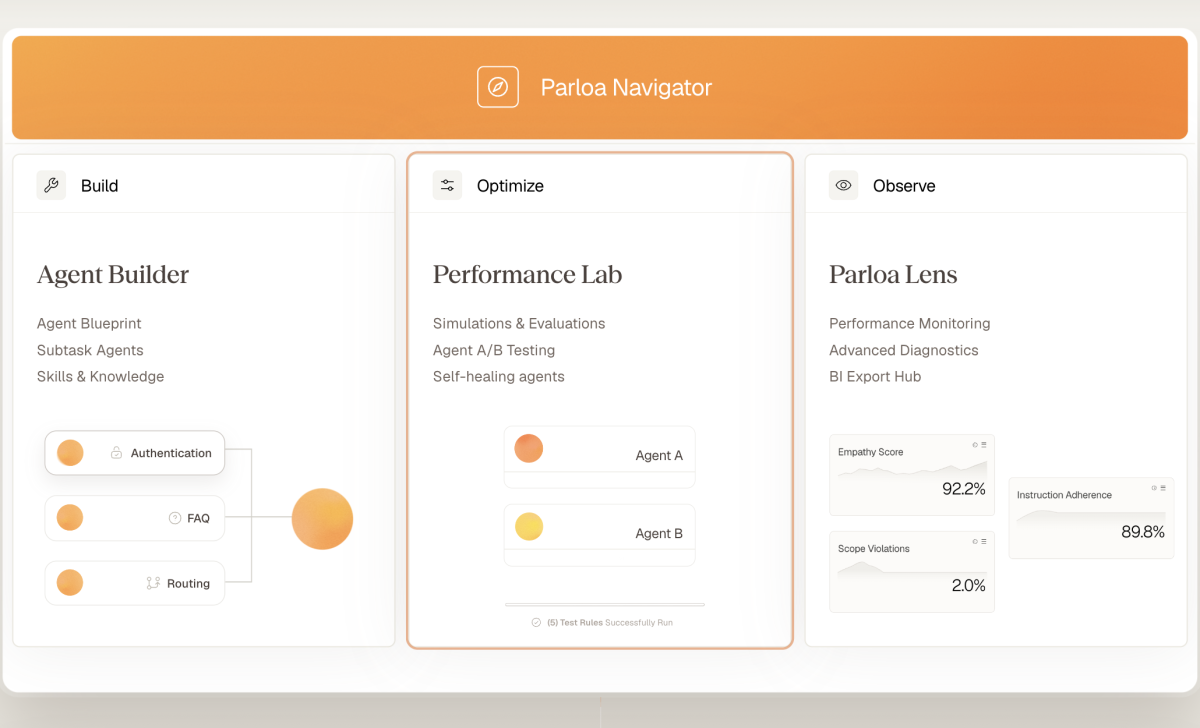
Parloa is built around voice: AI agents that answer and resolve phone calls, with chat on the same platform. If you bought Decagon mainly for phone support, Parloa is built for that workload.
Key features:
- Voice AI agents for inbound calls.
- Chat agents on the same platform.
Pros
- Pricing that follows the channel: per minute for voice, per interaction for chat.
- A clear specialty in phone support.
Cons
- No public prices.
- Less suited to teams whose support is mostly chat or email.
Pricing: custom plans; voice billed per minute, chat per interaction.
Rating: G2 4.3/5 (108 reviews)
Versus Decagon: you gain a voice-first platform priced per minute. You give up Decagon's balance across chat, email and voice.
9. Freshdesk (Freddy AI)
Best for: growing support teams that want a help desk and AI agent on a per-agent budget.
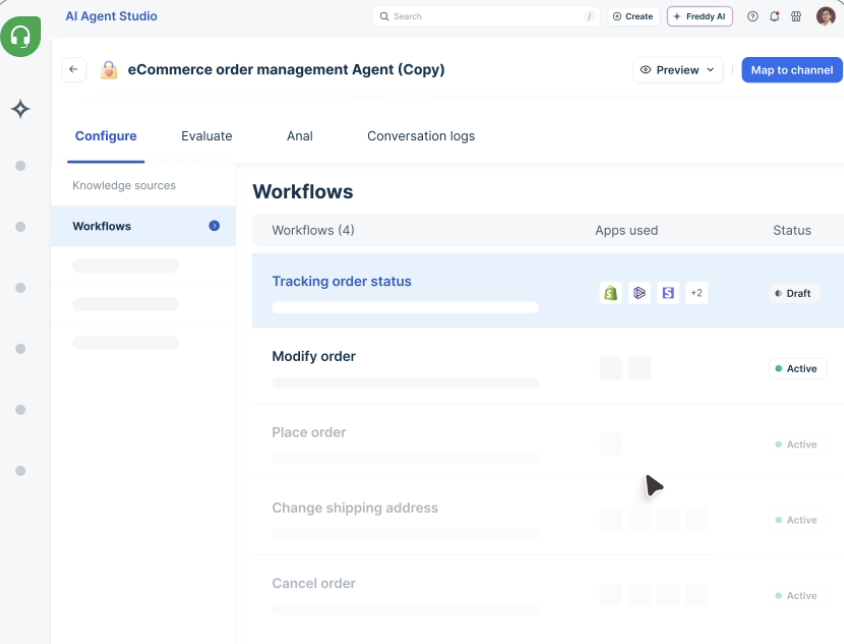
Freshdesk pairs a ticketing help desk with Freddy, an AI agent for customers and a copilot for staff.
Key features:
- Freddy AI Agent for chat and email answers.
- Freddy AI Copilot with reply suggestions and summaries.
Pros
- Low entry price per agent for a full help desk.
- Public prices for both the help desk and AI sessions.
Cons
- AI sessions and Copilot both add to the per-agent price.
- No free plan, only a 14-day trial.
Pricing (per agent a month, billed annually): Growth $19, Pro $55, Enterprise $89. Freddy AI Agent: first 500 sessions free (once per account), then $49 per 100. Copilot: $29 per agent a month. 14-day free trial.
Rating: G2 4.4/5 (3,773 reviews)
Versus Decagon: you gain a help desk and an AI agent with public prices and a trial. You give up Decagon's procedure testing and voice agents.
10. Gorgias
Best for: Shopify and other online stores with a large ticket queue.
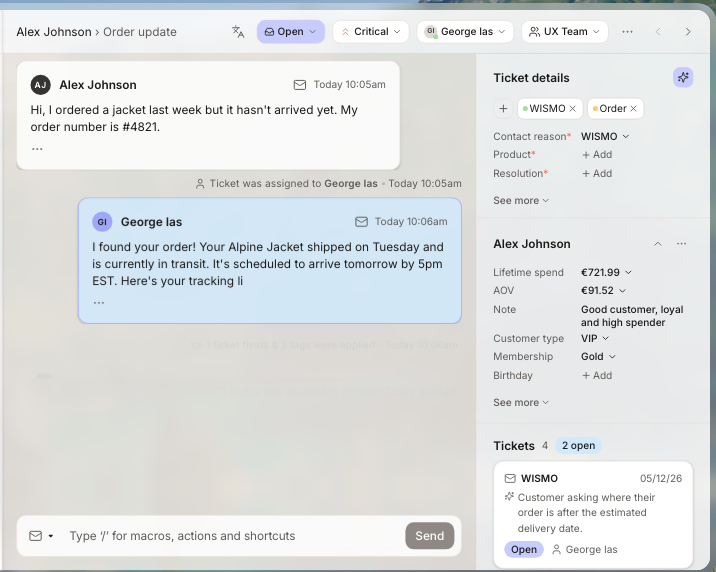
Gorgias is a help desk for e-commerce brands. Its AI Agent answers support questions, recommends products and handles returns, order tracking and cancellations, with native Shopify, BigCommerce, Magento and WooCommerce integrations. Decagon serves some large retail brands, but it does not list Gorgias or Shopify on its integrations page; Gorgias is built around them.
Key features:
- AI Agent with brand voice and guardrails.
- Order management inside every ticket: cancel, refund, discount, track.
Pros
- Pricing follows ticket volume, not seats.
- Store integrations come with every plan.
Cons
- Every automated interaction is billed on top of the plan.
- Little to offer outside e-commerce.
Pricing (monthly; annual in brackets): from $10 for 50 tickets (Starter, monthly only) up to $900 ($750) for 5,000 on Advanced; Basic is $60 ($50) for 300. AI Agent: $1.00 per automated interaction on Starter, $0.90 on Basic and Pro, $0.85 on Advanced. Free trial.
Rating: G2 4.6/5 (582 reviews)
Versus Decagon: you gain native store integrations and public per-interaction prices. You give up voice agents and anything beyond e-commerce.
11. Yellow.ai
Best for: teams that want to start on a free plan and grow into an enterprise contract.
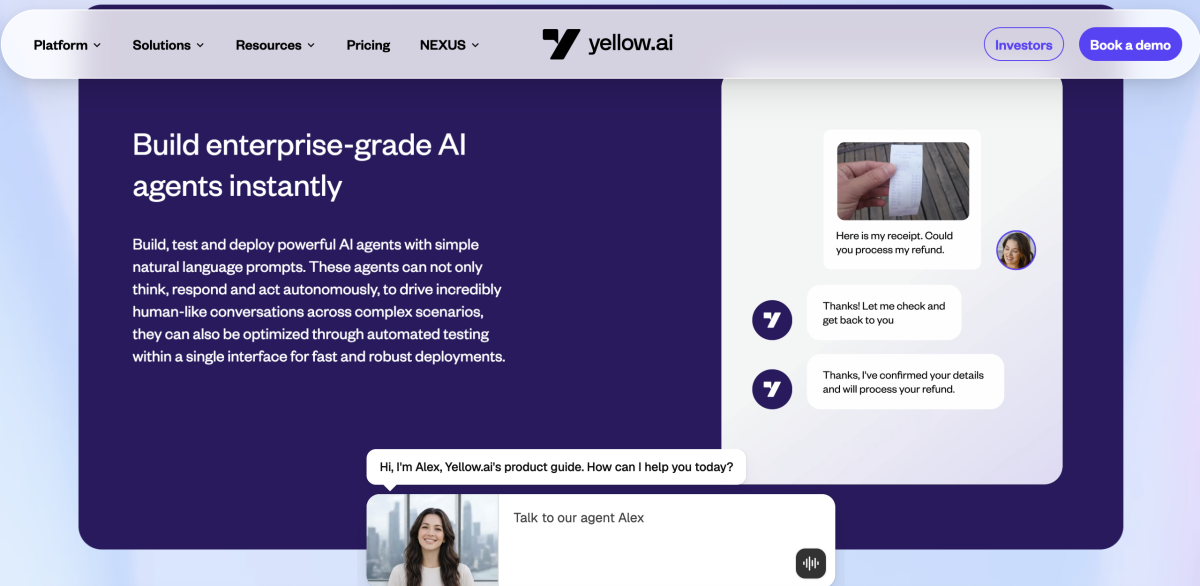
Yellow.ai builds AI agents for chat, voice and email, with a long list of messaging channels. Unlike Decagon, it has a free plan with one AI agent, so you can build and test before a sales call.
Key features:
- AI agents for chat, voice and email.
- Many messaging channels from one builder.
Pros
- A free plan to test before you talk to sales.
- A published per-resolution rate above the free allowance.
Cons
- Enterprise terms are quote-only.
- Plan limits are worth checking on the pricing page before you build on the free tier.
Pricing: free plan with one AI agent, then $0.99 per resolution; Enterprise on request.
Rating: G2 4.4/5 (107 reviews)
Versus Decagon: you gain a free plan and a public rate. You give up Decagon's procedure testing and its enterprise customer base.
AI agent pricing: how each alternative charges
AI agent pricing turns on the billing unit. Decagon quotes per conversation (escalated chats are billed too) or per resolution (a higher rate, paid only when the AI solves the request). Whatever the vendor, ask what counts as a conversation, whether hand-offs are billed and what happens at the monthly limit.
Each row shows the unit the vendor bills its customer-facing AI agent by, the published rate per unit, and the smallest plan or commitment that includes the AI agent, billed annually where offered. Help desk seats are extra unless the cell says so. Decagon is the baseline; the rest run cheapest entry first.
| Tool | Billing unit | Public rate | Smallest plan with the AI agent |
|---|---|---|---|
| Decagon | Per conversation or per resolution | No | Quoted after a demo |
| Yellow.ai | Per resolution | $0.99 above the free allowance | Free plan with one AI agent |
| Gorgias | Per automated interaction | $0.85 to $1.00 | Starter, $10/mo for 50 tickets (monthly only), AI on top |
| Freshdesk | Per AI session | $49 per 100 | Growth, $19/agent/mo; first 500 sessions free once |
| Tidio | Conversations shared by Lyro and human replies; per resolution on Premium | Yes | Starter with Lyro, $33/mo for 50 conversations, up to 10 seats included |
| Fin by Intercom | Per outcome | $0.99; voice $1.99 | $49/mo including 50 outcomes, on another help desk |
| Zendesk AI agents | Per automated resolution | $1.50 committed, $2.00 pay-as-you-go | Suite Team, $55/agent/mo with 5 resolutions per agent |
| Salesforce Agentforce | Per conversation or per action (Flex Credits) | $2 per conversation; about $0.10 per action | Editions and volume terms through sales |
| Sierra | Per outcome (task completed) | No | Through sales |
| Ada | Per conversation (default) or per resolution | No | Through sales |
| Kore.ai | Custom | No | Through sales |
| Parloa | Per minute (voice), per interaction (chat) | No | Custom plans |
A worked example. Say a team of five gets 500 conversations a month across chat, email and WhatsApp, and the AI agent resolves 300 of them:
- Tidio: Growth with Lyro for 500 conversations, $292/month billed annually ($350 monthly). The 200 hand-offs count in the same 500; the five seats are included.
- Fin on your current help desk: $49 covers 50 outcomes, plus 250 × $0.99, so $296.50/month on top of the help desk.
- Zendesk Suite Team: 5 × $55 in seats with 25 resolutions included, plus 275 × $1.50 committed, so $687.50/month.
- Agentforce: 500 conversations at $2 each, $1,000/month, before Salesforce licenses.
A high resolution rate favors per-conversation pricing; frequent escalation favors per-resolution. Model both on a month of your own tickets before you sign.
Tidio vs Decagon
| Tidio | Decagon | |
|---|---|---|
| Built for | Small, mid-sized and e-commerce teams | Large consumer and tech enterprises |
| How you start | Sign up, free plan or 7-day trial | Demo and sales cycle |
| Public price | Yes, Starter with Lyro from $33/mo (annual), up to 10 seats included on self-serve plans | No |
| AI billing | Lyro and human replies share one conversation quota; pay-per-resolution on Premium | Per conversation or per resolution, quoted |
| Live chat and tickets | Included in the same inbox | Not its focus; runs on your help desk |
| Works on Zendesk, Intercom, Salesforce | Yes | Yes |
| Workflow rules | Lyro Guidance and Actions, plus MCP | AOPs in plain language |
| Testing before rollout | Lyro playground | Simulations, live A/B experiments, Watchtower QA |
| Voice and languages | Voice add-on (US, Canada, Australia, UK); Lyro answers in 51 languages | Voice agents in 70+ languages |
| Shopify | Cart preview; order history and actions on Growth | Not listed on its integrations page |
Choose Decagon for a large program that needs heavy testing and voice at scale. Choose Tidio for a mid-sized team or an online store that wants an AI agent, chat and tickets live this week.
Compare Tidio plans with Lyro AI
How to switch from Decagon
- Check your contract. Note the renewal date, notice period and any volume commitment.
- Export your AOPs as text. Most rivals accept plain-language procedures or SOPs as input.
- Keep your knowledge base. Point the new agent at the help center Decagon used.
- Rebuild actions one at a time, starting with the top three by volume (order status, refunds, account changes).
- Test, then run both in parallel. Replay past tickets in test mode, then route one channel to the new agent for two weeks and compare resolution and CSAT.
- Move voice last. Phone flows take longest to rebuild.
Choose by your reason for leaving Decagon
Before you sign, ask each vendor where conversation data is stored and how long it's kept, and test the agent on your own past tickets.
- You need a price before the demo. Tidio, Fin, Zendesk, Freshdesk, Gorgias and Yellow.ai publish their AI rates. For a mid-sized team or an online store, start with Tidio's Starter with Lyro at $33/month billed annually.
- You want to test on real tickets this month. Tidio has a 7-day trial with Lyro, Fin, Zendesk and Freshdesk offer 14 days, and Yellow.ai has a free plan.
- You want to keep your help desk or CRM. Fin runs on Zendesk and Salesforce, Lyro plugs into Zendesk, Intercom and Salesforce, and Zendesk AI agents and Agentforce work on the data you already keep there.
- You want enterprise scale with a different billing unit. Sierra bills per completed task; Ada bills per conversation or, on request, per resolution.
- Phone is your main channel. Parloa is built around voice and bills per minute.
- You sell online. Tidio shows the shopper's cart next to the chat, with order history and actions on Growth, and bills by conversation. Gorgias puts order data on every ticket and bills by ticket, so pick by whether your volume is mostly chats or tickets.
- You run many agents across a contact center. Kore.ai orchestrates specialized agents on one platform.
Bottom line
Decagon is a capable enterprise AI agent, and a large company that tests every change before rollout may have no reason to leave. If you're leaving for a price before the demo, a faster start or a better fit with your help desk, pick by that reason and model the AI bill on a month of your own tickets. For a mid-sized team or an online store, Tidio's free trial puts Lyro in front of your own customers before you commit.
Try Tidio free
Related guides
- Best AI agents for customer service
- Best agentic customer service software
- Agentic AI companies
- Intercom alternatives
- Zendesk alternatives
- Chatbot pricing
- Freshdesk alternatives
- Gorgias alternatives
- Lyro vs Ada
Frequently asked questions
Tidio for mid-sized teams and online stores; Sierra and Ada for large enterprises; Fin, Zendesk AI agents and Agentforce for teams staying on their current help desk.
Decagon doesn't publish prices. There is no free trial or self-serve plan, and quotes follow a demo, on one of two models: a fixed rate per incoming conversation or a higher rate per resolved conversation. Decagon says most customers choose per conversation.
Yes, with public prices. Tidio's Starter with Lyro costs $33 a month billed annually, with up to 10 seats included, and Lyro and human replies share one conversation quota; Fin by Intercom costs $0.99 per outcome with a $49 monthly minimum, and Yellow.ai has a free plan. Your total depends on volume and resolution rate.
Both build enterprise AI agents and sell through sales. Decagon writes workflows as AOPs and stresses testing with simulations and live experiments. Sierra bills on outcomes, builds agents with Ghostwriter and adds ChatGPT as a channel.
One quota covers every conversation Lyro or your team answers on chat, email, WhatsApp, Instagram and Messenger, and a long thread still counts as one. Monthly plans step up to the next tier at 95% of the limit by default, with a heads-up at 80%. Annual plans don't step up on their own.
Use live chat to support your customers in real-time