Key takeaways:
- A restaurant chatbot takes orders, books tables, answers menu questions, and now handles voice ordering across your website, app, and channels like WhatsApp.
- The Messenger bots of 2016–2018 have given way to AI agents that read what a guest means instead of following fixed button menus.
- Big chains show what’s possible: Wendy’s and Taco Bell run voice AI at the drive-thru, and Casper Hospitality booked $28,000 in one month with a reservation voice agent.
- You can build one without code by pointing an AI agent like Lyro at your menu, FAQs, and booking rules.
Your phone rings in the middle of the dinner rush. Someone wants a table for four at 8, while two takeout callers wait on hold and your host is seating a party of six. Those are the calls you miss, and missed calls are missed revenue.
A restaurant chatbot catches them for you. It answers guests in plain language, takes orders, books tables, shows the menu, and handles common questions on your website or through channels like WhatsApp and Facebook Messenger.
This guide covers what a restaurant chatbot does in 2026, real examples from brands like Wendy’s and KFC, the shift to voice ordering, and how to build your own with an AI agent. By the end, you’ll know how to field more orders and reservations without hiring more staff.
Use live chat to support your customers in real-time
What is a restaurant chatbot?
A restaurant chatbot is a software assistant that talks to your guests in natural language to take orders, make reservations, show the menu, and answer common questions. It works on your website, app, or messaging channels, at any hour. Modern versions use AI to understand free-form questions instead of fixed button menus.
That last point is the big change since the Facebook Messenger bots of 2017. Early restaurant bots followed rigid scripts: tap “Menu,” tap “Hours,” tap “Book.” An AI chatbot reads intent. A guest can type “do you have anything gluten-free for a group of six on Friday” and get a real answer, plus a booking, in one exchange.
What can a restaurant chatbot do?
A restaurant chatbot handles the repeatable guest tasks that eat your staff’s time: taking orders, booking and modifying reservations, recommending menu items, collecting reviews, and answering hours-and-location questions. The newest builds go further, taking spoken orders at the drive-thru and coaching staff mid-shift.
Here are the jobs a chatbot for restaurants does well today:
- Take orders. Guests browse the menu and order inside a chat, with no app download and no wait on hold.
- Book and change reservations. The bot checks live availability, confirms the table, and handles cancellations and waitlists.
- Recommend and upsell. It suggests pairings and add-ons on every order, which staff forget to do when they’re slammed.
- Collect feedback. It sends a quick survey or review link after the meal.
- Answer FAQs. Hours, location, allergens, parking, and delivery status, resolved without a human.
- Support voice ordering. Voice AI now takes spoken orders at drive-thru lanes and over the phone.
Restaurant chatbot examples in 2026
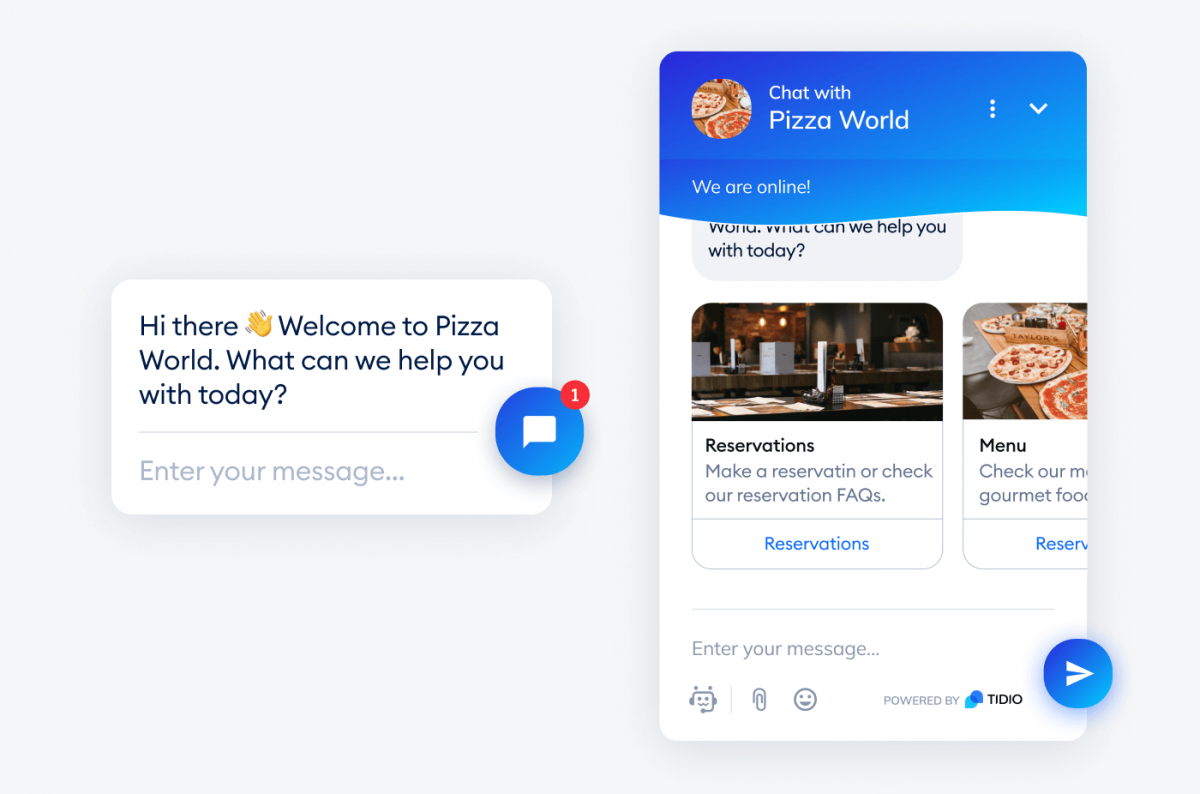
The strongest restaurant chatbot examples in 2026 are AI-first, not the Messenger bots of the last decade. Brands now use them to take orders inside WhatsApp, coach drive-thru crews through headsets, and answer every reservation call. Here are current examples grouped by what they do.
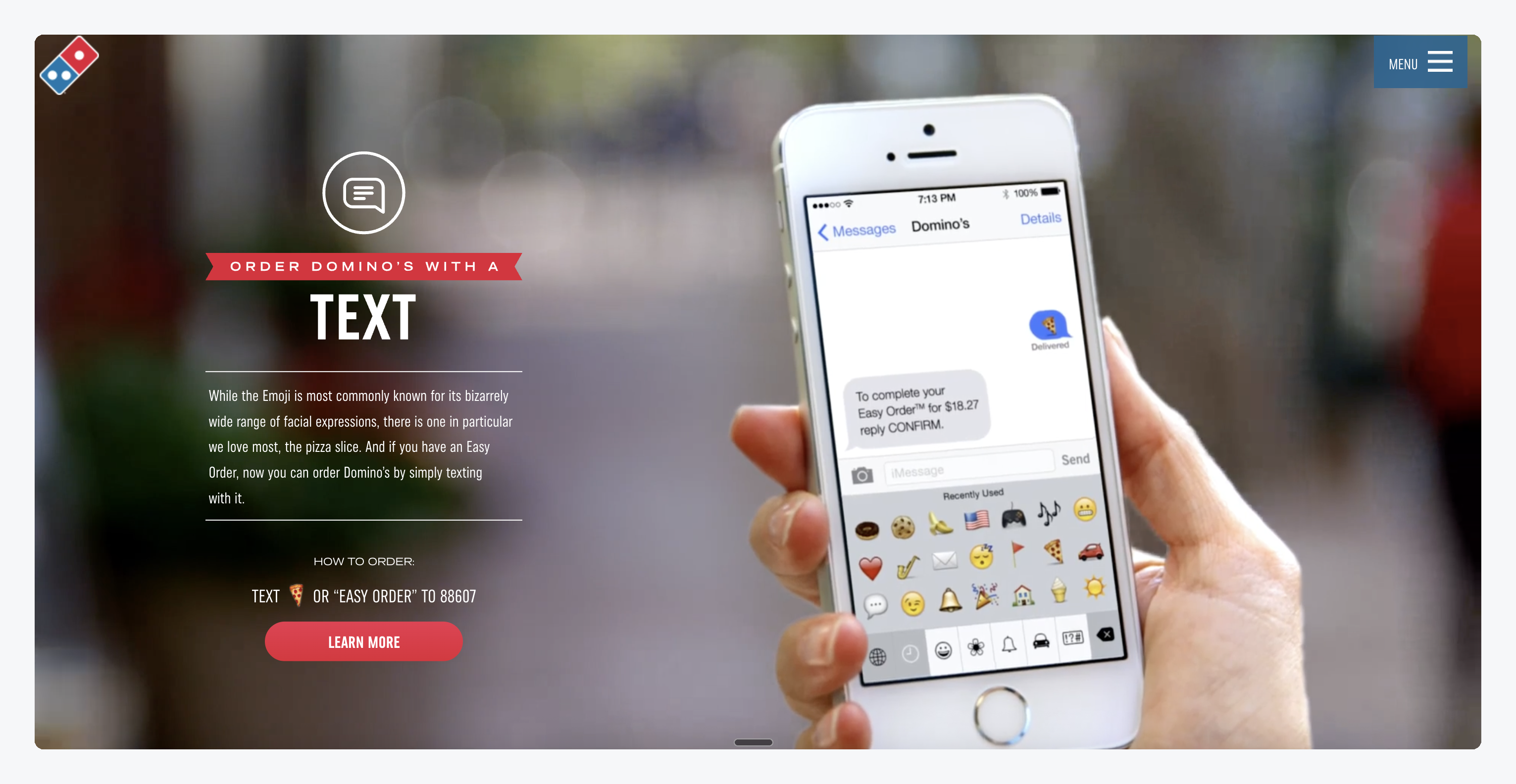
Ordering: Domino’s (Dom / AnyWare). Domino’s takes orders across its app, web, and messaging through its ordering assistant, part of the long-running AnyWare program. It’s the clearest proof that a food ordering chatbot can carry real transaction volume and complete purchases, well beyond answering questions.
What to learn: let guests reorder favorites in as few steps as possible.
Staff support: Burger King “Patty.” Burger King is piloting an OpenAI-powered assistant called Patty in roughly 500 US restaurants, part of its BK Assistant platform (as of early 2026)[1]. Patty lives in crew headsets. It answers prep questions, flags out-of-stock items, and analyzes drive-thru audio to improve order accuracy. It coaches staff rather than replacing them.
What to learn: AI can support the people at the counter, not only the guest at the window.
Staff support: McDonald’s “Ask Pickles” and Starbucks “Green Dot Assist.” McDonald’s built a crew chatbot with Google, “Ask Pickles,” to answer equipment and procedure questions on the line[2].
Starbucks runs a similar staff assistant, Green Dot Assist, that helps baristas solve equipment and drink-build problems in real time[3].
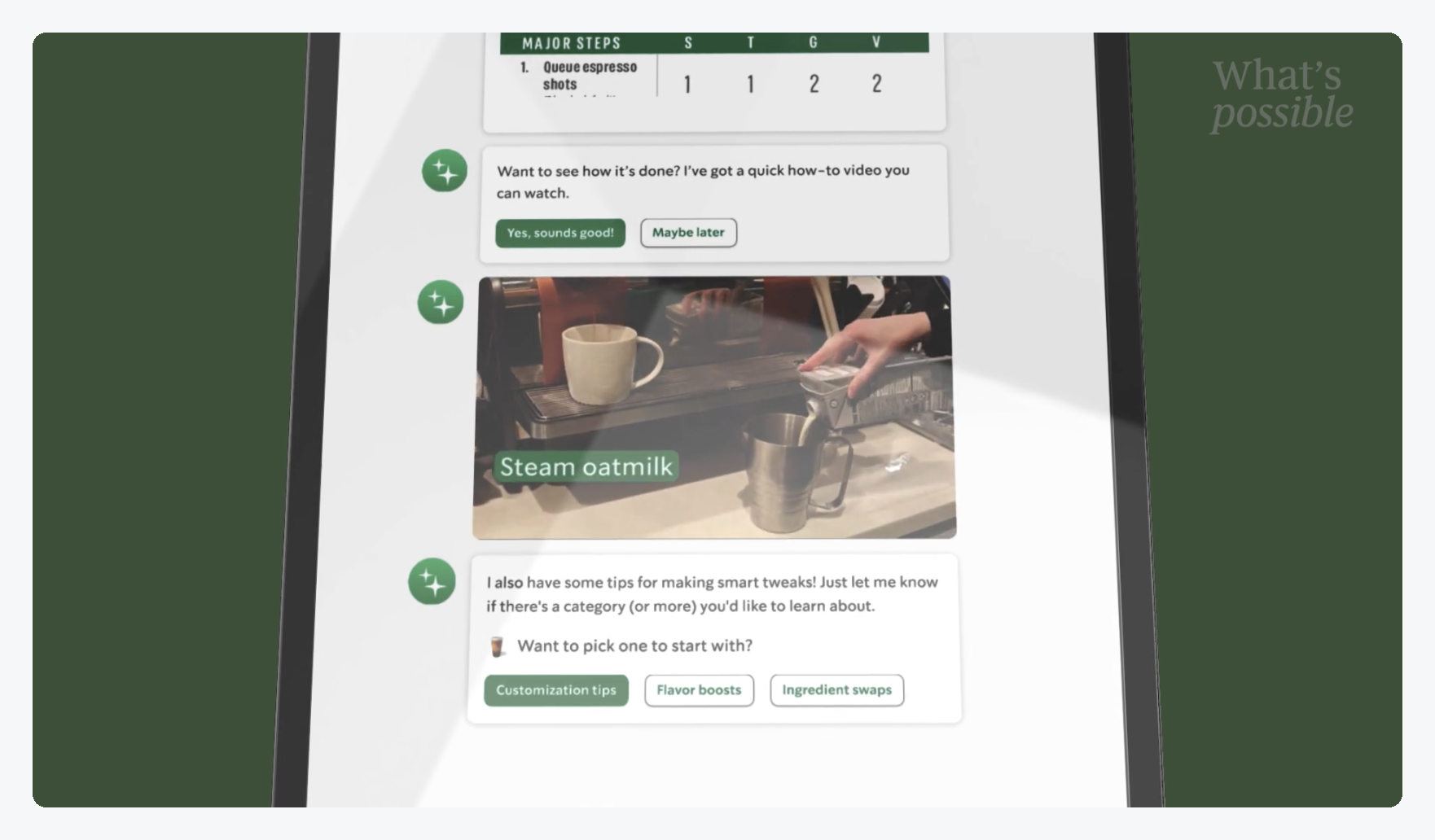
What to learn: the fastest AI wins are often internal, cutting the time crews lose looking up answers.
For more cross-industry builds, see our roundup of AI chatbot examples.
Boost customer satisfaction with a professional AI agent
AI voice and drive-thru ordering
Voice is the fastest-growing use for restaurant chatbots. AI now takes spoken orders at the drive-thru speaker and over the phone, understanding natural speech and confirming the order on a screen. It’s the net-new category that barely existed in 2024, and it’s where the big quick-service chains are spending.
Wendy’s leads the visible rollout. Wendy’s FreshAI, built with Google Cloud, was on track for 500–600 US locations by the end of 2025. Wendy’s reports the system cut average wait times by about 22 seconds and reached roughly 99% order accuracy in its own communications[4].
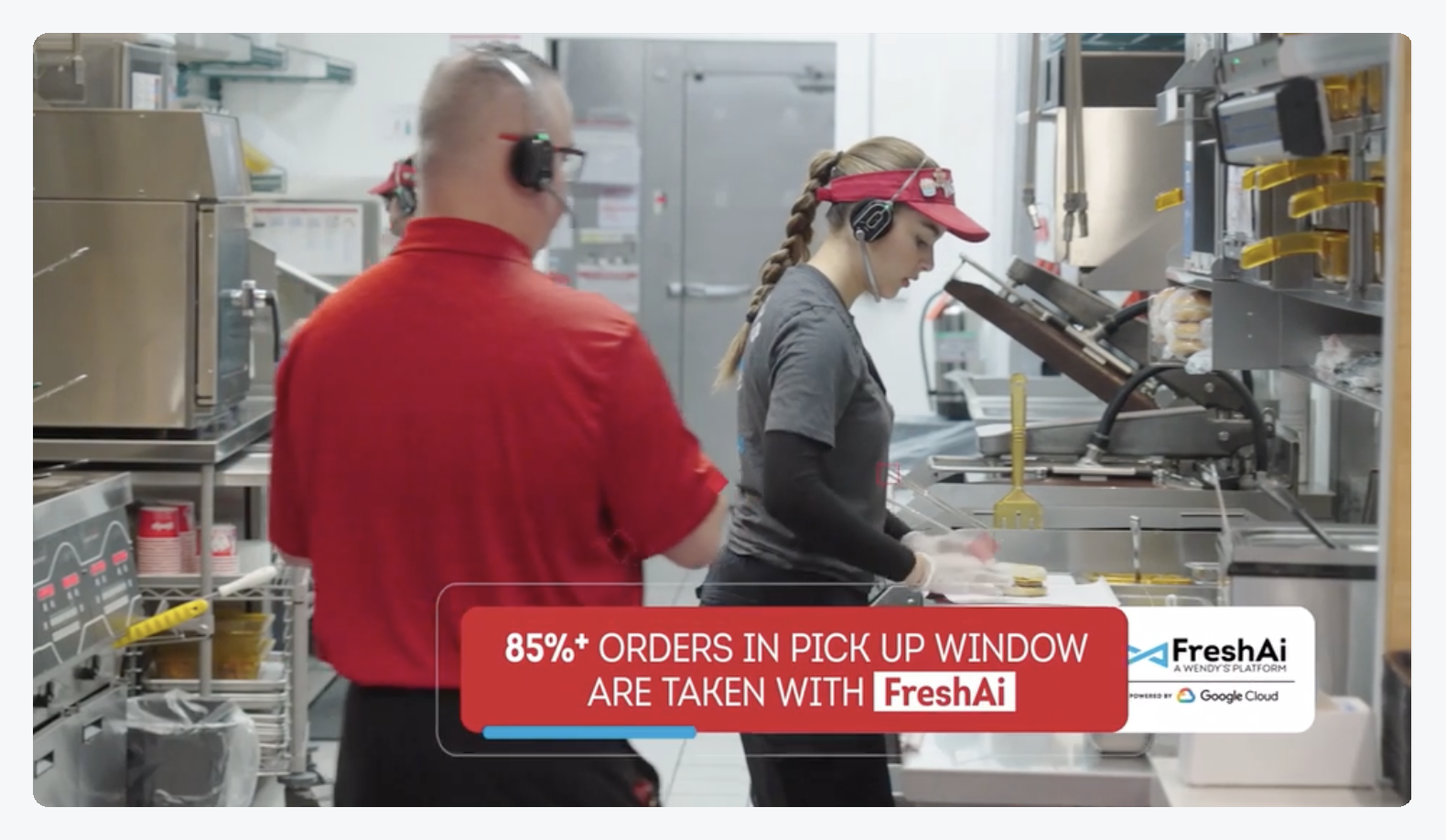
White Castle runs SoundHound’s voice AI (“Julia”) across roughly 40 lanes[5], and Taco Bell expanded its own voice ordering, built on Yum’s Byte platform with Nvidia, to close to 900 locations[6].
Restaurant reservation chatbots
A restaurant reservation chatbot books tables, changes and cancels bookings, manages waitlists, and sends reminders to cut no-shows. The strongest versions answer the phone too, so a call during service never goes to voicemail. They check live availability, capture the guest’s details, write the booking into your system, and confirm, without pulling a host off the floor.
The chatbot restaurant reservation use case is where small operators feel the difference fastest, because the alternative is a ringing phone nobody can answer. Casper Hospitality is a clear example. After putting SevenRooms Voice AI on the phones across its four US locations, it handled more than 3,800 calls in a single month, created 850-plus covers, and booked around $28,000 in revenue, according to SevenRooms[7]. Its COO said the group “practically retired” its phones and freed staff hours every week for guests in the room.
How to build a restaurant chatbot with Lyro
The fastest way to build a restaurant chatbot in 2026 is to point an AI agent at content you already have. With Lyro, our AI agent, you connect your menu, FAQs, and booking rules, deploy on your site and messaging channels, then review and improve. No code, and no scripting every question by hand.
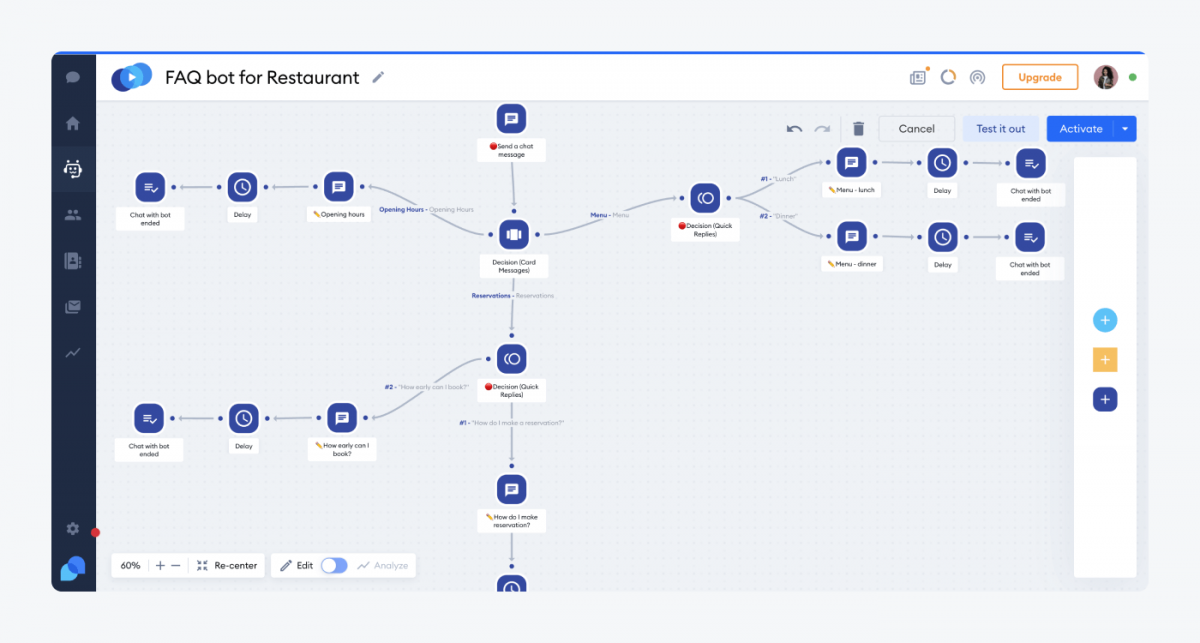
Three steps get you live:
- Feed Lyro your content. Add your menu, hours, allergen list, delivery zones, and reservation policy. Lyro reads it and answers from that content only, so it won’t invent a dish you don’t serve.
- Deploy where guests are. Put Lyro on your site and connect it to WhatsApp and Messenger so one agent covers every channel.
- Review and improve. Check the conversations Lyro handled, add any knowledge it was missing, and let it take on more over time.
Lyro resolves 67% of customer questions on average, costs $0.50 per resolved conversation, and starts with 50 free conversations so you can test it on real guests before you commit. For a light-touch option alongside it, you can still add rule-based Tidio Flows for fixed prompts like a reservation button.
Why restaurants use chatbots: the benefits
Restaurants adopt chatbots to recover missed revenue and free staff during the rush. Labor is the pressure point: 62% of quick-service leaders name it their most pressing challenge, per the 2025 Intouch Insight study. A chatbot answers the calls and orders your team can’t get to, which turns dropped calls into booked tables and completed orders.
The gains cluster in three places. Speed: guests self-serve on orders, bookings, and status checks without waiting on hold. Coverage: the bot works nights and weekends when your phone would otherwise ring out. Focus: with routine questions handled, your staff spend their time on the guests in front of them. Restaurants running chat-based ordering also report higher order-completion rates than app-based ordering, because there’s no download to abandon.
One caution worth naming: guests notice when a bot is worse than a person. Accuracy on complex, customized orders still trails human staff, so the best results come from letting AI handle the routine and routing the tricky cases to your team. Set that handoff up from day one.
Restaurant chatbots have gone from Messenger FAQ bots to AI agents that take orders, book tables, and even run the drive-thru. The brands winning with them share one habit: they let AI handle the routine and keep people on the moments that need a human. Want to see how an AI agent handles your menu and bookings? Start for free with Lyro and test it on 50 real conversations.
Restaurant chatbot FAQs
A restaurant chatbot is AI software that talks to guests to take orders, book tables, show the menu, and answer questions on your website, app, or messaging channels. Modern versions understand natural language, so guests can ask freely instead of tapping through fixed menus.
Costs range from free starter tiers to per-conversation pricing. Lyro, for example, starts with 50 free conversations and then costs $0.50 per resolved conversation. Enterprise voice-AI phone and drive-thru systems cost more and are usually priced by location or call volume.
The best chatbot for restaurants depends on your main job. For website and messaging support, orders, and reservations, an AI agent like Lyro fits most independents and small chains. For drive-thru voice ordering at scale, large chains use specialist vendors like SoundHound or Google Cloud.
Yes. A restaurant chatbot can check live availability, book and modify reservations, manage waitlists, take food orders, and process payment inside a chat or over the phone. Voice AI can now do the same at the drive-thru speaker.
Many do, when it’s fast and accurate. Guests value the speed and the lack of hold time, and chat-based ordering avoids the app-download barrier. Satisfaction drops when a bot fumbles a customized order, which is why a smooth handoff to human staff matters.