
Adoption of agentic AI is gaining momentum as businesses look for more flexible ways to manage customer interactions. In fact, recent data shows that 63%[1] of support teams are already using AI to improve their workflows, with adoption only continuing to rise.
Agentic customer service software is designed to take action, not just respond. These tools can understand customer intent and carry out tasks like updating orders or booking a service. What’s more, these handy tools allow you to keep conversations moving without constant human input, helping support teams manage higher volumes of requests.
In this article, we’ll look at what agentic customer service software offers and explore some of the best platforms available today. You’ll also be able to review the features that allow teams to automate workflows and improve the overall customer experience.
| Agentic customer service platform | Free plan? | Best for |
| Tidio | ✅ | Conversational AI for customer support and ecommerce |
| Intercom | ❌ | AI-powered customer support with automated resolution and routing |
| Zendesk AI | ❌ | AI automation within ticketing and help desk workflows |
| Salesforce (Agentforce) | ❌ | Enterprise customer service automation connected to CRM data |
| Ada | ❌ | Automated customer service for large and global support teams |
| Forethought | ❌ | AI-driven ticket triage and end-to-end support automation |
| Cognigy | ❌ | Enterprise contact center automation across voice and chat |
| Kore.ai | ❌ | Building and managing AI agents for enterprise workflows |
| Freshdesk (Freddy AI) | ✅ | AI-assisted customer support for growing teams |
| Aisera | ❌ | Customer service and internal support automation |
Tidio
Ratings: 4.7/5 ⭐️
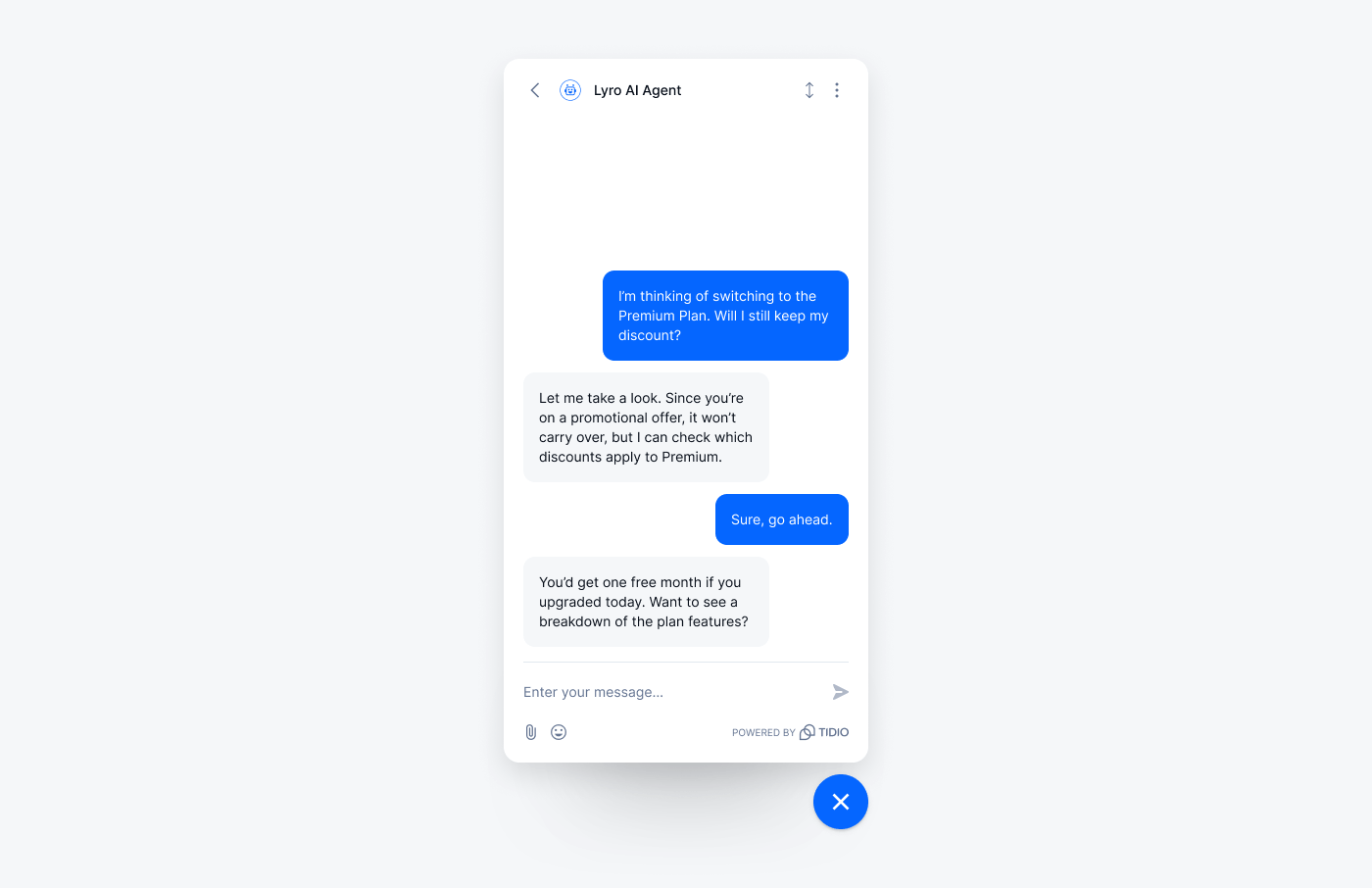
Tidio is an agentic customer service platform designed to help businesses manage and automate customer interactions across chat, email, and messaging channels. It brings customer communication and automation into one system. In turn, this helps teams handle conversations and keep support workflows running without constant manual input.
What sets Tidio apart is how it applies agentic AI to everyday support tasks. Lyro, Tidio’s AI customer service agent, can understand customer intent, respond to questions, and carry out actions such as guiding users through product searches or resolving common requests in real time. Instead of only replying to messages, Lyro helps move conversations forward by handling repetitive tasks and maintaining context, while human agents can step in whenever more complex support is needed.
Main features:
- Lyro AI agent for automated conversation handling, intent recognition, and resolution of common customer requests
- Shared inbox for managing and coordinating conversations across live chat, email, and messaging channels
- Visual chatbot automation builder for creating workflows that handle repetitive support tasks and trigger actions
- Real-time visitor insights that help personalize interactions based on user behavior
- Live chat widget with customizable appearance and proactive messaging
Pricing:
- 7-day free trial available
- Free version available
- Starter ($24.17/mo)
- Growth (starts at $49.17/mo)
- Plus (starts at $749/mo)
- Premium (starts at $2999/mo)
Keep your support running without delays
Read more: Here are the best agentic AI companies and their detailed reviews.
Intercom (Fin AI Agent)
Ratings: 4.5/5⭐️
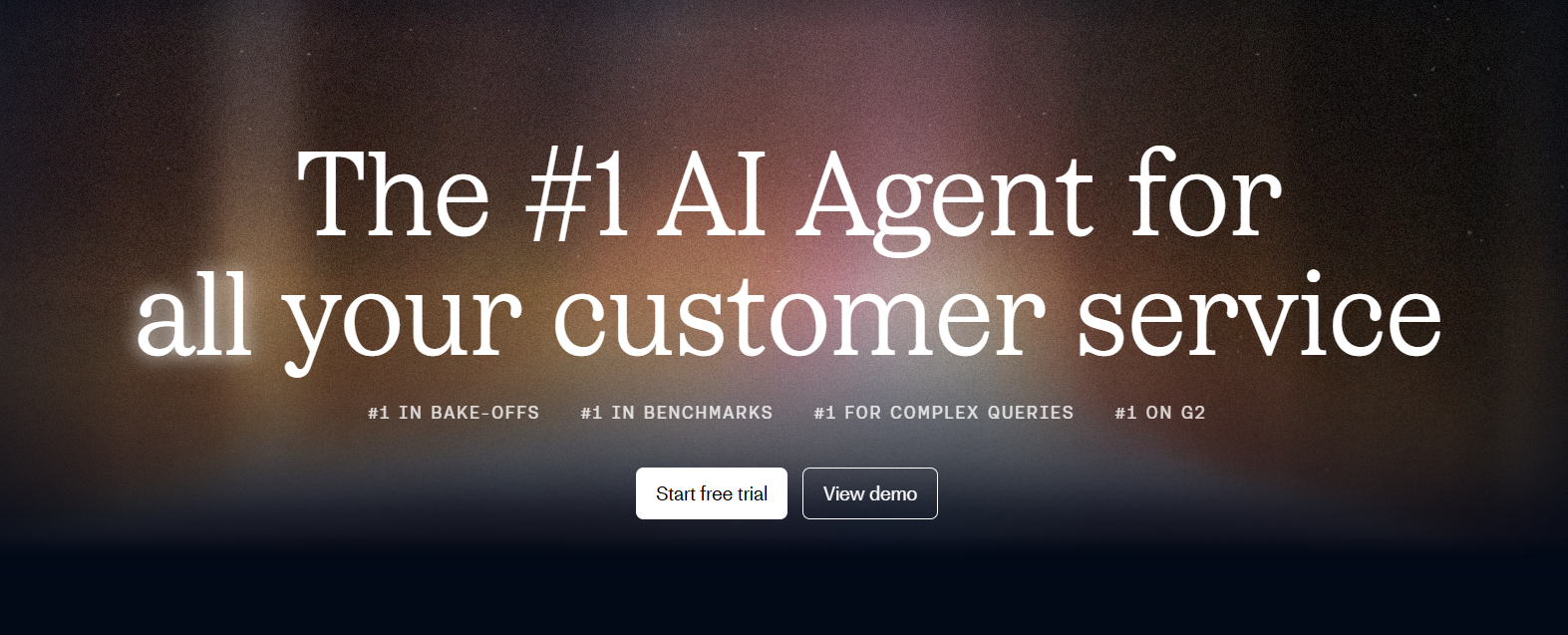
Intercom brings together customer messaging, help desk tools, and AI automation in one platform, making it easier for support teams to manage conversations across chat, email, and in-app channels. It’s often used by SaaS and ecommerce companies that want to keep support organized while handling a growing number of customer interactions.
Fin, Intercom’s AI agent, is built to resolve support requests end-to-end. It can answer questions using your knowledge base, handle conversations across multiple channels, and take action within external systems when needed. It also hands conversations off to human agents with full context, which helps reduce back-and-forth and keeps support workflows moving smoothly. Teams can use it alongside automation tools like workflows and routing to manage incoming requests.
Main features:
- Fin AI agent that resolves customer conversations across chat, email, and messaging channels
- Shared inbox and ticketing system for managing support interactions in one place
- Workflow automation builder for routing conversations and handling repetitive tasks
- Help center with multilingual support for self-service content
- AI assistant (Copilot) that helps agents respond faster inside the inbox
Pricing:
- Free trial available (14 days)
- Essential ($29/mo/seat)
- Advanced ($85/mo/seat)
- Expert ($132/mo/seat)
- Fin AI agent ($0.99 per resolved conversation)
Read more: Here are the best Intercom alternatives for customer service.
Zendesk AI
Ratings: 4.3/5⭐️
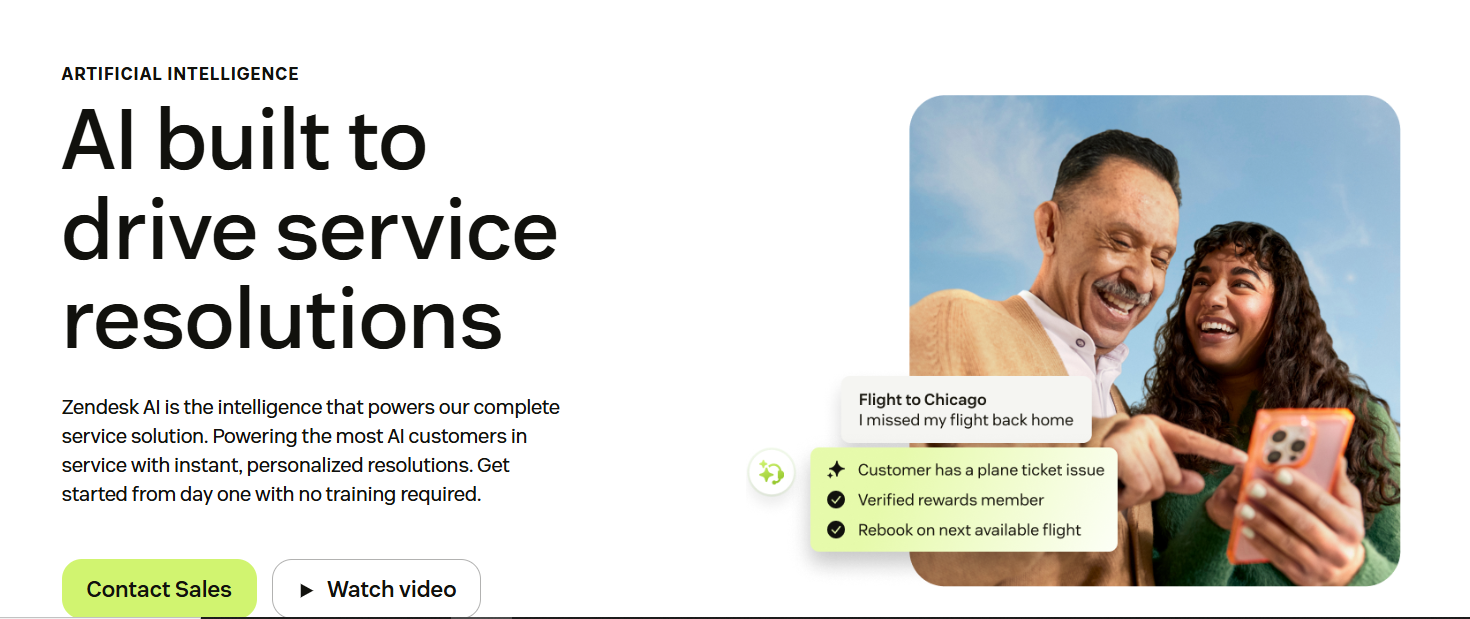
Zendesk focuses on helping teams manage customer support through structured workflows that connect conversations, tickets, and internal processes. Its platform brings together multiple channels, including messaging, email, and voice.
Its AI capabilities are built around resolving requests through defined procedures. Zendesk AI agents can interpret customer intent, pull from knowledge sources, and follow step-by-step workflows to complete tasks like processing requests or updating information. These agents can also connect with external systems, which allows them to carry out actions instead of only responding. Alongside this, Zendesk’s agent Copilot supports human agents with suggestions and summaries, helping teams keep conversations moving without delays.
Main features:
- AI agents for customer service that handle conversations and follow structured procedures to resolve requests
- Omnichannel support across email, messaging, voice, and help center
- Workflow automation for routing tickets and managing support processes
- Agent Copilot that assists with replies and summaries
- AI knowledge base integration used to power both AI responses and self-service
Pricing:
- Free trial available
- Support Team ($19/mo/agent)
- Suite Team ($55/mo/agent)
- Suite Professional ($115/mo/agent)
- Suite Enterprise ($169/mo/agent)
Read more: Check out the top Zendesk alternatives and competitors.
Salesforce (Agentforce)
Ratings: 4.4/5⭐️
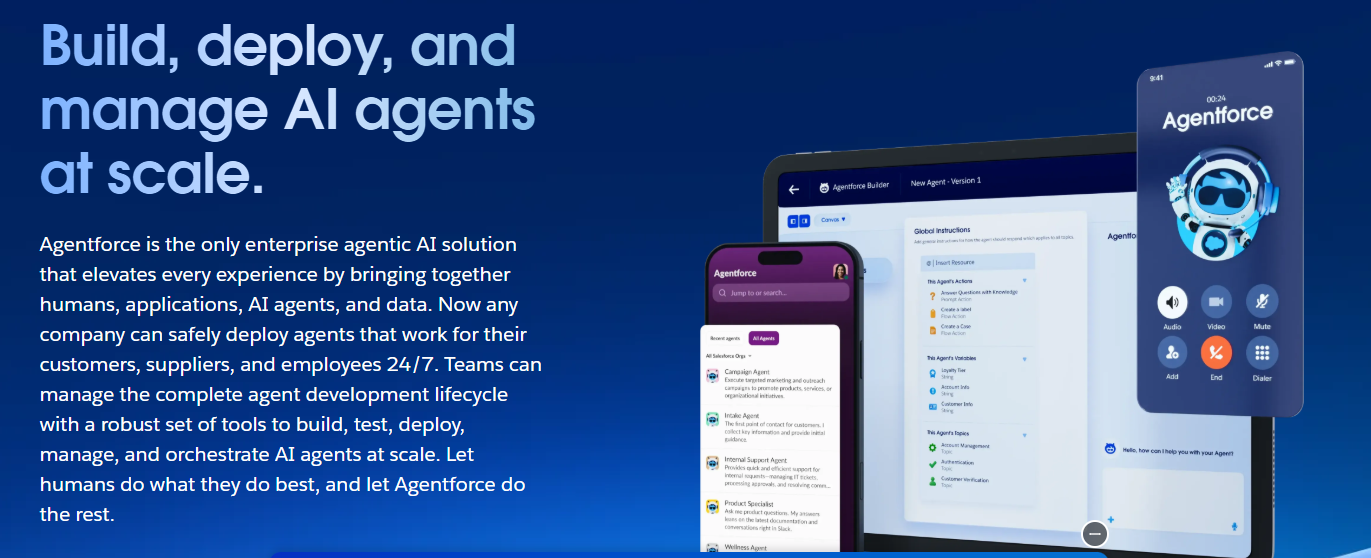
Salesforce approaches customer service through its broader ecosystem, where support, sales, and customer data are all connected within one platform. Service Cloud is the core product used for support, giving teams a way to manage conversations and customer history in one place while keeping everything tied to CRM data.
Agentforce introduces AI agents that can take action across this environment. These agents can interpret requests, trigger workflows, and update records directly within Salesforce or connected systems. For example, they can handle service requests or assist with account-related actions without requiring manual input at every step. Because everything runs on top of CRM data, interactions stay context-aware, and both AI and human agents can work from the same information.
Main features:
- AI agents that execute workflows and complete actions across Salesforce and connected systems
- Case management system that tracks customer issues and interactions in one place
- Omnichannel support across chat, email, social media, and voice
- Automation tools for building service workflows
- Built-in CRM data that provides full customer context during interactions
Pricing:
- Contact sales
Read more: Explore the best omnichannel support software.
Ada
Ratings: 4.6/5⭐️
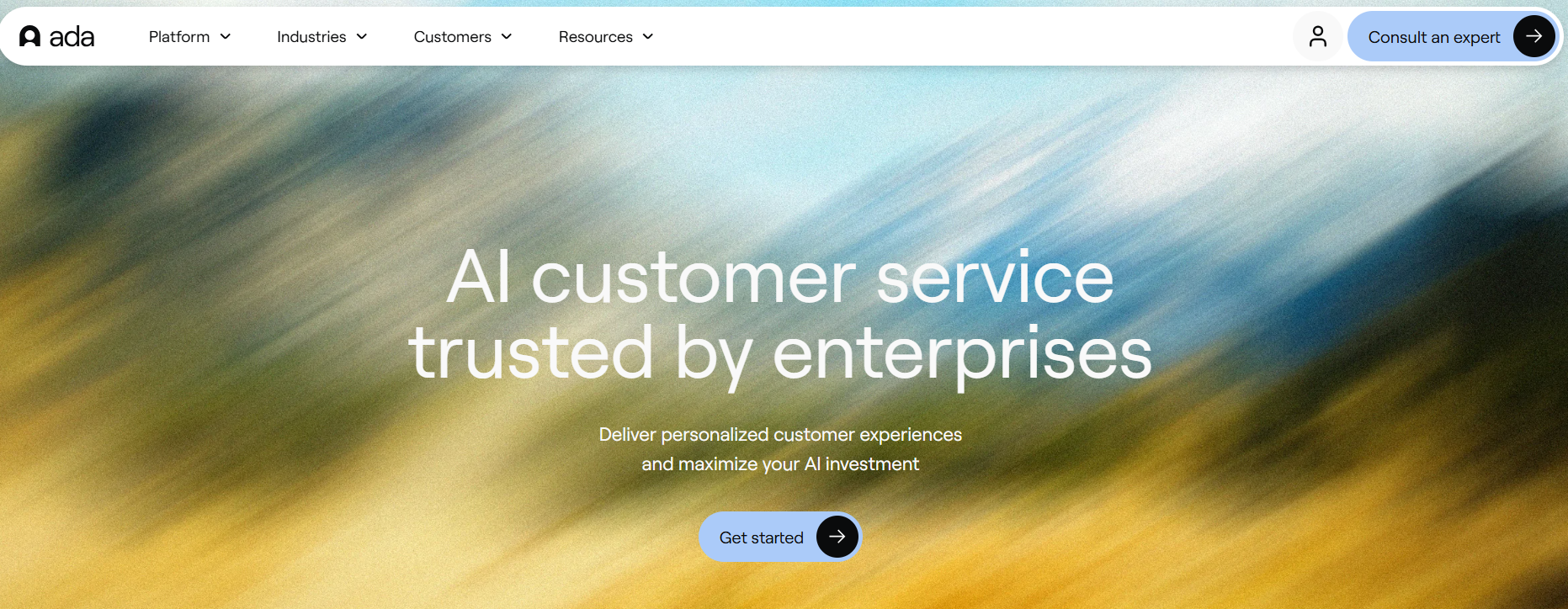
Ada focuses on helping large support teams automate customer service through AI agents that can resolve requests across multiple channels. The platform is built with enterprise use in mind, giving teams control over how conversations are handled while still allowing automation to scale across high volumes of interactions.
Its AI agents are designed to follow structured workflows and carry out tasks based on predefined processes. Teams can train Ada to handle actions such as processing refunds or managing account requests by teaching it specific procedures. The platform also supports continuous improvement, allowing teams to test and refine how the AI agent performs over time.
Main features:
- AI customer service agent that resolves inquiries across multiple channels
- Workflow-based automation that allows agents to follow step-by-step procedures
- No-code tools for building and managing AI-driven support flows
- Omnichannel support with coverage across digital and voice interactions
- Performance insights and testing tools for improving resolution rates
Pricing:
- Contact sales
Forethought
Ratings: 4.3/5⭐️
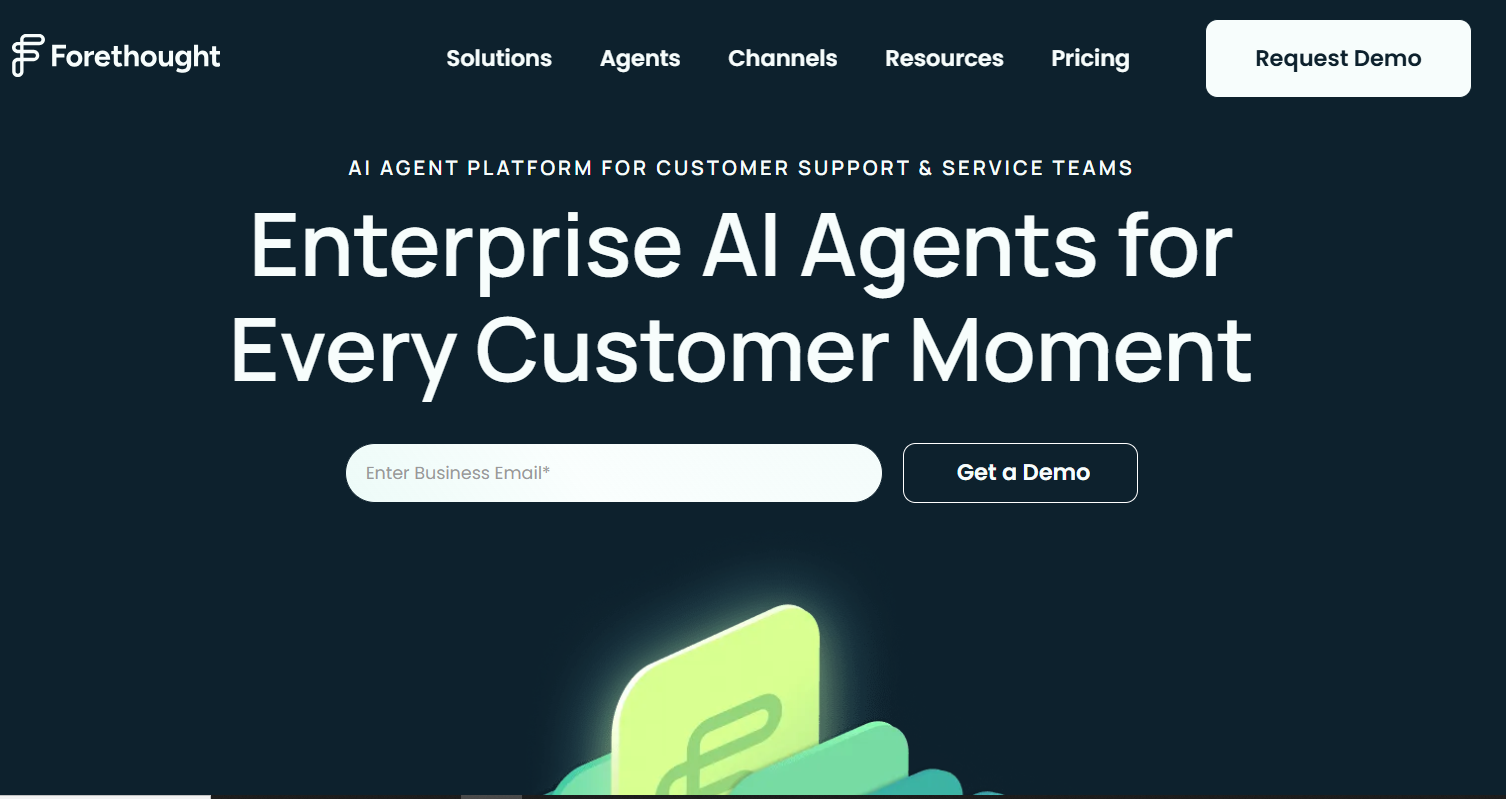
Forethought focuses on automating customer support by using AI agents that can handle the full lifecycle of a request, from the first message to resolution. It’s built for teams dealing with large volumes of tickets, where reducing manual work and keeping responses consistent becomes a priority.
Its platform is centered around a multi-agent system that can reason through requests and take action based on business rules. These AI agents learn from past tickets and help center content, which allows them to resolve common issues, classify incoming requests, and support human agents when needed. They can also identify gaps in knowledge and suggest improvements, so the system becomes more effective over time.
Main features:
- AI agents that reason, decide, and take action to resolve customer requests
- Ticket triage and classification that routes inquiries based on intent and context
- Autoflows for building automated support workflows without manual handling
- Agent assist tools that provide suggestions and context during live conversations
- Insights and knowledge gap detection
Pricing:
- Basic (Contact sales)
- Professional (Contact sales)
- Enterprise (Contact sales)
Cognigy

Ratings: 4.6/5⭐️
Cognigy is built for companies that want to run customer service through AI agents across both voice and digital channels. It’s commonly used in contact centers where handling large volumes of interactions requires automation that can scale without losing context.
The platform focuses on creating what it calls an “AI workforce,” where agents can understand requests, make decisions, and carry out tasks across connected systems. These agents cando anything from managing phone conversations to assisting human agents in real time. Because Cognigy connects with existing tools like CRMs and contact center platforms, it can update records, trigger workflows, and keep interactions consistent across channels.
Main features:
- AI agents that handle conversations across voice, chat, and messaging channels
- Voice AI capabilities for automating phone-based customer service
- Agent Copilot that supports human agents with context and suggestions
- Integrations that connect AI agents with CRM systems and backend tools
- Real-time analytics and monitoring
Pricing:
- Contact sales
Kore.ai
Ratings: 4.6/5⭐️
Kore.ai is built around the idea of running customer service through multiple AI agents that work together across different systems. Instead of relying on a single assistant, Kore.ai supports multi-agent orchestration. This means different AI agents can handle specific tasks, then pass requests between each other depending on the situation. These agents can access enterprise data, trigger workflows, and operate across channels from one setup.
The platform also includes pre-built agent templates and a marketplace, which helps teams deploy automation faster while still customizing how each process works.
Main features:
- Multi-agent orchestration that routes requests between specialized AI agents
- Omnichannel deployment across chat, voice, messaging apps, and internal systems
- Agent platform for building and managing AI-driven workflows
- Pre-built agents and templates available through the Kore.ai marketplace
- Integrations with CRM, ERP, and other enterprise tools
Pricing:
- Contact sales
Freshdesk
Ratings: 4.4/5⭐️
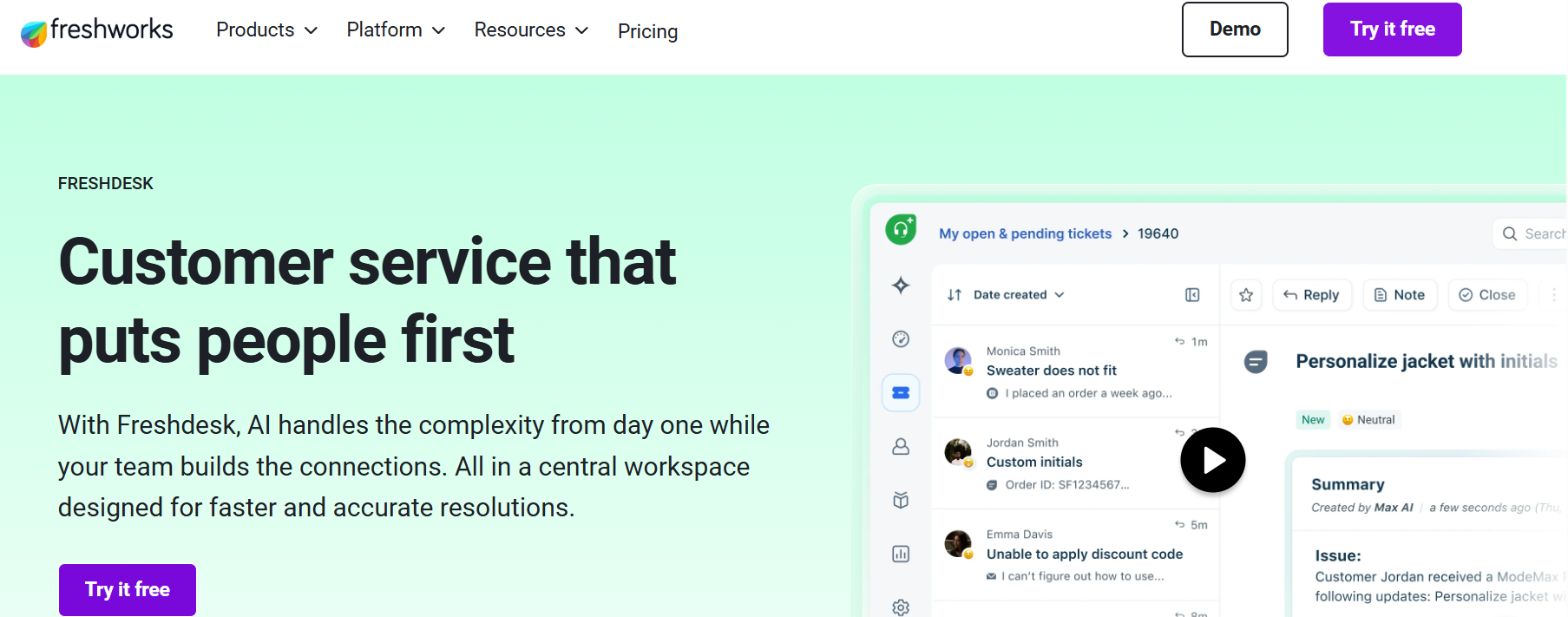
Freshdesk combines help desk software with built-in AI capabilities that support both customer-facing automation and internal workflows. It’s often used by growing teams that want to organize support across multiple channels while gradually introducing automation into their processes.
Freddy AI sits at the center of this setup, supporting different parts of the support journey. The AI agent can respond to customer questions through chat or email and resolve common issues automatically. At the same time, Freddy Copilot assists human agents by suggesting replies and pulling relevant knowledge base content into the workflow.
Main features:
- Freddy AI agent that handles customer queries through chatbots and email automation
- AI-powered ticket triage and sentiment analysis to prioritize incoming requests
- Agent Copilot with reply suggestions, summaries, and writing assistance
- Knowledge base integration that supports automated answers and agent workflows
- Integrations with any external app via pre-built connectors
Pricing:
- Free plan available (up to 2 users)
- Growth ($19/mo/agent)
- Pro ($55/mo/agent)
- Enterprise ($89/mo/agent)
Read more: Check out our list of the best Freshdesk alternatives and competitors.
Aisera
Ratings: 4.4/5⭐️
Aisera positions itself as an AI-native platform that automates service operations across customer support, IT, HR, and other business functions. Instead of focusing on a single channel or use case, it acts as a central layer that connects conversations, data, and workflows across the organization.
Its approach to customer service is built around autonomous AI agents that can resolve requests from start to finish. These agents can understand user intent and carry out multi-step workflows such as processing requests or updating systems. Because the platform integrates with existing tools, it can operate across different departments while keeping interactions consistent. It also supports conversational experiences that feel more natural, allowing users to get help, track orders, or complete tasks without switching between systems.
Main features:
- AI agents that automate customer service, IT support, and internal workflows
- Agent composer feature that lets you quickly launch agents with natural language and guided assistance
- Workflow automation that handles multi-step requests and executes actions across systems
- Enterprise search and knowledge integration that powers responses with internal data
- Agent assist tools that provide real-time suggestions
Pricing:
- Contact sales
Best agentic customer service software: key takeaway
Agentic customer service software helps address growing customer expectations by taking over repetitive work and keeping conversations moving without constant supervision. The shift is less about faster replies and more about actually resolving issues within the conversation, which changes how human agents approach support.
For teams looking for a simpler way to get started, Tidio offers a setup that’s easy to manage. Lyro AI Agent can step in to answer questions, guide customers through common scenarios, and keep requests moving even when agents are offline. Because everything runs through one shared workspace, it’s easier to stay organized while gradually introducing more automation into daily support operations.
Be sure to give Tidio a try and see how its agentic customer service features can support your team.
Resolve more conversations with less manual work
FAQ
The best agentic customer service software depends on your needs, but some of the top options include Tidio, Intercom, Zendesk, and Salesforce. These platforms use AI agents to handle conversations and complete customer requests across different channels.
For teams that want a simple way to get started, Tidio is a strong option. Its Lyro AI agent can resolve common requests and keep conversations moving, which makes it especially useful for ecommerce and growing support teams.
Tidio is a customer service platform that combines live chat, help desk tools, and AI automation in one place. It helps businesses manage conversations across chat, email, and messaging channels while keeping everything organized in a shared inbox.
Yes, Tidio uses AI through its Lyro AI agent, which can understand customer intent, answer questions, and handle common support requests automatically. Lyro helps keep conversations moving and can resolve issues without requiring constant human involvement.
The ROI of using Tidio comes from reduced workload, faster response times, and the ability to handle more conversations without expanding your team. By automating up to 67% of common questions and improving response consistency, businesses can lower support costs while maintaining a better customer experience.