
Key takeaways:
- Live chat is a real-time messaging tool embedded in a website or app. Customers type a question and get an answer from a human agent, an AI agent, or both.
- The 2026 default is hybrid: an AI agent answers routine questions instantly and hands off to a human for anything complex or sensitive.
- Hybrid setups resolve 57% of conversations versus 29% for bot-only.
- Tidio’s Lyro AI agent resolves 67% of common questions on its own and replies in under six seconds.
Live chat is a messaging tool embedded in a website or app that lets customers talk with a business in real time—with a human agent, an AI agent, or both. It sits in the corner of the page as a small widget. A visitor clicks it, types a question, and gets a reply without leaving the site or picking up the phone.
This guide covers what live chat is, how it works, the features to look for, and how it fits alongside chatbots and AI agents in 2026.
Use live chat to support your customers in real-time
What is live chat?
Live chat is a real-time form of online messaging that lets website visitors talk with a business and get answers instantly from an agent or AI. The visitor types inside a chat window and gets a reply within seconds. It runs on almost any site, needs no download from the visitor, and keeps the whole conversation on the page.
In 2026, most live chat runs as a hybrid model. An AI agent takes the first message and resolves routine questions on the spot, then hands off to a human when one needs judgment, empathy, or account access. The customer sees one continuous conversation, not two separate tools.
Here’s a live chat example:
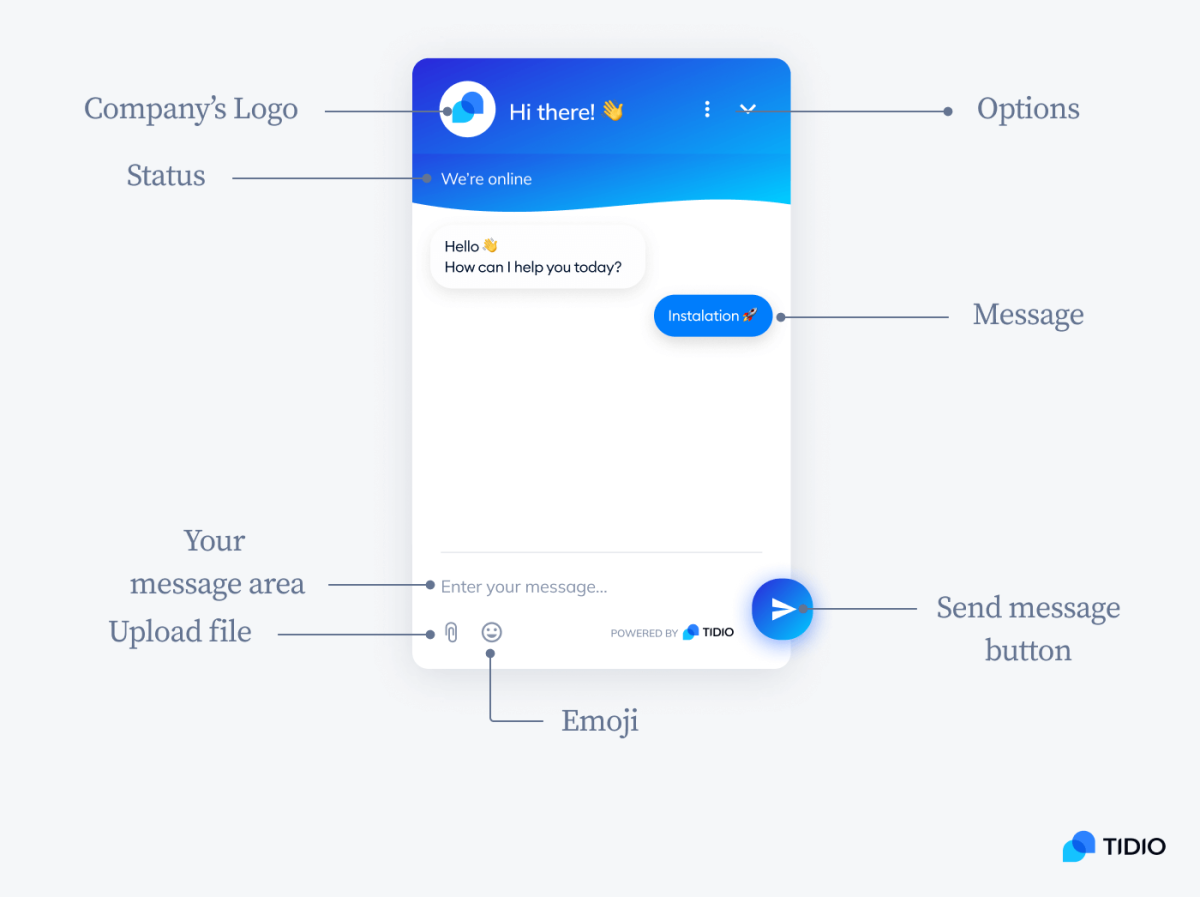
What does live chat mean?
In plain terms, live chat means messaging a business the way you’d text a friend, except the reply comes from its support or sales team. “Live” refers to the timing. The exchange happens now, in real time, rather than over hours or days like email. The word covers both the widget your visitors see and the software your team uses behind it.
How does live chat work?
Live chat works through a small piece of code or a plugin added to your website. That code loads a chat widget, usually in the bottom corner. A visitor clicks it and types a message, which lands in your team’s inbox. An agent or AI agent replies, and the visitor sees the answer in the same window seconds later.
You and your visitor see two different views of the same chat.
What the visitor sees: the messages they’ve sent and received, plus the option to attach files, images, links, and emojis. That’s it. The experience stays simple on purpose.
What your team sees: a lot more. Agents can see which pages a visitor is browsing, read what they’re typing before they send, use canned responses, assign or transfer chats, and open the full transcript. Analytics dashboards sit alongside the inbox.
Modern routing adds one more layer. The AI agent answers first. If it can’t resolve the question or the customer asks for a person, it escalates to a human with the full context attached, so nobody has to start over.
Key features of live chat
The features that matter most speed up replies, catch visitors at the right moment, and keep every conversation in one place. Not every tool offers all of them, so the list below doubles as a checklist. These functions separate a basic chat box from a working support channel.
| Feature | What it does |
|---|---|
| AI agent + human handoff | Answers routine questions instantly, escalates complex ones to a person with context |
| Canned responses | Pre-written replies for common questions, sent in one click |
| Chat routing and assignment | Sends each chat to the right agent or team |
| Proactive triggers | Starts a chat automatically based on page, time on site, or cart value |
| Live visitor tracking | Shows who’s on your site and what they’re viewing right now |
| Live typing preview | Lets agents see what a visitor is typing before they send it |
| Transcripts and history | Records every conversation for follow-up and quality checks |
| Offline messages and tickets | Captures questions after hours and turns them into tickets |
| Analytics and reporting | Tracks response time, resolution rate, and satisfaction |
| Mobile apps | Lets your team answer from a phone |
| Integrations | Connects to Shopify, WooCommerce, your CRM, and messaging channels |
Live chat vs. chatbot vs. AI agent
Live chat, chatbots, and AI agents all appear in the same widget, so they get confused. The difference is who answers. Live chat means a human replies. A rule-based chatbot follows a fixed decision tree. An AI agent understands the question in natural language and answers from your own content, then escalates when needed.
| Live chat | Rule-based chatbot | AI agent | |
|---|---|---|---|
| Who answers | A human agent | A pre-set decision tree | AI trained on your content |
| Availability | When agents are online | 24/7 | 24/7 |
| Best for | Complex, sensitive, high-value chats | Simple menu-driven flows | Most routine questions, at scale |
| Main limit | One chat at a time; needs staffing | Breaks the moment a question leaves its script | Needs a solid knowledge base; hands off edge cases |
The three work best together. An AI agent handles the volume, a human steps in for the hard cases, and live chat gives that human the context to solve it fast. The data backs this up. Hybrid human-and-AI conversations resolve at 57%, nearly double the 29% that bot-only handling manages[1]. The gap widens on complex issues. Bots alone resolve just 18% of refund conversations, versus 53% when a human steps in.
That’s the model Tidio’s Lyro AI agent runs on. Lyro resolves 67% of common questions on its own, on average, and replies in under six seconds. Anything it can’t handle goes to your team with the full conversation attached. Across ecommerce deployments, its AI satisfaction score reaches 88% of the human benchmark.
Instant messaging apps like Messenger or WhatsApp sit in the same family but are built for personal chats, not business support. For the full breakdown, see our chatbot vs. live chat comparison.
Answer customers in real time, with AI and human agents working in one place
Benefits of live chat on a website
Live chat helps your business convert more visitors and gives customers faster, less frustrating support. Because the conversation is instant and stays on the page, you catch buyers while they’re still deciding, gather data on what they need, and resolve issues before they turn into lost sales or churn.
For your business:
- Higher conversions. You answer buying questions at the moment of doubt, before a shopper leaves.
- Lower cost per resolution. An AI agent absorbs routine volume at $0.50 per conversation with Lyro, freeing your team for chats that need a person.
- More leads. A chat box that offers help in exchange for details collects contacts without an intrusive pop-up.
- Better data. Every chat shows what customers are confused about, pointing to fixes across your site.
For your customers:
- Instant answers. The 2025 industry benchmark for a first live chat reply is 1 minute 35 seconds, and an AI agent answers in seconds—no phone queue, no day-long email wait.
- No repeating themselves. The agent already has the history, so customers don’t re-explain to a new person.
- Help without leaving the page. They report an issue, attach a screenshot, and get a fix in the same window.
Resolution is still hard to reach. Across industries in 2026, only 49% of conversations end fully resolved with no follow-up[2], and the businesses closing that gap pair AI with human agents rather than leaning on either alone.
Live chat examples and use cases
Live chat earns its place when you point it at a specific job. The strongest use cases reach the right visitor at the right moment and move them toward an outcome. Below are five that consistently pay off for ecommerce and service businesses.
| Use case | What happens | Goal |
|---|---|---|
| Cart recovery | A proactive message triggers when a shopper stalls at checkout | Save the sale before they leave |
| Ticket deflection | An AI agent answers order-status and return questions instantly | Cut repetitive volume off your team |
| Lead capture | A pre-chat form collects details in exchange for help or a discount | Grow your contact list |
| Feedback collection | A post-chat survey asks for a rating right after the conversation | Measure satisfaction while it’s fresh |
| Proactive upsell | A message offers help on a high-value product page | Guide the buyer and raise order value |
For ready-to-use wording on any of these, see our live chat scripts. For the wider ecommerce angle, our ecommerce live chat guide covers store-specific setups.
How to add live chat to your website
Adding live chat takes four steps and no code for most platforms. Pick a provider, create an account, customize the widget to match your brand, and install it with a plugin or a snippet in your site’s header. On Shopify, WordPress, and similar platforms, an app handles the install for you.
- Choose a provider that fits your platform, budget, and whether you want a built-in AI agent.
- Create a free account or start a trial so you can test before you commit.
- Customize the widget (colors, position, greeting) so it matches your site.
- Install it by adding the plugin or pasting the snippet, then send a test message.
For the detailed walkthrough, see how to add live chat to a website. For quick etiquette rules once you’re live, our live chat etiquette guide covers tone, response times, and handoffs.
What is live chat software (and how to choose)
Live chat software is the platform that runs your chat widget, inbox, automations, and reporting. Choosing one comes down to five things: AI and human handoff, the channels it connects to, pricing transparency, page-load speed, and analytics quality.
Use this checklist when you compare tools:
- AI plus handoff. Does it resolve routine questions automatically and pass hard ones to a person cleanly?
- Integrations. Does it connect to your store, CRM, and channels like Messenger and WhatsApp?
- Clear pricing. Can you see what you’ll pay as you scale, without hidden per-resolution surprises?
- Performance. Is the widget lightweight enough to keep your page fast?
- Analytics. Can you track resolution rate, response time, and satisfaction?
Tidio covers all five: live chat, the Lyro AI agent, a shared inbox, ticketing, and ecommerce integrations in one platform, with 50 free Lyro conversations to test the AI before you pay. For a full side-by-side of options, see our best live chat software roundup.
Frequently asked questions
It can be either. When you message a business through live chat, the reply may come from a human agent or an AI agent. Most 2026 setups are hybrid: an AI agent answers first and hands off to a person for complex or sensitive questions, so you often get both in one conversation.
Many live chat tools offer a free plan or a free trial, including Tidio. Free tiers usually cover the core chat widget and a set number of conversations, while paid plans add AI resolution, more agents, and advanced automation. Tidio includes 50 free Lyro AI conversations to start.
Live chat connects a customer to a human agent in real time. A chatbot replies automatically—a rule-based one follows a fixed script, while an AI agent answers from your content in natural language. They work best together: the bot handles routine volume and the human takes the complex cases.
You add a small snippet of code or a plugin to your site, which loads a chat widget in the corner of the page. A visitor clicks it and types a question that lands in your team’s inbox. An agent or AI agent replies, and the visitor reads the answer in the same window within seconds.
Yes, in most cases. An AI agent resolves routine questions on its own, but complex or high-value chats still need a human. Live chat lets that human step in with the full context, in the same widget, so the customer never notices the handoff.