
Key takeaways:
- Meta discontinued the native Facebook Messenger Chat Plugin on May 9, 2024, so you can no longer embed the old chat widget on your site.
- Three ways to add Facebook Messenger to your website in 2026: an m.me link, a third-party chat widget, or a live chat platform connected to your Facebook Page.
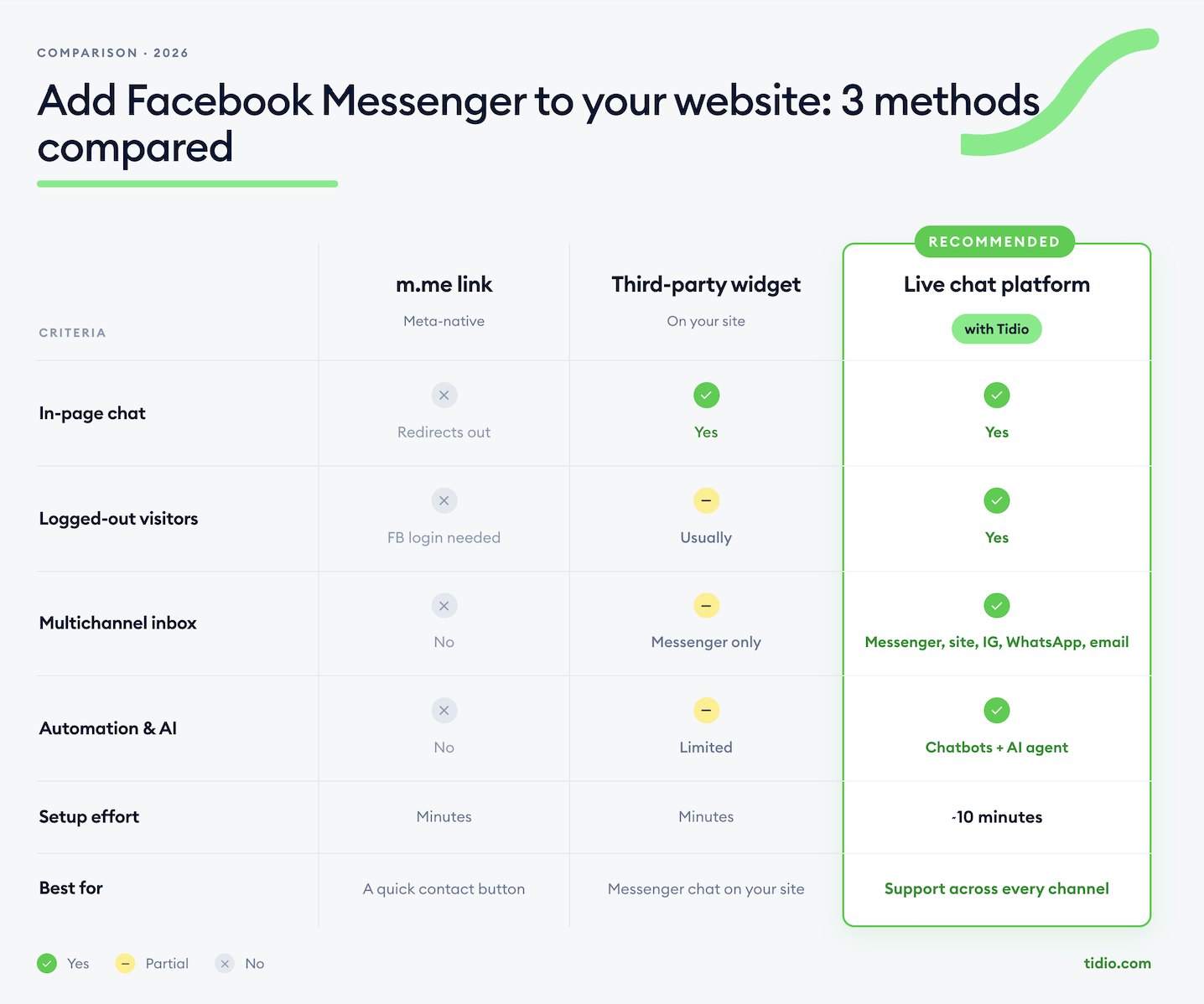
- An m.me link is the only native option Meta still supports, but it redirects visitors to Messenger instead of opening chat on your page.
- A live chat platform gives you the widest reach: Messenger, website chat, Instagram, WhatsApp, and email in one inbox, plus automation.
Facebook discontinued its native Messenger Chat Plugin on May 9, 2024, so you can no longer embed the old chat widget straight onto your site. You now have three working options: an m.me link or button (Meta’s official redirect), a third-party chat widget connected to your Facebook Page, or a live chat platform like Tidio that pulls Messenger into one inbox with your other channels. This guide covers all three and helps you choose the right one.
Ready to reply to Messenger and website chats from one place?
Didn’t Facebook remove the Messenger chat plugin?
Yes. Meta shut down the Facebook Messenger Chat Plugin (the Customer Chat Plugin) on May 9, 2024, and switched off its guest mode even earlier. The embeddable widget that once let visitors chat on your site no longer works, and legacy embed code now renders a dead element. Native in-page Messenger chat is off the table.
This one change explains a lot of outdated advice still floating around. Plenty of guides, some updated as recently as last year, still walk you through the old Meta Business Suite flow that generates plugin code. That code does nothing now. If your own site still carries that snippet, pull it out. A dead widget is its own bad look for visitors, and it can slow the page for no return.
Meta has kept folding Messenger into Facebook. It dropped the Messenger desktop apps in 2024, and it plans to close the standalone messenger.com site in April 2026, pushing web users to facebook.com/messages. A fresh native website plugin isn’t coming back.
Here’s what still works.
Method 1: Add an m.me link or button
An m.me link is Meta’s official shortcut to your Messenger inbox, in the form m.me/yourpagename. Add it as a link or button, and anyone who clicks opens a chat with your Page in Messenger. It’s the only native method Meta still supports, though it sends visitors to Messenger rather than embedding chat on your page. Because it’s only a URL, you can reuse the same link in email signatures, ad buttons, and QR codes, not just on your website.
Setting one up takes a few minutes:
- Open your Facebook Page and find your Page username (the handle after facebook.com/, e.g. @happyfacepizza).
- Build your link as m.me/happyfacepizza. You can also use your numeric Page ID if you haven’t set a username.
- Add the link to a button, a header CTA, or your footer (“Message us on Messenger”).
- Test it on desktop and mobile to confirm it opens the right Page.
The trade-off is real. An m.me link redirects to the Messenger app or site, so there’s no on-page conversation and no anonymous chat. Visitors need a Facebook account to reply. For a small site that wants one quick contact button, that’s fine. For live support, most businesses want Method 2 or 3.
Method 2: Connect Facebook Messenger to a live chat platform (recommended)
Connecting Messenger to a live chat platform gives you the most control. You get one inbox for Facebook Messenger, website live chat, Instagram, WhatsApp, and email, plus automation and an AI agent that answers first-line questions. You reply to every channel from a single dashboard, and visitors get help whether they start on Facebook or on your site.
This is where a tool like Tidio fits. Instead of jumping between Meta Business Suite and your site, you manage Messenger alongside every other conversation in one place, and you keep your own contact list rather than renting it from Facebook. You can also add live chat to your Facebook Page and handle those messages from the same inbox, so nothing slips through whichever way a customer reaches you.
Connecting your Page takes about ten minutes:
- Create a free Tidio account.
- Follow the setup tour and add your website address.
- Open Settings → Channels and connect your Facebook Page.
That’s it. Messenger conversations now arrive in the same inbox as your website chats. For step-by-step detail, see the Tidio Messenger integration guide.
Automation is the upgrade most teams come for. You can trigger Facebook chatbot replies for common questions, and Lyro, our AI agent, resolves an average of 67% of support questions on its own, so your team steps in only when it matters. Our free plan includes 50 free Lyro conversations to test it, and you can connect Messenger without paying anything. Weighing your options first? Our best live chat software roundup lines up the main tools side by side.
Turn Messenger into a support and sales channel you actually control
Method 3: Add a third-party Facebook Messenger widget
A third-party Messenger widget is a chat button you install on your site that connects to your Facebook Page. Unlike the retired native plugin, these widgets run on the provider’s own layer, so they can show a real in-page chat and work for visitors who aren’t logged into Facebook. Setup usually takes minutes.
When Meta pulled the plugin, a category of replacement widgets filled the gap. They differ in one important way from an m.me link: the conversation happens on your site, not on Messenger. A visitor can start chatting without leaving your page, and you route those messages to your team.
These widgets connect to your Page through the Messenger Platform, not the retired plugin, which is why they keep working. One warning: plenty of tutorials still show the old plugin setup. If a guide tells you to generate chat-plugin code inside Meta Business Suite, it’s out of date.
What to look for when you pick one:
- Page connection. It should link cleanly to your Facebook Page so Messenger chats land in your inbox.
- Coverage for logged-out visitors. The provider’s own chat layer should let anyone message you, not just Facebook users.
- CMS fit. Confirm it supports your platform, whether that’s WordPress, Shopify, or a custom build.
- Customization and pricing. Check that you can match your brand, and read the pricing before you commit.
How to add Facebook Messenger to WordPress
On WordPress, the fastest route is a Messenger-compatible chat plugin. Install it, connect your Facebook Page, and place the widget from your dashboard. You can also drop an m.me button into a menu or widget area if you only need a link. For a side-by-side look at the options, see our guide to the best WordPress chat plugins. Running a store instead? The same logic applies to Shopify live chat apps.
m.me vs. widget vs. platform: which should you use?
Pick an m.me link if you just want a quick button to your Messenger inbox. Pick a third-party widget if you want real in-page chat tied to your Facebook Page. Pick a live chat platform if you want Messenger, website chat, and other channels together with automation. Most growing businesses end up on the third.
Why add Facebook Messenger to your website
Messenger meets customers on an app they already open every day. Meta’s family of apps reached 3.58 billion daily active people in December 2025, according to Meta’s investor reporting, and Facebook alone counts roughly 3.07 billion monthly users. Putting Messenger on your site lets shoppers ask questions in a familiar place and keeps the thread going after they leave.
Three reasons it earns its spot in 2026:
- One inbox, less switching. Connect Messenger to a platform and you answer Facebook, Instagram, and website chats from the same screen instead of chasing tabs.
- AI handles the repeats. An AI agent can resolve routine questions instantly, day or night, and hand off anything complex to a person. Lyro clears an average of 67% of common questions for our customers.
- Conversations that follow the customer. A message started on Messenger stays tied to that contact, so a returning shopper picks up where they left off, across devices and without repeating themselves.
- A channel that’s always open. Even outside business hours, automation answers the common questions and captures the rest, so a late-night visitor doesn’t leave empty-handed.
Want templates that turn those chats into sales? Steal a few from our live chat scripts.
FAQ
No. Meta discontinued the native Messenger Chat Plugin on May 9, 2024, and its guest mode was disabled earlier. Old embed code no longer works. To add Messenger to your site now, use an m.me link, a third-party Messenger widget, or a live chat platform connected to your Facebook Page.
The free route is an m.me link (m.me/yourpagename) added as a button. For real in-page chat at no cost, Tidio’s free plan connects your Facebook Page to a website widget, so Messenger and site conversations land in one inbox without a paid subscription.
Two things replaced it. Third-party chat widgets and live chat platforms now connect to your Facebook Page and embed chat on your site, and Meta’s m.me links still redirect visitors to your Messenger inbox. The widgets run on the provider’s layer, so they work even after the native plugin’s shutdown.
Install a Messenger-compatible chat plugin, connect your Facebook Page, and place the widget from your WordPress dashboard. If you only need a link, add an m.me button to a menu or widget area. Our WordPress chat plugins guide compares the current options in detail.
Not on its own. Meta removed guest mode, so native Messenger now requires visitors to log into Facebook. A live chat platform solves this: its own chat layer lets anyone message you on your site, and you can still route those conversations to Messenger when it helps.
Neither wins outright. Messenger is familiar and mobile-friendly but limited to Facebook users. Website live chat reaches every visitor and supports automation. Connecting both through one platform gives you the widest reach, since customers can choose the channel they prefer while you answer from a single inbox.