
Every month, Tidio powers over 2,000,000 live chat conversations. Our data specialists managed to dig up some interesting live chat statistics. These stats gave us some eye-opening insights into the usage of the chat.
Here are our key findings on live chat numbers:
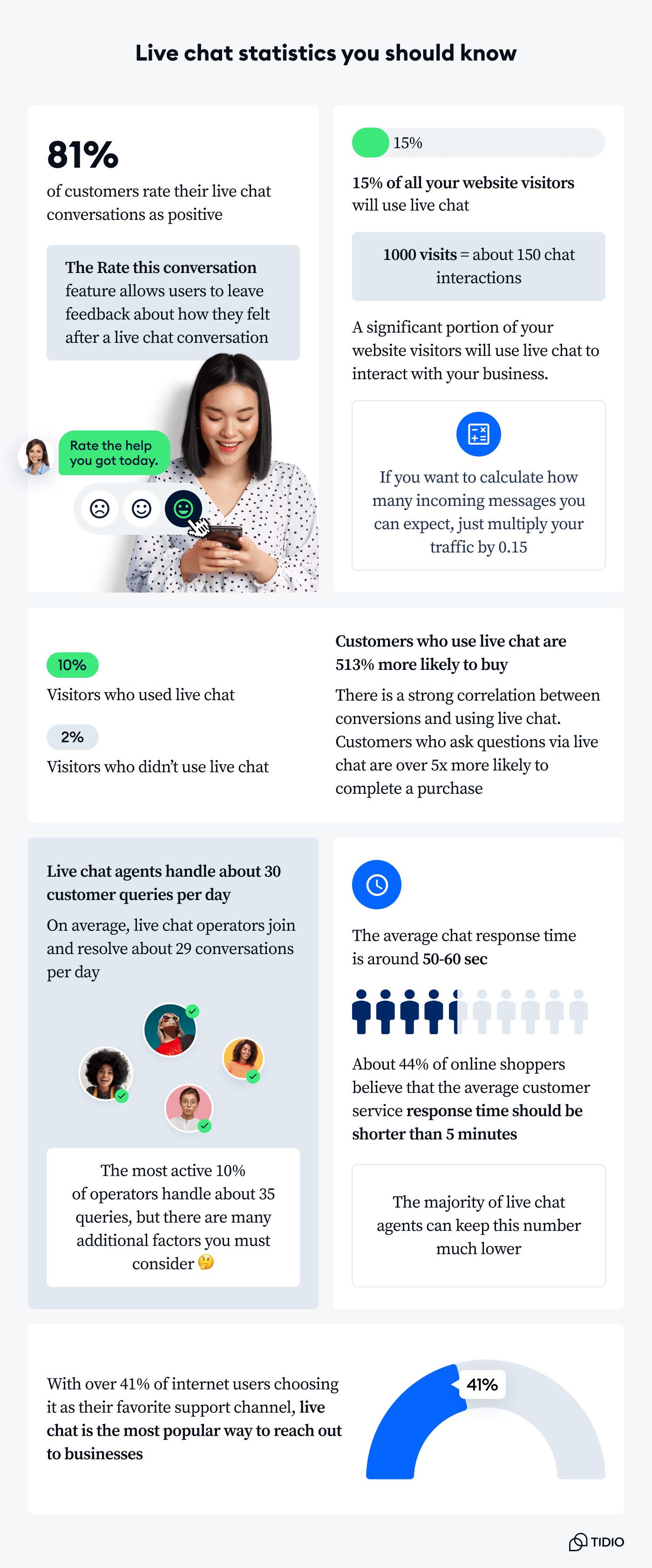
In order to offer a complete picture and a broader perspective, we have also collected findings from third-party reports and studies.
Here are some of the most important live chat statistics you should be aware of.
Customer service channel preference statistics
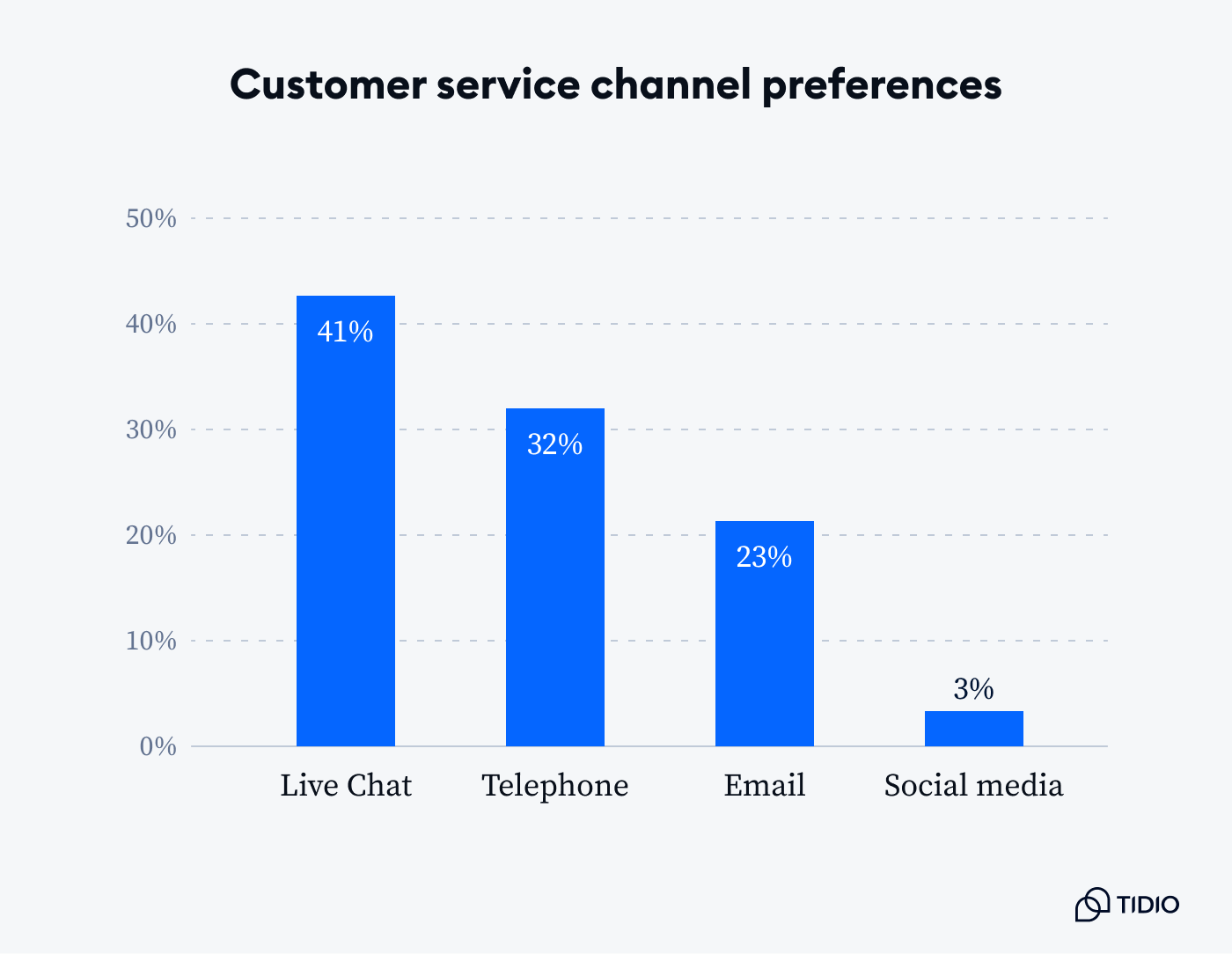
Many business owners are still on the fence about whether to add live chat to their website. The latest statistics might help sway things in favor of this channel. As a recent study shows, over 41% of customers prefer using live chat when compared to other customer service channels.
1. Do people prefer live chat to phone customer service?
Around 41% of customers say live chat is their preferred way to get support, especially when compared to email or phone. That preference is tied to speed and convenience, and it’s becoming more common as people get used to instant help when they’re online.
(Source: Tidio)
2. Do customers like live chat?
Yes. Actually, about 63% of people who spend between $250-500 monthly online are most likely to buy from and be loyal to companies offering live chat.
(Source: Kayako)
Delivering high-quality live chat experiences helps to build customer loyalty across different stages of the buyer journey. Live chat users appreciate the immediacy of this channel. It can’t be matched by email support or even phone calls.
3. What is the average satisfaction rate for live chat as a customer service channel?
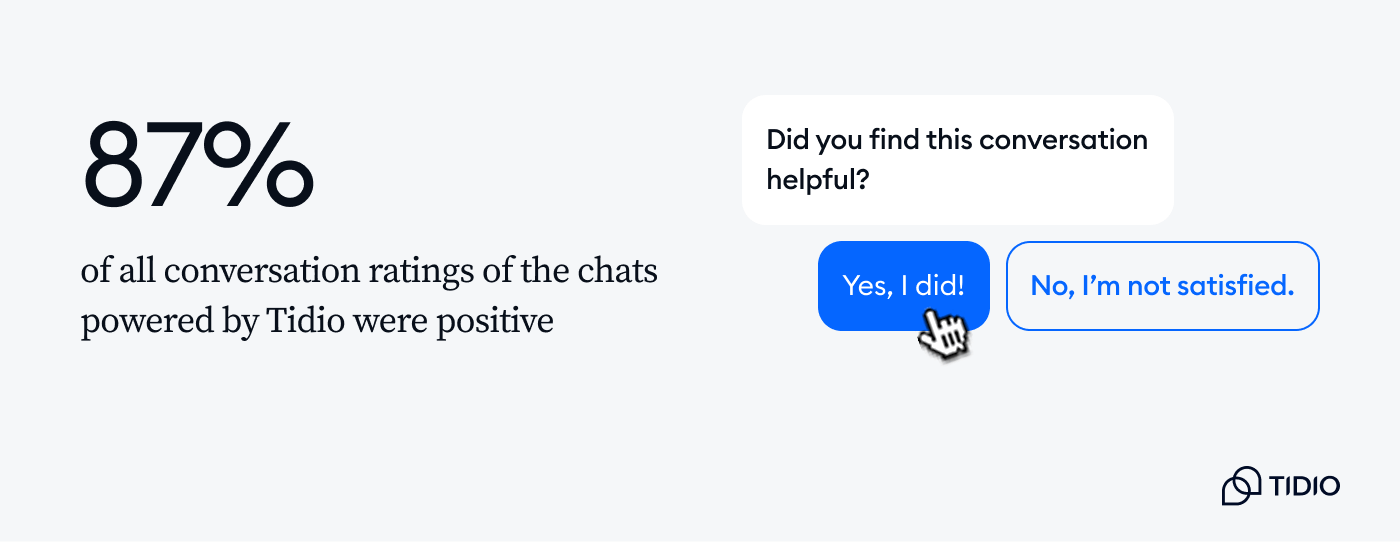
Based on our own data, 87% of live chat conversations receive a positive customer satisfaction (CSAT) rating.
(Source: Tidio)
This number is almost exactly the same as the average satisfaction rating for live chat as a customer service channel (88%), according to a recent report by the American Customer Satisfaction Index (ACSI).
4. What demographic groups use live chat?
Research from Microsoft shows a clear generational shift in how people want to communicate with support teams. Younger customers tend to gravitate toward live chat and social channels, while older groups still lean more heavily on traditional options. Among digital shoppers aged 18 to 34, live chat is noticeably more popular, with this group being 21% more likely to choose it over customers aged 35 to 54.
That preference becomes even more apparent when looking at millennials. According to WhosOn, 60% of them would rather get answers through live chat than use any other support channel.
(Source: WhosOn)
Social media messaging and live chat are the fastest-growing channels for connecting with businesses.
(Source: Microsoft)
While the youngest customer segment uses live chat on a regular basis, there are still some Gen Z and Millennials who have never tried chatting for business communication. In fact, a whopping 71 percent of Gen Z customers agree that live phone calls are most convenient to reach a customer service solution they seek.
(Source: McKinsey)
5. What percentage of website visitors use live chat?
About 15% of all visitors join live chat conversations. This ratio was calculated by comparing the number of live chat widget impressions (how many people saw the live chat icon) and the number of chats that were initiated on almost 300,000 websites.
(Source: Tidio)
Live chat trends and statistics for ecommerce and online businesses
If you run an online business, live chat is probably already on your radar. Many teams rely on it to stay available when customers have questions, especially at moments that can influence a purchase or a support outcome. What’s less obvious is how the live chat market is evolving and whether it consistently delivers value in ecommerce and customer service today.
The statistics below offer a grounded look at how live chat is being used and what it actually achieves for businesses.
6. How many websites use live chat?
The percentage of companies with live chat support has been steadily increasing over the past few years. Live chat usage distribution in the top 1 million sites on the internet shows that there are over 519,700 installations of chat widgets on popular websites.
(Source: BuiltWith)
7. How many ecommerce businesses offer store chat for customers?
Currently, Shopify is one of the most popular, and probably the best, ecommerce platforms out there. There are over 4,400,000 Shopify stores. But a quick visit to the Shopify App Store reveals that the number of Shopify live chat plugin reviews is not too impressive compared to the number of stores. This means that, for now, there aren’t too many stores that implemented a live chat app.
Based on a standard review/plugin installation ratio of 2%, we can estimate that there are no more than 730,650 live chat plugins installed. It means that only about 6% of Shopify stores offer live chat for their customers. This number could be extrapolated to the whole ecommerce sector.
(Source:Tidio)
8. What is the live chat software market size?
The global live chat software market is expected to reach $1.7 billion by 2030. What’s evident is the growing trend of digitalization and the need for businesses to provide engaging customer experiences as key drivers of market growth. The live chat technology market is expected to grow at a Compound Annual Growth Rate (CAGR) of 8.8% year over year throughout the next decade.
(Source: Allied Market Research)
9. What is the current market share of live chat technologies?
Some of the most popular live chat software providers include Tawk.to (21.8% of the market), Facebook Chat Plugin (17.7%), Zendesk Chat (8.5%), Tidio (7.7%), and LiveChat (6.02%). These platforms offer a variety of tools and can be integrated with other apps, as well as pricing plans with premium live chat features that suit the needs of businesses of all sizes.
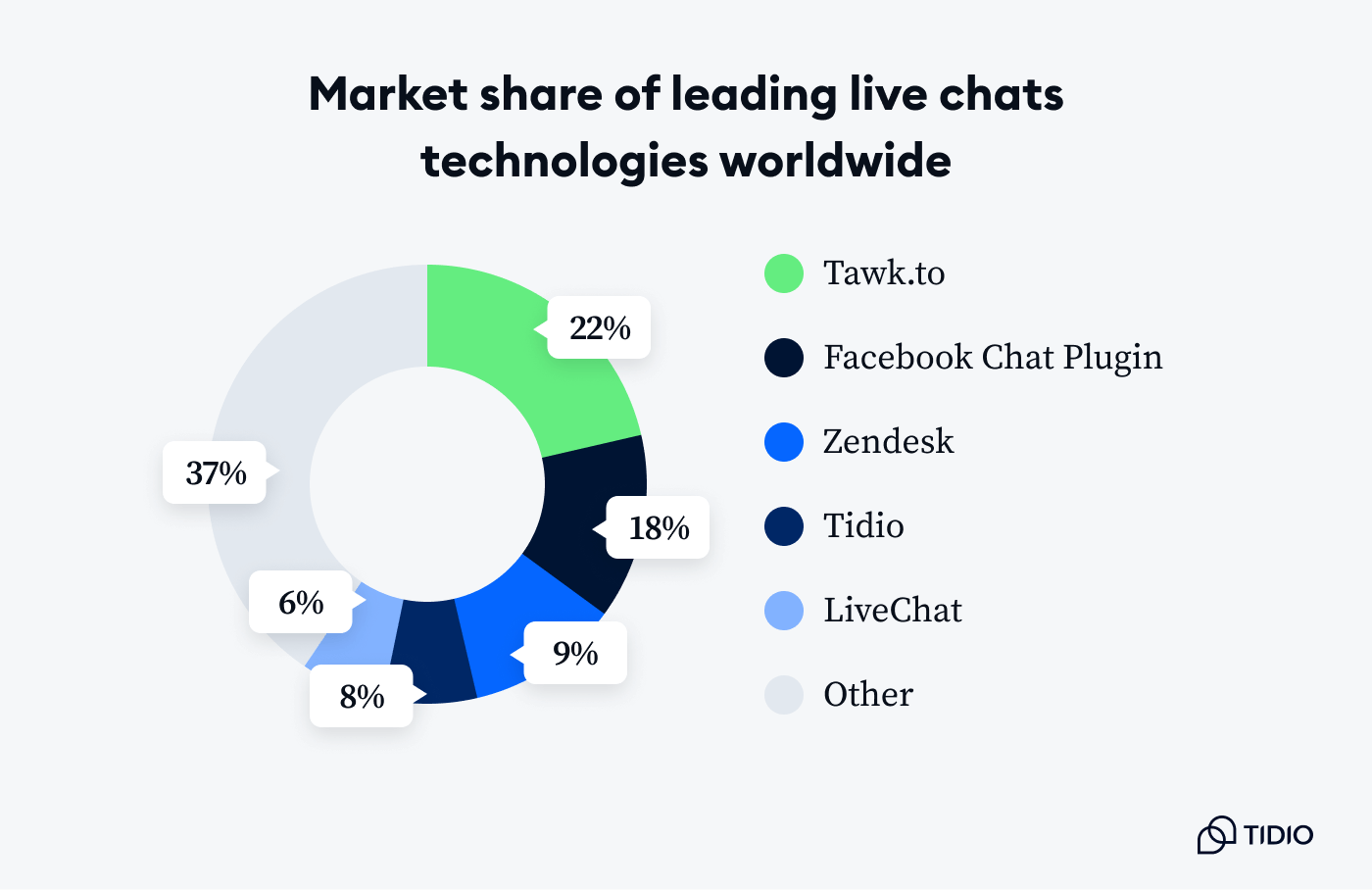
(Source: Datanyze)
10. Does live chat increase sales?
While there are numerous live chat benefits, ultimately, as many as 79% of businesses state that offering live chat has had a positive effect on sales and revenue. At the same time, 38% of clients are more likely to buy from a business if it offers live chat support.
(Source: Kayako)
See how live chat support fits into your customer experience strategy
11. How effective are live chats?
Measuring the effectiveness of any new technology can be tricky, but numerous case studies show that live chat can have a significant impact on a company’s bottom line. Many businesses report impressive ROIs and increased customer satisfaction rates. For example, according to a study by Forrester, live chat interactions result in a 10% increase in average order value.
(Source: Forrester)
Read more: Check out some of the most relevant customer service statistics and trends.
12. Can live chat be used for lead generation?
The answer is yes! In fact, live chat can be an extremely effective lead generation tool if used correctly. If you use automated welcome messages and chatbots, you can generate leads around the clock. Live chat automated with bots can convert about 4% of your website visitors into leads. And if you use a pre-chat survey, the number can be even higher.
(Source: Tidio)
Read more: Collect Leads with Tidio’s Pre-Chat Survey
13. Does live chat increase conversions?
Live chat data shows a strong link between conversations and conversions. Visitors who engage with live chat are far more likely to become customers, even though that connection doesn’t always translate into a clean, one-to-one conversion lift. The impact is often indirect, shaping how confident people feel while browsing rather than pushing an immediate sale.
That confidence plays a meaningful role. Our research suggests that online stores without live chat or real-time support are seen as almost twice as untrustworthy compared to those that offer it. When shoppers know help is available, they tend to stay longer and feel more comfortable moving forward.
In addition, live chat also allows customers to ask for recommendations or advice from a human agent, which can further increase the likelihood of them making a purchase.
(Source: Tidio)
Some tools let you track your live chat sales with ecommerce integrations. For example, Tidio can be connected to your main Shopify admin panel. You can track Shopify conversions in Tidio to find the connection between the stats on live chat usage and completed purchases.
14. What is the ROI for live chat customer support?
Many businesses report a positive return after adding live chat to their support setup, particularly when chat is used to start conversations proactively. In those cases, companies have seen returns as high as 305%, driven by timely interactions that help visitors move forward instead of dropping off.
Of course, results vary depending on factors like industry and company size. Even so, live chat is widely viewed as a reliable way to support customers while making better use of support resources.
(Source: Etech)
15. How do businesses maximize live chat ROI?
Using automation and canned responses is an effective way to increase your chat rate. About 58% of businesses boost live chat with chatbots to deliver faster replies and around 43% use FAQ bots to provide answers to repetitive questions. It’s also a good idea to integrate your live chat with Facebook and Instagram to deliver omnichannel support.
(Source: Tidio)
Live chat performance statistics
It’s hard to improve something if you don’t have a clear way to track how it’s performing. Data makes it easier to spot what’s working and whether changes are actually making a difference. Without that visibility, decisions tend to rely on assumptions instead of results.
The following live chat statistics and metrics highlight what’s worth paying attention to when evaluating chat performance.
16. How many chats can an agent handle per day?
The answer to this question depends on a number of factors, including the agent’s ability, the complexity of the chats, and the number of breaks the agent takes. However, a general guideline is that an agent should be able to handle between 30 and 50 chats per day. The average number of conversations per day among tens of thousands of operators using Tidio is 29.
(Source: Tidio)
17. How many chats can an agent handle per hour?
Most chat agents handle 3–5 conversations at once, which translates to about 7 resolved chats per hour. Best-practice benchmarks typically suggest keeping concurrency at 2–3 chats to preserve quality, although experienced agents can exceed this, while more complex issues tend to lower concurrency to one or two conversations.
(Source: Quora)
18. What is the average live chat typing speed?
On average, a person can type around 40 words per minute (hereinafter referred to as WPM). Professionals are somewhere between, say, 65 and 75. Although typing faster than 40-60 WPM helps in handling complex queries, it’s more like a nice-to-have rather than a necessary skill.
Live chat reps also use chatbots, pre-written live chat scripts, and canned responses to increase their response time. So, at the end of the day, you don’t have to type at record speed to be an effective live chat agent.
Still, if you want to practice or test your skills, you can take our typing speed test.
(Source: LiveAgent)
19. What is the industry standard for chat response time?
There’s no specific industry standard for chat response time, but most online customers expect an instant reply. That’s why the majority of companies aim to respond to client queries as quickly as possible. In most cases, businesses have target response times of under one minute for chat support.
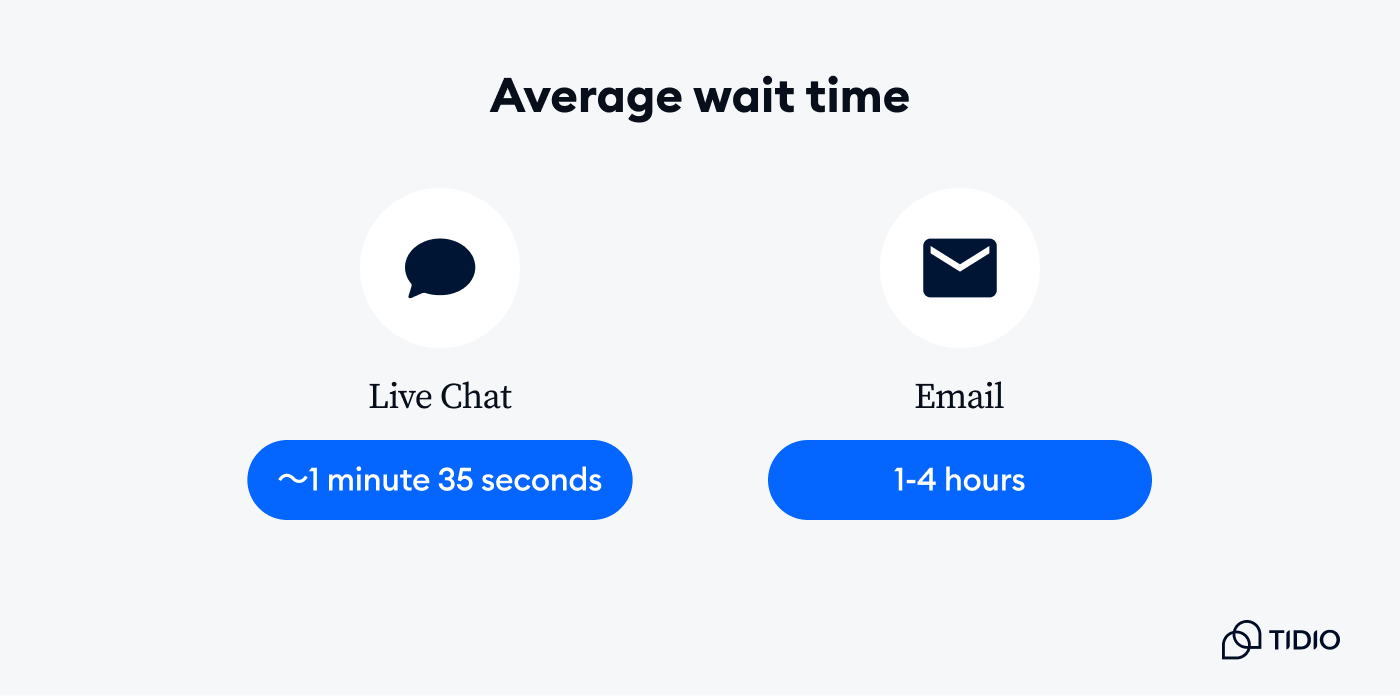
Our live chat tool data shows that the average live chat response time is 1 minute and 35 seconds. (Source: Tidio)
That’s a huge improvement over the median wait time for email, which is usually counted in hours if not days. In fact, even for high-performing teams, it usually takes them anywhere from 1 to 4 hours to respond to an email.
(Source: Agents Republic)
20. What is the average live chat concurrency?
The average live chat concurrency should be around 1-3%. This means that during any given time period, 1-3% of your website’s visitors should be engaging in a live chat session. Many live chat tools provide real-time visitor monitoring to see how many people are browsing your page and who they are.
(Source: Zendesk)
21. How do you forecast chat volume?
Forecasting your chat volume is a complex process. It includes understanding the historical chat patterns of your business, as well as monitoring changes in customer behavior. Many unpredictable events such as spikes in web traffic or contact center calls may affect your chat volume.
That said, data shows that roughly 15% of website visitors will interact with a live chat widget at some point during their visit, which gives teams a useful baseline when planning capacity.
(Source: Tidio)
22. What is the standard service level for a call center?
The most widely accepted call center service level standard is the 80/20 benchmark, which means answering 80% of incoming calls within 20 seconds. While this remains the most common reference point, some call centers use variations such as 80/30 or adjust targets based on industry needs.
In practice, many teams aim to answer roughly 75–90% of calls within 20 to 30 seconds, depending on their volume and customer expectations.
(Source: Verint)
23. What is the most important agent KPI in live chat service?
Customer satisfaction is the most important live chat support KPI. It reflects how helpful and smooth conversations feel from the customer’s point of view, not just how quickly they end. Teams usually track this through CSAT surveys or Net Promoter Score, with an NPS above 50 and a CSAT score over 75 considered strong results. These benchmarks indicate that customers are leaving chats with a positive impression. (Source: HubSpot)
At the same time, support teams operate within real limits. Agents need to balance speed, accuracy, and availability, which makes it essential to understand how many conversations they can handle without service quality dropping. Tracking satisfaction alongside capacity metrics helps teams maintain consistency, especially during high-traffic periods.
Other live chat KPIs worth monitoring include:
- number of chats: shows how often customers choose live chat and how visible or appealing the widget is
- completed chats: helps assess how many conversations reach a resolution and how effectively issues are handled
- abandoned chats: highlights where customers leave conversations, most often due to long wait times
- chat transfers: can point to routing issues, unclear ownership, or training gaps
- first response time: indicates how quickly customers receive an initial reply
- average resolution time: shows how long it takes to fully resolve a conversation
- chat concurrency: reveals how many chats an agent handles at once and whether workloads are sustainable
These live chat metrics can be used to help you troubleshoot issues with your live chat system, or to simply keep track of how well your team is performing over time.
Live chat industry statistics: key takeaways
The data makes it clear that live chat is now a common part of how websites communicate with customers. Adoption continues to grow, and its role has expanded over time. What started mainly as a post-purchase support channel now plays an important part earlier in the customer journey, helping visitors feel confident as they browse and make decisions.
Live chat supports a smoother customer experience by keeping conversations quick and accessible at the moment people need help. When questions are answered in real time, customers are more likely to stay engaged and move forward with a purchase, which contributes to higher satisfaction and stronger retention over time.
Real-time support has become a familiar experience for online shoppers, and live chat remains one of the simplest ways to meet that demand. So, for businesses that haven’t added live chat yet, now is the time to start.
Discover how live chat can drive real results for your business with Tidio
FAQ
Tidio is a customer service platform that brings live chat, automation, and AI tools together. It helps businesses support customers in real time, automate repetitive questions, and manage conversations across channels in one workspace.
Live chat is a real-time messaging feature that lets customers communicate directly with a business through a website or app. It provides quick, conversational support without requiring phone calls or emails, helping visitors get answers while they browse.
Yes. Tidio includes AI features such as Lyro AI Agent and Tidio AI Copilot. Lyro handles common customer questions through conversational automation, while Copilot assists support agents with suggested replies and faster responses.
Yes. Tidio includes a built-in live chat widget that businesses can add to their websites. It allows teams to respond to visitors instantly, track conversations, and combine live chat with automation and AI for smoother customer support.