Key takeaways
- Start with a teaser phase in early November, so the sale opens to an audience that already knows what is coming.
- Build your email list and a loyalty early-access window before the sale. Both are cheaper than buying clicks on the day.
- Raise order value with bundles, BOGO deals and a free shipping threshold instead of cutting every price.
- Recover carts with a chatbot and a three-email sequence, because most carts are abandoned.
- Staff the peak: put AI and live chat in front of repetitive questions, and keep humans for the sales conversations.
Black Friday online sales in the US reached a record $11.8 billion in 2025, up 9.1% on the year before.[1] Shopify merchants alone sold $14.6 billion across the Black Friday to Cyber Monday weekend.[2] Shoppers come with money and a short attention span, and your store has a few days to earn the order. This guide covers 12 strategies for e-commerce stores, each with what to do, why it works and an example you can adapt this week.
Why Black Friday marketing needs a plan, not just a discount
The benefits of a Black Friday marketing strategy come from timing and order value, not from the size of the discount. A store that teases deals early, owns an email list and has answers ready for peak traffic wins orders that a deeper discount alone does not.
Three things have changed since most Black Friday playbooks were written:
- Deals are everywhere. Every competitor runs a sale, so a bare "30% off" banner no longer stands out. A reason to act now, such as early access or a bundle, does.
- Discovery is shifting. Adobe measured generative AI traffic to US retail sites up 693.4% over the previous holiday season.[3] Clear product pages and policies help both shoppers and the assistants that summarize your store.
- Questions spike with traffic. Shipping dates, sizing and discount-code problems all arrive at once. Marketing that drives traffic without a support plan sends visitors to a chat nobody answers.
Run Black Friday chats and flows with Tidio
12 Black Friday marketing strategies
The strategies follow the order of the work: plan, build the audience, shape the offer, launch, then support the peak.
| # | Strategy | Phase |
|---|---|---|
| 1 | Start with a teaser timeline | Plan |
| 2 | Build your email list before the sale | Plan |
| 3 | Give loyal customers early access | Plan |
| 4 | Bundle products and run BOGO deals | Offer |
| 5 | Run flash sales with countdown timers | Offer |
| 6 | Remove shipping and return friction | Offer |
| 7 | Sell gift cards early | Offer |
| 8 | Send a three-email campaign | Launch |
| 9 | Pay for social ads and retarget visitors | Launch |
| 10 | Recover carts and recommend products with a chatbot | Launch |
| 11 | Greet shoppers on WhatsApp and Instagram with the deal | Launch |
| 12 | Prepare AI and live chat for peak traffic | Support |
1. Start with a teaser timeline
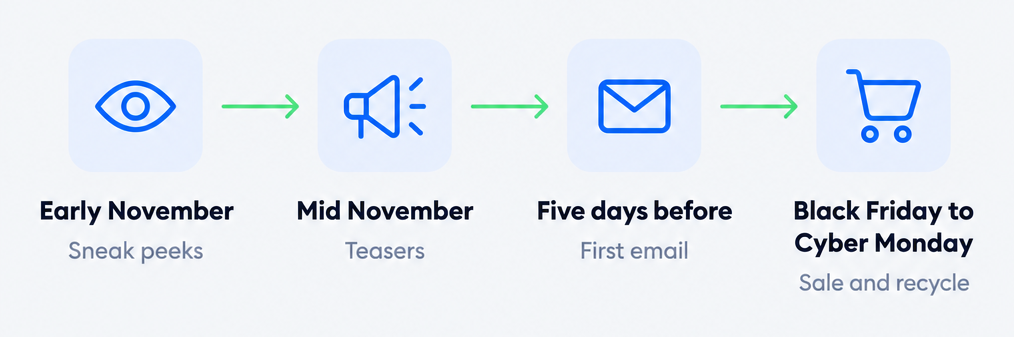
Your campaign starts weeks before the sale, in three steps. Early November is for sneak peeks to loyal customers and early-bird subscribers. Mid to late November is for teasing deals on email, social media and your site. The final week is for the announcement and the first email.
Shoppers who know what is coming arrive with intent, and a sale that opens to a warm audience needs fewer paid clicks to fill the first hours. Adjust the dates to your category: gift and gadget stores peak earlier than stores that sell replacements.
How to do it:
- Write a one-page calendar with one action per week, owned by one person each.
- Publish a "Black Friday is coming" page with an email field, so teasers collect addresses.
- Decide your three headline offers now, so every channel says the same thing.
Example: A skincare store posts a sneak peek of its bundle two weeks out, with the line "Join the list to shop 24 hours before everyone else." The page collects emails for the early-access window in strategy 3.
For the numbers behind shopper timing, see our Black Friday statistics.
2. Build your email list before the sale
An email list is the one channel you own on Black Friday, when ad costs rise and organic reach drops. If you have few contacts, start collecting now and keep growing the list all year.
A time-limited, exclusive offer converts better than a generic newsletter signup, because shoppers know a deal can vanish. Give something before anyone else gets it, or something free.
How to do it:
- Run a social ad or an on-site popup that trades an email address for early access or a gift.
- Say exactly what subscribers get and when: "Deals open to the list 24 hours early."
- Send a confirmation email that repeats the date, so the list stays warm.
Example: A popup reads, "Get first access to our Black Friday deals plus a free gift with your first order." The visitor enters an email and receives a confirmation with the early-access date.
3. Give loyal customers early access
Your best customers should not compete with strangers for limited stock. Early access rewards repeat buyers, protects your margin on the best deals and gives you a first wave of orders to learn from.
How to do it:
- Segment customers who bought in the last six months.
- Open a landing page 24 hours before the public sale and send each person a unique access code.
- Add a bonus for the group, such as extra loyalty points or a small free gift.
Example: An email to past buyers reads, "Your Black Friday access opens tonight. Use code VIP-XXXX at checkout." The code works on a page that is not linked anywhere else.
Our guide to customer loyalty covers how to keep those buyers coming back.
4. Bundle products and run BOGO deals
Bundles and buy-one-get-one deals raise the average order value and clear excess stock without cutting the price of every item. Shoppers also see the saving more clearly than a percent off.
How to do it:
- Bundle complementary top sellers and show the saving in dollars, not only percent.
- Use BOGO on slow stock you want to clear, and cap the quantity.
- Put the deal on the homepage, the product page and in the email, with the same wording.
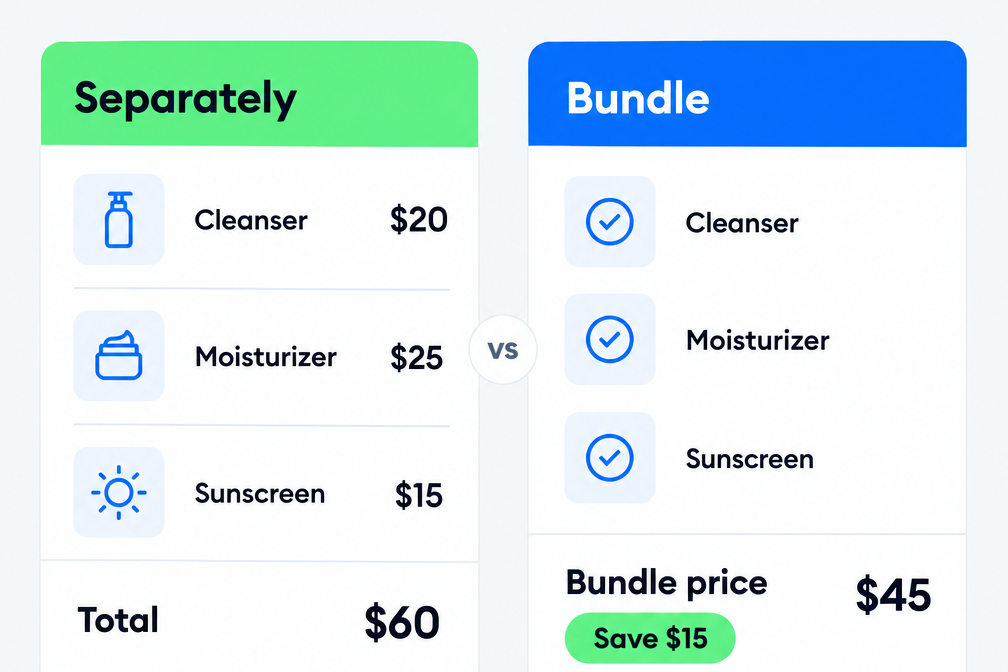
Example: A skincare store sells a cleanser at $20, a moisturizer at $25 and a sunscreen at $15. Bought separately, they cost $60. The Black Friday bundle costs $45, so the banner reads "Complete routine: $45, save $15."
5. Run flash sales with countdown timers
Short windows create urgency and spread traffic across the day instead of one spike at midnight. A countdown timer makes the deadline visible, and visible deadlines get acted on.
How to do it:
- Plan two-hour sales on one category each, announced a day ahead by email.
- Add a banner with a timer to the homepage and the product pages in the sale.
- Put the same deadline in the email, so the timer in the inbox matches the one on the site.
Example: Sale 1 runs 8:00 to 10:00 am on dresses at 40% off. Sale 2 runs 12:00 to 2:00 pm on shoes, buy one get the second 50% off. Sale 3 runs 4:00 to 6:00 pm on outerwear at 30% off.
6. Remove shipping and return friction
Shipping cost and return risk are the most common reasons a shopper hesitates at checkout. Removing them is often worth more than a bigger discount.
How to do it:
- Offer free standard shipping for the whole weekend, or set a low threshold such as $50.
- State the return window in the product page, the cart and the confirmation email.
- Publish a returns page with step-by-step instructions and a prepaid label policy.
Example: The banner reads "Free shipping on every order, Friday to Sunday. Free returns within 30 days." The cart repeats the same promise.
Read more in our guide to a store return policy.
7. Sell gift cards early
Gift cards delay the purchase, so orders and shipping spread over a longer period instead of landing on one weekend. They also work as a pressure valve when stock is tight, because you can set a redemption date after the holidays.
How to do it:
- Offer fixed amounts, such as $25, $50 and $100, and promote them from mid November.
- Add a bonus: a free $10 card for every $50 card bought.
- Ask new card holders to join your newsletter or loyalty program when they redeem.
Example: A banner reads "Buy a $50 gift card now, get a $10 bonus card, redeem from December 26." Redemption after the rush keeps fulfillment manageable.
8. Send a three-email campaign
Email is where most Black Friday revenue starts for small stores, and one email is not enough. A three-message sequence reaches people who missed the first or needed a reminder.
How to do it:
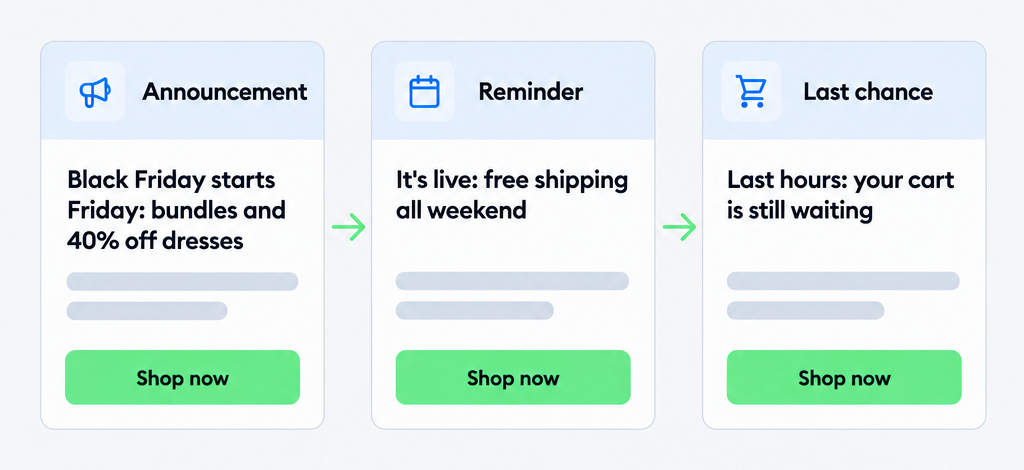
- Send the announcement about five days before Black Friday, with the offer in the subject line.
- Send a reminder on the morning of the sale and a last-chance message before it ends.
- Reuse the sequence for Cyber Monday with new copy, visuals and codes, and say it is the final chance.
Example: Subject 1: "Black Friday starts Friday: bundles and 40% off dresses." Subject 2: "It's live: free shipping all weekend." Subject 3: "Last hours: your cart is still waiting."
Use our email marketing templates as a starting point, and see how an abandoned cart email can add a fourth message.
9. Pay for social ads and retarget visitors
Organic posts rarely reach enough people on Black Friday, and paid ads let you target by audience and budget. Retargeting people who already visited your site converts better than cold traffic.
How to do it:
- Run ads on the channels your customers use, usually Facebook and Instagram.
- Retarget visitors who viewed a product or started checkout, with the same offer they saw.
- Add a contest or giveaway where entrants share or comment, and reuse the user-generated content.
Example: A retargeting ad shows the exact bundle a visitor looked at, with "Your bundle is $45 until Sunday."
Our guide to Facebook chatbots shows how to follow an ad click with an automatic message.
10. Recover carts and recommend products with a chatbot
An average of 70.22% of online carts are abandoned.[4] Black Friday adds price comparison and distraction, and a chatbot can answer the question that made the visitor hesitate.
On Tidio, Flows start a chat on a trigger you set, such as time on a page or an exit, and can cross-sell products or save abandoned carts. Lyro AI Agent recommends products from your catalog as visual cards, and on Shopify it lets shoppers add items straight to the cart.
How to do it:
- Trigger a chat for visitors who linger on a product or move to leave, with the Black Friday offer.
- Let the chatbot recommend a matching item right before checkout, such as socks with shoes.
- Offer a time-limited code to visitors who leave with items in the cart, and answer follow-up questions about warranty or sizing.
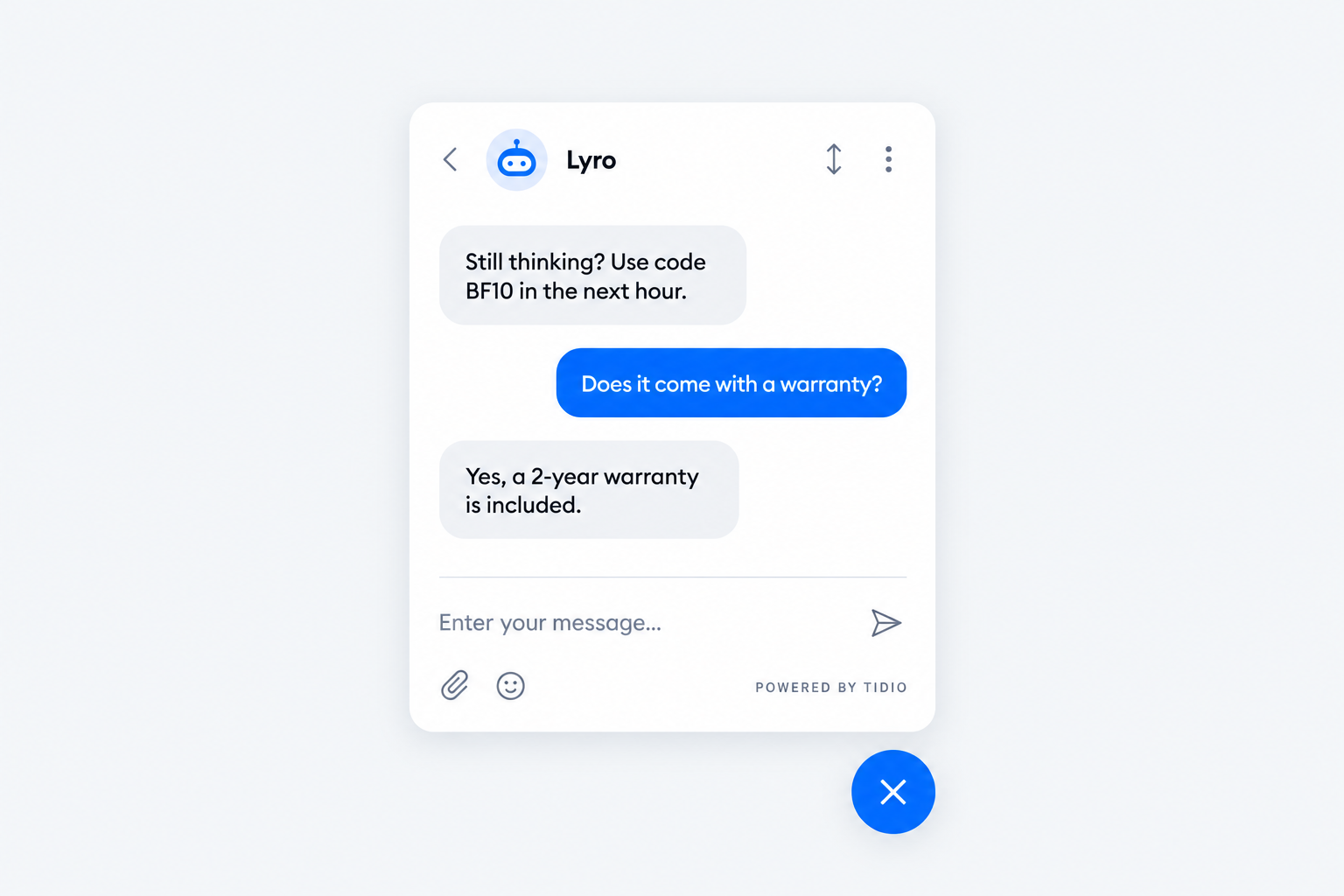
Example: A visitor leaves a phone in the cart. The chat opens with "Still thinking? Use code BF10 in the next hour." The shopper asks about the warranty, gets the answer and checks out.
For the full setup, see chat triggers, e-commerce chatbots and our guide to shopping cart abandonment.
11. Greet shoppers on WhatsApp and Instagram with the deal
Many shoppers message a store on WhatsApp or Instagram before they buy. The first reply is a free place to mention the sale, because it reaches the person who is already asking.
How to do it:
- Set an automatic greeting that names the Black Friday offer and the end date.
- Add quick answers for the questions this season brings: delivery cutoffs, returns and codes.
- Hand the chat to a person when the shopper asks for one.
Example: The greeting reads "Hi, Black Friday is live: free shipping on every order until Sunday. Ask me anything about sizing or delivery."
See our guides to WhatsApp chatbots and Instagram chatbots.
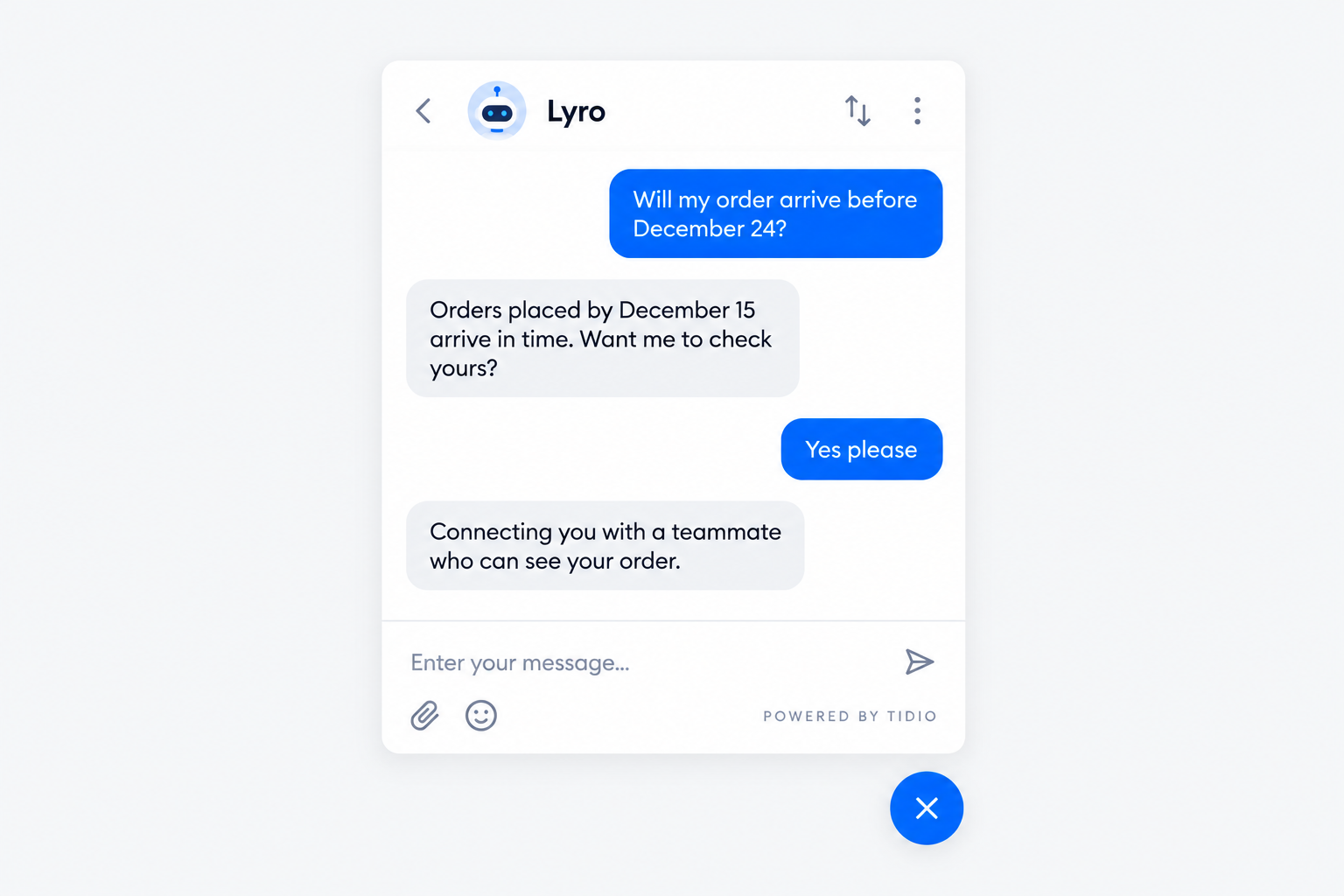
12. Prepare AI and live chat for peak traffic
Traffic multiplies questions, and unanswered questions become lost orders. Train your AI before the weekend and keep a person ready for the shoppers who are close to buying.
Lyro can resolve up to 75% of support requests. Tidio's live visitors list shows who is on your site and which pages they browse, so an agent can start a chat with someone looking at a winter coat. Lyro learns from the support content you give it and hands over to a human when it cannot answer.
How to do it:
- Give your AI your FAQ, shipping cutoffs and return policy now, and test it on real questions.
- Review the questions it could not answer and add them to its knowledge before the weekend.
- Staff live chat for the busiest hours and use the visitor list to start chats on high-value pages.
Example: A visitor spends three minutes on a winter coat page. An agent writes, "Need help with sizing? Happy to check the length for you."
Our guides on e-commerce live chat and customer service automation go deeper.
How Tidio helps you run Black Friday
Tidio puts the on-site pieces of this plan in one place: Flows for discount popups and cart-saving chats, Lyro AI Agent for product recommendations and peak-day answers, and live chat for the conversations worth a person's time. It works with Shopify, so you can set it up before the first teaser goes out.
Try Tidio free
Where to start
Pick two strategies and finish them this week: the early-access email list and the cart-recovery chat. They are the cheapest to set up and they protect the most revenue on the day. Then add the bundle, the three-email sequence and the support plan.
FAQ
Start in early November with sneak peeks for loyal customers, tease deals through mid to late November, and send your first campaign email about five days before Black Friday.
Build an email list and offer early access, then raise order value with bundles and free shipping. These cost less than discounting every item and work with a small team.
Combine a chatbot that opens when a visitor hesitates with a reminder email that repeats the offer. Answer the question that stopped the purchase, such as shipping time or warranty.
Yes. Redesign the same campaign with new copy, visuals and codes, and say Cyber Monday is the last chance to buy at that price.
Train an AI agent on your FAQ, shipping cutoffs and returns policy before the event, and keep live chat staffed for the busiest hours. Hand sales questions to a person.
Use live chat to support your customers in real-time