Key takeaways
- Best for small teams and online stores: Tidio. Live chat, email tickets, Messenger, Instagram, WhatsApp, and the Lyro AI agent share one inbox, with Shopify order tools built in.
- Best for large multichannel teams: Zendesk. Chat, phone, and email in one workspace, with chat starting on the $55 per agent plan.
- Best on a tight budget: Zoho Desk. A free plan for 3 users, then paid plans from $7 per user a month, billed annually.
- AI is billed in different units: per resolution (Zendesk, Intercom, HubSpot, Help Scout), per session (Freshdesk), or bundled into the plan (Zoho Desk, LiveAgent). Compare that unit before the seat price.
- Only 4 of the 10 have a free plan: Tidio, HubSpot, Zoho Desk, and Help Scout.
Customer service software looks the same on every pricing page and behaves very differently once the queue fills up. One tool bills per seat, another per AI answer, and a third keeps live chat on a higher plan. We compared ten tools on their pricing pages, help centers, and G2 reviews, and checked each price in October 2026. You get who each tool suits, what it costs, and where the bill grows. Tidio is listed first because the list is ordered for small and mid-sized teams and online stores. Every tool, ours included, is judged on the same criteria and shown with its real drawbacks.
What is customer service software?
Customer service software is the set of tools a business uses to receive, route, answer, and track customer requests across channels. A typical product combines a shared inbox or ticketing, live chat, a knowledge base, automation or an AI agent, and reporting, so every conversation has an owner, a history, and a status.
Teams also call it a customer service platform, a customer support tool, or a customer service management system. The label changes with the vendor. The job stays the same: no customer question gets lost, and no agent answers it twice.
Most products cover the jobs below, and the cheap ones skip a few.
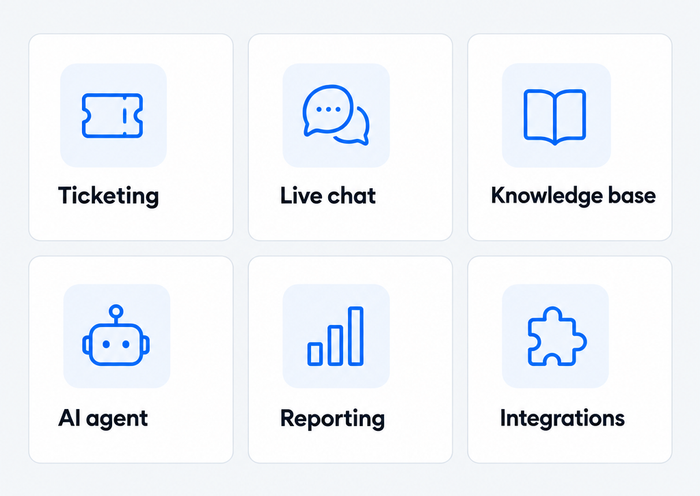
| Job | What it does |
|---|---|
| Shared inbox and ticketing | Turns every message into a ticket with an owner and a status |
| Live chat and messaging | Answers visitors in real time on your website, Messenger, Instagram, or WhatsApp |
| Knowledge base | Lets customers find answers without contacting you |
| AI agent and automation | Resolves repeat questions and hands the rest to your team |
| Reporting | Tracks response time, resolution time, and customer satisfaction |
| Integrations | Connects to your store, CRM, and the rest of your stack |
Where products differ is the starting point. Help desks such as Zendesk and Freshdesk begin with tickets. Chat-first tools such as Tidio and Intercom begin with the conversation. CRM-native suites such as HubSpot and Salesforce begin with the customer record. Store-specific tools such as Gorgias begin with the order. The tools below span all four, so the right pick depends on where your customers already talk to you.
The best customer service software at a glance
Our short list: Tidio for small teams and online stores, Zendesk for large multichannel teams, and Zoho Desk for the lowest price per seat.
| Tool | Best for | Starting price (paid) | Free plan / trial | AI pricing | G2 rating |
|---|---|---|---|---|---|
| Tidio | Small teams and online stores, especially Shopify | $24.17/mo, billed annually | Free plan · 7-day trial | Lyro from $32.50/mo for 50 AI conversations | 4.6 (1,962) |
| Zendesk | Large teams across chat, phone, and email | $19/agent/mo (email only); $55 with chat | No free plan · 14-day trial | $1.50 to $2.00 per resolution | 4.3 (7,091) |
| Freshdesk | Small email-led support teams | $19/agent/mo, billed annually | No free plan · 14-day trial | 500 free sessions, then $49 per 100 | 4.4 (3,773) |
| Intercom | SaaS teams that put AI first | $29/seat/mo, billed annually | No free plan · 14-day trial | $0.99 per outcome | 4.5 (2,900+) |
| HubSpot Service Hub | Teams already in HubSpot CRM | Starter $20/seat/mo list price | Free for 2 users | $0.50 per resolved conversation | 4.4 (3,017) |
| Zoho Desk | Budget-conscious teams | $7/user/mo, billed annually | Free for 3 users · 15-day trial | Zia bundled in plan | 4.4 (7,954) |
| Help Scout | Email-first teams that want a simple inbox | $25/user/mo, billed annually | Free for 5 users | $0.75 per resolution | 4.4 (431) |
| Gorgias | Shopify stores with high ticket volume | $10/mo for 50 tickets; $50 for 300 | Free trial | $0.85 to $1.00 per automated interaction | 4.6 (582) |
| Salesforce Service Cloud | Companies already on Salesforce CRM | $25/user/mo (Starter Suite) | Free trial | $2 per Agentforce conversation | 4.4 (8,432) |
| LiveAgent | Small teams that need phone, chat, and social | $15/agent/mo, billed annually | No free plan · 30-day trial | AI bundled in plan | 4.5 (1,537) |
How we chose these tools
We started with the customer service tools that recur most often in buyer comparisons and AI answers, then kept the ten that fit a small or mid-sized team, an online store, or a Salesforce shop. We left out products that only do one job (chat-only widgets, survey tools) and IT service desks.
Each tool got the same checks:
- Channels: live chat, email, social, and phone, and which plan unlocks each.
- AI: what the agent does and how it is billed.
- Knowledge base and reporting: whether they come with the entry plan.
- Integrations: especially store and CRM connections.
- Price: the real starting price and what grows the bill.
- Reviews: the G2 rating and review count.
The list is ordered by fit for small and mid-sized teams and online stores, not by rating. We didn’t run a full pilot of every tool. For rivals, we relied on vendor documentation and reviews, and we say so where a limit comes from a vendor claim.
The 10 best customer service software tools in 2026
Tidio
Best for: small teams and online stores that want chat, tickets, and AI in one inbox
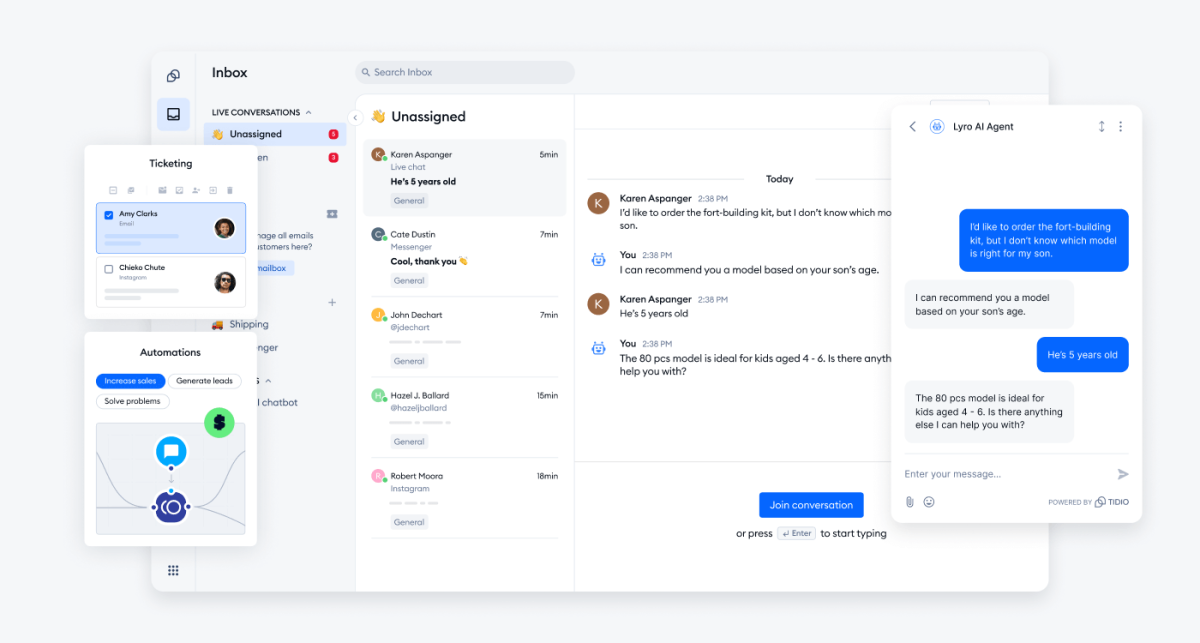
Tidio puts live chat, email tickets, Messenger, Instagram, and WhatsApp in one inbox. It adds an AI agent called Lyro and no-code automations called Flows, and both run on the same project. Ticketing, live video calls, and basic analytics come with the Free plan, and advanced analytics start on Growth. Tidio says Lyro can resolve up to 75% of support requests automatically and hands the rest to your team with the conversation attached.
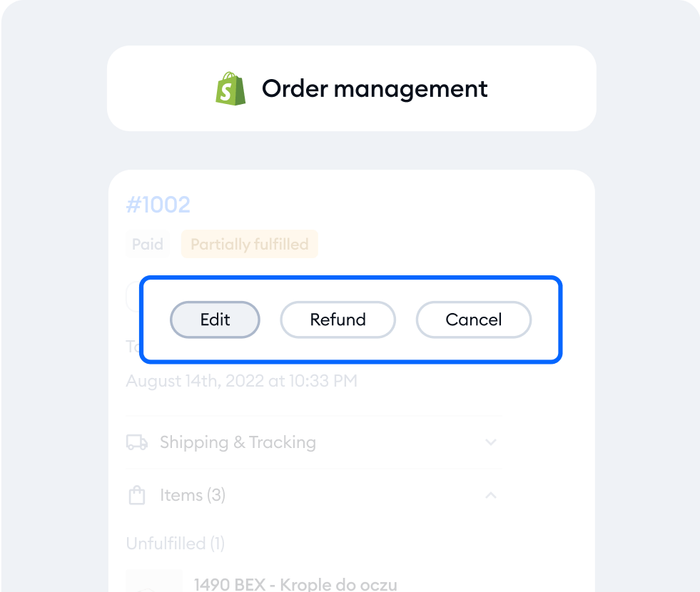
On Shopify, agents see the shopper’s cart and order history beside the chat and can cancel an order, issue a refund, or change a shipping address without leaving the inbox.
Tidio fits these teams best:
- Shopify stores that want cart preview and order history in the inbox.
- Small and mid-sized teams that use automation and AI to cover for a small staff.
- Busy support queues full of repeat questions.
- Multichannel teams that handle live chat, email, Messenger, Instagram, and WhatsApp in one place.
Skip Tidio if phone calls and an IVR are your main channel. Zendesk and LiveAgent cover that better.
Key features:
- Lyro AI agent: answers from your help content and website, works across chat, Messenger, Instagram, and WhatsApp, and checks order status on Shopify.
- Tickets and SLAs: views, assignment, merging, custom fields, and first-reply targets for email tickets.
- Flows: greet visitors, recover carts, and collect leads.
Pros
- A free plan with 10 seats and 50 billable conversations a month, enough to test on a live site.
- Shopify actions such as refunds and order edits work straight from the inbox.
- AI, human chat, and tickets share one inbox, so handoffs keep their context.
Cons
- Pricing grows with usage. Billable conversations, Lyro, and Flows are priced separately, so you only pay for what you use, but there are a few quotas to keep an eye on as you grow.
- Lyro answers common questions well and passes complex cases to your team. The free Lyro allowance is a one-time 50 conversations.
- Phone is not a channel today, so teams that take many calls pair Tidio with a phone tool.
Pricing: Tidio’s pricing page lists these plans (billed annually; monthly in brackets):
- Free: $0, 50 billable conversations a month, 10 seats.
- Starter: $24.17 a month ($29), 100 conversations.
- Growth: from $49.17 a month ($59), 250 to 2,000 conversations.
- Plus: from $300 a month plus usage. Premium: by quote.
- Lyro AI agent: from $32.50 a month ($39 billed monthly) for 50 AI conversations. Flows: from $24.17 a month ($29).
- 7-day free trial, no card.
Rating: G2 4.6/5 (1,962 reviews)
See which Tidio plan fits your support volume
Zendesk
Best for: large teams that run chat, phone, and email in one workspace
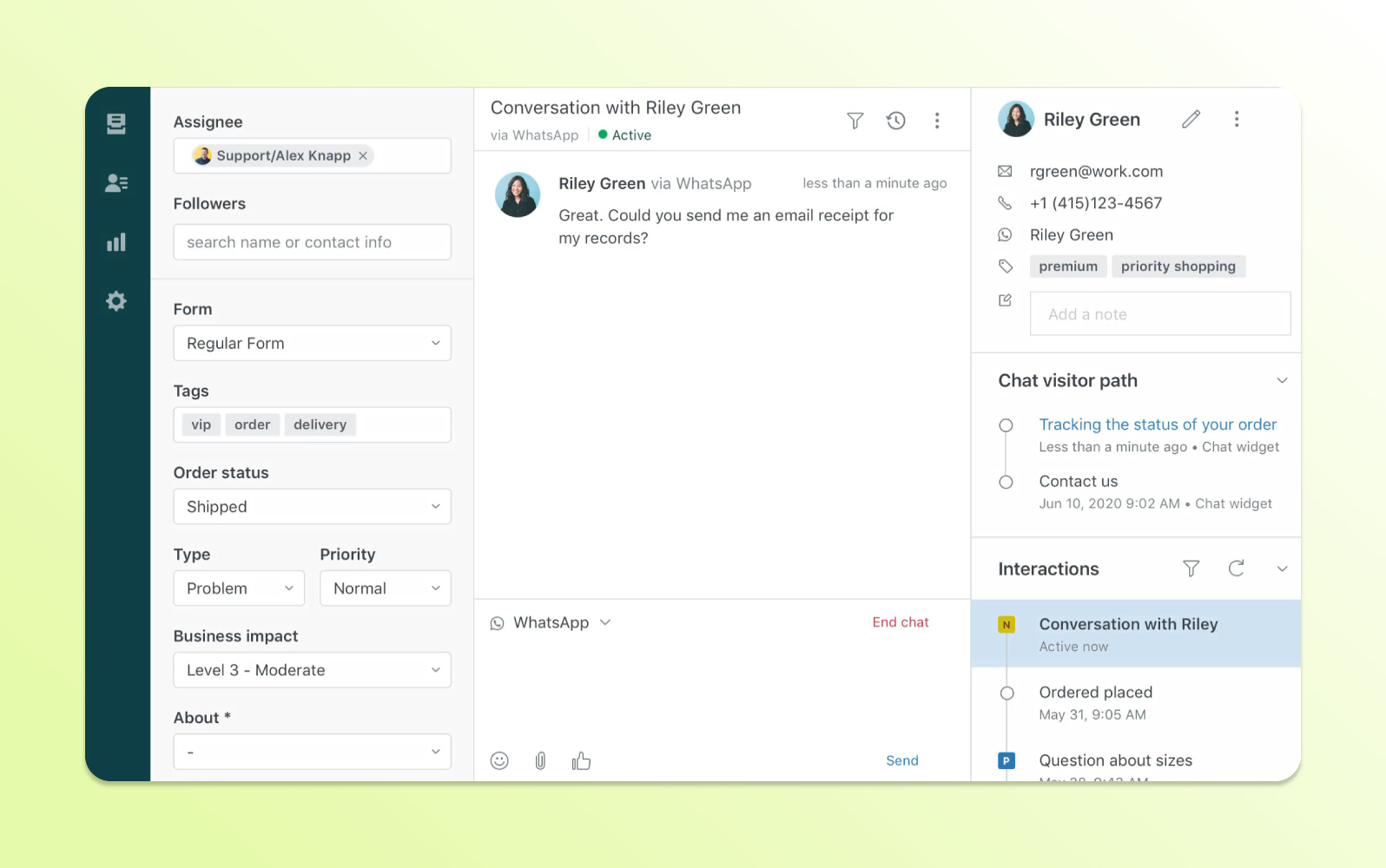
Zendesk is the broadest option here. The Suite plans put live chat, phone, and an AI agent in the same workspace as email tickets. The catch for small teams is the plan steps: the $19 Support Team plan is email only, so chat starts at Suite Team.
Key features:
- Omnichannel routing across email, chat, phone, and social.
- AI agents on every plan, billed per automated resolution.
- Prebuilt analytics dashboards from the entry plan.
Pros
- One queue for every channel.
- Analytics dashboards come with the entry plan.
Cons
- The entry plan has no live chat.
- AI cost scales per resolution, which is hard to forecast when chat volume spikes.
Pricing (per agent, billed annually; monthly in brackets): Support Team $19 ($25) · Suite Team $55 ($69) · Suite Professional $115 ($149) · Enterprise on request. Each agent includes 5 AI resolutions a month (10 on Professional), then $1.50 each committed or $2.00 pay-as-you-go. No free plan; 14-day trial.
Rating: G2 4.3/5 (7,091 reviews)
Read more: Zendesk review · Zendesk alternatives
Freshdesk
Best for: small, email-led support teams that want a knowledge base at a low price
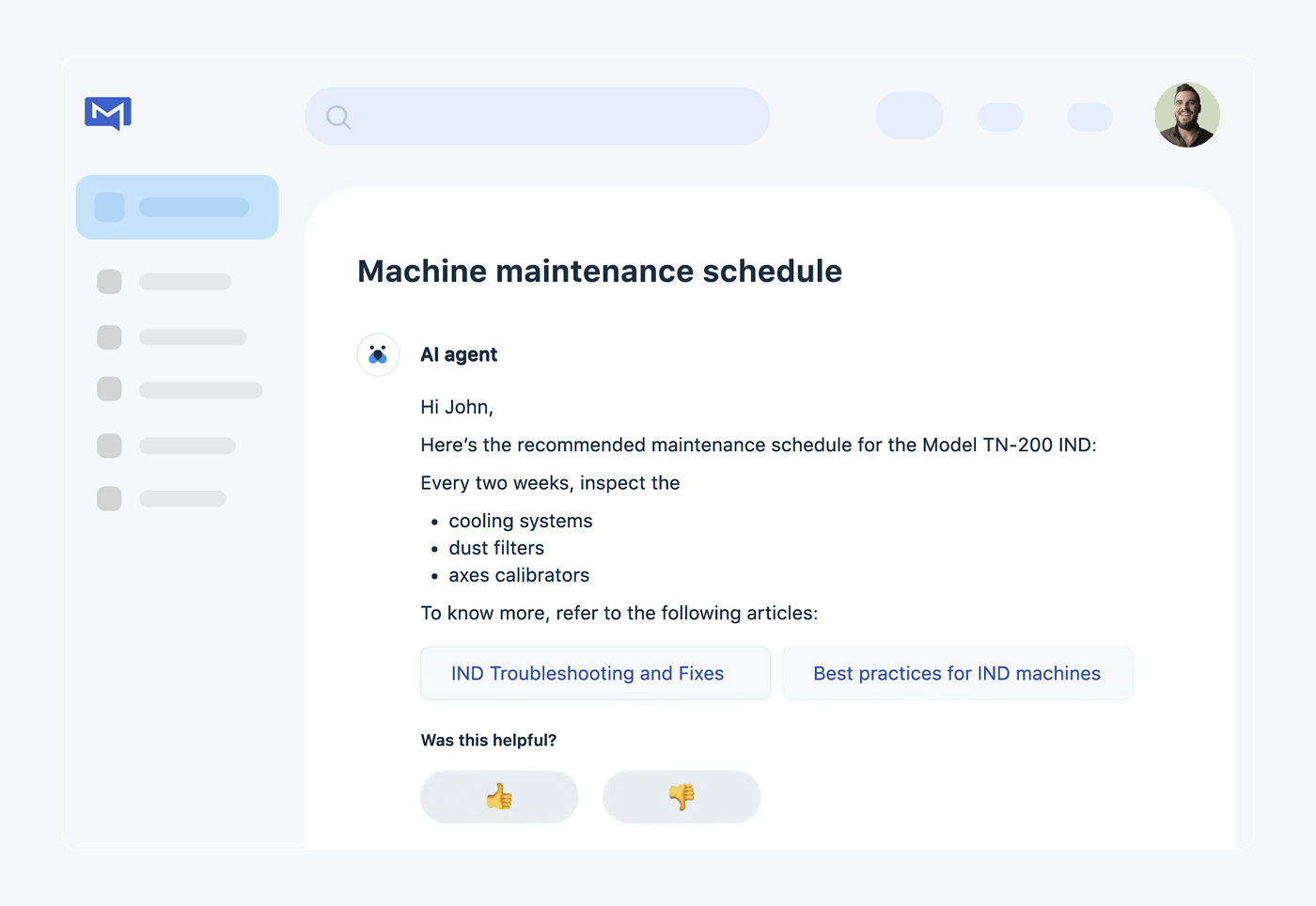
Freshdesk is the cheapest annual entry here that still bundles a customer portal, a knowledge base, and reporting. It sells an email-first help desk, so live chat, WhatsApp, and phone come from separate Freshworks products.
Key features:
- Ticketing and shared inbox with roles, permissions, and SLA policies.
- Customer portal and knowledge base from the Growth plan.
- Freddy AI Agent, with Copilot as a paid add-on from Pro.
Pros
- A transparent AI price: 500 free sessions, then $49 per 100.
- Knowledge base and reporting on the entry plan.
Cons
- Chat and phone are separate products with their own pricing.
- Copilot ($29 per agent) is not available on Growth.
Pricing (per agent, billed annually; monthly in brackets): Growth $19 ($23) · Pro $55 ($66) · Enterprise $89 ($107). No free plan; 14-day trial.
Rating: G2 4.4/5 (3,773 reviews)
Read more: Freshdesk review · Freshdesk alternatives
Intercom
Best for: SaaS teams that want an AI agent to handle most conversations
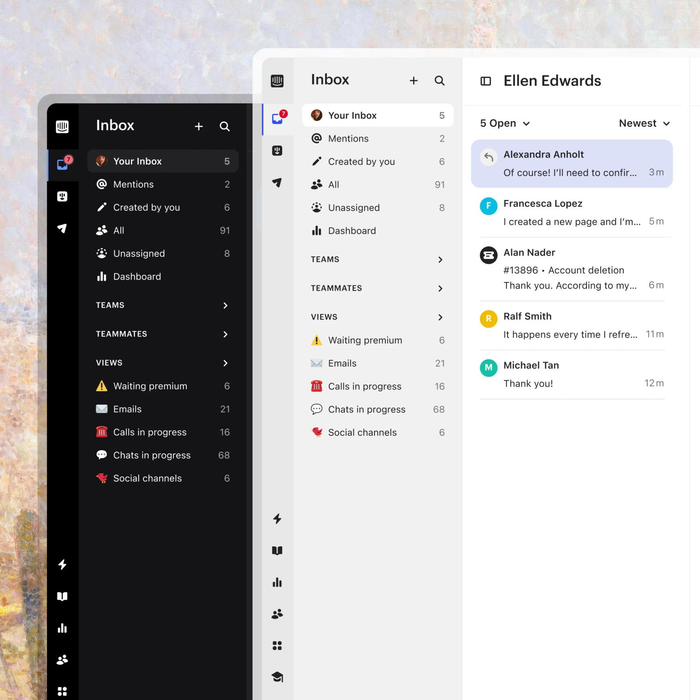
Intercom is built around its AI agent, Fin. The Messenger, shared inbox, and help center come with every plan, and Fin is billed only when it resolves a conversation. The second bill is the catch: seats plus outcomes, so a team with high chat volume pays for both.
Key features:
- Fin AI agent on every plan, and usable on top of another help desk.
- Messenger live chat with a shared inbox and ticketing.
- Workflow builder from Advanced.
Pros
- AI is charged only when Fin resolves a conversation.
- Messenger, shared inbox, and a public help center on every plan.
Cons
- 1,000 resolutions a month add $990 before seats.
- Lite seats are free only on Advanced and Expert.
Pricing (per seat, billed annually; monthly in brackets): Essential $29 ($39) · Advanced $85 ($99) · Expert $132 ($139). Fin costs $0.99 per outcome. No free plan; 14-day trial.
Rating: G2 4.5/5 (2,900+ reviews)
Read more: Intercom review · Intercom alternatives
HubSpot Service Hub
Best for: teams that already run sales and marketing in HubSpot CRM
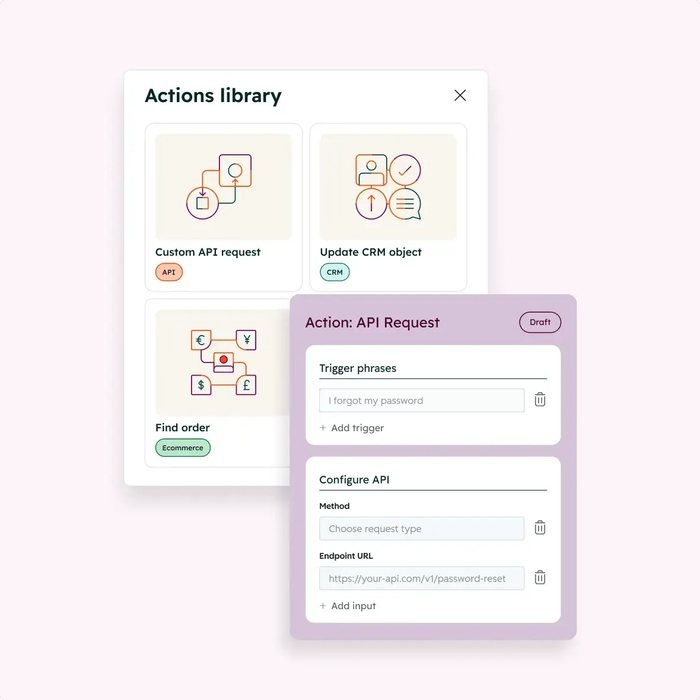
HubSpot’s strength is the shared customer record. Tickets, chat, and the Breeze Customer Agent sit next to the CRM data your sales team already uses, which also works as a light client management system. The free plan covers two users, and the agent is billed at $0.50 per resolved conversation. The agent starts on Professional, which also needs a one-time $1,500 onboarding fee.
Key features:
- Ticketing and team email on the Free plan.
- Live chat from Starter.
- Breeze Customer Agent and a knowledge base on Professional.
Pros
- A clear AI price and a free plan for 2 users.
- Tickets and CRM data live in one record.
Cons
- The AI agent and knowledge base are not on Starter.
- Required onboarding fees: $1,500 for Professional and $3,500 for Enterprise.
Pricing (per seat a month): Free for 2 users · Starter $20 list price ($7 promotional price shown) · Professional $100 list price ($90 shown) · Enterprise from $150. HubSpot’s pages disagree on some of these figures, so confirm at checkout.
Rating: G2 4.4/5 (3,017 reviews)
Read more: HubSpot alternatives
Zoho Desk
Best for: teams on a tight budget that want a free tier and a clear upgrade path
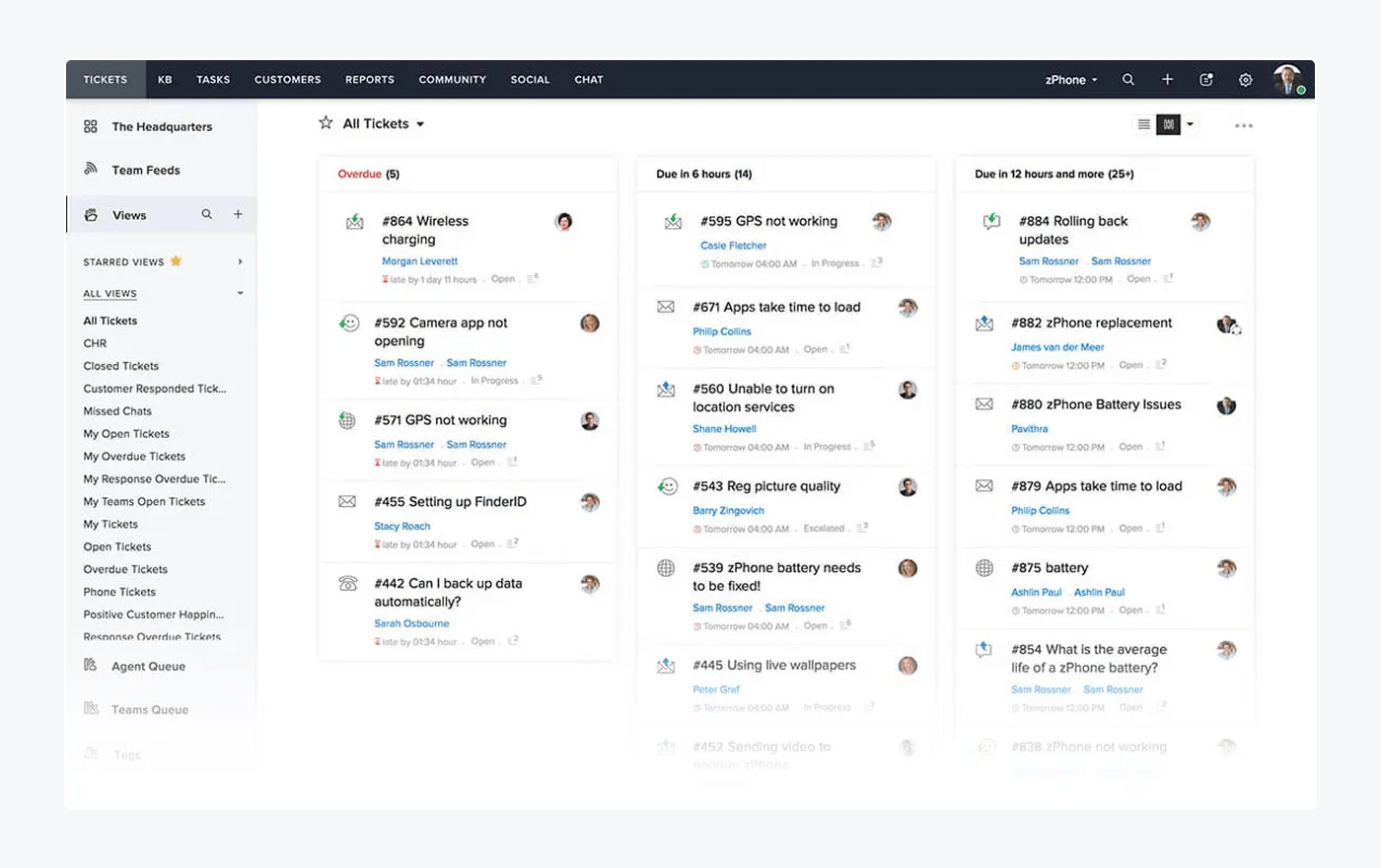
Zoho Desk has the lowest seat prices in this group and a real free plan. The ladder has five plans, and the AI assistant Zia comes with the plan at no per-resolution fee. The full live chat window sits on Enterprise, so teams that want chat on a website should price that step first.
Key features:
- Email and social tickets from the entry plan, with instant messaging channels on Standard.
- Knowledge base and CSAT ratings from Standard.
- Zia AI with reply help and summaries on Professional.
Pros
- A free plan for 3 users and a $7 Express plan.
- AI bundled with no per-resolution fee.
Cons
- Full live chat starts on Enterprise.
- Standard caps support users at 5.
Pricing (per user, billed annually; monthly in brackets): Free · Express $7 ($9) · Standard $14 ($20) · Professional $23 ($35) · Enterprise $40 ($50). 15-day trial.
Rating: G2 4.4/5 (7,954 reviews)
Read more: Zoho Desk review · Zoho Desk alternatives
Help Scout
Best for: email-first teams that want a simple shared inbox with a human tone
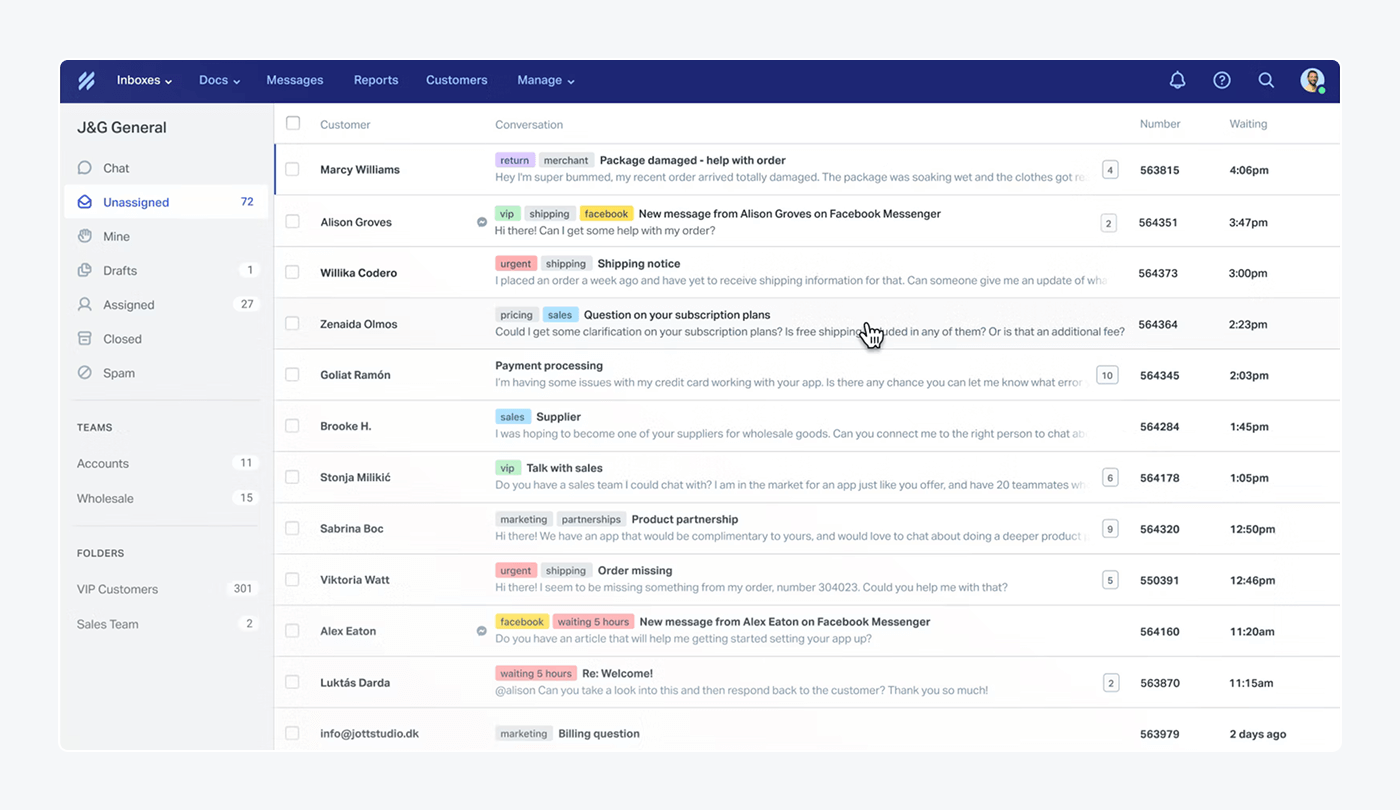
Help Scout keeps conversations looking like ordinary email. Live chat and messaging channels are on the paid plans, and the AI Answers add-on has the lowest per-resolution rate here. It has no native store data in the inbox, so e-commerce teams rely on integrations.
Key features:
- Shared inbox with multiple inboxes and saved replies.
- Knowledge base (Docs) from the entry plan.
- AI Answers, billed per resolution.
Pros
- A free plan with 5 users.
- Multiple inboxes and knowledge bases on the entry paid plan.
Cons
- Live chat starts on the Standard plan, not on Free.
- Advanced workflows and SLA policies start on Plus.
Pricing (per user, billed annually; monthly in brackets): Free · Standard $25 ($30) · Plus $45 ($54) · Pro $75 ($90). AI Answers costs $0.75 per resolution, with the first three months of resolutions free.
Rating: G2 4.4/5 (431 reviews)
Read more: Help Scout review · Help Scout alternatives
Gorgias
Best for: Shopify stores with high ticket volume

Gorgias is a help desk made for online stores. Order data, returns, and refunds appear inside the ticket, and the price follows ticket volume instead of seat count, so a bigger team doesn’t raise the bill. Stores with spiky volume pay overage.
Key features:
- Shopify, WooCommerce, and BigCommerce order data in every ticket.
- AI Agent on every plan.
- Email, chat, and social on all plans.
Pros
- No per-seat fees.
- Order actions inside the ticket.
Cons
- Ticket caps with paid overage.
- Less useful for teams that are not online stores.
Pricing (helpdesk only, billed annually): Starter $10 a month for 50 tickets (monthly billing only) · Basic $50 for 300 · Pro $300 for 2,000 · Advanced $750 for 5,000. The AI Agent adds $0.85 to $1.00 per automated interaction. Free trial; no free plan.
Rating: G2 4.6/5 (582 reviews)
Read more: Gorgias review · Gorgias alternatives
Salesforce Service Cloud
Best for: enterprises whose customer data already lives in Salesforce CRM
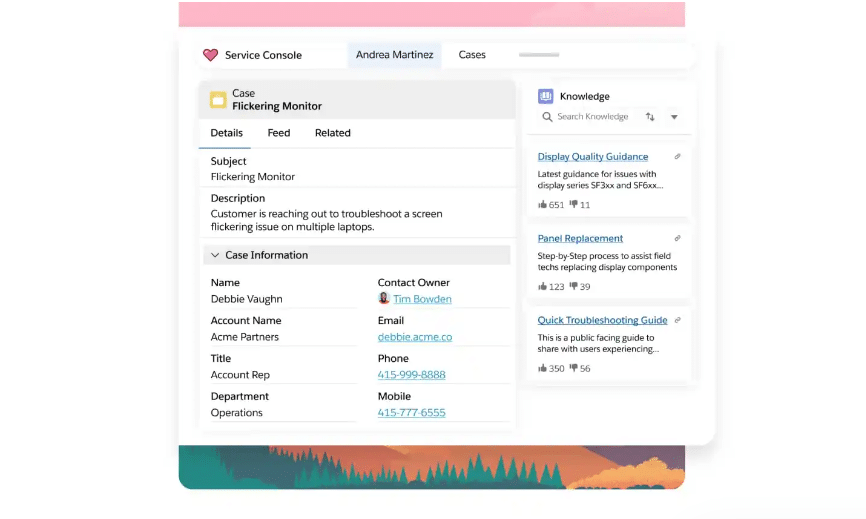
Service Cloud puts cases on the same data model as your sales and marketing records, so agents see the whole account without switching tools. Omni-channel routing, knowledge management, and Agentforce AI agents arrive as you move up the editions. It needs admin time to configure, and the full AI suite sits in the top editions. Without Salesforce CRM, a standalone help desk launches faster.
Key features:
- Case management and Service Console on Core and up.
- Agentforce for Service: AI agents and rep assistance, included in Max.
- Full sandbox and data tools on Advanced and up.
Pros
- One data model across sales, service, and marketing.
- Scales to complex, multi-department processes.
Cons
- Needs dedicated admin time to configure and run.
- AI and contact center features push you into the top editions.
Pricing (per user per month): Starter Suite $25 · Pro Suite $100 (annual contract) · Core $195 · Advanced $395 · Max $550, billed annually. Agentforce usage is billed at $2 per conversation or through Flex Credits. Free trial available.
Rating: G2 4.4/5 (8,432 reviews)
LiveAgent
Best for: small teams that want phone, chat, and social in one tool at a low price
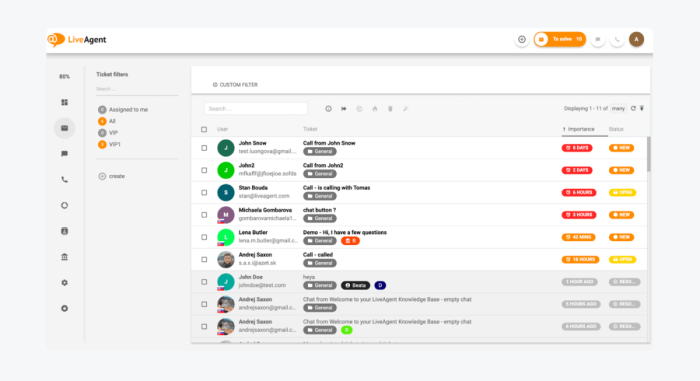
LiveAgent bundles ticketing, live chat, a knowledge base, and a call center at a low per-agent price, which makes it a fit for small call center software needs. Social channels are where the bill grows: on the Small and Medium plans, Facebook, X, Viber, and WhatsApp are $39 a month each, so three channels add more than $100 before seats.
Key features:
- Ticketing and live chat on every plan.
- Call center and IVR from Medium.
- AI features (Answer Assistant, chatbot with handover, ticket triage) bundled in plans.
Pros
- Cheap per agent, with a 30-day trial.
- Many channels in one inbox.
Cons
- Social channels are paid add-ons below the Large plan.
- Plan-by-plan AI limits are not stated clearly on the pricing page.
Pricing (per agent, billed annually; monthly in brackets): Small $15 ($19) · Medium $29 ($35) · Large $49 ($59) · Enterprise $69 ($85). 30-day free trial; no free plan.
Rating: G2 4.5/5 (1,537 reviews)
Read more: LiveAgent review
Use live chat to support your customers in real-time
How to choose customer service software
Start from the channels you must cover, then price the AI, then add up the real bill at your volume. A tool that is cheap per seat can be the most expensive once your queue is busy, so test every shortlist on your own conversations before you commit.
Match the channels to where customers write
List where your customers contact you today: website chat, email, Messenger, Instagram, WhatsApp, phone. Then check which plan unlocks each one. Zendesk keeps chat off its $19 plan. Zoho Desk reserves full live chat for Enterprise, and Freshdesk sells chat as a separate product. Tidio, Intercom, and Gorgias include chat from the first paid plan.
Price the AI, not only the seats
AI billing comes in different units. Per resolution (Zendesk, Intercom, HubSpot, Help Scout) means you pay each time the agent solves a conversation. Per session (Freshdesk) counts every conversation the agent opens. Bundled (Zoho Desk, LiveAgent) means no separate fee, with limits you should read. Ask each vendor what counts as a resolution, because that unit decides your bill. For AI-first tools, see our agentic customer service software roundup.
Add up the real cost at your volume
List price is never total cost. Multiply seats by the monthly price, then add AI at your own conversation volume, social channels, onboarding fees, and any add-on you need. A 5-agent team on Zendesk Suite Team pays $275 a month before AI. A 5-agent team on Tidio Starter pays $24.17 a month and keeps 100 billable conversations. Seat-based and conversation-based pricing cross over at different team sizes, so run the math on your own numbers.
Check the store or CRM connection
If you sell on Shopify, look for order data inside the ticket: cart, order history, refunds. Tidio and Gorgias have it. If your customer record lives in HubSpot or Salesforce, a CRM-native tool saves the sync. Our e-commerce help desk guide covers the store side.
Plan for growth
Pick a tool whose next plan still fits your budget in a year. Check the plan that adds SLAs, roles, and advanced reporting, and whether phone is an option later.
Run it on your own questions
Before you pay, load your 20 most common questions into each shortlisted AI agent and send 10 real customer messages through it. Count how many it resolves and how many it hands off. A one-week pilot beats any comparison page, including this one.
Which customer service software should you pick?
Pick by team size and channel. Tidio fits small teams and online stores, Zendesk or Salesforce Service Cloud fit large teams, Zoho Desk and Help Scout fit tight budgets, and Intercom fits SaaS teams that want AI to answer first. The scenarios below say why.
Small business or online store: Tidio on a paid Growth plan. Chat, tickets, and Lyro share one inbox, and on Shopify agents see cart and order history while they reply. [CTA: Compare Tidio plans for your team | https://www.tidio.com/pricing/]
Shopify store with very high ticket volume: Tidio when you want one tool for chat, tickets, and AI. Gorgias when most of your work is order tickets and you want the price to follow ticket count. [CTA: Try Tidio on your Shopify store | https://www.tidio.com/integrations/shopify/]
Large team with phone, chat, and email: Zendesk, or Salesforce Service Cloud if your data already lives in Salesforce.
Tight budget: Zoho Desk for a free tier with a cheap upgrade path, or Help Scout for a free plan and a simple shared inbox.
SaaS team that wants AI to take most conversations: Intercom, as long as you model Fin’s per-outcome cost at your volume.
Already on HubSpot CRM: HubSpot Service Hub, since the ticket and the contact record share one view.
Small team that needs phone and social channels cheaply: LiveAgent, watching the add-on fees for social channels.
Frequently asked questions
For small teams, Tidio is a strong fit because live chat, email tickets, social messages, and an AI agent share one inbox, with a free plan to test it. Zoho Desk and Help Scout are good low-cost alternatives when email is your main channel.
All ten tools here offer some AI. Tidio’s Lyro, Intercom’s Fin, Zendesk’s AI agents, HubSpot’s Breeze Customer Agent, Freshdesk’s Freddy, Gorgias’s AI Agent, and Salesforce’s Agentforce are AI agents. Zoho Desk’s Zia and LiveAgent’s AI features are bundled assistants. Compare how each one bills, since that varies more than the features.
For online stores, look for order data inside the conversation. Tidio and Gorgias both show Shopify orders in the inbox and can act on them. Tidio adds live chat and Lyro in the same tool; Gorgias is built around ticket volume.
Yes, four of the ten: Tidio (50 billable conversations a month, 10 seats), HubSpot Service Hub (2 users), Zoho Desk (3 users), and Help Scout (5 users). Free plans limit seats or volume, so check what you lose before you rely on one.
Entry prices run from $7 to $29 per user a month for most seat-based tools, billed annually. Tidio starts at $24.17 a month on a conversation-based plan, and Gorgias starts at $10 for 50 tickets. AI agents often add per-resolution fees of $0.50 to $2.00.
A help desk is one type of customer service software, focused on tickets, assignment, and SLAs. Customer service software is the wider category, adding live chat, a knowledge base, AI agents, and social channels. Many modern tools, such as Tidio and Zendesk, combine both.
Talk to your customers in one inbox with Tidio