Key takeaways
- Every reply here follows one shape: name and issue, what you’re doing, when they’ll hear back, an open door.
- Pair every “no” with an option. A refusal with an alternative leaves the customer a next step.
- Keep a template for each stage of the ticket (acknowledge, ask, update, resolve, close) and your team never starts from a blank box.
- A template is a first draft. Change the opening line and one specific detail before you send it.
Typing the same ticket reply for the fortieth time turns a simple “we’re on it” into a stiff, copy-pasted mess. This page has 37 help desk templates you can paste today: 30 ticket replies, 4 chat and phone scripts and 3 request forms.
They cover customer support and internal IT, from the first acknowledgment to the closing note. Copy one, swap the brackets, send. Personalizing a reply takes about a minute.
Save these replies as macros and send them from one shared inbox
Jump to a group
- Acknowledging a ticket
- Asking for more details
- Updates and escalation
- Resolving the issue
- Orders, refunds and availability
- Saying no
- Outages and maintenance
- Feedback and closing
- Help desk scripts for chat and phone
- Help desk ticket form templates
What is a help desk template?
A help desk template is a pre-written reply, script or form that support agents reuse for a situation that keeps coming up, such as acknowledging a ticket, asking for details or closing a request. Agents edit the bracketed details and send it, so every customer gets a consistent answer.
The same idea goes by other names. In your help desk software these are canned responses, saved replies or macros; Tidio calls them macros. There are three kinds, and this page has all of them:
- Reply templates: the message an agent sends back on a ticket or in chat.
- Scripts: the words an agent follows live, on chat or the phone.
- Form templates: the fields a customer or employee fills in to open a ticket.
If you want the broader library of ready-made replies, see our guide to canned responses.
How to use these templates
Brackets mark what you change. Fill them in from the ticket, not from memory.
| Placeholder | What to insert |
|---|---|
| [Customer name] | The first name on the ticket |
| [Agent name] | Your own first name |
| [Company] | Your company name |
| [ticket number] | The reference the customer sees |
| [timeframe, e.g. “by 5pm today”] | A real time you can keep |
| [issue] | The problem in the customer’s own words |
| [link] | The exact article, form or page, not the home page |
Before you send anything, do three things:
- Rewrite the first line so it mentions their situation. “Thanks for the screenshot, that helps” beats a bare “Hello”.
- Replace every time estimate with one you can meet. A template that promises 24 hours and arrives in 72 does more harm than no template.
- Delete lines that don’t apply. A resolved ticket doesn’t need an apology.
Skip templates when a customer is upset or the case is unusual. See how to deal with angry customers for those moments.
Which templates fit your help desk?
Customer support and internal IT help desks share most stages of a ticket. These are the groups that fit each.
| Group | Customer support | Internal IT |
|---|---|---|
| Acknowledging a ticket | Yes | Yes |
| Asking for more details | Yes | Yes |
| Updates and escalation | Yes | Yes |
| Resolving the issue | Yes | Yes (password reset, access) |
| Orders, refunds and availability | Yes | No |
| Saying no | Yes | Yes |
| Outages and maintenance | Yes | Yes |
| Feedback and closing | Yes | Yes (survey invites) |
30 help desk reply templates by scenario
The groups follow the life of a ticket, from first contact to close. Each reply has a subject line, so you can use it by email or paste the body into chat.
Acknowledging a ticket
Customers want proof that someone has their request. Send the acknowledgment within minutes, say what happens next and give a time.
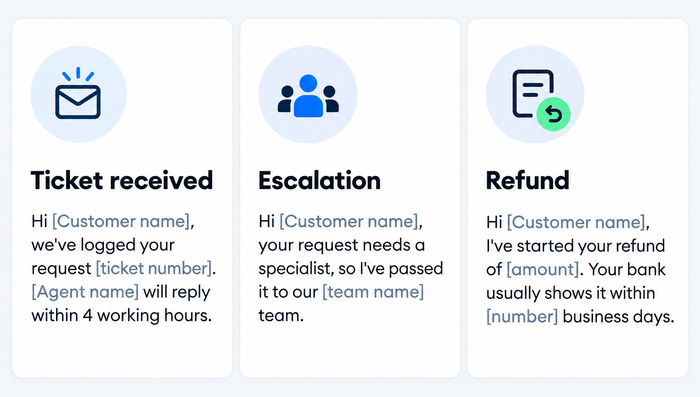
1. Ticket received
Subject: We’ve got your request ([ticket number])
Hi [Customer name],
Thanks for contacting [Company]. We’ve received your request about [issue] and your ticket number is [ticket number].
[Agent name] is looking at it now and will reply [timeframe, e.g. “within 4 working hours”]. If you have a screenshot or an error message, reply to this email and add it to the ticket.
[Agent name]
2. Ticket received, with priority
Subject: Your request is in the queue ([ticket number])
Hi [Customer name],
We’ve logged your request as [priority level, e.g. “high priority”] because [reason, e.g. “you can’t log in to your account”]. Our target for this level is a first reply [timeframe].
You don’t need to do anything else. We’ll update this ticket as soon as there’s news.
[Agent name]
3. After-hours auto-reply
Subject: We’ll reply when we’re back ([ticket number])
Hi [Customer name],
Our team is offline until [day and time]. Your message is saved as ticket [ticket number] and is first in line when we return.
If it can’t wait, [link to the help center or emergency contact] has answers to the most common problems.
[Company] support
Asking for more details
Ask once, ask specifically. A vague “can you tell us more?” costs a full reply cycle, so name the exact detail you need.
4. Request more information
Subject: One detail we need for [ticket number]
Hi [Customer name],
Thanks for reaching out about [issue]. To fix this quickly, could you tell us [the specific detail, e.g. “which browser you’re using and the page you were on when the error appeared”]?
Reply to this email with that detail and we’ll pick it up straight away.
[Agent name]
5. Ask for a screenshot or error message
Subject: Can you send a screenshot? ([ticket number])
Hi [Customer name],
A screenshot would help us see what you’re seeing. Please send one that shows [the screen or message, e.g. “the full error message”], including the address bar if it’s a web page.
If you’re not sure how to take one, [link to a short how-to] shows you in under a minute.
[Agent name]
6. Request sensitive information securely
Subject: Verifying your account ([ticket number])
Hi [Customer name],
To protect your account, I need to confirm it’s you before I make changes. Please reply with [the verification detail, e.g. “the email address on the account and the last four digits of the order number”].
Never send us your password or full card number. We’ll never ask for either.
[Agent name]
7. Unable to reproduce the issue
Subject: We’re still looking into [ticket number]
Hi [Customer name],
I tried to reproduce [issue] on my end and couldn’t, so I need a bit more from you. Could you tell me [the steps they took, the device, the time it last happened]?
With that, I can recreate it and pass the exact case to our engineers.
[Agent name]
Updates and escalation
Silence is what turns a slow ticket into an angry one. Update before the customer asks, even when the update is “no news yet”.
8. Update on a pending issue
Subject: Update on [ticket number]
Hi [Customer name],
A quick update on [issue]: we’re still working on it and [what has been done so far]. We expect to have an answer for you [timeframe].
I’ll write again then, or sooner if anything changes. Thanks for your patience.
[Agent name]
9. Escalation to a specialist team
Subject: Your request has moved to our [team name] team ([ticket number])
Hi [Customer name],
Your request about [issue] needs a specialist, so I’ve passed it to our [team name] team with everything you’ve told us. You won’t need to repeat yourself.
They’ll contact you [timeframe]. I’ll stay on the ticket until it’s resolved.
[Agent name]
For when to escalate and how to route it, see ticket escalation.
10. Waiting on a fix from engineering
Subject: We’ve found the cause ([ticket number])
Hi [Customer name],
Good news: we’ve found what’s causing [issue]. A fix is with our engineering team and we expect it live [timeframe].
I’ll tell you the moment it ships and ask you to confirm it works on your side.
[Agent name]
11. Temporary workaround
Subject: A workaround while we fix [issue] ([ticket number])
Hi [Customer name],
While we work on a permanent fix, you can get around [issue] by [workaround steps]. It’s not ideal, and I’m sorry for the extra effort.
I’ll write again as soon as the fix is live so you can go back to the normal way.
[Agent name]
Resolving the issue
Close the loop in plain words. Say what you did, say how to check it worked and make replying easy if it didn’t.
12. Issue resolved
Subject: [issue] is fixed ([ticket number])
Hi [Customer name],
I’ve [what you did, e.g. “restored your access and cleared the sync error”]. Please check that [what to check] and let me know it’s working.
If something still looks off, reply here and I’ll reopen the ticket right away.
[Agent name]
13. Password reset
Subject: Reset your password ([ticket number])
Hi [Customer name],
Use this link to choose a new password: [reset link]. It expires in [number] hours.
If you didn’t ask for this, ignore this email and your password stays the same. If the link doesn’t work, reply and I’ll send a new one.
[Agent name]
14. Share a knowledge base article
Subject: The steps for [topic] ([ticket number])
Hi [Customer name],
The fastest way to sort out [issue] is this guide: [link]. It walks through [what it covers] in [number] steps.
If you get stuck on any of them, tell me which one and I’ll help from there.
[Agent name]
Linking to a help center article works best when the article is short and current. If you don’t have one yet, start with customer self-service and an AI knowledge base.
15. Access request approved
Subject: Access granted to [resource name] ([ticket number])
Hi [Customer name],
Your access to [resource name] is active as of [date and time]. Sign in at [link] with your usual work account.
Access is set to [permission level, e.g. “view only”]. If you need more, ask your manager to approve it on the ticket.
[Agent name]
Orders, refunds and availability
E-commerce tickets come with a deadline in the customer’s head: the money, the parcel, the product they wanted. Give a date or an exact next step in every reply.
16. Order delayed
Subject: An update on order [order number]
Hi [Customer name],
Your order [order number] is running late. It’s now due [new date], because [reason, e.g. “the carrier is behind after a weather delay”]. Here’s your tracking link: [link].
I’m sorry about the wait. If the new date doesn’t work for you, tell me and I’ll offer [options: a refund/a replacement/free upgraded shipping].
[Agent name]
17. Refund initiated
Subject: Your refund of [amount] is on its way ([ticket number])
Hi [Customer name],
I’ve started your refund of [amount] for order [order number]. It goes back to your original payment method, and your bank usually shows it within [number] business days.
I’m sorry it didn’t work out this time. If you’d like a replacement instead, reply and I’ll set it up.
[Agent name]
18. Return instructions
Subject: How to return order [order number]
Hi [Customer name],
Here’s your prepaid return label: [link]. Pack the item in its original packaging, attach the label and drop it at any [carrier] location by [date].
We’ll refund you within [number] business days of the parcel arriving back with us, and I’ll email you when it does.
[Agent name]
19. Item back in stock
Subject: [Product] is back in stock
Hi [Customer name],
You asked us to let you know: [product] in [size/color/version] is available again. We have [number] left, so here’s the link to grab one: [link].
If it sells out before you check out, reply and I’ll add you to the next restock list.
[Agent name]
Saying no
Saying no is the hardest reply to template, because it only works when it’s specific. Lead with what you can do, then explain what you can’t.
20. Feature request
Subject: Thanks for the idea ([ticket number])
Hi [Customer name],
Thanks for suggesting [feature]. We don’t offer it today, and I can’t promise it’s on the roadmap. I’ve shared your request with our product team along with how it would help you.
In the meantime, you can get part of the way there by [workaround]. I’ll let you know if we add it.
[Agent name]
21. Out of scope
Subject: About your request ([ticket number])
Hi [Customer name],
I’m sorry, but [issue] is outside what we can support, because [short reason, e.g. “it depends on a third-party service we don’t manage”].
The best place to get help is [where to go]. If it would be useful, I can write up what we found so you can pass it on.
[Agent name]
22. Declining within policy
Subject: About your refund request ([ticket number])
Hi [Customer name],
I’ve looked at your request carefully. Our policy covers refunds within [number] days, and your order is [number] days old, so I can’t refund it in full.
What I can do is [options: offer store credit for the full amount/exchange it/refund part of it]. Tell me which you’d like and I’ll sort it today.
[Agent name]
Outages and maintenance
When something breaks for everyone, say so fast. Send the first message before customers start writing in, and promise the next update at a set time.
23. Scheduled maintenance
Subject: Planned maintenance on [date]
Hi [Customer name],
On [date], from [start time] to [end time] [time zone], [service] will be unavailable while we carry out maintenance.
You don’t need to do anything. Please [what to do before, e.g. “save your work before the window starts”]. We’ll confirm when everything’s back.
[Company] support
24. Unexpected outage
Subject: We’re aware of an issue with [service]
Hi [Customer name],
[Service] is currently down for some customers. We know about it and our team is working on it now.
Our next update will be at [time]. You can follow progress at [status page link]. We’re sorry for the disruption.
[Company] support
25. Outage resolved
Subject: [Service] is back
Hi [Customer name],
[Service] has been working normally since [time]. The cause was [short, honest reason], and we’ve [what you changed so it doesn’t happen again].
If anything still looks wrong on your account, reply to this email and we’ll check it.
[Company] support
Feedback and closing
The end of a ticket is the best time to ask how you did, and the worst time to leave it dangling. Close every ticket on purpose.
26. Ask for a rating
Subject: How did we do on [ticket number]?
Hi [Customer name],
[Agent name] has closed your ticket about [issue]. Could you take 30 seconds to tell us how it went? [link to a one-question survey]
If it wasn’t fully resolved, reply to this email instead and we’ll reopen it.
[Company] support
For survey wording that gets answers, see customer satisfaction surveys.
27. Thank a customer for positive feedback
Subject: Thank you, [Customer name]
Hi [Customer name],
Thank you for the kind words about [what they praised]. I’ve shared them with [Agent name] and the rest of the team, and they made our day.
If you ever need anything else, you know where we are.
[Company] support
28. Respond to negative feedback
Subject: Thank you for telling us ([ticket number])
Hi [Customer name],
I’m sorry about [what went wrong in their words]. That isn’t the experience we want you to have, and I’d like to make it right.
I’ve asked [manager name] to look at your ticket personally. You’ll hear from them by [timeframe]. If you’d rather talk, reply with a good time to call.
[Agent name]
29. Subscription cancellation request
Subject: Cancelling your [Company] subscription
Hi [Customer name],
I’m sorry to see you go. To cancel, [steps or link]. Your plan stays active until [date], so you can keep using it until then.
If cost or a missing feature is the reason, tell me. I can [option, e.g. “pause your plan for 3 months”] instead if that helps. Either way, I’ll confirm once it’s done.
[Agent name]
30. Closing a ticket after no reply
Subject: Closing [ticket number] for now
Hi [Customer name],
We haven’t heard back about [issue], so I’m closing this ticket today. Nothing is lost: reply to this email within [number] days and it reopens with the full history.
If you’ve already solved it, great. If not, we’re here.
[Agent name]
This is the short version for a ticket that has gone quiet. If your team closes a lot of them, write a gentle reminder first and close only after the second silence.
Use live chat to support your customers in real-time
Help desk scripts for chat and phone
A script is the live version of a template. You don’t read it word for word; you keep its order. Use these on chat or on a call when there’s no time to type a full reply.
S1. Opening
“Hi [Customer name], this is [Agent name] from [Company]. I can see you’re having trouble with [issue]. Do I have that right?”
S2. Verifying identity
“Before I look at the account, can you confirm [detail 1] and [detail 2]? I’m asking so nobody else can get into your account.”
S3. Placing on hold or transferring
“I need [number] minutes to check this with [team]. Is it OK if I put you on hold? If we get cut off, I’ll call you back on [number]. I’m not going to leave you waiting without an update.”
S4. Wrapping up
“To sum up, I’ve [what you did], and you’ll [what happens next] by [timeframe]. Is there anything else I can help with today?”
For more live scripts by situation, see our live chat scripts and welcome messages.
Help desk ticket form templates
A form template is what the customer or employee fills in. A good one asks for what an agent needs to start, and nothing more. Every extra field loses a few people.
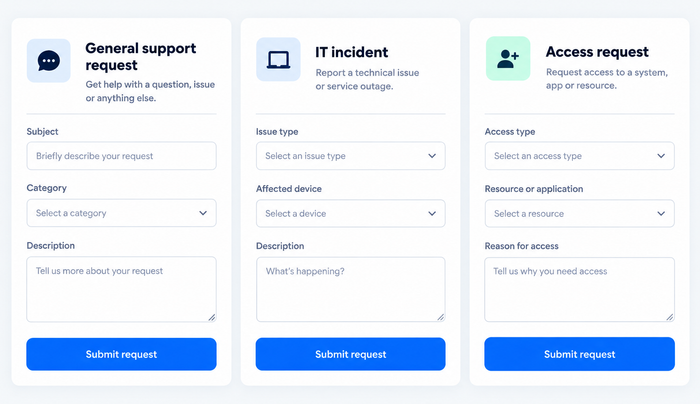
F1. General support request form
Name: [Customer name] Email: [email address] What do you need help with? [choose: billing/technical issue/order/account/other] Describe the problem: [free text, with a hint: “What did you expect, and what happened instead?”] Order or account number (optional): [number] Attach a file or screenshot (optional): [upload]
F2. IT incident form
Your name and team: [name], [team] Affected system or app: [name of the system] What happened? [description] When did it start? [date and time] Error message (copy it exactly): [text] How many people are affected? [just me/my team/everyone] How urgent is it? [can’t work/slowed down/can wait]
F3. IT service or access request form
Requester: [name and email] What do you need? [new account/software install/access to a folder/hardware] Which system or resource? [name] Why do you need it? [one sentence] Manager who approves it: [name] Needed by: [date]
Best practices for using help desk templates
Templates save time only if they don’t sound like templates. These habits keep them sounding like you.
- Write them in your voice, then trim. Read each one aloud. If you wouldn’t say it to a customer face to face, rewrite it.
- Always personalize the first and last lines. Use the name, the issue and one detail from the ticket. Everything in between can stay.
- Give times you can keep. “Within 4 working hours” beats “as soon as possible”, and it’s a promise you can measure.
- Pair every apology or refusal with an option. Say what you can do before you say what you can’t.
- Review the library every quarter. Check links, prices, policy dates and product names. A reply that cites a retired feature is worse than a slow one.
- Name and label every template. An agent should find “Refund approved” by typing two letters, not by scrolling.
- Let automation take the repeatable ones. Order status, opening hours and password resets have one right answer. An AI agent can answer them, and your team keeps the cases that need a person.
For the process behind all this, see help desk best practices and the help desk workflow guide.
How to set up help desk templates in Tidio
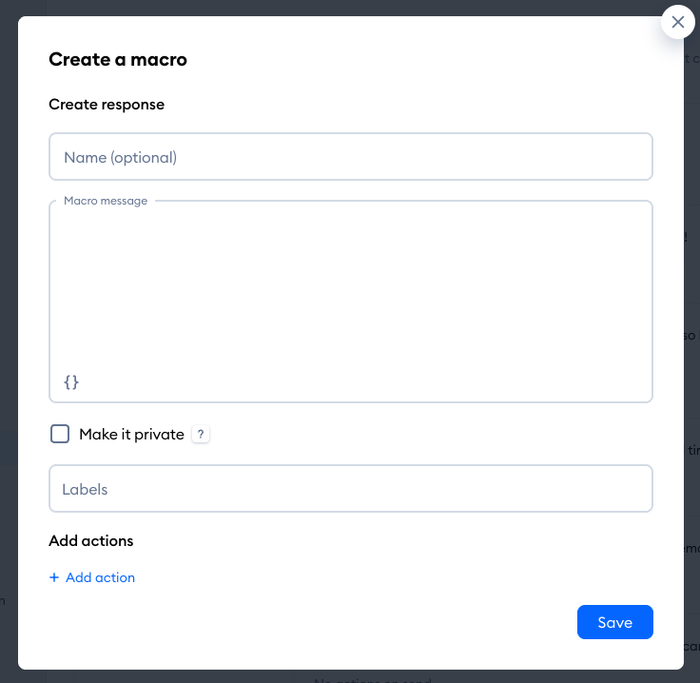
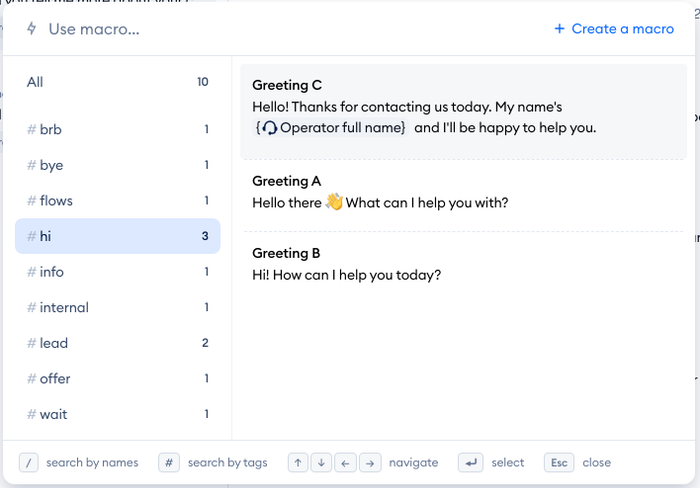
Tidio calls saved replies macros. You can use them in live chat conversations, ticket replies and internal notes. According to Tidio’s help center (updated March 2026), macros are a paid feature on the Growth and Plus plans.
- Open Settings > Macros in the Tidio panel and click Create a new macro.
- Name the macro the way an agent would search for it, such as “Refund approved”. Paste the template text.
- Add labels (for example “Refunds” or “Escalation”) so replies group by scenario. Mark a macro as private if only you should see it.
- Replace the brackets with variables where Tidio has one: customer name, email and agent name fill in automatically when you use the macro.
- In any conversation or ticket, type / in the message box to open your macros, pick one and edit the details before you send.
Macros can also run an action when you use them, such as reassigning the conversation, changing a ticket’s status or adding a tag. That’s useful for the escalation and closing templates above.
If your team is also getting started with ticketing, Tidio Helpdesk puts chat, email and tickets in one inbox, and our guide to help desk software compares the options.
Start with the five replies you send most
You don’t need all 37 on day one. Pick the five your team types most often, such as the acknowledgment, the information request, the update, the resolution and the close. Use them for a week, then add more where agents still type from scratch.
Frequently asked questions
A help desk template is a pre-written reply, script or form that agents reuse for common situations. They fill in the brackets, such as the customer’s name and the issue, and send it. It keeps answers fast and consistent without writing each one from scratch.
A good ticket response includes the customer’s name, the specific issue in their words, what you’ve done or will do, a real time for the next update and a way to reply. Add the ticket number so nobody has to repeat their story if the conversation moves.
List the situations that come up most often, then write the order of the call or chat for each: greeting, confirming the problem, verifying identity, the fix, a summary and the close. Write them as prompts an agent can adapt, not sentences to read out.
Templates suit anything repeated and predictable: acknowledging tickets, asking for the same details, password resets, refund updates, outage notices and closing a ticket. Write the reply fresh when the customer is upset or the case is unusual.
Nothing much in practice. “Canned response”, “saved reply” and “macro” are names software uses for the same feature: a stored message an agent inserts. “Template” is the general word, and it also covers scripts and forms.
Review them every quarter, and whenever a policy, price, link or product name changes. Check that every link still works and every time estimate matches what your team actually delivers.
Reply faster to tickets across all channels with Tidio